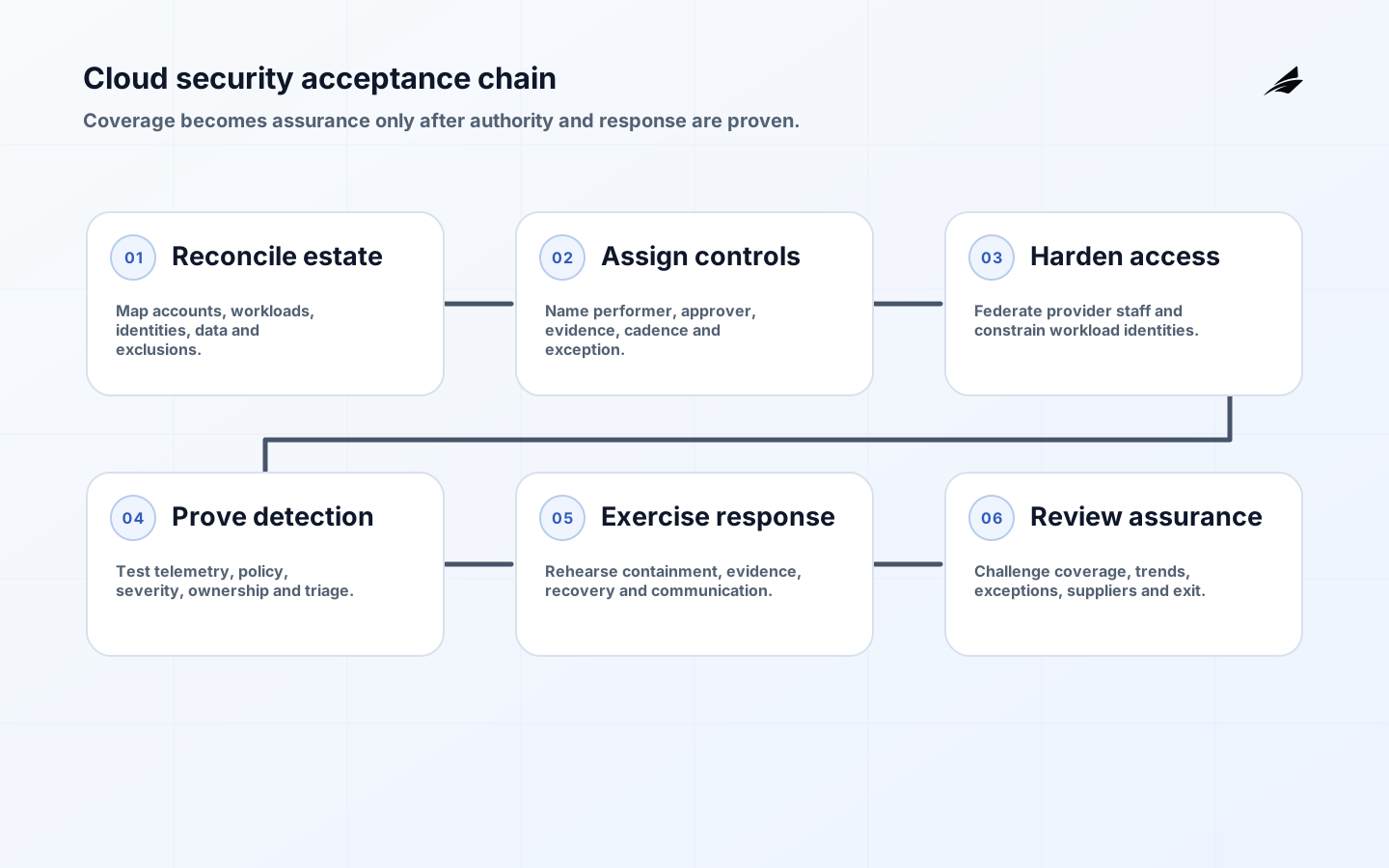
Cloud security services are implemented when the provider and customer can show which estate is covered, who performs each control, what authority they hold, how exceptions move, and what evidence proves operation. Connecting a posture tool is only one step. A useful implementation covers identities, workloads, data, software delivery, telemetry, incidents, recovery, suppliers and exit across the selected cloud service and deployment models.
This provider-neutral checklist follows the cloud security services delivery plan, answers practical questions alongside the cloud security services FAQ and can be compared with the managed cloud security implementation checklist. Tailor every item to data sensitivity, threat profile and applicable obligations.
1. Reconcile scope and criticality
Inventory organizations, tenants, accounts, subscriptions, projects, regions, networks, clusters, workloads, identities, data stores, keys, pipelines and security services. Reconcile cloud-native inventory with configuration, billing and service-management records. Label an accountable business and technical owner, environment, data class and criticality. Decide how newly discovered resources enter service: automatically covered, quarantined or routed for approval. Record exclusions with rationale and expiry; an undocumented exclusion will otherwise be interpreted differently during an incident and an invoice dispute.
Map important business services to technical dependencies and recovery objectives. The CISA Cloud Security Technical Reference Architecture connects shared services, migration and cloud security posture management. Use that systems view: a protected compute instance still depends on identity, DNS, keys, logs, CI/CD and SaaS integrations. Prioritize coverage where compromise or outage would create material impact.
2. Assign control responsibility and evidence

Create a control matrix with the cloud provider, customer and security service provider. For each control name the performer, approver, consulted party, evidence, cadence, service level and exception authority. “Shared” is not an assignment. The Cloud Controls Matrix can help organize cloud control domains, but applicability still depends on architecture. Extend high-level mappings into resource-specific runbooks and handoffs.
Clarify decision rights. A provider may isolate a compromised workload, disable a credential or change a firewall only with pre-approved authority. Define emergency actions by severity and the customer role that accepts business interruption. Include the underlying cloud provider’s escalation route. Require exportable evidence and retention independent of the managed service portal where risk warrants it. Verify evidence by sampling several controls before accepting onboarding.
| Control | Implementation decision | Required proof |
|---|---|---|
| Inventory | Discovery sources, owner fields and new-resource route | Reconciled coverage report with dated exclusions |
| Privileged access | Federation, elevation, session recording and revocation | Named access test and emergency-access review |
| Configuration | Baseline, applicability, exception and remediation | Versioned policy plus sampled resource evidence |
| Detection | Telemetry, rules, severity and triage authority | Synthetic event reaches the correct responder |
| Recovery | Backup boundary, isolation, restore and validation | Timed restore of a representative service |
3. Harden provider and workload access
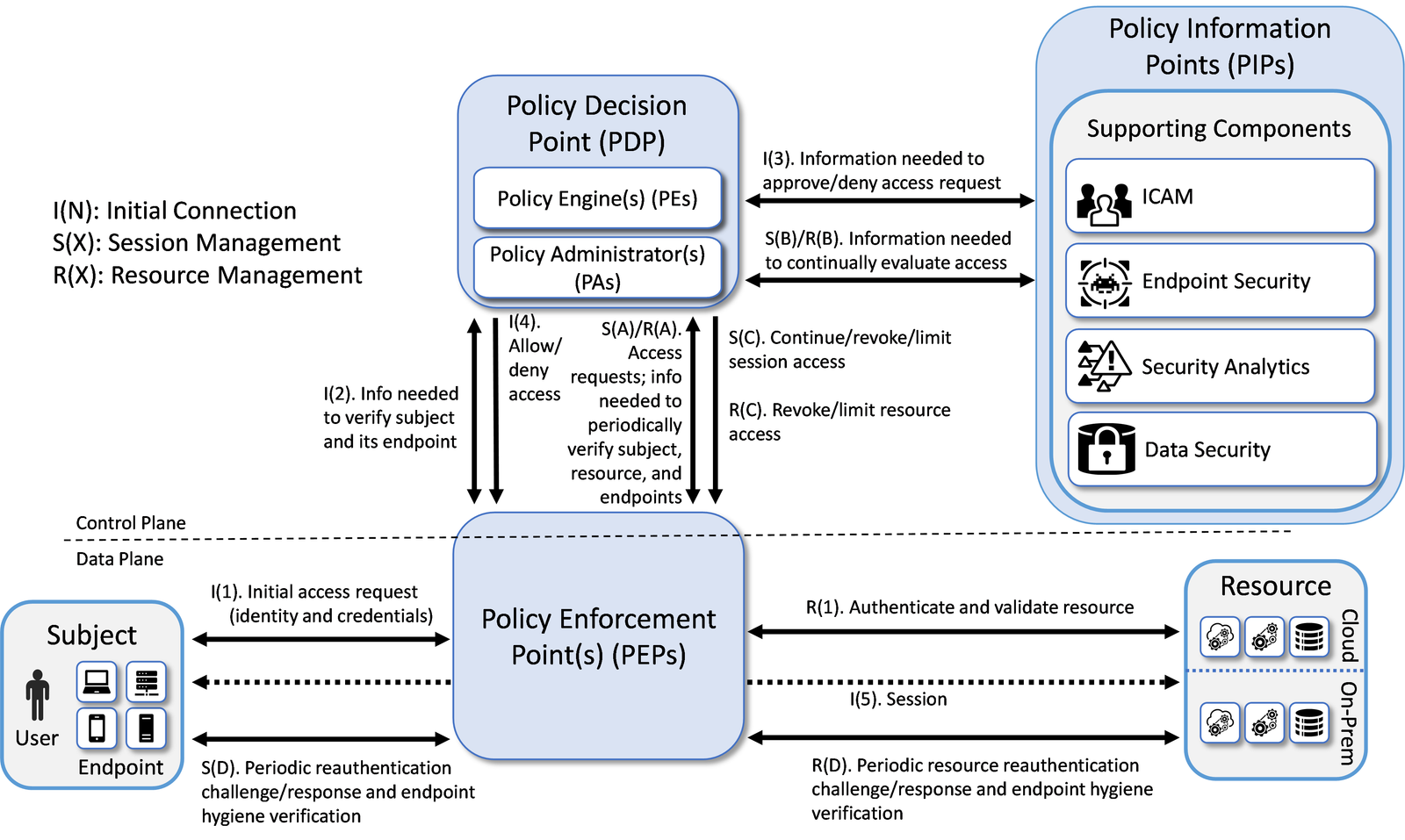
Federate named provider staff, require phishing-resistant authentication where feasible, and grant least privilege through time-bounded elevation. Separate routine monitoring from remediation and from security administration. Avoid shared accounts and customer-owned permanent credentials handed to a supplier. Monitor role creation, policy changes, failed elevation and break-glass use. Test one joiner, role change, departure and emergency session. Provider subcontractors should follow the same control path and be visible to the customer.
Apply the same discipline to workloads. Use managed identities or short-lived credentials, protect secret stores and narrow trust policies. NIST zero trust architecture rejects implicit trust based on network location; evaluate identity, resource and context for each access path. Protect control-plane APIs separately from application traffic. A private subnet does not compensate for an overpowered role or a public object policy.
4. Apply baselines and manage exceptions
Select baselines by provider, service and workload. Applicable CIS Benchmarks can supply detailed checks, but do not enable settings blindly. Record applicability, implementation method, test and owner. Express guardrails as policy code where the platform supports reliable evaluation. Start with high-impact controls: logging cannot be disabled, storage is not public by default, keys have restricted administration, internet ingress is approved and privileged identities are monitored.
An exception needs affected resources, business reason, compensating controls, risk owner, review date and expiry. Distinguish a policy exception from a scanner limitation. Remediation workflow should preserve change approval and service context; auto-remediation can cause an outage when a finding lacks architecture context. Pilot automated changes on representative low-risk resources, capture outcomes and maintain a kill switch. Report overdue risk by criticality and owner rather than presenting an undifferentiated finding count.
5. Prove telemetry, detection and triage
Specify required control-plane, identity, network, workload, data, key, endpoint and application telemetry. Verify timestamp, source identity, correlation fields, integrity, retention and access. Measure coverage against reconciled inventory. A falling alert count is not improvement if log coverage fell. Monitor disabled logging, new privileged roles, public exposure, unusual data transfer, key-policy changes, unapproved regions and high-impact configuration drift.
For each detection, define hypothesis, required sources, owner, severity logic, expected false positives, test event and response playbook. Send safe synthetic events and trace receipt, enrichment, triage and notification. Triage service levels should begin when the provider can receive the signal, while ingestion delay is measured separately. Give customer responders enough context to decide: resource, owner, data class, observed action, confidence, related changes and immediate options.
6. Exercise incident response and recovery
Align the service with enterprise response. NIST SP 800-61 Revision 3 integrates incident response across Cybersecurity Framework functions. Name the incident commander, provider lead, cloud-provider escalation, legal and communication contacts. Define evidence preservation, time synchronization, secure communications and customer notification. Pre-authorize narrow containment actions and rehearse decisions that could stop a revenue service or affect regulated data.
Test credential compromise, public data exposure, malicious deployment and destructive administration. Validate that the provider can revoke its own access during an incident without losing the evidence required to investigate. Restore a complete business service, reconcile data and verify security controls before return. Backups in the same administrative boundary may not survive a privileged attack. Record actual recovery time, gaps, decisions and corrective owners.
7. Accept service and review assurance
Use NIST Cybersecurity Framework 2.0 to connect governance, identification, protection, detection, response and recovery without reducing assurance to a single score. Acceptance should require demonstrated inventory coverage, access revocation, baseline evaluation, detection, incident handoff, restore and report production. Track outcome and coverage together. Samples should include critical, ordinary and exception resources, not only a provider-selected clean account.
Review monthly operational evidence and periodic control design. Challenge aging exceptions, recurring noise, late actions, subcontractor changes, cloud-service changes and concentration risks. Retain customer access to raw evidence needed for independent review. Agree how findings are disputed and corrected. A dashboard is useful only when definitions, population and freshness are visible and the customer can reproduce material claims.
| Measure | Defensible definition | Misleading alternative |
|---|---|---|
| Inventory coverage | Observed in-scope resources divided by reconciled resources | Number of resources scanned |
| Log coverage | Critical resources sending all required sources within freshness target | Daily log volume |
| Triage time | Alert availability to documented severity decision | Average ticket closure time |
| Baseline posture | Applicable checks passing with exceptions separate | Single blended security score |
| Recovery proof | Representative service restored and reconciled inside objective | Backup job success rate |
8. Prepare portability and exit
Define export formats and assistance for inventory, policies, exceptions, detections, cases, evidence and reports. The customer should retain cloud ownership and avoid provider-only identities as the sole administrative route. Specify data return, deletion evidence, access revocation and transition overlap. Test a small export during normal operation; an untested exit clause may fail when staff, tools and commercial incentives are under pressure.
Record dependencies on provider intellectual property, proprietary agents, storage and cross-customer analytics. Decide what can continue during transition and how duplicated alerts will be reconciled. Final acceptance should include removal of provider access and deployed components without disabling customer controls. Portability is also a resilience control: it reduces the impact of supplier failure, acquisition, service withdrawal or an irreparable relationship.
Key takeaways
Practical acceptance example
Suppose a team intentionally creates a storage resource with prohibited public access in a pilot account. A complete test records when inventory discovers it, which policy evaluates it, whether resource ownership and data class are attached, how severity is assigned, who receives the case, and whether the provider has authority to remediate. The team then confirms the policy change, audit trail and customer notification. If the scanner detects the setting but the finding lacks owner context or waits in an unmonitored queue, the service has not passed.
Repeat the test with logging disabled and with a privileged role created through an approved emergency path. The first proves visibility safeguards; the second proves that detection logic can distinguish controlled change from suspicious behavior without suppressing evidence. Record each elapsed stage separately so ingestion delay is not hidden inside triage time. These exercises also establish realistic service levels before a serious incident tests them.
- Reconcile the real cloud estate before measuring control coverage.
- Assign performer, approver, evidence, cadence and exception authority for every material control.
- Test provider access, telemetry, detection, containment and recovery with representative resources.
- Report coverage and outcomes together so missing visibility cannot appear as improvement.
- Exercise evidence export and provider revocation before they become urgent.
Cloud security implementation FAQ
Is a cloud posture tool enough to implement the service?
No. It can discover and evaluate configurations, but the service also needs scope reconciliation, accountable decisions, access, remediation, telemetry, incident coordination, recovery and assurance. Tool findings require architecture context and an owned workflow.
Does provider certification prove our controls operate?
It supplies useful assurance about a defined provider scope and period. It does not prove customer configuration, workload coverage or day-to-day performance. Map the report to responsibilities, inspect exceptions and test customer-specific controls.
Conclusion
A cloud security service becomes trustworthy through explicit boundaries and tested handoffs. Reconcile scope, constrain authority, prove the evidence chain and rehearse consequential decisions. Those practices let a provider extend security operations without obscuring the customer’s ownership of risk and service continuity.