Managed cloud security combines cloud-provider controls, customer governance and specialist operations to protect cloud identities, configurations, workloads, applications and data. It is not a transfer of all security accountability to a third party. Responsibilities change by service model and by each technical service selected, and a managed partner introduces its own identities, automation and supply-chain dependencies. This FAQ helps cloud, security, procurement and application owners define the service they actually need.
The Security Managed Cloud scope and delivery guide covers program shape and cost drivers. Use the Security Managed Cloud Implementation Checklist when onboarding accounts and controls. The key is to translate broad shared-responsibility statements into resource-level tasks, evidence and decision rights for the organization’s architecture.
What does managed cloud security cover?
Coverage may include landing-zone guardrails, identity and entitlement management, configuration posture, vulnerability and workload protection, data security, key management, network controls, logging, detection engineering, incident response and compliance evidence. Some partners manage one cloud-native security stack; others provide a multicloud layer. Define subscriptions, accounts, projects, regions, resource types and environments. Include newly created and acquired accounts, not just the inventory known at contract signature.
A service should state whether it designs, configures, monitors, investigates, remediates or advises for each control. Cloud posture alerts without an owner and safe change path accumulate as backlog. A managed detection service without application context may see suspicious API use but not know whether it represents a critical business action. Connect cloud control work to application, data and service owners so findings can be prioritized by exposure and consequence.
How does shared responsibility work in practice?
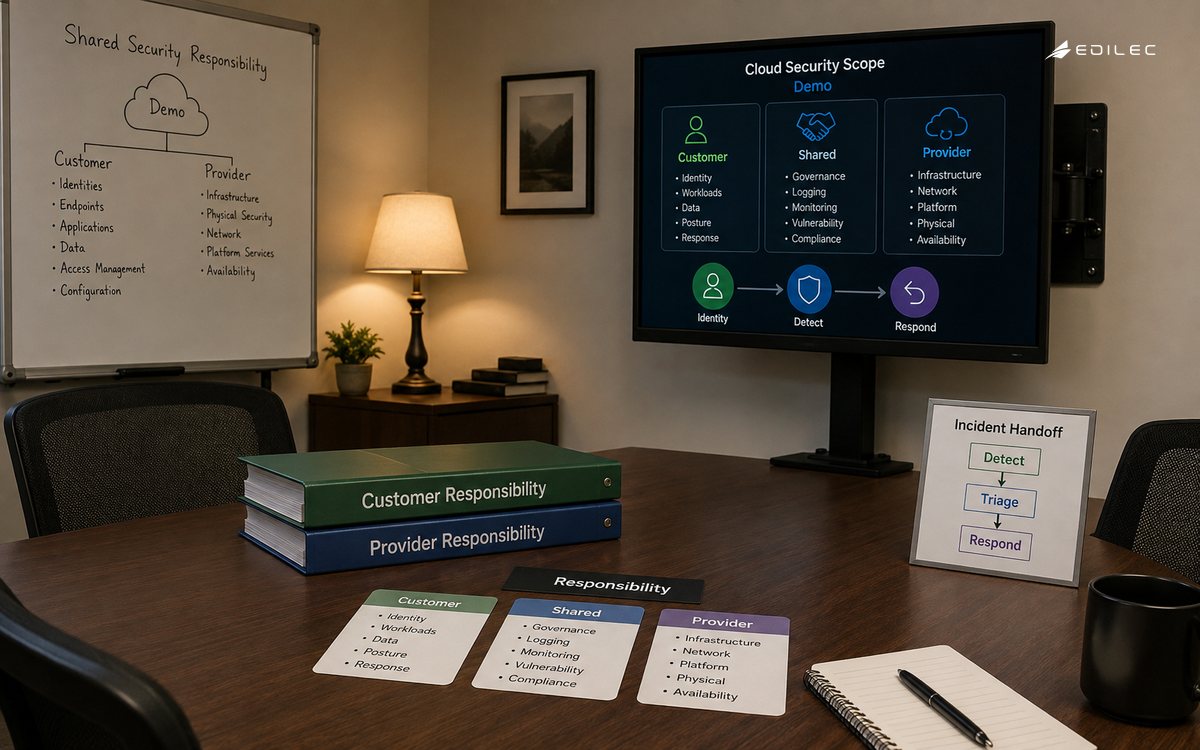
AWS describes security of the cloud as its responsibility and security in the cloud as dependent on the services the customer selects. Microsoft similarly shows that duties shift across software, platform and infrastructure service models. Google adds a shared-fate perspective that emphasizes active help and secure defaults. These frameworks do not assign the customer’s tasks to a managed security partner; a separate responsibility design must do that.
Build a matrix per service pattern. For a managed database, the provider may operate physical infrastructure and database binaries, while the customer and partner still divide account access, network exposure, data classification, encryption choices, configuration, query behavior, logging and recovery validation. Name who creates policy, deploys it, monitors drift, approves exceptions, fixes violations and supplies evidence. Review the matrix when architecture or provider features change.
| Control domain | Cloud provider | Customer | Managed security partner |
|---|---|---|---|
| Physical and foundational service | Operates facilities and service infrastructure | Selects region and service assurance needs | Reviews relevant provider assurance |
| Identity | Provides identity and policy capabilities | Owns workforce lifecycle and risk decisions | Configures, monitors or reviews as contracted |
| Workload configuration | Publishes secure features and defaults | Owns architecture and accepted exceptions | Deploys guardrails and remediates within authority |
| Application and data | Protects managed platform boundaries | Owns code, classification and permitted use | Monitors or tests specified controls |
| Incident and recovery | Responds to provider-layer events | Owns business response and restoration priorities | Investigates and contains agreed customer-layer events |
Why is identity the first managed-cloud boundary?
Cloud control planes allow identities and automation to change infrastructure quickly across a large scope. Inventory human, workload, federated, emergency and third-party identities. Require phishing-resistant multifactor authentication where feasible, short-lived credentials, separation of administration, just-in-time elevation and controls on service-account creation. The managed partner should use customer-visible named or workload identities, not shared credentials, and access only the accounts and actions needed for the contracted function.
Protect the security tooling itself. Restrict who can suppress alerts, change policy, delete logs, alter integrations or disable agents. Log every provider action and review privileged use. Store emergency access securely and test it. When the partner’s automation performs remediation, set scope, rate, preconditions and rollback. A compromised high-privilege security integration can create broader damage than the condition it was intended to fix.
How should posture and workload findings be managed?
Establish baseline policies for approved regions, public exposure, encryption, logging, backups, network paths, software images, secrets and resource ownership. Use policy as code and infrastructure as code where possible so preventive guardrails and review are repeatable. Classify findings by exploitability, data, internet exposure, privilege and service criticality. Suppression requires an owner, reason, compensating control and expiration date.
Do not confuse a provider benchmark score with risk. Some failing controls may affect unused services; one exposed privileged path may dominate the actual risk. Verify scanner coverage and freshness. For workloads, combine configuration with vulnerability, runtime and application evidence. Maintain a documented route from detection to the team able to fix code or architecture. Measure recurrence to identify templates and pipelines that need correction.
| Evidence | Healthy condition | Escalation trigger |
|---|---|---|
| Account inventory | Every account has owner, environment and log integration | Unknown or unmanaged account appears |
| Privileged access | Named, time-bound and strongly authenticated | Standing broad privilege or shared identity |
| Policy coverage | Required resource types evaluated continuously | Blind spot or disabled policy in production |
| Security telemetry | Expected events arrive within freshness target | Gap, deletion or material ingestion delay |
| Recovery | Restore meets tested RTO and RPO for critical data | Backup cannot be isolated or restored |
What should cloud detection and incident response include?
Collect control-plane audit, identity, network, workload, data access and security-service events according to risk. Normalize account, region, resource, principal and request identifiers while retaining a path to original evidence. Detection use cases should cover persistence, privilege escalation, unusual token use, logging impairment, public exposure and suspicious data movement. Test detections with safe simulations and measure whether the correct owner receives enough context.
Create joint playbooks for credential theft, public storage, exposed secret, compromised workload, ransomware and malicious automation. Specify actions the partner may take without approval, such as revoking one known-compromised session, and actions that require a customer incident commander. Preserve cloud snapshots and logs appropriately, coordinate provider support and understand legal or privacy notification. Recovery must validate configuration, identity and data integrity, not only service availability.
Does one managed service solve multicloud complexity?
A common service can unify governance, alert routing and reporting, but providers differ in identity, logging, network and managed-service semantics. Retain cloud-specific expertise for high-risk architecture and response. Define a common control objective, then implement and test it through native capabilities in each environment. Avoid forcing every cloud into the lowest common denominator or assuming a normalized alert retains all evidence needed for investigation.
Evaluate data transfer, latency, API quotas, regional availability, connector permissions and cost. Decide where security data is stored and which platform remains available if the managed partner has an outage. Preserve native logs and break-glass access. Organizations operating across regions can also consult Worldwide Managed Cloud Security: Scope, Cost, Risks and Delivery Plan for localization and follow-the-sun considerations.
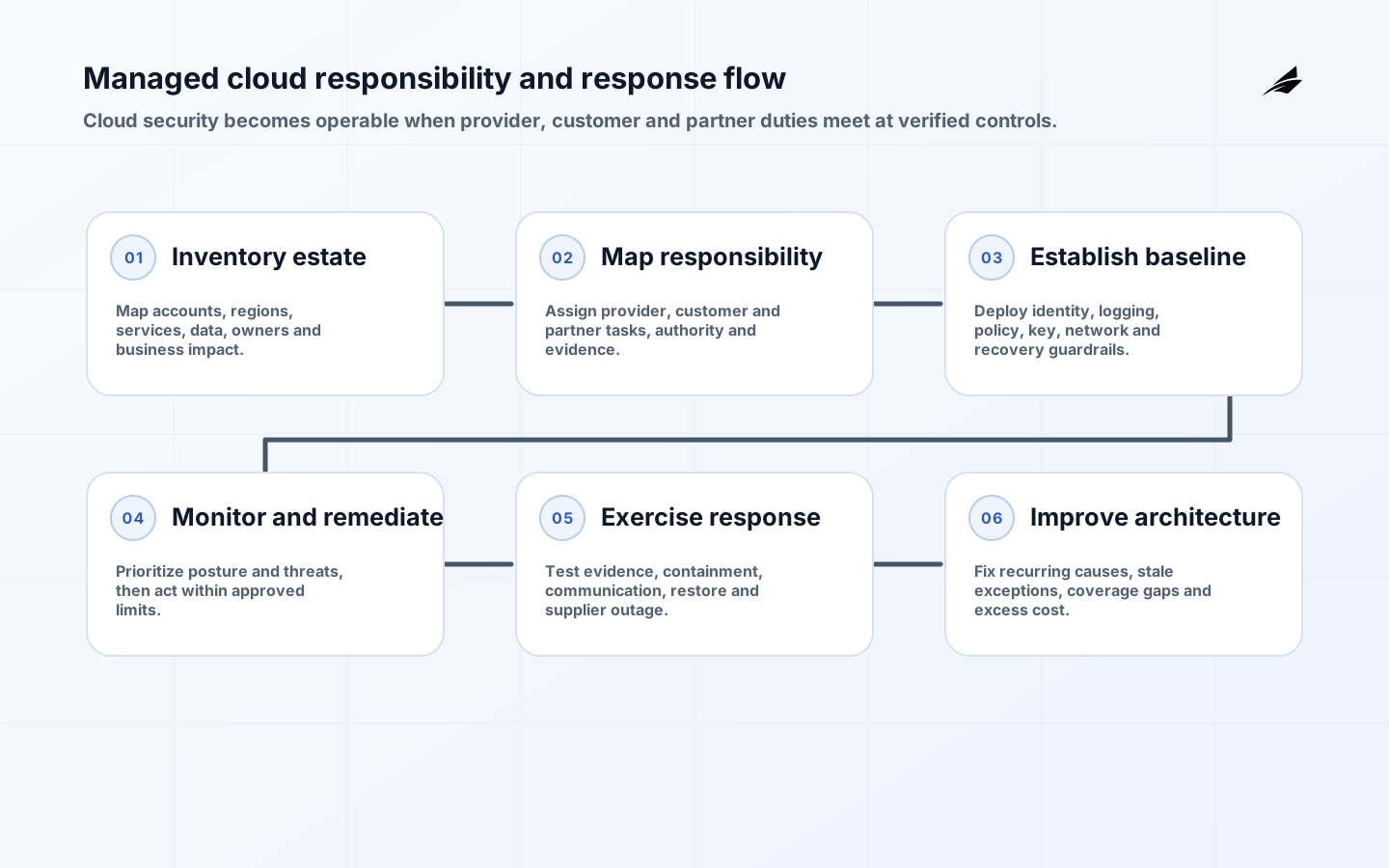
Operate managed cloud security in six stages
- Inventory cloud services, data, owners and business impact across every account and region.
- Map provider, customer and partner responsibilities to service-level tasks and evidence.
- Establish landing-zone, identity, logging, key, backup and policy baselines.
- Monitor posture and threats, route findings by context and remediate within authority.
- Exercise incident containment and restore, including provider and partner outage scenarios.
- Review coverage, exceptions, recurring causes, cost and architecture change; improve the baseline.
Assess managed-cloud supplier resilience
Review how the partner separates customers, protects its administration plane, develops automation and handles vulnerabilities. Ask which cloud permissions its connectors require and whether narrower modes are available. Understand subcontractors, support locations, key personnel, capacity during widespread cloud incidents and the dependencies between the partner platform and the cloud it monitors. An assurance report helps only when its scope includes the service, period and controls the customer relies on.
Create contingency for partner compromise or outage. The customer should be able to revoke all partner identities quickly, preserve native telemetry, operate essential guardrails and contact cloud providers directly. Test the revocation and fallback procedure without waiting for an emergency. Require timely notice of events affecting partner credentials, automation, customer separation or evidence integrity, plus cooperation with investigation and recovery.
Control security-service cost without creating blind spots
Estimate by cloud accounts, protected resources, data ingestion, retention, scans, users, investigations and response hours. High-volume audit or network logs can dominate cost, but removing them without threat and incident analysis may destroy necessary evidence. Tier retention and routing by risk, eliminate duplicate collection, filter known low-value events at an accountable point and monitor unexpected volume changes. Review whether native and third-party tools duplicate the same control while leaving another domain uncovered.
Use unit measures such as cost per covered account, protected workload or investigated high-severity case alongside coverage and outcome. A cheaper service with stale inventory is not efficient. Security, platform, finance and application owners should make trade-offs together, document accepted visibility gaps and revisit them when architecture or threats change.
Key takeaways
- Shared responsibility changes by cloud service and must be extended to the managed partner.
- Protect partner identities, integrations and policy-changing permissions as critical assets.
- Prioritize findings through exposure, privilege, data and business impact.
- Test detections, containment and restores with cloud-specific evidence.
- Keep native expertise, evidence access and fallback operation in a multicloud service.
Frequently asked questions
Does cloud-provider certification make a workload compliant?
No. Provider assurance may cover part of the control environment, but the customer remains responsible for its configuration, identities, applications, data and use. Determine which controls are inherited, shared or customer-operated and collect evidence for the actual workload and regulatory scope.
Should the partner use cloud-native or third-party tools?
Choose from architecture and operating needs. Native tools often have strong service context and rapid feature support; third-party tools can provide consistency and cross-cloud workflow. Test evidence depth, permissions, response integration, resilience and total cost. A mixed design is common, but duplicate alerts need an explicit system of record.
Conclusion
Managed cloud security succeeds through precise boundaries and verified operation. Translate shared responsibility into resource-level duties, control privileged access, maintain policy and telemetry coverage, practice cloud-specific response and keep recovery evidence accessible. The partner extends the team; accountable cloud risk management remains a joint operating discipline.