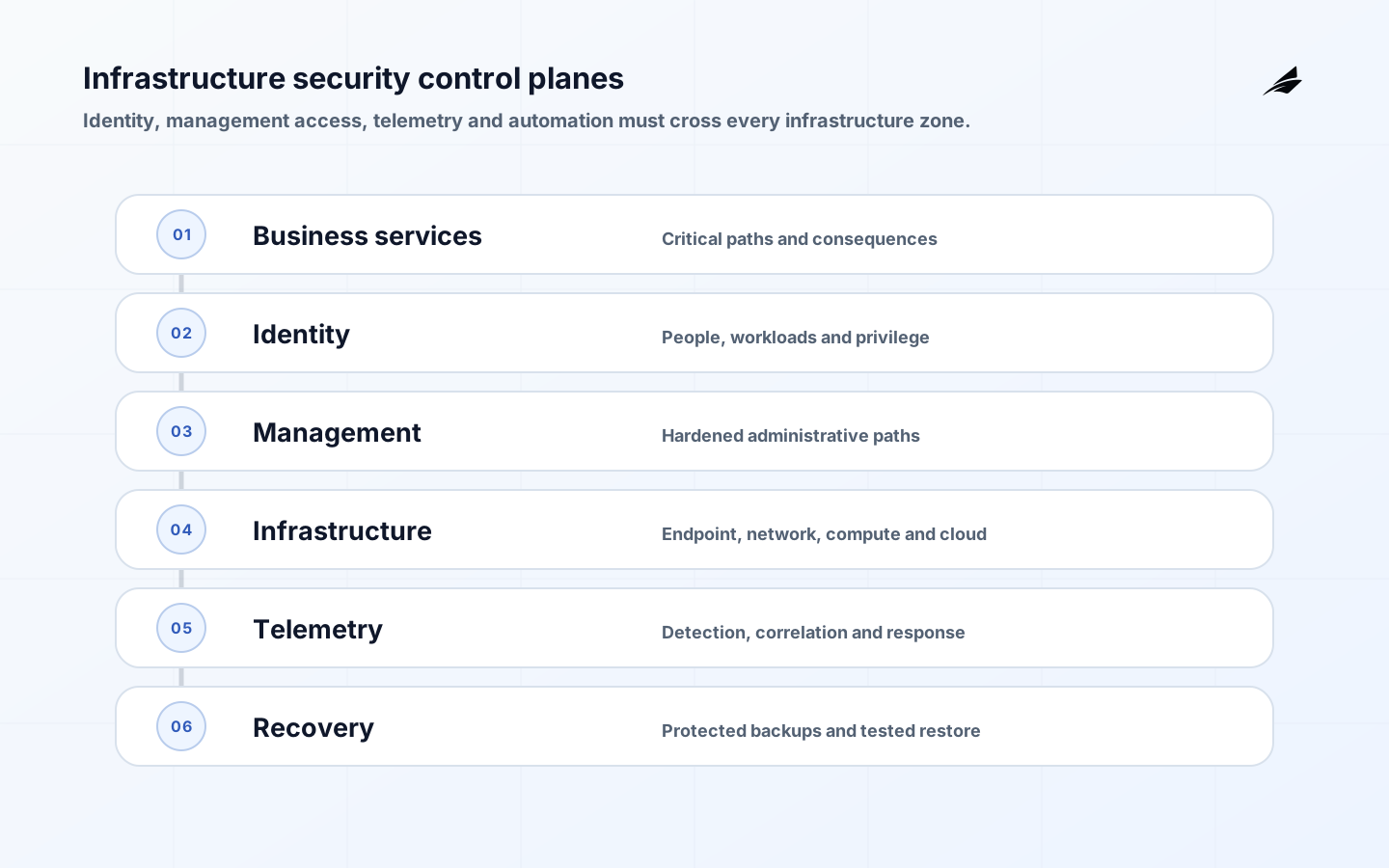
Infrastructure cybersecurity services protect the technology layer on which applications and operations depend: endpoints, servers, networks, identity systems, cloud resources, virtualization, storage, backup and the management plane. The work is not a one-time hardening exercise. Assets change, software ages, accounts accumulate privilege and detections lose context. A useful engagement therefore creates an owned, measurable control program that can discover change, reduce exposure, detect misuse, support response and prove recovery.
What an infrastructure security buyer is really seeking
An infrastructure-security engagement should clarify which controls belong in scope, how much effort they create, what a provider should deliver and how progress can be measured. Begin with business services and risk, not a tool catalogue. NIST CSF 2.0 offers an outcome language across Govern, Identify, Protect, Detect, Respond and Recover. NIST SP 800-53 provides a deeper control catalogue, while CISA's Cross-Sector Cybersecurity Performance Goals help organizations prioritize a smaller baseline. These references are complementary: outcomes define the destination, tailored controls define safeguards, and technical platforms implement and evidence them.
Scope the assets, paths and control planes
An asset list is necessary but insufficient. Record the business service supported, technical owner, hosting location, exposure, data sensitivity, lifecycle state and management path. Include infrastructure that is easy to miss: hypervisors, VPNs, wireless controllers, DNS, certificate services, CI runners, backup consoles, out-of-band interfaces, service accounts, SaaS administration and vendor remote access. Map how administrators authenticate and how telemetry reaches the security team. An unmonitored management plane can bypass otherwise strong workload controls. Where operational technology is present, separate safety and availability constraints from standard IT patch assumptions.
| Control domain | Minimum service outcome | Evidence | Common owner |
|---|---|---|---|
| Asset and software visibility | Authorized assets are identified, owned and reconciled with observed devices and services | Inventory coverage, unknown-asset queue and lifecycle status | Infrastructure with security oversight |
| Identity and privileged access | Human and machine access is strongly authenticated, least-privileged and reviewable | Role assignments, elevation logs, stale-account review and service-account ownership | Identity team and system owners |
| Secure configuration and change | Approved baselines are deployed, drift is detected and exceptions expire | Baseline compliance, drift tickets and exception register | Platform engineering |
| Vulnerability and exposure | Findings are contextualized by exploitability, exposure and business impact | Coverage, risk-aged backlog and remediation validation | Security with asset owners |
| Detection and response | Relevant events are retained, correlated, triaged and linked to tested response actions | Telemetry health, detection tests, cases and exercise actions | Security operations |
| Recovery and resilience | Critical systems and data can be restored within approved objectives | Restore results, immutable-copy checks and dependency-aware recovery plans | Service owner and continuity lead |
Design the control architecture around identity and evidence
NIST's zero trust architecture does not grant implicit trust because a user or device is on an internal network. Apply that principle to administration: centralize identity, require phishing-resistant authentication where feasible, use device and context signals, issue time-bound privilege, separate daily and administrative accounts, and record sensitive sessions. Machine identities need the same discipline: named owners, narrowly scoped permissions, managed secrets, rotation and usage monitoring. Network segmentation still matters, but it should limit reach rather than serve as the only basis for trust.

Evidence should be designed with the control. Decide which source proves configuration, access, patch state, backup success or alert handling; who reviews it; how long it is retained; and how exceptions are approved. The CIS Controls Assessment Specification usefully distinguishes whether a safeguard is implemented from how well it works. Coverage might show that endpoint detection is installed on nearly all supported servers; effectiveness testing asks whether a safe simulation generates the expected alert and response. Both views are necessary.
What determines cost and timeline
Cost follows complexity more than raw device count. Important drivers include the number of technology patterns, geographic and regulatory boundaries, unsupported systems, identity fragmentation, telemetry volume, required coverage hours, integration quality and remediation authority. A discovery-only assessment is cheaper than operating controls, but leaves the organization with a backlog. A fixed implementation can establish baselines and tooling, while a continuing service handles drift, vulnerability cycles, detection tuning, exercises and reporting. Price these phases separately and make tool licensing, log ingestion, travel, emergency response and specialist testing explicit.
| Delivery component | Effort driver | Acceptance criterion |
|---|---|---|
| Discovery and architecture | Inventory quality, network complexity, locations and stakeholder availability | Critical services, assets, trust paths, owners and gaps are documented |
| Control implementation | Platforms, baseline variance, automation and legacy constraints | Approved controls operate on the agreed scope with recorded exceptions |
| Telemetry and detection | Log sources, event volume, retention, integrations and use cases | Source health is monitored and priority detections pass controlled tests |
| Remediation | Backlog age, outage windows, application dependencies and vendor support | Priority exposures are closed or formally risk-accepted with expiry |
| Managed operation | Coverage hours, case volume, change rate and reporting obligations | SLOs, review cadence, evidence and improvement backlog are active |
Example: securing a hybrid professional-services firm
A professional-services firm has two offices, cloud-hosted client applications, employee laptops and a small virtualized server estate. Discovery finds several local administrator patterns, incomplete ownership for service accounts and backups that report success but have no recent restore evidence. The first release does not attempt every control. It centralizes administrative identity, removes shared accounts, establishes endpoint and server inventory, defines secure baselines, routes priority logs to the monitoring platform and restores one critical workload in an isolated environment. The second release automates drift checks, expands vulnerability coverage and tests response to a compromised administrator token. Each improvement has an owner and evidence, so leadership can see reduced exposure rather than a list of purchased products.
Delivery risks and practical controls
- Unknown infrastructure: combine authoritative inventories with network, endpoint, cloud and identity observations; investigate discrepancies instead of merging them blindly.
- Legacy disruption: test configuration and patch changes in representative environments, define rollback and use compensating controls when replacement cannot happen immediately.
- Privilege concentration: separate provider access from customer administration, use time-bound elevation and keep emergency access controlled and tested.
- Telemetry gaps: monitor source health and timestamps; an empty dashboard can mean collection failure rather than a quiet environment.
- Permanent exceptions: require a business owner, rationale, compensating control, review date and expiry for every risk acceptance.
- Control overload: prioritize by business impact and credible threat paths; too many simultaneous controls can create shallow implementation and weak ownership.
- Recovery assumptions: validate restores, credentials, dependencies and clean-room access through exercises rather than relying on backup-job status.
A phased infrastructure security rollout
Use a compact measurement set that can trigger action. Useful examples include the proportion of critical assets with an accountable owner, privileged roles reviewed on schedule, supported systems meeting the approved baseline, priority vulnerabilities beyond their risk deadline, required telemetry sources reporting health, and recovery scenarios successfully exercised. Pair coverage with effectiveness: a high configuration-compliance percentage does not show that drift alerts reach an owner, and a completed access review does not show that revoked privilege is removed promptly. Report material exceptions and trends alongside the metric, then tie corrective work to the same engineering backlog used for infrastructure change.
- Phase 1, govern and discover: define risk tolerance, critical services, scope, owners, control framework, inventory sources and exception process.
- Phase 2, contain urgent exposure: close unsupported internet-facing services, protect privileged access, remove shared credentials and secure backup administration.
- Phase 3, establish baselines: implement secure configurations, patch and vulnerability workflows, network boundaries, certificate and secret management, and evidence retention.
- Phase 4, detect and respond: onboard priority telemetry, test detection use cases, integrate case management and rehearse technical and executive response.
- Phase 5, prove recovery: restore representative critical services, validate dependencies and credentials, and track recovery gaps to closure.
- Phase 6, operate and improve: monitor coverage, drift, risk-aged findings, access reviews, detection performance and exercise actions through a recurring governance forum.
Key takeaways
- Scope business services, hidden management planes, identities and dependencies as well as visible devices.
- Use a recognized framework to organize outcomes, then tailor controls to risk and operating constraints.
- Measure both control coverage and tested effectiveness; tool deployment alone is not proof.
- Prioritize privileged access, exposed services, telemetry integrity and recoverability before lower-impact polish.
- Treat exceptions, evidence, exercises and continual improvement as normal operations, not audit-season activity.
FAQ: What is included in an infrastructure security assessment?
A useful assessment covers business criticality, assets and software, identity, administration paths, configuration, network exposure, vulnerabilities, telemetry, incident readiness, backup and recovery. It should produce validated findings, owners, priorities, dependencies and acceptance criteria, not only a maturity score.
FAQ: Should a smaller organization use NIST or CIS guidance?
Either can help, and they can be used together. NIST CSF 2.0 gives leaders a flexible outcome structure; CIS Controls and CISA's performance goals can help prioritize implementable practices. Select a coherent baseline, document tailoring and avoid claiming compliance merely because a tool maps its checks to a framework.
FAQ: How often should controls be reviewed?
Review frequency should follow change and risk. Monitor inventory, privileged events, collection health and critical exposure continuously where feasible; review exceptions, access and backlog on a defined cadence; and retest recovery and response through scheduled exercises and after material architecture or incident changes.
Conclusion
Infrastructure security becomes dependable when every critical asset and access path has an owner, every safeguard has evidence, and every exception has an expiry. Use frameworks to structure the work, but let business impact determine order. Deliver visibility and privileged-access control first, establish repeatable configuration and vulnerability practices, then prove detection and recovery. That turns a collection of security products into an operating capability.