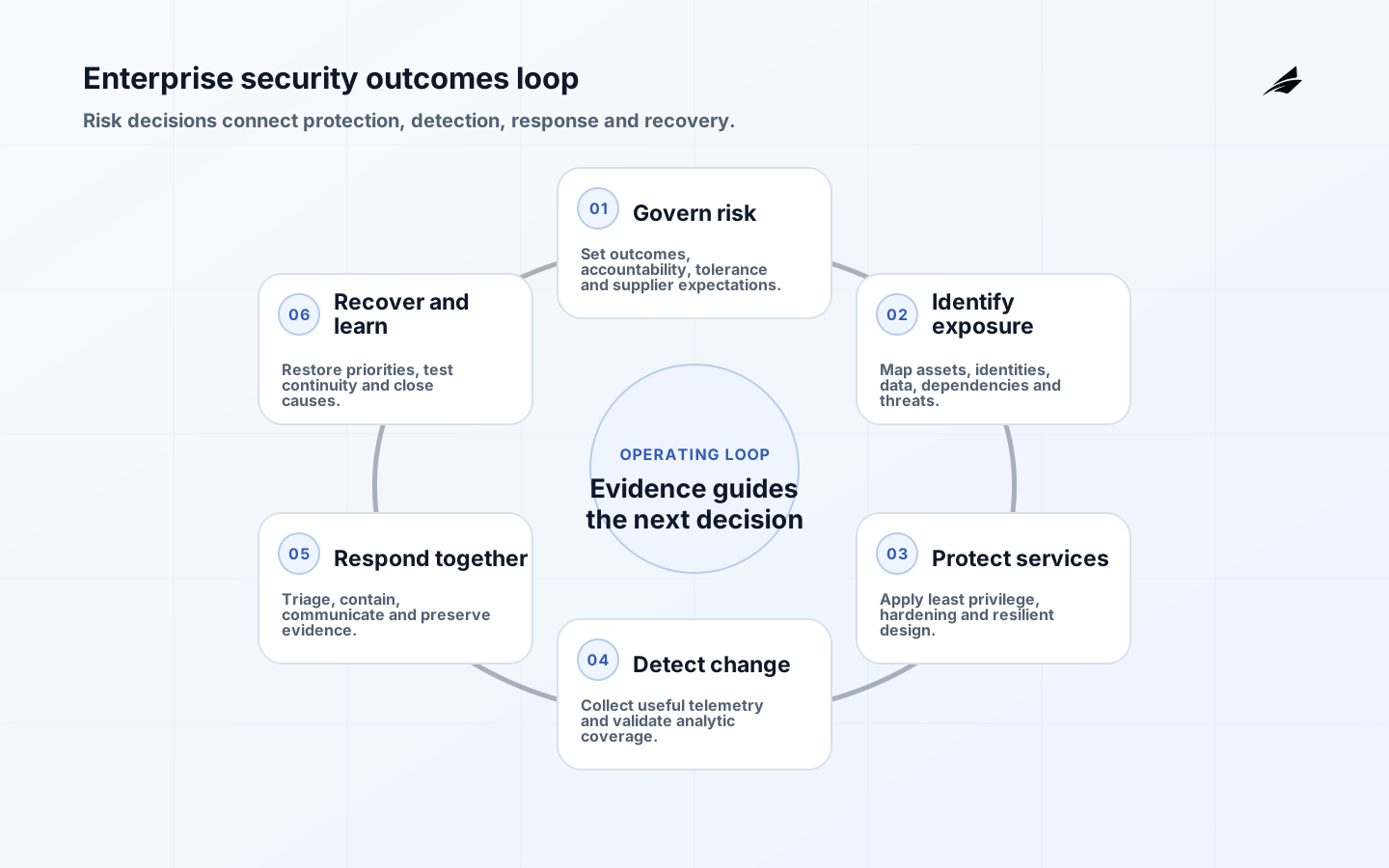
Enterprise security solutions are the coordinated controls, services and operating practices used to manage cyber risk across identity, devices, applications, data, networks, cloud and suppliers. Implementation should begin with the business outcomes that need protection, not a shopping list of overlapping products. This checklist helps security, technology, risk and business owners define a target state, deploy controls in workable increments and verify that prevention, detection, response and recovery operate together.
Use the enterprise security delivery plan and enterprise security FAQ for portfolio decisions. The related security and protection plan and security implementation checklist provide additional control detail. State which business services, data and threat scenarios each investment addresses, then make gaps and inherited responsibilities visible.
1. Govern security through risk outcomes
Identify critical services, legal and contractual duties, risk tolerance, threat actors, likely attack paths and unacceptable consequences. Map service owners, data owners, security owners and suppliers. NIST’s current Cybersecurity Framework 2.0 organizes outcomes through Govern, Identify, Protect, Detect, Respond and Recover. Use a current profile to describe evidence-backed reality and a target profile to prioritize gaps. The functions are concurrent outcomes, not six project phases or a product taxonomy.
Create a security charter with decision rights, exception authority, escalation, reporting and funding. Integrate cyber risk into enterprise risk and change governance. Record assumptions and residual risk in business language. Set architecture principles such as identity-based access, secure defaults, data minimization, segmented failure domains, authenticated administration, immutable evidence and tested recovery. Every principle needs implementation patterns and an exception path; aspiration without deployable guidance produces inconsistent local interpretation.
| Outcome | Implementation evidence | Misleading substitute |
|---|---|---|
| Known assets | Reconciled business service, identity, device and data inventories | One scanner’s discovered hosts |
| Controlled access | Lifecycle, least privilege, strong authentication and reviews | MFA enabled for an undefined population |
| Secure configuration | Versioned baseline, drift detection and owned exceptions | Unprioritized finding count |
| Useful detection | Threat-informed telemetry coverage and tested analytics | Events ingested without response |
| Effective response | Exercised authority, communications and containment | A plan document with no rehearsal |
| Recoverability | Restored, reconciled and business-validated services | Successful backup jobs |
2. Design the target security architecture
Map trust boundaries and flows among workforce, customers, partners, workloads, management planes and data stores. Define authoritative identity, device posture, workload identity, policy decision and enforcement points. NIST SP 800-207 describes zero trust as removing implicit trust based solely on network location or ownership. Apply that principle through continuous identity and context evaluation, least privilege and protected resources, not by renaming remote access.

Use the CISA Zero Trust Maturity Model as one planning aid across identity, devices, networks, applications and workloads, and data, with visibility, analytics, automation and governance across them. Avoid pursuing maturity labels equally everywhere. Prioritize controls that break material attack paths. Define integration and data contracts among identity, endpoint, cloud, vulnerability, email, data protection, SIEM, case management and automation systems so policy and evidence remain consistent.
3. Implement foundational controls first
Harden identity lifecycle: unique accounts, phishing-resistant authentication where appropriate, separate administration, just-in-time privilege, service-account ownership, access reviews and rapid revocation. Build a reconciled asset inventory tied to business service and owner. Establish secure configuration baselines, vulnerability prioritization, patch or mitigation targets, endpoint protection, protected backups, email controls and centralized logging. CISA’s Cross-Sector Cybersecurity Performance Goals provide a prioritized baseline; adapt it to organizational risk and technology.
Secure delivery as well as production. The NIST Secure Software Development Framework groups practices around preparing the organization, protecting software, producing well-secured software and responding to vulnerabilities. Apply requirements to internally built and acquired software: protected source and build systems, dependency governance, review and testing, provenance, vulnerability intake and root-cause prevention. Procurement should require evidence and coordinated disclosure, not a generic statement that a supplier follows best practices.
| Rollout gate | Required test | Decision owner |
|---|---|---|
| Identity | Joiner, mover, leaver, privilege elevation and break glass | Identity and service owners |
| Endpoint or workload | Policy deployment, isolation and business compatibility | Platform and business service owners |
| Telemetry | Expected event, timestamp, fields, retention and alert | Detection engineering owner |
| Automation | Authorization, rate limit, idempotency and rollback | Security operations and affected service |
| Recovery | Deletion, corruption, identity outage and supplier failure | Continuity and business owners |
| Supplier | Access removal, evidence export and incident escalation | Procurement and service owner |
4. Engineer detection, response and recovery together
Start detection from threat scenarios and business assets. For each analytic, record data sources, required fields, logic, expected false positives, severity, owner, response and test. Measure source coverage and pipeline health alongside alert volume. Correlate identities, devices, workloads and services using stable identifiers. Tune through reviewed cases, and retire detections that have no actionable response. Automation should enrich and contain only within explicit authority, preserving evidence and a human escalation path.
NIST SP 800-61 Revision 3 integrates incident response with CSF 2.0 risk management. Define incident authority, legal and privacy consultation, supplier escalation, evidence handling, communications and business recovery before an event. Exercise credential compromise, ransomware, cloud control-plane misuse, data exposure and critical supplier loss. Validate recovery objectives by restoring complete services, reconciling data and confirming business operation, then track corrective actions through normal ownership and change management.
5. Roll out controls without losing service ownership
Pilot controls with a representative business service and production-like policy. Establish compatibility, support and rollback criteria before enforcement. Use monitor mode to learn where appropriate, but give it an end date and decision. Communicate what changes for users and administrators, provide a fast support route, and separate genuine business exceptions from deployment defects. Expand by service or risk tier only after inventory, policy, telemetry and response coverage are proven.
Assign one owner for each control service and one owner for each protected business service. Central security supplies patterns, platforms and oversight; application and infrastructure teams implement workload-specific behavior. Document managed-provider responsibilities at activity level. Keep exception records with business justification, affected assets, compensating controls, approver and expiry. Review architecture when acquisitions, cloud migrations, identity changes or new external access alter trust boundaries.
6. Measure control effectiveness and portfolio value
Report denominators and outcomes: percentage of authoritative identities under lifecycle control, critical assets meeting baseline, sensitive repositories with tested access, required telemetry arriving, high-risk findings beyond target, detections exercised, containment actions completed and recovery scenarios passed. Segment by business criticality. A falling vulnerability or alert count is ambiguous if inventory or telemetry coverage also fell. Preserve evidence behind executive measures so teams can investigate and auditors can reproduce them.
Rationalize overlapping tools after control outcomes are stable. Compare coverage, integration, operator effort, data retention, lock-in, supplier assurance and exit capability, not feature lists alone. Review license utilization and automation effectiveness without rewarding alert closure volume. Conduct independent assessment of material controls and red-team or adversary simulation where risk justifies it. Feed incidents, exercises, exceptions and near misses into target-profile and investment updates.
Design data protection around use and flow. Classify sensitive data, map repositories and transfers, minimize collection, set retention and deletion, and apply encryption with owned key lifecycle. Use access policy and monitoring that understand data context, but test false positives before blocking business operations. Protect exports, analytics copies, backups and support tools as well as primary databases. When tokenization or masking is used, verify reidentification paths and downstream compatibility. Data loss prevention alerts need an investigation and business-resolution process; deploying a rule without response ownership only creates another queue.
Manage suppliers as part of the architecture. Inventory services, data access, administrative connectivity, software components, concentration and fourth parties. Tier assurance by business impact and verify contract terms for security controls, vulnerability handling, incidents, continuity, evidence, change notice and exit. Restrict supplier identities through the same lifecycle and telemetry as employees. Exercise loss of a critical SaaS, managed provider or identity dependency. A questionnaire can inform assessment, but technical integration, access behavior and recovery evidence show how the supplier actually affects the enterprise service.
Protect the security platform itself. Separate administration, require strong authentication, limit API tokens, review configuration changes and maintain recovery for identity, endpoint, logging and case systems. Test what happens when telemetry is delayed, a policy service is unavailable or an automation credential is compromised. Retain enough configuration and rule history to explain past decisions. Security tools often hold broad access and sensitive evidence; treating them as inherently trusted creates a concentrated control-plane risk.
Maintain a dated security improvement backlog tied to target outcomes, affected services, risk and dependency. Reserve capacity for lifecycle work and corrective actions, not only new control deployment. Close an item when evidence shows the outcome changed, not when a tool was purchased or a policy was published.
Key takeaways
- Select enterprise security solutions from business risk outcomes and attack paths.
- Build identity, asset, configuration, software and recovery foundations before advanced automation.
- Treat zero trust as resource-focused policy and evidence, not a product category.
- Engineer telemetry, response authority and recovery validation as one operating system.
- Measure coverage and tested outcomes with denominators, then rationalize the portfolio.
Frequently asked questions
Is NIST CSF 2.0 an implementation checklist?
No. It describes cybersecurity outcomes and supports profiles and communication. Organizations select practices and technologies appropriate to their risk. Use it to structure current and target outcomes, then define concrete controls, owners, evidence and tests.
How many security tools does an enterprise need?
There is no universal number. Minimize unmanaged overlap while preserving required coverage and resilience. Decide by protected services, threats, integrations, operating capacity, assurance and exit needs. More consoles can reduce visibility when identity, data and response are fragmented.
Does zero trust replace network security?
No. Network controls remain useful enforcement and segmentation mechanisms. Zero trust changes the basis of trust: access decisions consider identity, resource, context and policy rather than assuming a network location is safe.
Conclusion
Enterprise security implementation is the work of connecting risk decisions to controls that people can operate and test. Build a coherent architecture, prove foundational coverage, integrate response and recovery, and measure real outcomes. That makes the security portfolio defensible as threats, services and suppliers change.