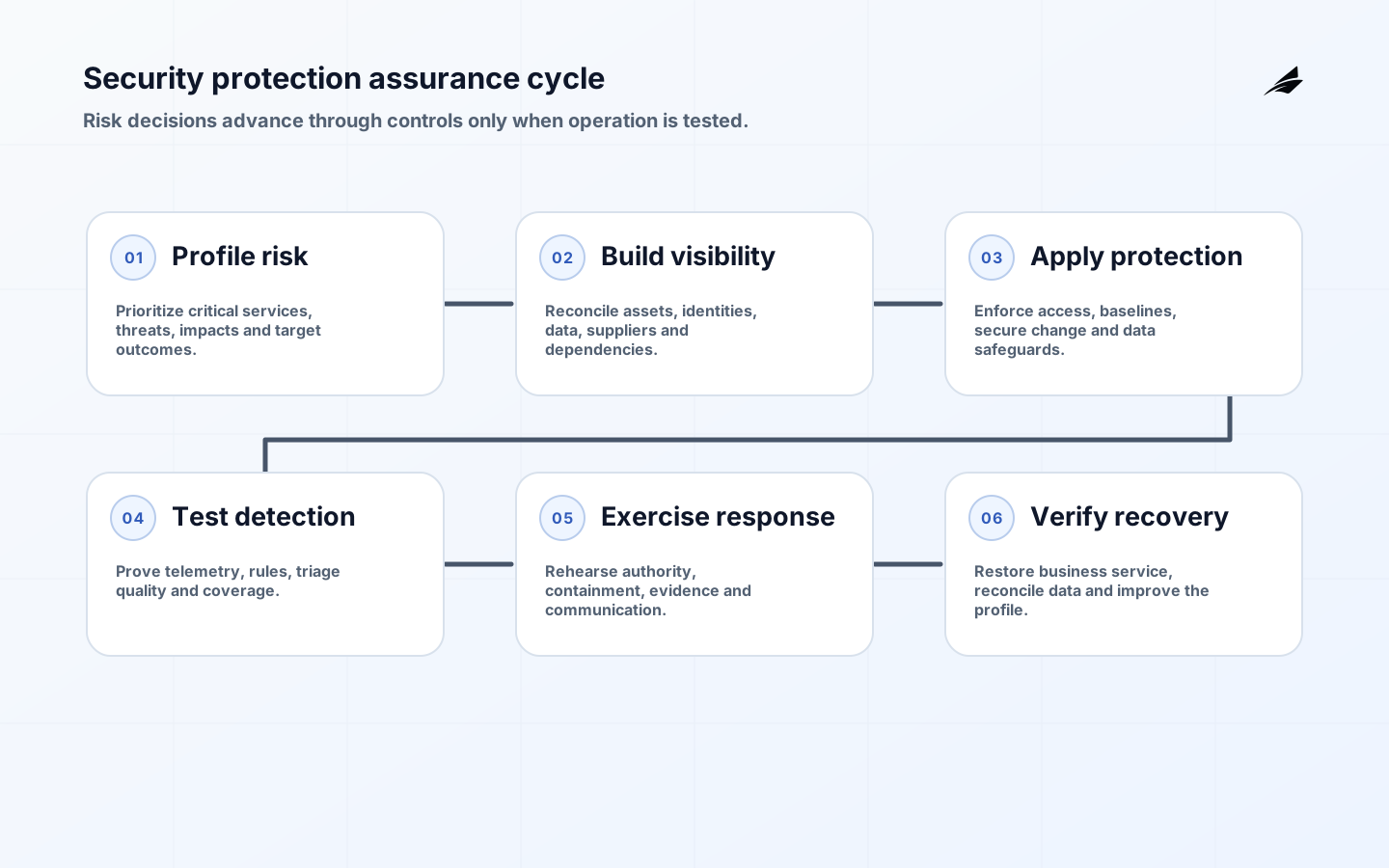
Security and protection solutions should reduce defined business risks through controls that are owned, operated and tested. Buying endpoint, identity, network, data and monitoring products without an integrated operating model creates overlapping alerts and uncovered decisions. This security and protection solutions implementation checklist organizes the work around outcomes: govern, identify, protect, detect, respond and recover.
Use it with the security and protection scope guide, security and protection FAQ and enterprise cybersecurity implementation checklist. Tailor controls to mission, threats, obligations and resources; a copied baseline without applicability decisions is difficult to defend or operate.
1. Build a current and target risk profile
Identify critical services, data, affected people, legal obligations, threat scenarios and business impact. Interview service owners as well as security staff. State risk tolerance and prioritize scenarios such as account takeover, ransomware, supplier compromise, data exfiltration or destructive administrator action. NIST Cybersecurity Framework 2.0 provides common outcomes under six functions and adds Govern as an explicit foundation for enterprise risk decisions.
Document current evidence and target outcomes. The CSF Organizational Profiles guide explains how profiles can describe current and target cybersecurity posture and prioritize outcomes based on mission, stakeholders, threats and requirements. Do not turn the gap list into an unranked procurement plan. Score gaps by impact, exposure, dependency and feasibility, then assign an accountable risk owner and due date.
| Profile element | Decision | Evidence |
|---|---|---|
| Critical service | Which outcome must continue or recover first? | Service map, owner and impact analysis |
| Threat scenario | Which plausible event is the control meant to change? | Threat model, incident history and intelligence |
| Target outcome | What protected or recoverable state is required? | Tailored framework outcome and acceptance test |
| Risk treatment | Mitigate, avoid, transfer or accept? | Approved action, owner, funding and residual risk |
| Review trigger | When must the decision be revisited? | Date, material change, incident or control failure |
2. Establish asset, data and dependency visibility
Create a reconciled inventory of devices, servers, cloud resources, applications, identities, certificates, data stores, third parties and external exposure. Combine authoritative sources rather than expecting one scanner to see everything. Every critical asset needs a business and technical owner, lifecycle state, data classification and relationship to a service. Define how newly discovered or ownerless assets are quarantined, investigated and assigned.
Map dependencies that affect recovery and trust: identity providers, DNS, key management, network control planes, package registries, managed service providers and communication channels. A technically minor shared service can be operationally critical. Record supported versions and end-of-life dates. Remove or isolate assets that cannot meet the target profile instead of granting permanent undocumented exceptions.
3. Harden identity and privileged access

Centralize workforce identity where practical, enforce phishing-resistant authentication for high-risk roles, and automate joiner, mover and leaver events from an authoritative source. Separate daily and privileged accounts. Use just-in-time elevation, approval and session evidence for sensitive administration. Review service identities, API keys and certificates as rigorously as human users; nonperson credentials often outlive their original application owner.
NIST SP 800-207 states that zero trust does not grant implicit trust based only on network location or asset ownership. Evaluate the user or workload identity, device and resource for each access decision. The later NIST implementation guide provides example architectures, but deployment should begin with a bounded high-value use case and measurable policy decisions, not a wholesale product replacement.
4. Apply protective baselines and secure change
Define secure configurations for endpoints, servers, cloud services, networks, applications and collaboration platforms. Baselines should be versioned, tested and mapped to applicability. Prevent drift through policy and automation where safe; route exceptions to a risk owner with scope, compensating controls and expiry. Patch according to exploitability, exposure and service criticality, not a single age threshold, and verify installation on the actual asset.
Protect software and administrative surfaces by design. CISA and FBI product security bad-practices guidance calls out dangerous practices relevant to critical infrastructure software, including unsupported products and weak default security. For acquired solutions, require supported lifecycles, secure defaults, vulnerability disclosure, update integrity and transparent remediation. For internal software, include threat modeling, dependency controls, secret scanning and authorization tests in delivery.
Encrypt sensitive data in transit and at rest where the threat model requires it, but manage keys separately, rotate access and test recovery. Minimize data collection and retention before adding protective tooling. Data that is not retained cannot be stolen later, and a smaller sensitive estate makes access review and incident scope more reliable.
5. Build detection around high-value events
Collect logs that answer investigation questions: who or what acted, on which resource, what changed, from where, when and with what result. Prioritize identity, endpoint, cloud control plane, application authorization, data access and network egress for critical services. Synchronize time, document field meaning, protect log integrity and monitor collection health. A detection platform cannot compensate for missing or ambiguous telemetry.
Write detections from threat scenarios and test them with controlled events. Define severity, triage evidence, false-positive handling, owner and review cadence. Measure detection coverage and precision, not alert count. Every alert needs a disposition and a feedback path to improve telemetry, rules or preventive controls. Retire detections that no longer map to a supported system or meaningful threat.
| Control proof | Test | Failure response |
|---|---|---|
| Access control | Attempt prohibited actions across roles, objects and channels | Contain exposure, repair policy and review similar paths |
| Configuration | Compare applicable assets to approved baseline and sample enforcement | Remediate drift or approve a time-bounded exception |
| Detection | Generate a known event and trace collection, alert and triage | Repair telemetry or rule before claiming coverage |
| Response | Exercise authority, evidence, containment and communication | Update contacts, decisions and automation |
| Recovery | Restore a representative service and validate business data | Fix dependency, backup or runbook gaps and retest |
6. Prepare and exercise incident response
Define incident authority, severity, on-call roles, legal and communications contacts, evidence handling, supplier escalation and decision rights. Pre-authorize narrow containment actions where delay creates unacceptable risk, while protecting service continuity and evidence. Maintain communication channels that do not depend solely on the environment likely to be compromised.
NIST SP 800-61 Revision 3 aligns incident response with all CSF 2.0 functions. Exercise plausible scenarios with service owners and executives, not only security analysts. Include uncertain facts, unavailable staff and failed tools. Record decisions, elapsed times and assumptions. Convert lessons into owned improvements and verify completion in a later exercise.
7. Verify recovery and continuity
Set recovery time and recovery point objectives from business impact. Design backups with separation from production identities, retention appropriate to the threat and protection against alteration. Monitor job completion, but judge readiness through restore. A successful backup log does not prove that applications, permissions, dependencies and reconciled data can return within the objective.
Prioritize restoration order and minimum viable service. Exercise loss of identity, cloud account, primary region or key supplier where those are credible dependencies. During recovery, scan and harden restored assets before reconnecting them, and maintain a clean source for software and configuration. Communicate service state and data limitations honestly; restored availability can still contain incomplete transactions.
8. Operate assurance as a continuous cycle
Review risks, control performance, incidents, vulnerabilities, exceptions, supplier changes and recovery evidence in one governance forum. Track leading indicators such as inventory ownership, privileged-access review and telemetry coverage alongside outcome indicators such as incident impact and recovery performance. Avoid combining unrelated measures into a single maturity score that conceals critical failures.
- Reassess the target profile after material architecture, threat or regulatory changes.
- Expire access and control exceptions automatically unless the owner renews them with evidence.
- Sample control operation independently from the team performing it.
- Use incidents and near misses to update threat scenarios and acceptance tests.
- Retire overlapping tools only after required data, detections and response paths are preserved.
Include suppliers in control operation, not only annual questionnaires. Tier providers by access, data, service criticality and substitutability. For material providers, verify named incident contacts, authentication, logging, vulnerability handling, continuity and termination obligations. Monitor changes in service, ownership and subcontracting. Exercise one supplier outage or compromise scenario and test whether internal teams can identify affected assets, revoke access, continue critical work and obtain evidence.
People and process controls also need tests. Use role-based exercises for privileged administrators, service owners, support and executives. Review whether workload and incentives make secure behavior practical; an approval that routinely waits days will be bypassed. Track repeated policy exceptions and risky workarounds as design signals. Improve the control or underlying workflow instead of assuming another awareness course will correct a structurally unusable process.
Key takeaways
- Choose controls from a current and target risk profile, not a product catalog.
- Make asset, identity, data and dependency ownership the foundation of protection.
- Test preventive, detective, response and recovery controls as an integrated system.
- Give exceptions scope, compensating controls, an accountable owner and expiry.
- Measure evidence coverage and business resilience, then revise the profile continuously.
Frequently asked questions
Does using NIST CSF 2.0 certify security?
No. The CSF provides outcomes and a common language for managing risk. It does not certify that controls are implemented or effective. Organizations need tailored profiles, operating evidence, tests and any separate assurance required by customers or regulators.
How many security tools are needed?
There is no universal number. Start from required control outcomes, telemetry and response actions. Prefer tools that integrate with existing ownership and can produce usable evidence. Remove redundant products only after confirming that no critical control or retained data depends on them.
Is zero trust a product rollout?
No. It is an architecture approach centered on explicit, context-aware access to resources. Products can enforce parts of it, but identity quality, policy, asset knowledge, application design and operations determine whether it works.
Conclusion
Effective security and protection solutions form a tested operating system for risk. Start with business services and plausible threats, establish identity and asset foundations, and connect protection to detection, response and recovery. Evidence, exercised authority and continuous review matter more than the number of products deployed.