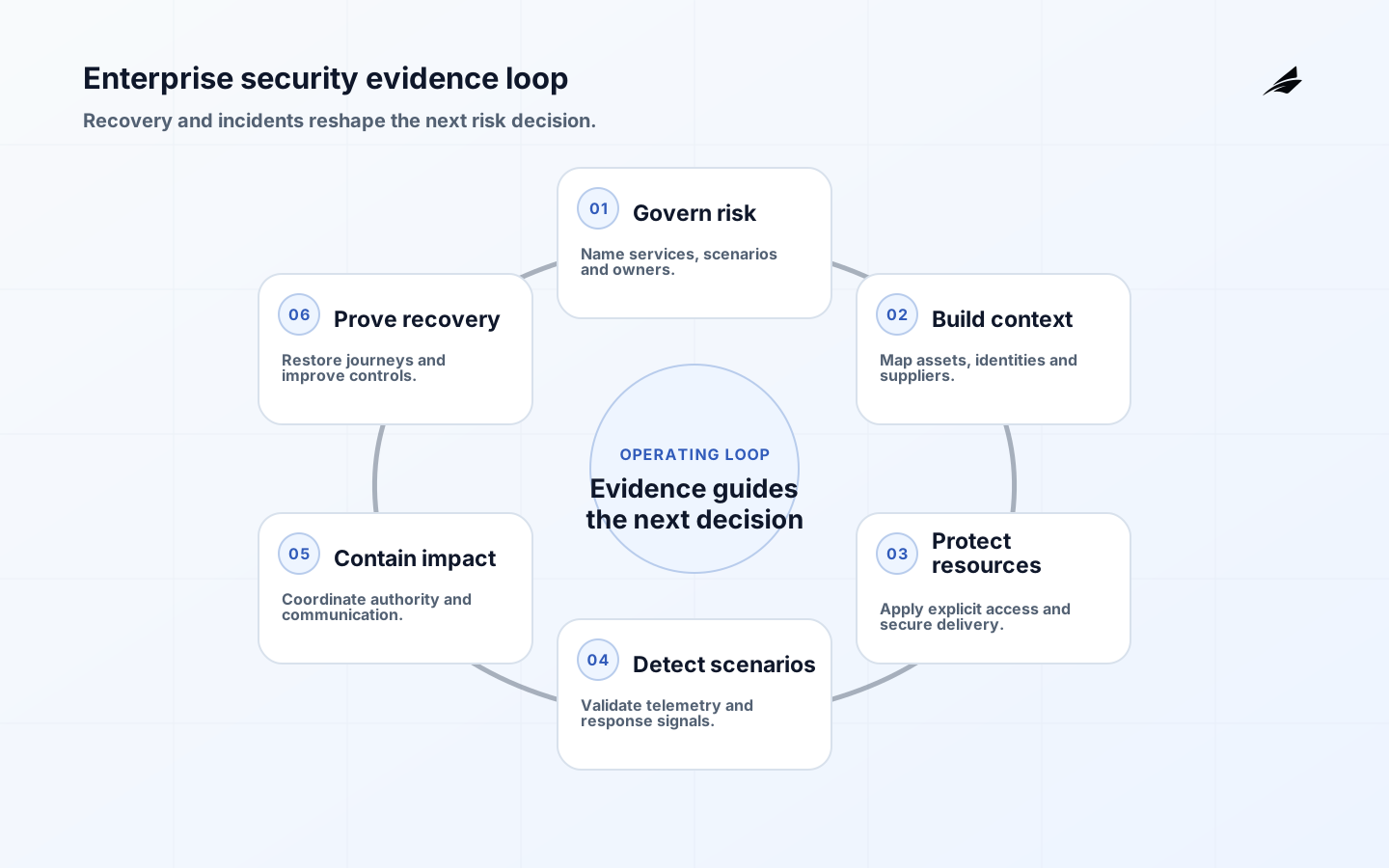
Enterprise security solutions are a coordinated set of people, processes, architecture and technology that reduce material cyber risk and support recovery. They are not a bundle of products purchased to fill framework boxes. The useful starting point is a business service and the harm to prevent: fraudulent payment, unavailable production, exposed customer data, compromised software or an undetected privileged action. Controls should produce evidence against that outcome across normal operation and failure.
This FAQ helps leaders connect governance, identity, assets, detection, response and recovery. The enterprise security scope guide covers investment planning, and the enterprise security implementation checklist provides delivery gates. Use the answers to challenge architecture and supplier claims, then tailor controls to organizational risk and obligations.
How should enterprise security governance begin?
Define mission, critical services, risk appetite, legal and contractual requirements, roles and reporting. NIST CSF 2.0 organizes outcomes across Govern, Identify, Protect, Detect, Respond and Recover and does not prescribe products. Create a current profile, target profile and prioritized action plan. Each material outcome needs an accountable business owner, control owner, evidence source and accepted exception route.
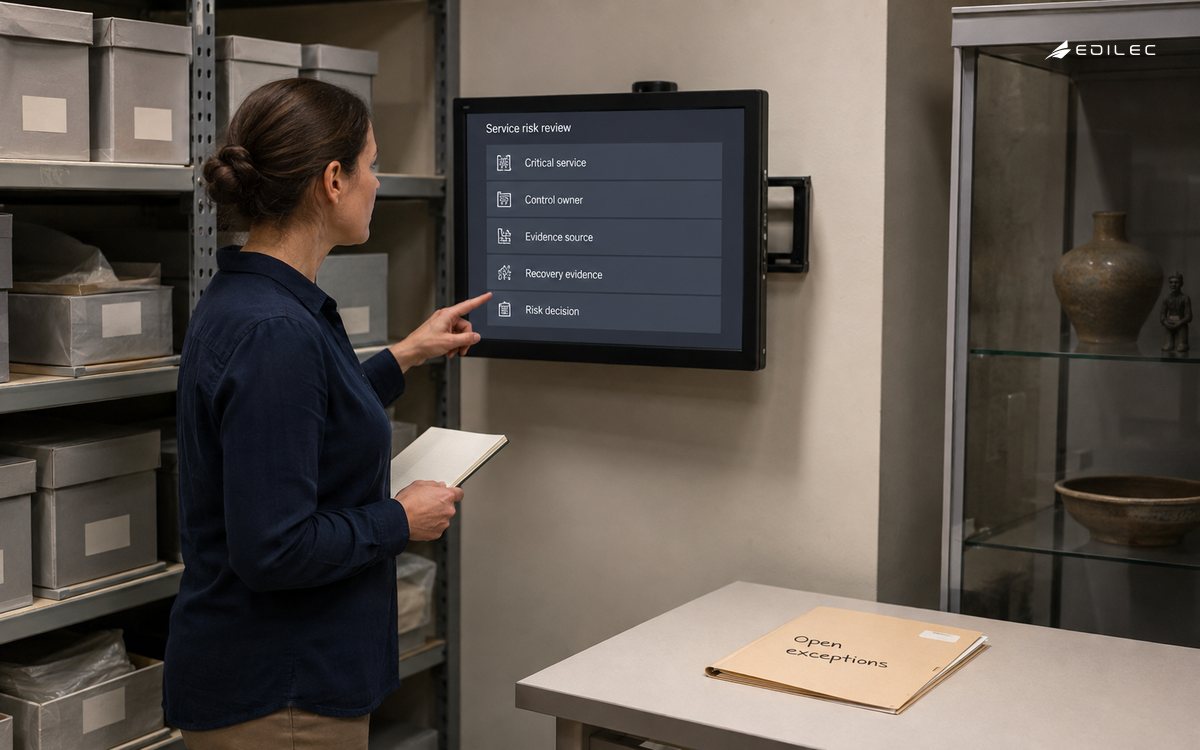
Report decisions, not a sea of control counts. Leadership needs material scenarios, exposure, control confidence, open exceptions, incident and recovery evidence, and investment choices. Security should participate in enterprise architecture, procurement, product delivery and supplier governance. A risk accepted by a system owner must include reason, consequence, compensating controls, expiry and review; acceptance is not a permanent label for unfunded work.
| Governance object | Required content | Review trigger |
|---|---|---|
| Risk scenario | Asset, threat, impact, controls and owner | Material architecture or threat change |
| Target profile | Priority outcomes and implementation state | Strategy or obligation change |
| Exception | Scope, reason, control, owner and expiry | Expiry, incident or dependency change |
| Supplier record | Service, data, access, assurance and exit | Contract, incident or material release |
| Recovery objective | Service, time, data point and dependencies | Exercise or business change |
| Board report | Decisions, exposure and evidence trend | Defined governance cadence |
What asset visibility is actually required?
Build enough context to protect services and prioritize response: applications, data, identities, endpoints, cloud resources, operational technology, repositories, suppliers and dependencies. Reconcile discovery sources rather than declaring one inventory complete. Every consequential asset needs an owner, criticality, environment, exposure, data class, supported state and service relationship. Unknown assets should create investigation work, not silently disappear from coverage metrics.
Start with attack paths to critical services. Which identities can administer them? Which internet-facing components or supplier connections reach them? Where are secrets and backups? CISA's Cross-Sector Cybersecurity Performance Goals prioritize high-impact actions across IT and operational technology. Use that baseline to address obvious exposure while the broader inventory and architecture mature.
Is zero trust a product or a migration strategy?
Zero trust is an architecture approach. NIST SP 800-207 removes implicit trust based solely on network location or ownership and focuses protection on resources. Translate that principle into identity proofing, strong authentication, device and workload posture, least privilege, explicit policy, session decisions and telemetry. Network segmentation remains useful, but presence on an internal subnet should not be sufficient authority.
Migrate one journey such as privileged administration, third-party support or access to a sensitive application. Map subject, device, resource, policy inputs, enforcement point, failure behavior and emergency access. Test revoked users, unmanaged devices, unavailable policy service, stale group membership and recovery. Measure reduced standing privilege and improved decision evidence, not the percentage of users routed through a vendor product.
How should software and vulnerability risk be prioritized?
Treat source, dependencies, builds, artifacts and deployment systems as part of the production attack surface. NIST's SSDF provides secure-development practices that can be integrated into different lifecycles. Require protected repositories, attributable change, isolated builds, dependency visibility, immutable artifacts, security testing and a vulnerability-response process. Suppliers should disclose their support policy and provide timely, usable remediation information.
Prioritize vulnerabilities through exploit evidence, exposure, privileges, asset criticality and available mitigations rather than severity score alone. CISA maintains the Known Exploited Vulnerabilities Catalog as an authoritative list of vulnerabilities exploited in the wild and recommends using it as an input to prioritization. Track affected assets, due decision, mitigation, verification and accepted residual risk. Scanning volume is not the same as reduced exposure.
| Security signal | Useful interpretation | Misleading version |
|---|---|---|
| MFA coverage | Protected high-risk journeys and exceptions | Percent of all accounts without context |
| Privilege | Standing access and reviewable elevation | Number of roles created |
| Vulnerability | Exploitable exposure by critical service | Raw finding count |
| Detection | Scenario coverage and validated signal path | Rules enabled |
| Response | Time to contain business impact and preserve evidence | Ticket acknowledgement |
| Recovery | Observed restoration against service objective | Backup job success |
What makes detection and incident response effective?
Design detection from threat scenarios and response decisions. For each scenario, identify required telemetry, expected attacker behavior, analytic, triage context, containment authority and evidence gaps. Validate with controlled simulations and known benign behavior. Alerts need a named responder and action; remove or redesign signals that repeatedly create no decision. Protect logs from alteration, synchronize time and limit sensitive data collection.
NIST SP 800-61 Rev. 3, finalized in April 2025, integrates incident response across CSF 2.0 risk management rather than treating it as a separate linear procedure. Prepare communications, legal and regulatory routes, suppliers, decision rights and recovery before an event. Run exercises that include executives, technical owners and business operations, then turn gaps into owned architecture or process changes.
How should recovery be proven?
Define recovery time and recovery point objectives for business services, then map applications, identity, keys, networks, data, suppliers and people required to meet them. Restore representative data into an isolated environment and complete the critical journey. Test clean-room access, credential rotation, rebuilding from trusted artifacts, dependency loss and communication. A backup that cannot be trusted or reconciled is not a recovery capability.
Preserve immutable or separately protected recovery evidence according to risk, but test authorized access and retention. Document conditions for returning to operation, compensating controls and heightened monitoring. Exercises should measure actual restoration and decision time, not whether participants found the runbook. Feed the result into architecture priorities and supplier contracts. Recovery cost and complexity are design signals.
How many tools are enough, and how should value be measured?
Select tools from required outcomes, integration, coverage, operating skill and exit. Consolidation can reduce gaps and administration, while a broad suite can also create dependence and shallow use. Require a proof with real assets, roles, alerts and response. Include implementation, telemetry, storage, tuning, training, support and retirement in cost. Keep control data and evidence exportable, and test what happens when the vendor service is unavailable.
Measure scenario and service coverage, exception age, privileged access, exploited-vulnerability exposure, validated detection, containment, restoration and recurring causes. Distinguish implementation from effectiveness: a control deployed is not necessarily configured, observed or successful under test. The security and protection scope guide and implementation checklist provide a broader baseline for organizations building the first coordinated program.
How should third-party security be governed?
Segment suppliers by the services, data, privileged access and operational dependency they introduce. Before contract, verify security responsibilities, secure-development practice, vulnerability disclosure, incident notification, evidence access, continuity and exit. Reassess after material architecture, ownership or subcontractor change. A questionnaire can start discovery, but consequential services need technical and operating evidence matched to the real integration.
Design containment for supplier failure. Use separate identities, least privilege, monitored administration, bounded network paths and the ability to revoke access without losing internal control. Preserve configurations, data exports and runbooks needed to continue or replace the service. Exercise a supplier compromise or outage with procurement, legal, operations and security; confirm who can isolate the connection, communicate impact and authorize restoration.
Track unresolved supplier findings by business service and expiry, not in a detached annual register. Compensating controls should be observable and owned. Contract language cannot prevent an incident, but it can preserve notification, evidence and response cooperation. The enterprise still needs telemetry and decision rights sufficient to detect that a supplier-dependent control or service is no longer meeting its promise.
Include supplier access and dependencies in recovery exercises. Verify that emergency contacts work outside normal hours, required evidence can be obtained, and the enterprise can restore a critical service when the provider's management plane or support channel is unavailable. Record any step that depends on informal personal relationships and replace it with an owned route.
Key takeaways
- Govern enterprise security through material business scenarios, owners and evidence.
- Connect assets, identities, suppliers and vulnerabilities to critical services.
- Implement zero trust as explicit per-resource policy and a staged migration.
- Prioritize exploited, exposed and consequential vulnerabilities over raw counts.
- Build detection around response decisions and validate the complete signal path.
- Prove recovery through restored business journeys and feed results into architecture.
Additional enterprise security solutions FAQ
Does adopting CSF 2.0 certify security? No. It provides outcomes and a common risk language. Organizations choose implementation and must verify effectiveness against their context.
Should every administrator have phishing-resistant authentication? Prioritize high-risk and privileged journeys, then expand according to threat and feasibility while controlling exceptions and recovery.
Can security operations be outsourced? Monitoring and response work can be contracted, but risk acceptance, business authority, legal duties and supplier governance remain with the enterprise.
What should a security program improve first? Address a material scenario with known exposure and weak recovery. Build one end-to-end control and evidence path, then expand from tested results.
Conclusion: make security an evidence system
Enterprise security solutions become dependable when governance, protection, detection, response and recovery operate as one evidence system. Start from critical services and credible harm, implement proportionate controls, test failure and use what incidents reveal. Product count matters far less than whether accountable people can prevent, contain and recover a consequential event.