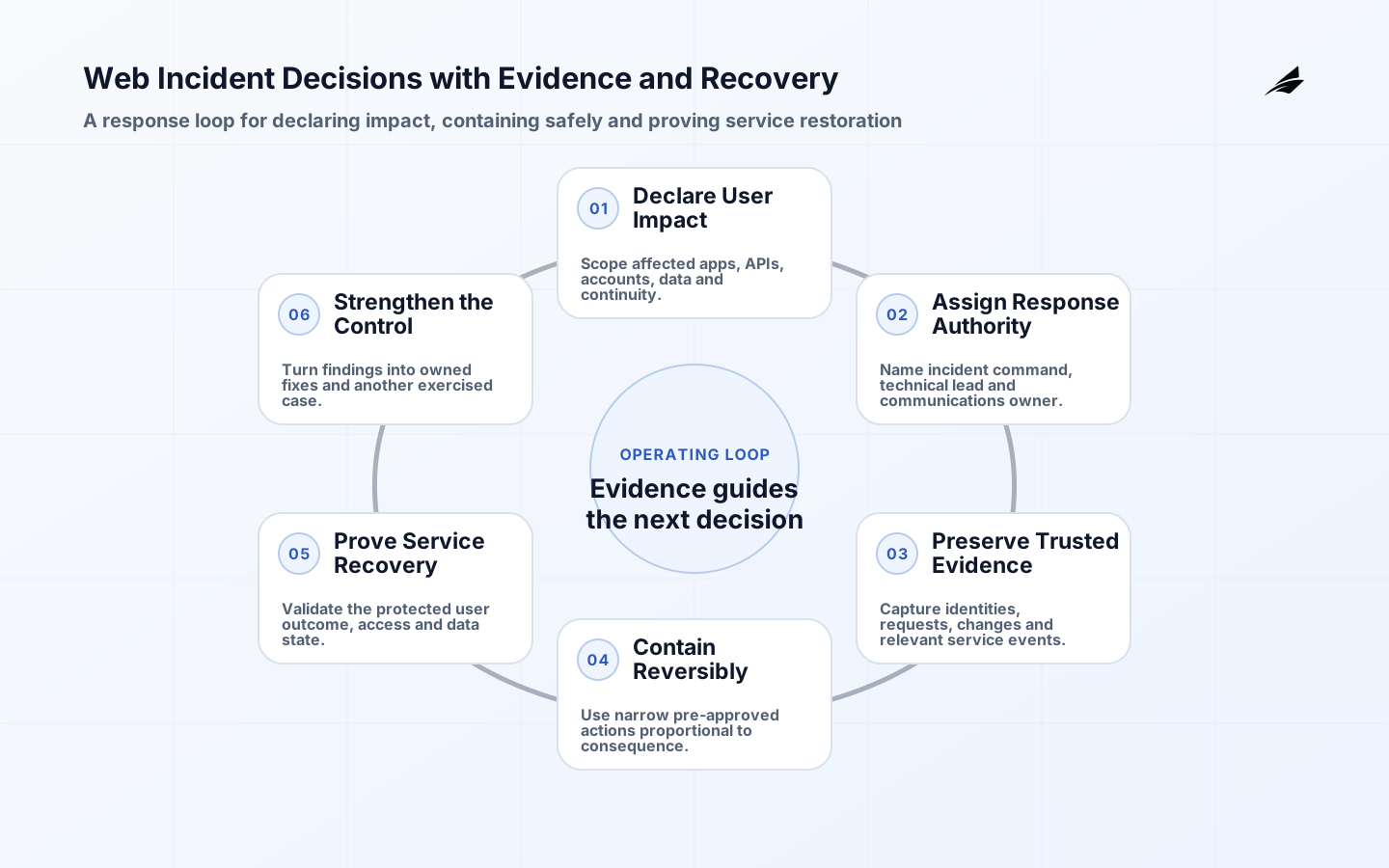
Incident Response for Web Apps: Roles, Evidence and Recovery is a delivery and operating problem before it is a tooling choice. Teams usually notice it when unclear incident commander authority, inadequate logs, destructive containment, unsupported public statements and restoring an unknown compromised state begin to slow work or create uncertainty. The useful starting point is not a product shortlist. It is a bounded map of internet-facing applications, APIs and administrative services whose failure or misuse could affect users, data, money or continuity, the people affected, the decisions that change risk, and the evidence needed when something goes wrong. That map gives product, engineering, security and operations teams a basis for choosing controls without pretending that one pattern fits every system.
Set the scope for incident response for web apps
Scope incident response for web apps around a real outcome instead of a department label. For this guide, the boundary is internet-facing applications, APIs and administrative services whose failure or misuse could affect users, data, money or continuity. Name the service owner, decision maker, expected users, sensitive actions and practical consequence of an incorrect allow, deny or delay. Then list dependencies: identity providers, user directories, APIs, storage, queues, customer-support processes and external vendors. The result is a reviewable problem statement that makes trade-offs visible before architecture or a rollout date is committed.
| Scope question | Decision to make | Evidence to retain |
|---|---|---|
| Protected asset | What makes the affected service, account, session, data set, deployment, integration or infrastructure component consequential? | Named owner, data classification and business impact |
| Access decision | how to validate a signal, contain harm, preserve evidence, communicate accurately and restore a known-good state | Policy rule, test cases and accountable approver |
| Trusted evidence | timestamped telemetry, request and identity context, release history, affected scope, containment actions, recovery validation and decision records | Source, freshness and access controls for each signal |
| Operating boundary | How is alert quality, time to triage, access to logs, containment execution, recovery verification and follow-up actions handled? | Runbook, alert route and review cadence |
Build a control model that can be tested
The core control is an exercised incident process with named authority, evidence access and pre-approved actions proportional to likely consequence. Separate authentication from authorization: proving an identity is not the same as deciding what it may do. Derive relevant context on the server from trustworthy sources, and make the final business operation responsible for checking policy. A user interface can hide unavailable actions and a gateway can reject malformed requests, but neither should become the only guard. Write normal paths, denied paths, time-limited grants and emergency cases so the same intent can be tested before and after release.

- Describe the affected service, account, session, data set, deployment, integration or infrastructure component and the business action in plain language before naming technical permissions.
- Use timestamped telemetry, request and identity context, release history, affected scope, containment actions, recovery validation and decision records as bounded input to a decision; do not trust client-supplied claims without verification.
- Default to a denied action when evidence is missing, stale or inconsistent, then provide a safe remediation path.
- Keep policy changes versioned, reviewed and observable so a regression has an owner and rollback option.
- Test negative cases deliberately, including cross-tenant access, stale sessions, failed dependencies and operator mistakes.
Control design must respect the work people need to complete. Friction around every harmless action will invite workarounds; no friction around high-impact actions creates a standing risk. Use the consequence of the action to choose assurance, approval and session constraints. Make exceptions explicit and temporary. If an emergency route is necessary, require a reason, an expiry and an after-the-fact review. This keeps legitimate work moving while preserving an accountable record of why normal controls were bypassed. For incident response, that means rehearsing authority and evidence access before an urgent decision compresses the time available for careful coordination.
Connect identity, data and the application boundary
Architecture becomes clearer when a team follows one request from entry to outcome. The caller asks to act on the affected service, account, session, data set, deployment, integration or infrastructure component; the service establishes trusted context; it evaluates policy; it performs a narrow operation; and it records the result. Each step needs an owner. Avoid spreading one business decision across browser code, a generic gateway and a downstream database trigger where no layer sees the whole picture. The system that owns the record or command is usually best placed to decide whether the action is permitted and to explain its outcome.
| Layer | Responsibility | Failure to avoid |
|---|---|---|
| Identity | Establish a verified human or workload identity and session context | Treating a username, header or client-side claim as proof |
| Policy | Evaluate permitted action against current business context | Using a broad role without object or tenant checks |
| Service | Execute the validated business operation with safe defaults | Letting an integration bypass the owning service |
| Evidence | Record outcome, correlation and safe context for review | Capturing secrets or leaving material actions unexplained |
Roll out with measured acceptance criteria
Use a tabletop and bounded technical exercise for one plausible web application incident before relying on the plan as the first release. Establish a baseline: how access is granted today, which failure modes appear, which users need support and which records are hard to reconcile. Build the entire path for that slice, including enrollment or provisioning, a denied request, an exception, a dependency outage and a recovery action. Review the flow with the people who will use and support it. A narrow pilot exposes assumptions about data, ownership and usability sooner than a broad migration with no meaningful way to compare new behavior to old.
Acceptance combines correctness, security and operability. Prove that authorized people can complete necessary work, unauthorized requests are rejected at the owning boundary, important events can be explained, and the team can recover safely from a representative failure. Monitor alert quality, time to triage, access to logs, containment execution, recovery verification and follow-up actions. Treat results as operational evidence, not a vanity dashboard. Trends should trigger an owner-led decision: refine policy, improve guidance, change the workflow, reduce scope or fix an upstream dependency that is creating exceptions.
Address common failure modes early
The recurring failure pattern is a technically correct control that does not fit the operating model. Permissions become stale because no one owns them; logs are collected but cannot answer a customer question; a recovery process works only for engineers; or an integration gets a broader credential than it needs because it is expedient. Counter these risks with named ownership, small scopes, explicit expiry, protected audit records and rehearsal. Design review is most valuable when it asks what happens under pressure, not when it merely confirms that a control exists in a diagram. This matters specifically for incident response for web apps, where the operating consequences are borne by customers and staff rather than by the architecture diagram.
- Review unclear incident commander authority, inadequate logs, destructive containment, unsupported public statements and restoring an unknown compromised state against a real recent workflow rather than a hypothetical diagram.
- Keep a visible inventory of privileged or exceptional paths and their owners.
- Make support and incident responders able to find necessary facts without unrestricted production access.
- Test a policy change, a dependency loss and a recovery route before declaring the service ready.
- Retire unused roles, tokens, integrations and dashboards when the business path is removed.
Key takeaways
- Incident response for web apps works when it protects an owned business action, not when it is treated as a generic platform feature.
- Keep authentication, authorization, business execution and evidence distinct but connected.
- Start with a bounded consequential workflow and test failure paths before expanding coverage.
- Use lifecycle ownership, expiry and review to prevent temporary access from becoming permanent.
- Make production observations part of the control: an undocumented exception is a future incident waiting for context.
Frequently asked questions
Do small teams need a formal incident plan?
Yes, but it can be concise. A small team needs to know who can declare an incident, how to contact decision makers, where evidence lives, which containment actions are safe and how recovery will be verified.
Should we immediately delete suspicious data or accounts?
Containment actions should balance speed with evidence and service impact. Preserve facts needed for investigation where possible, restrict access or rotate credentials as appropriate, and record who made each decision.
Conclusion
A final readiness check for incident response for web apps is to ask a person outside the delivery team to follow the evidence from request to outcome. They should be able to identify the owner, the protected action, the control decision, the recorded event and the recovery route without relying on tribal knowledge. If they cannot, the design needs another bounded iteration before broader rollout.
Incident response for web apps becomes reliable when a team can explain the protected action, the evidence behind the decision, the person accountable for exceptions, and the proof that the system behaved as intended. Begin with a tabletop and a bounded technical exercise for one plausible web application incident before relying on the plan, keep controls close to the operation, and make alert quality, time to triage, access to logs, containment execution, recovery verification and follow-up actions visible after release. That approach does not promise perfect prevention. It creates a system that can limit harm, support legitimate work and improve from evidence instead of assumptions.