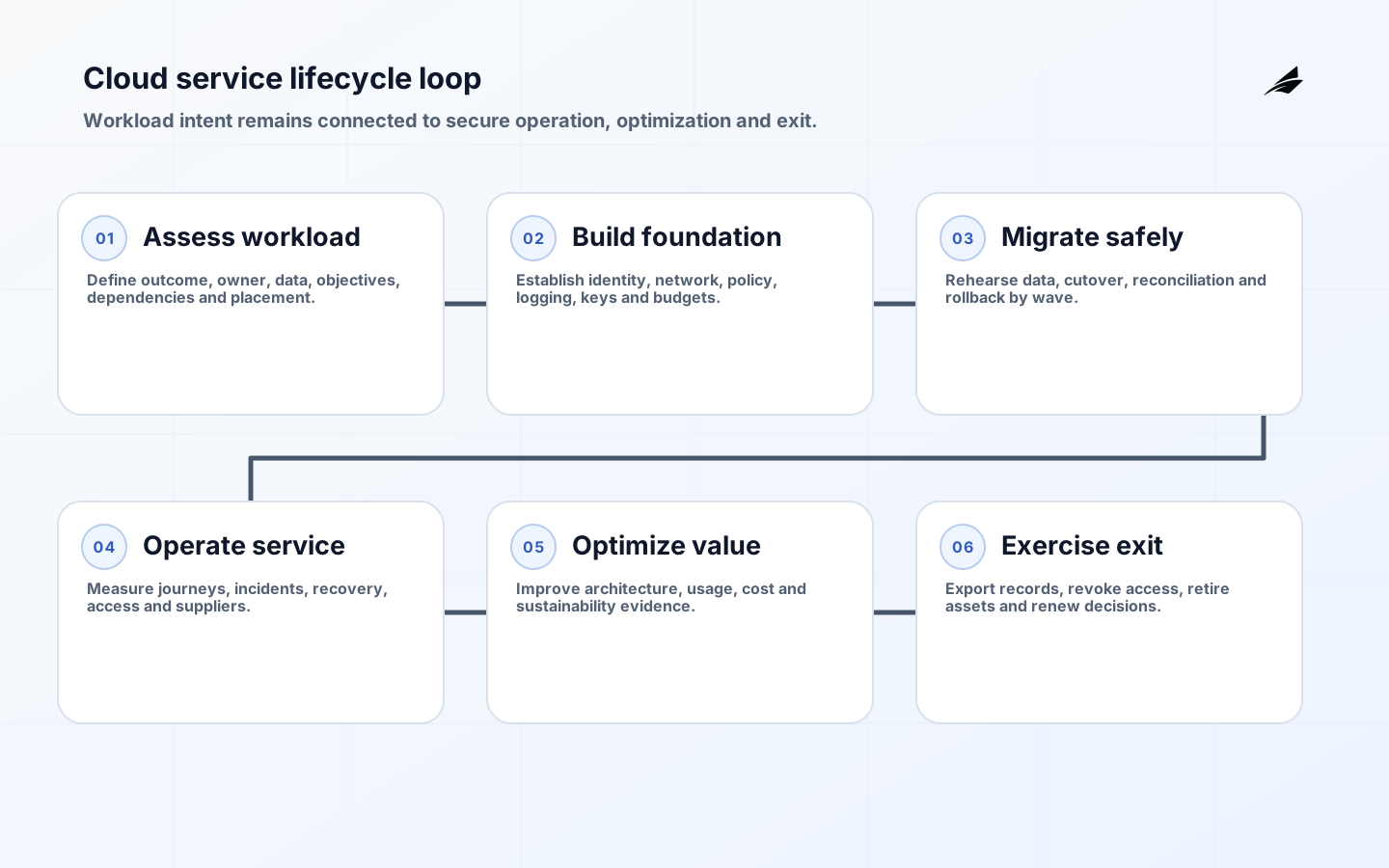
An end-to-end cloud services implementation checklist must extend from business intent through architecture, migration, secure delivery, reliability, cost and daily ownership. Provisioning an account or subscription is only the beginning. A useful cloud program gives each workload a justified placement, governed identity and network boundaries, reproducible infrastructure, observable service objectives, tested recovery and an exit path. The checklist should be applied per workload because criticality, data, latency, compliance and team capability differ across an estate.
Use the cloud scope, cost and risk plan before funding and the end-to-end cloud services FAQ for common decisions. Teams considering outsourced operation can compare the managed cloud delivery plan and managed cloud implementation checklist. The provider’s shared-responsibility documentation must be mapped to named internal and supplier owners.
Confirm strategy, workload and ownership
- Name the business outcome, workload owner, users and baseline constraint.
- Classify data, availability, recovery, latency, residency and compliance needs.
- Compare retain, retire, rehost, replatform, refactor and replace options.
- Estimate migration, dual running, provider, network, support and exit costs.
- Define decision rights across platform, workload, security, finance and suppliers.
Create a workload dossier containing dependencies, traffic, data stores, certificates, schedules, interfaces, operational contacts and known incidents. Select cloud services from requirements rather than novelty. Managed services can reduce undifferentiated operations while adding limits, provider-specific behavior and exit work. Record architecture decisions and rejected alternatives. Microsoft’s Cloud Adoption Framework separates foundational strategy, plan, ready and adopt activities from ongoing govern, secure and manage methods; that distinction helps prevent migration from ending before operations begin.
Build the cloud foundation and guardrails
Establish organization hierarchy, accounts or subscriptions, regions, identity federation, emergency access, network patterns, DNS, logging, encryption, policy, budgets and approved deployment paths. Separate production and non-production with enforceable boundaries. Prefer short-lived workload identity to static keys. Central guardrails should deny prohibited regions, public exposure and unapproved services where appropriate, while documented exception workflows prevent teams from bypassing the platform. Test the emergency path and record its use.
| Foundation area | Required evidence | Failure to test |
|---|---|---|
| Identity | Federation, least privilege and access review | Compromised or removed account |
| Network | Ingress, egress, DNS and private connectivity map | Dependency or resolver outage |
| Data protection | Classification, keys, backup and retention | Restore and key unavailability |
| Policy | Automated guardrails and exception ownership | Non-compliant deployment |
| Cost | Tags, allocation, budget and anomaly route | Unowned or runaway resource |
Review workload architecture across six concerns
AWS and Google organize well-architected guidance around operational excellence, security, reliability, performance, cost and sustainability. Use those concerns as a review, not a scorecard detached from context. Define service objectives and failure domains. Make interactions idempotent, set timeouts and bounded retries, control queues and provide graceful degradation. Choose capacity and scaling from measured load. Minimize data movement and idle capacity where it also improves cost and environmental impact. Record tradeoffs when one concern limits another.
Prepare data and migration waves
Clean and classify source data, define mapping and reconciliation, and rehearse migration with representative volume. State cutover authority, freeze window, rollback boundary and customer communication. For online migration, define replication lag and how conflicting writes are prevented. Group waves by dependency and learning rather than only business unit. Migrate a representative low-consequence workload first, improve the platform, then increase criticality. Keep the legacy service recoverable until exit criteria are met, but avoid indefinite dual operation without an owner and budget.
| Migration gate | Pass condition | Evidence retained |
|---|---|---|
| Assess | Dependencies, risks and target pattern approved | Dossier and decision records |
| Prepare | Foundation, access and observability ready | Automated checks |
| Rehearse | Time, integrity and rollback within target | Run result and reconciliations |
| Cut over | Owner approves measured production state | Timeline and communications |
| Stabilize | Objectives and support stay within limits | Incidents, cost and user evidence |
| Retire | Data, access, contract and archive duties complete | Decommission record |
Make infrastructure and software change repeatable
Provision through reviewed infrastructure as code, use immutable artifacts and detect drift. Protect repositories and pipelines, verify dependencies and provenance, and separate deployment roles. NIST SSDF practices apply to cloud-delivered software and pipeline environments. Test policy, configuration and application together. Define rollback or forward repair for schema and stateful changes. Keep platform modules versioned; an automatic module upgrade across every workload can create a larger failure domain than the change it standardizes.
Instrument service objectives and recovery
Collect metrics, logs and traces with consistent resource and correlation context; OpenTelemetry provides a vendor-neutral framework for these signals. Measure customer journeys, errors, tail latency, saturation, queue age, data freshness and dependency health. Give alerts owners and executable runbooks. Define recovery time and recovery point objectives from business impact, then test restore, regional failover and credential access. A replicated corrupt database is not a backup, and a successful restore command is not proof that the application’s records reconcile.
Operate cost as an engineering signal
Allocate cost to products, environments and owners using a governed taxonomy. Build budgets and anomaly routes before migration. Track forecast, commitment coverage, idle resources and unit cost per useful transaction or customer. The FinOps Framework emphasizes collaboration and timely data across engineering, finance and business. Optimize architecture and usage before buying commitments that lock in waste. Include support plans, logs, data transfer, backups, security services and disaster recovery in ownership cost, not only compute.
Complete operational handover and exit
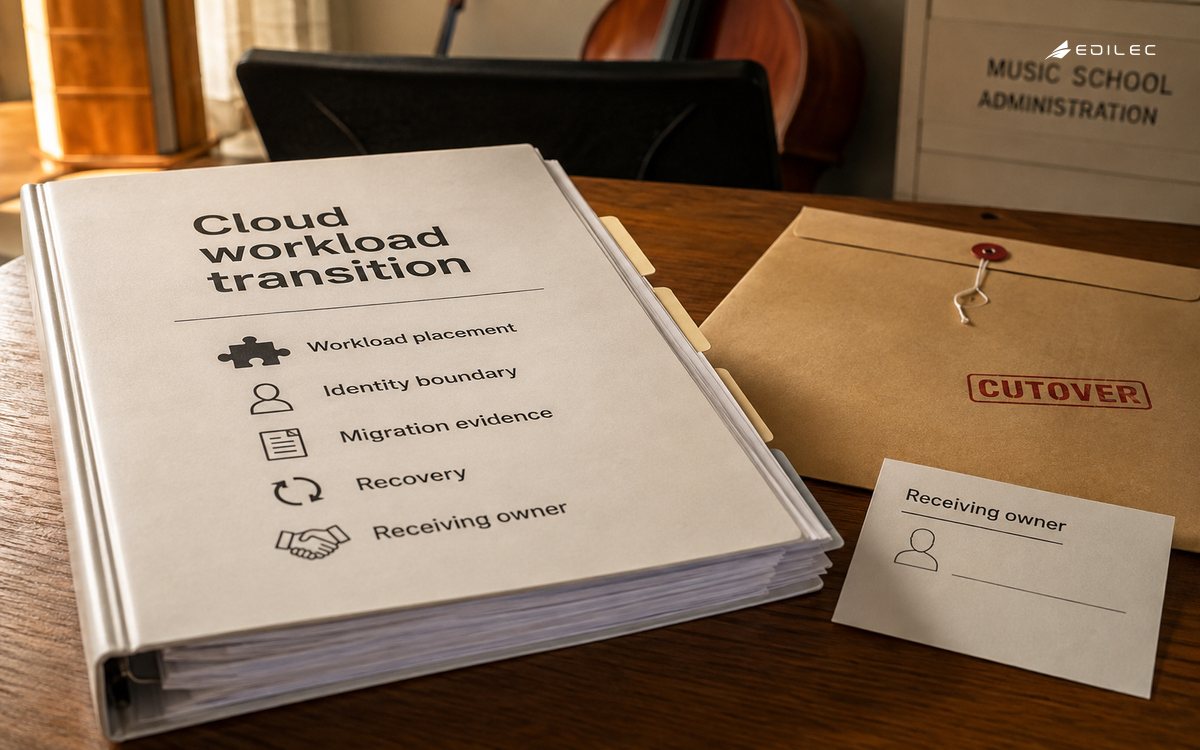
- Run shadow operations with real alerts, requests, releases and access changes.
- Rehearse incident command, restore, provider escalation and customer communication.
- Verify customer ownership of accounts, domains, keys, repositories and billing.
- Transfer inventories, diagrams, decisions, dashboards, runbooks and known risks.
- Test a representative change by the receiving team without supplier intervention.
- Document data export, deletion, access revocation and contract exit procedures.
Integrate security and incident operations
Route provider audit logs, identity changes, network findings, vulnerability data and workload events into a monitored process with severity and ownership. Tune detections against the workload threat model; collecting every provider event without response capacity creates cost and noise. Restrict interactive production access and use approved automation or just-in-time elevation. Inventory internet exposure continuously. Test suspected credential compromise, public data exposure and malicious deployment, including evidence preservation and key or token revocation.
Define incident roles across workload, platform, security, provider and communications teams. Provider support severity does not replace the organization’s customer-impact severity. Keep account identifiers, support plans and escalation contacts available outside the affected environment. Rehearse control-plane impairment and loss of normal identity. After recovery, reconcile data and delayed queues, rotate compromised trust, review cost spikes and fund corrective work. A post-incident report without owned actions and deadlines does not improve the service.
Govern provider and managed-service dependencies
Maintain a register of cloud and marketplace services, regions, data categories, account owners, contract terms, service limits, support tier, recovery assumptions and exit method. Subscribe to deprecation and security notices and test upgrades before deadlines. Confirm whether backups, logs and encryption keys remain usable during account suspension or commercial dispute. Review concentration where several critical workloads depend on one identity, region or control plane. Resilience can come from isolation and recoverability without duplicating the entire estate across providers.
For a managed cloud partner, define which party changes policy, approves access, responds to alerts, patches workloads, tests recovery and communicates with the cloud provider. Require evidence through tickets, configuration history, exercises and service reviews. Customer accounts, domains, repositories, keys and billing should remain transferable. Periodically execute an exit sample: export inventory and logs, deploy a representative module, revoke a partner identity and verify that the customer team can continue operation.
Key takeaways
- Assess and own each workload, not cloud adoption in the abstract.
- Create a governed foundation before critical migration.
- Rehearse data integrity, rollback, restore and supplier failure.
- Operate reliability, security, cost and sustainability together.
- Finish with tested ownership and exit, not a document handoff.
Document the point at which restore becomes a business decision rather than an infrastructure command. A recent backup may lose accepted work within the recovery-point window, requiring replay from durable events or customer communication. Define which queues can be reconstructed, which external effects must be queried and who approves reconciliation differences. Test recovery access when normal identity and primary region are unavailable, and retain the exercise evidence with the workload dossier.
Frequently asked questions
Should the implementation be multi-cloud?
Only when specific resilience, regulatory, commercial or capability requirements justify the additional identity, network, data, delivery and skills burden. Portability has degrees; start with data export, open interfaces and replaceable boundaries. Duplicating every workload across providers often increases complexity without proving usable failover.
How complete must a landing zone be?
Complete enough for the first workload’s risk: hierarchy, identity, network, logging, policy, security, cost and operations. Build iteratively but do not migrate critical data before required controls exist. A huge universal platform delays learning; an ungoverned account creates later remediation. Version the foundation and add capabilities from observed workload needs.
When is cloud implementation finished?
A wave is complete when the workload meets objectives, data reconciles, support and recovery are exercised, cost is owned and obsolete resources are retired. Cloud capability continues through review, patching, architecture evolution, access governance and cost optimization. Treat it as a product with customers and an operating roadmap.
Conclusion
End-to-end cloud implementation connects business placement decisions to a secure foundation, recoverable migration and measurable operation. Apply the checklist by workload, retain evidence at every gate and transfer authority through rehearsal. The result is not merely infrastructure in a provider account; it is a service the organization can secure, change, finance, recover and eventually exit.