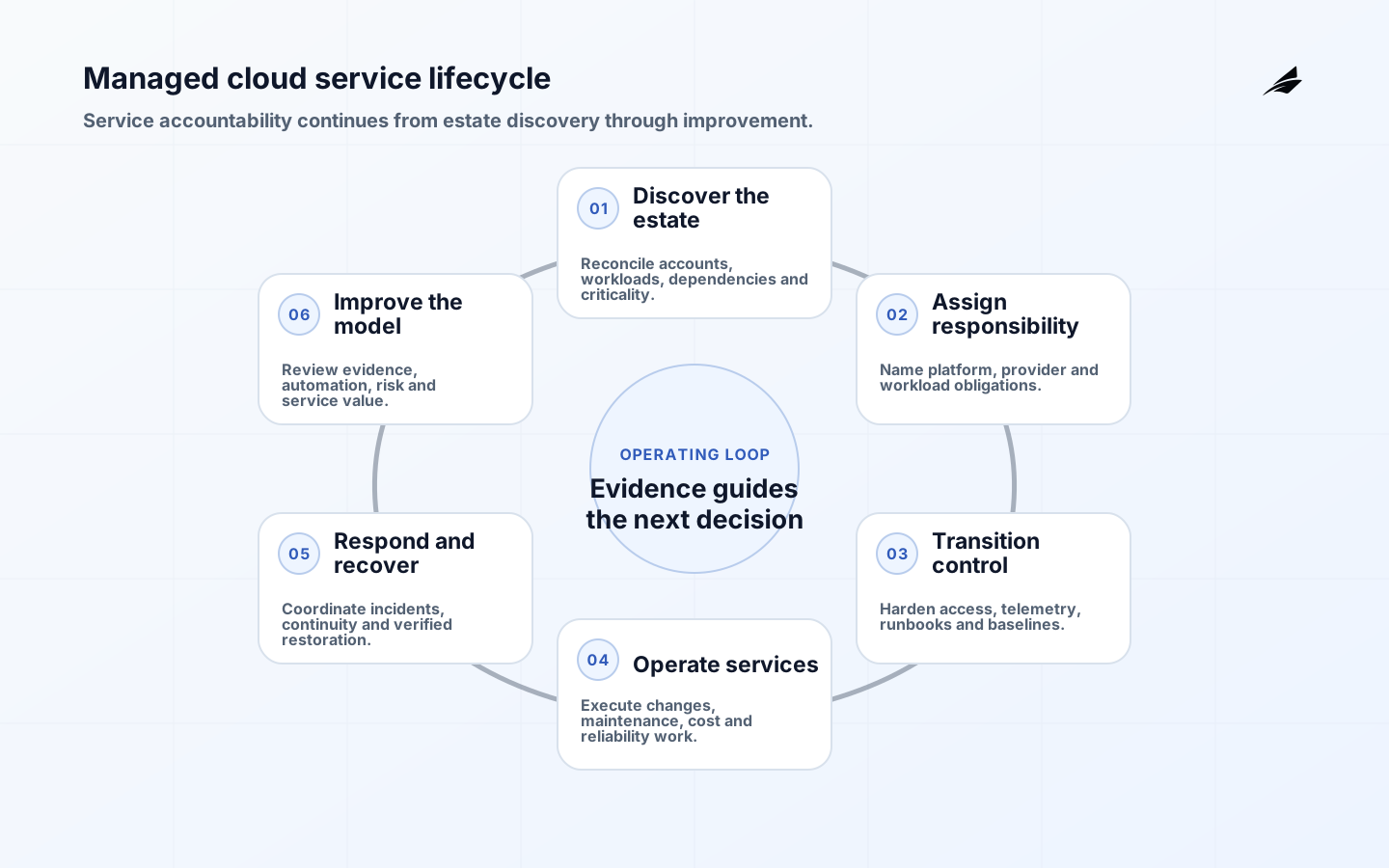
End-to-end managed cloud services combine platform administration, workload operations, security, reliability, cost management and service improvement under an agreed operating model. The phrase does not mean the customer has transferred every cloud responsibility. It means the handoffs from account foundation to application support are designed, staffed and measured as one service. This implementation checklist helps buyers and delivery teams turn a broad managed-cloud promise into explicit scope, authority, evidence and tested outcomes.
Use the end-to-end managed cloud delivery plan to frame commercial scope and the end-to-end managed cloud FAQ to settle service-level questions. The broader managed cloud implementation checklist and managed cloud buyer FAQ provide useful comparisons. In every document, replace verbs such as manage or optimize with the exact activity, resource boundary, decision right, cadence and evidence.
1. Define the managed cloud service boundary
Create a reconciled inventory of organizations, tenants, subscriptions, accounts, projects, regions, networks, clusters, data platforms, workloads, identities and external dependencies. Classify business criticality, data sensitivity, recovery objectives, support hours and regulatory constraints. State whether newly discovered resources enter scope automatically, wait for owner acceptance or remain quarantined. List exclusions at the same level of detail. A proposal that names a cloud but not the supported services, operating systems, applications and deployment patterns leaves both cost and accountability unresolved.
Build a service catalog covering request, change, event, incident, problem, vulnerability, patch, backup, recovery, capacity, cost and compliance-evidence activities. The AWS Managed Services documentation illustrates that managed offerings have plan-specific capabilities and onboarding requirements; use that as a reminder to inspect the exact service, not as a universal scope. For each catalog item, document trigger, inputs, performer, approver, completion evidence, response target, customer dependency and excluded work.
| Service area | Managed activity | Customer decision that remains |
|---|---|---|
| Identity | Federation, role assignment workflow, privileged monitoring | Who is entitled and which conflicts are acceptable |
| Platform | Landing-zone policy, network and shared-service operation | Architecture standards and approved exceptions |
| Workload | Monitoring, runbooks, deployment support and maintenance | Product priority and release acceptance |
| Security | Telemetry, triage, remediation and evidence collection | Risk treatment, legal notification and business interruption |
| Resilience | Backup jobs, replication, restore execution and exercises | Recovery objectives and business validation |
| Cost | Allocation data, anomaly review and optimization actions | Value tradeoffs and demand decisions |
2. Extend shared responsibility to the managed provider
Cloud-provider responsibility varies by service model and does not disappear when a managed provider joins. The AWS shared responsibility guidance explicitly notes that customer duties vary with selected services, integrations and applicable requirements. Create a three-party matrix for cloud provider, managed provider and customer. For every control, distinguish performance, approval, evidence supply, oversight and residual-risk acceptance. Shared is a relationship, not a sufficient owner label.
Split central platform and workload accountability. Microsoft’s current cloud operations guidance separates central responsibilities from workload responsibilities across security, resources, deployment and management. Apply the pattern even outside Azure. The managed provider may enforce platform policy while an application team remains responsible for secure code and workload-specific alerts. Name a customer service owner who can authorize urgent action, challenge missed obligations and resolve conflicts among provider, platform, security and product teams.
3. Transition access, telemetry and operating knowledge
Treat transition as controlled acceptance, not a calendar period. Establish named, federated identities; strong authentication; least-privilege roles; time-bound elevation; and recorded administrative activity. Eliminate shared accounts. Inventory credentials, certificates and keys the outgoing team or provider can access, then plan rotation. Connect cloud activity logs, workload telemetry, configuration findings, cost data, backup status and service-management records. Test timestamps, fields, retention, integrity and tenant boundaries before relying on dashboards.

Collect architecture records, dependency maps, support history, maintenance schedules, known errors, open risks, supplier contacts, deployment procedures and recovery runbooks. Validate them by performing work: execute a standard change, investigate an alert, revoke access, fail over an on-call escalation and restore representative data. Record gaps in an owned, dated backlog with interim controls. Do not accept a critical service because documents were delivered if the provider cannot execute them with the access and evidence available in production.
4. Establish daily operations and safe change
Define severity from business impact and urgency, not the monitoring tool’s label. Every actionable alert needs an owner, response procedure, escalation and test history. Suppress noise through governed tuning, while measuring telemetry coverage so a quiet dashboard cannot conceal missing data. Route incidents and requests through a common case record with correlation to cloud resources and changes. The Google Cloud Architecture Framework organizes operational, security, reliability, performance, cost and sustainability considerations; use such pillars as review lenses rather than independent provider silos.
Standardize changes as version-controlled, peer-reviewed automation where practical. Classify normal, standard and emergency paths; require a tested rollback or forward-recovery plan; and retain approver, execution and validation evidence. Patch obligations must specify asset coverage, risk-based timing, compatibility testing, deferrals and exception ownership. Maintenance windows need time-zone and business-calendar treatment. Give workload owners visibility into planned changes to shared services, because a technically successful platform update can still break an application dependency.
| Measure | Defensible definition | Warning sign |
|---|---|---|
| Inventory coverage | Observed in-scope resources divided by reconciled resources | Coverage inferred from billing alone |
| Telemetry coverage | Critical resources sending required usable signals | Alert count falls with no coverage check |
| Change success | Changes completed without rollback, incident or rework | Emergency changes excluded from denominator |
| Restore proof | Scenarios restored and business-validated within objectives | Backup job success reported as recoverability |
| Cost allocation | Spend assigned to accountable product or shared service | Large unowned or generic allocation bucket |
| Control exceptions | Open exceptions by age, exposure and owner | Exception totals without expiry or risk |
5. Integrate cost, resilience and security decisions
Cost management is not a periodic discount exercise. Implement allocation metadata, account hierarchy, budgets, anomaly handling and unit measures tied to service demand. The FinOps Framework emphasizes collaboration among engineering, finance and business roles. Turn recommendations into owned decisions: delete, resize, schedule, commit, redesign or consciously retain. Track realized savings after action and guard against shifting cost into reduced resilience, staff effort or commercial lock-in.
Map recovery objectives to dependencies, data consistency and business validation. Test deletion, corruption, regional impairment and identity-provider failure, not only infrastructure restart. Pre-authorize narrowly defined containment actions while keeping material shutdown, notification and customer decisions with named customer authorities. NIST SP 800-61 Revision 3 places incident response across Govern, Identify, Protect, Detect, Respond and Recover; reflect that integration in contacts, evidence handling, communications, recovery and corrective work.
6. Accept, govern and exit the service
Set acceptance criteria for inventory, access, telemetry, runbooks, service levels, control evidence, open risks and practical exercises. Review results jointly and record conditional acceptance with deadlines rather than allowing silence to become approval. Monthly reviews should focus on trends, recurring causes, risk decisions, automation candidates and business outcomes. Verify measurement queries and denominators when services change. Use service credits only as one remedy; chronic failure also needs corrective plans, escalation and termination rights.
Design exit before go-live. Require timely, machine-readable export of inventory, configurations, code, policies, tickets, cases, detections, exceptions, logs, dashboards, runbooks and reports. Define assistance, costs, retention and deletion evidence. Test an export during the term. At exit, transfer open work, revoke provider identities, rotate reachable secrets, validate replacement monitoring and preserve required records. Portability is not complete until the successor can operate the service and reconcile what the previous provider handed over.
Include service-management data quality in governance. Require a consistent link from incidents, changes and problems to affected cloud resources and business services; otherwise trend analysis cannot distinguish a noisy shared component from unrelated workload failures. Sample closed tickets for correct severity, evidence, customer communication and durable resolution. Review recurring manual interventions as automation candidates, but automate only after the action’s authority, preconditions and recovery are explicit. Maintain a tested customer route for challenging provider classification or closure. This makes the service record a source of operational learning rather than a billing ledger.
Plan capacity and support for demand events. Document seasonal peaks, launches, month-end processing, maintenance conflicts, quota limits and supplier dependencies. Before a critical event, validate scaling assumptions, support rosters, escalation contacts, change restrictions and cost exposure. Afterward, compare forecast with actual demand, performance and spend. Managed operations should also track end-of-support dates for runtimes, images, databases and provider services, giving workload owners enough lead time to test upgrades. Deferring lifecycle work must be a visible risk decision with a date, not an unowned backlog label.
Key takeaways
- Translate end-to-end into a resource boundary and activity-level service catalog.
- Assign provider, managed operator and customer duties for performance, approval and evidence.
- Accept transition only after access, telemetry, change, escalation and restore paths work.
- Measure coverage and business outcomes alongside speed and ticket volume.
- Integrate cost, security and resilience tradeoffs, and test service exit before it is needed.
Frequently asked questions
Does end-to-end include application code?
Only if the service catalog says so. Some providers stop at infrastructure or platform operation; others support runtime, middleware and application releases. Define responsibility for source code, dependencies, functional defects, database changes and business validation separately for every application class.
Which service levels matter most?
Use provider-controlled measures such as acknowledgement, triage, authorized change execution, restore completion and evidence delivery, paired with quality and coverage. Cloud availability alone may not isolate managed-provider performance. Define clock starts, pauses, severity, exclusions and data sources precisely.
Can one provider standardize multiple clouds?
It can standardize outcomes, governance and reporting, but service behavior and evidence differ. Require cloud-specific supported-service matrices, runbooks and tests. A common portal is useful only when it preserves the underlying responsibility and technical detail.
Conclusion
End-to-end managed cloud services work when boundaries and handoffs become more visible, not less. Build the implementation around a reconciled estate, three-party responsibility, tested transition, integrated operations and portable evidence. That creates a service the customer can govern while the provider supplies genuine operational depth.