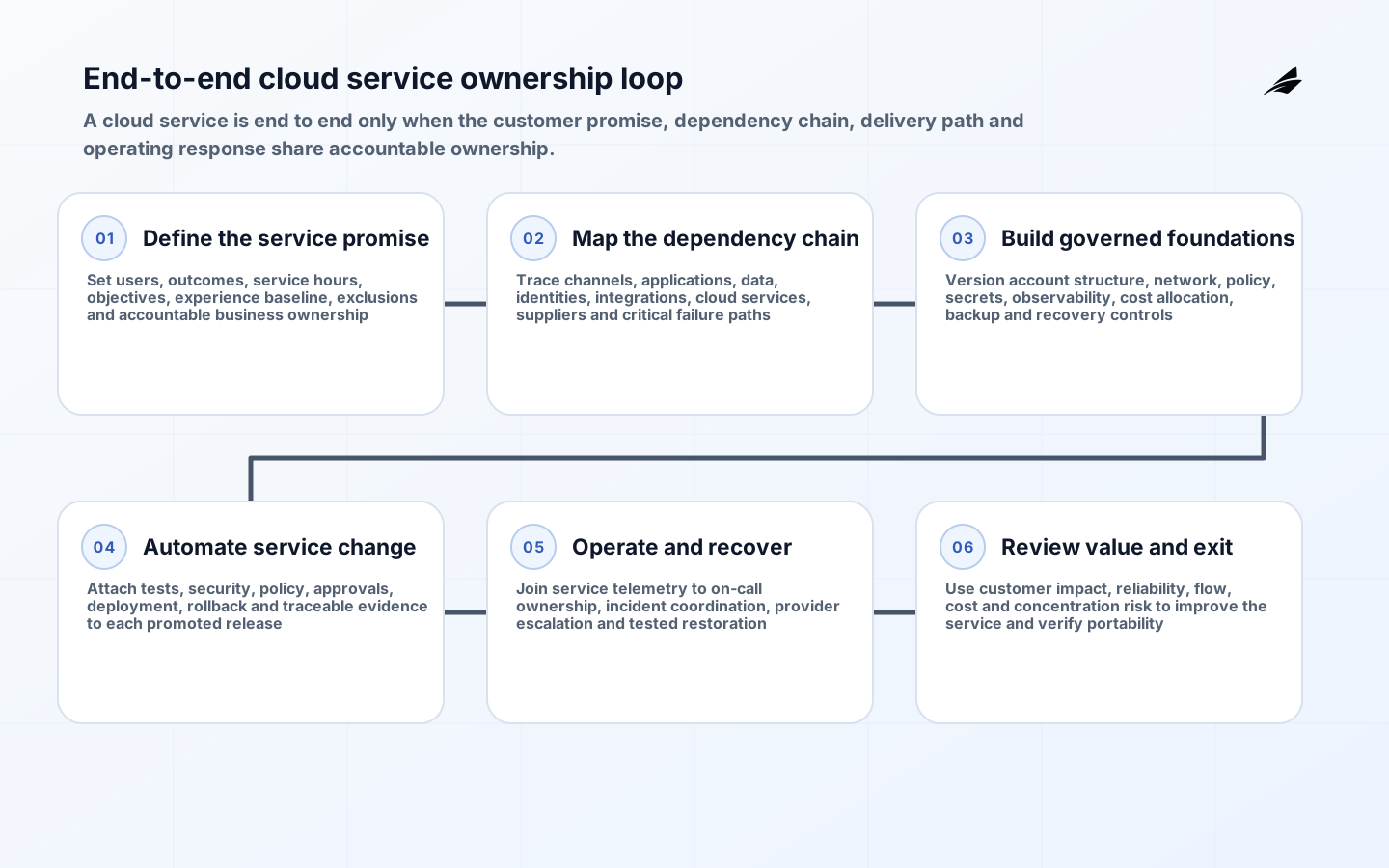
End-to-end cloud services should connect portfolio decisions, platform engineering, workload change, migration, security, reliability, finance and retirement. The phrase is often used to promise that one supplier handles everything, but completeness is not a long service menu. It is continuity of ownership and evidence from the first business assumption to the last revoked legacy credential.
This end-to-end cloud services FAQ complements the scope, cost and risk plan and implementation checklist. Use it to expose handoffs and missing acceptance criteria. No provider can outsource the customer's risk acceptance, product priorities or accountability for data and users.
What does end-to-end cloud services mean?
A credible lifecycle covers business discovery, workload disposition, cloud foundation, application and data change, migration, operational acceptance, ongoing reliability and security, cost optimization, modernization and exit. It can involve several suppliers. The key is a shared service model with current ownership, interfaces, acceptance evidence and escalation, not one commercial logo across every activity.
Confirm that planned services actually use the characteristics described by NIST SP 800-145, such as on-demand self-service, resource pooling, elasticity and measured service where applicable. A managed hosting contract may be valid, but it should not be evaluated against agility and cost assumptions that depend on cloud-native operating characteristics it does not provide.
| Lifecycle stage | Core output | Acceptance question |
|---|---|---|
| Discover | Owned portfolio and measurable outcome | Do facts justify the disposition? |
| Establish | Governed platform capabilities | Can teams consume and recover them? |
| Migrate | Reconciled service and retired dependency | Did user and data outcomes survive? |
| Operate | SLO, risk, cost and improvement evidence | Can owners make informed trade-offs? |
How is the workload portfolio assessed?
Record business capability, owner, users, criticality, data, dependencies, lifecycle, incidents, recovery, demand, cost and contract constraints. Use runtime discovery and financial evidence to challenge interview assumptions. Choose retain, retire, replace, rehost, replatform or refactor with rationale and confidence. Sequence by dependency, business calendar, platform readiness and organizational capacity, not by an arbitrary count of servers per month.
Treat unknowns as work. An application with an undocumented database, batch partner or identity dependency can disrupt a whole wave. Map service transactions and observe peak behavior before sizing. Identify legacy capabilities that cloud services do not replace, such as specialist support or records tooling. Link every disposition to a benefit hypothesis and a closure condition so the portfolio remains an investment instrument rather than an inventory.
What belongs in the cloud foundation?

The foundation provides account hierarchy, identity, network, DNS, encryption, logs, policy, deployment, backup, recovery, billing and support integration. Build common paths as versioned modules with tests and documentation. CISA's Cloud Security Technical Reference Architecture offers useful reasoning about shared services, secure migration and posture management. Tailor it to sector and provider.
Operate the foundation as a product with a roadmap, users, SLOs and support. Offer a paved path that makes correct implementation easier, plus a risk-based exception process. Test denied access, logging, budget boundaries, restore and emergency administration. A foundation is not complete after deployment; it must remain compatible, patched, observable and consumable while workloads and providers evolve.
How are applications and data migrated safely?
Use a pilot that exercises normal controls and representative dependencies. Define cutover, rollback, authority during coexistence, transaction reconciliation, performance, monitoring, support and communications. Profile source data and validate business-readable results, not only transfer counts. Rehearse failure around identity, network, provider quota and delayed messages. Feed platform defects discovered by the pilot back into shared capabilities before scaling waves.
Modernize only where the benefit exceeds complexity. Rehosting may meet a deadline and create a later improvement path; refactoring can reduce operating burden but expands testing and organizational change. State the quality attributes driving each choice. After acceptance, remove legacy jobs, routes, credentials, licenses, backups and support obligations. Dual running without a deadline is an architecture, cost and security problem.
How are security and compliance maintained across the lifecycle?
Map controls to provider, customer and supplier operators, then link each to policy, configuration, tests, alerts and risk decisions. NIST CSF 2.0 makes governance and supplier risk visible alongside identify, protect, detect, respond and recover. Embed repeatable checks in infrastructure and delivery, while preserving accountable human approval for exceptions and material residual risk.
Secure the transformation itself. Consultants and migration tools often gain broad data and administrator access. Use individual short-lived identity, narrow environments, controlled exports, protected build systems and monitored support. Maintain a finding register with closure evidence. Exercise incident coordination across suppliers. When a provider changes a service or control, assess affected workloads and evidence rather than assuming inherited assurance stays current automatically.
How are reliability and recovery governed?
Set user-centered indicators and objectives for each service. Google SRE's SLO guidance explains how objectives inform prioritization and acceptable risk. Monitor dependency and business transaction health, not only resource uptime. Use error budgets to decide when feature delivery must yield to reliability. Align supplier commitments with the service objective but do not confuse a component SLA with the full user journey.
Build recovery from business impact: protected backups, infrastructure rebuild, key and identity access, dependency order, data restore, queue replay and reconciliation. Exercise realistic loss and compromise scenarios. Measure actual recovery and update architecture. Incident reviews should produce verified improvements and revise assumptions. End-to-end ownership means a user does not have to coordinate several providers to discover who restores their service.
How are cloud economics controlled?
Model transformation and recurring cost together: people, tooling, migration, dual operation, consumption, support, licenses, security, data transfer, retirement and exit. Assign spend to service owners and expose unit economics. The FinOps Framework promotes collaboration among engineering, finance and business. Forecast from demand and architecture, then compare actual usage and outcomes rather than relying on static annual allocations.
Automate anomaly alerts, budget thresholds and idle-resource identification, but govern recommendations through service objectives and data obligations. Reserved commitments should follow stable measured demand. Track realized benefits such as retired costs, shorter lead time or lower incident impact. A lower provider bill can still represent a failed program if migration fees, retained estate and extra manual support are excluded.
| Operating review | Evidence | Decision |
|---|---|---|
| Service health | User SLO, incidents, changes and recovery actions | Protect or improve reliability |
| Security | Control health, exposure, findings and supplier changes | Remediate or accept risk |
| Economics | Forecast, unit cost, anomalies and commitments | Optimize without breaching objectives |
| Portfolio | Value, lifecycle, debt and exit readiness | Invest, modernize or retire |
What operating model sustains end-to-end service?
Give product teams service outcomes, platform teams reusable capabilities, security teams risk and assurance leadership, finance teams economic partnership and suppliers explicit boundaries. Maintain one escalation map and decision forum across these roles. Put reliability, risk, cost and feature work in a visible prioritization system. Avoid a handoff from migration project to an operations team that did not participate in design or acceptance.
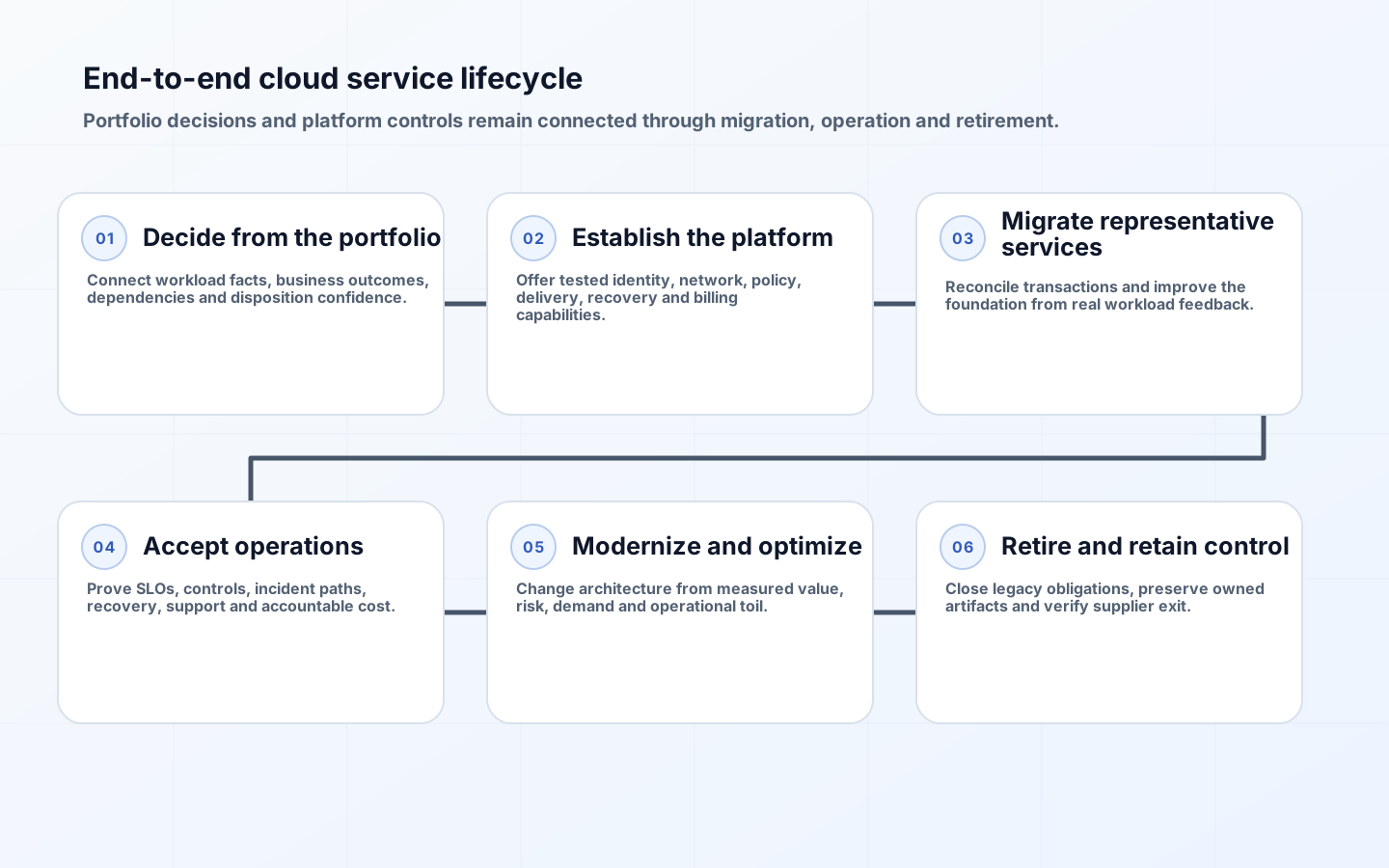
Define material change, release authority, incident command, service review and exception expiry. Keep documentation close to owned code and operational evidence. Test supplier exit and internal operation before dependency becomes critical. End-to-end does not mean a single permanent transformation program; it means lifecycle decisions remain connected while teams and contracts change.
Maintain a lifecycle evidence index rather than separate project archives. For each service, link disposition, architecture, deployed configuration, control tests, recovery result, cost owner, incidents, exceptions and retirement plan. Automate freshness where possible and assign review. This reduces audit reconstruction and lets a new owner understand which assumptions remain valid after a reorganization, supplier change or acquisition.
Use post-migration value reviews to challenge the original roadmap. Some workloads will deserve deeper modernization; others may be stable enough to leave alone or ready to retire. Reallocate capacity using observed user value, risk and toil. End-to-end management is adaptive precisely because it does not force every application through the same technical destination after evidence changes.
End-to-end cloud takeaways
- Define completeness by lifecycle evidence, not supplier breadth.
- Use a living portfolio to connect disposition, benefit and closure.
- Run the foundation as a tested internal product.
- Accept migration through transactions, recovery, support and legacy retirement.
- Join SLO, security, unit cost and roadmap decisions in one operating model.
Frequently asked questions
Must one provider deliver end to end? No. Multiple specialists can work if interfaces, ownership and acceptance are coherent. Is multicloud inherently safer? No. It may reduce selected concentration risks while increasing identity, data and operational complexity. Should everything migrate? No. Retain, replace and retire are valid dispositions. Can migration and modernization happen together? Yes, when benefit and testing capacity justify it.
What is the most common missing stage? Legacy retirement and capability transfer are frequently underfunded. How should success be reported? Show user outcomes, SLOs, risk, unit economics, delivery performance and closed obligations against a baseline. When does optimization begin? During architecture and workload design, then continuously from measured demand; it is not a cost-cutting phase after migration.
Conclusion
End-to-end cloud services are credible when every phase leaves evidence the next owner can use. Build from a living portfolio, a consumable foundation and representative migration. Operate with service objectives, control health and unit economics, then close obsolete obligations. That continuity turns cloud from a collection of projects into an adaptable, accountable business capability.