End-to-end managed cloud services should provide an accountable operating path from approved change through monitoring, incident response, recovery, cost review and continual improvement. The phrase does not mean the supplier owns every decision or that the customer can outsource accountability. A credible plan identifies the business services and cloud estates in scope, the exact provider and customer responsibilities, the service levels, the evidence exchanged and the capabilities the customer must retain.
This guide frames the commercial and operating decisions before transition. Teams can convert them into tasks with the managed cloud implementation checklist and resolve detailed operating questions in the managed cloud services FAQ. The plan should be anchored to customer outcomes such as reliable ordering, protected health records, faster product releases or tested disaster recovery, rather than to ticket volume or resource count.
Define the managed service outcome and estate
Create a service register containing business owner, technical owner, users, criticality, dependencies, data classes, regions, objectives, support hours, regulatory duties and continuity priority. Reconcile cloud accounts, subscriptions, projects, clusters, networks, identities, repositories, data stores, SaaS integrations, contracts and current providers. Include shadow and inherited estates. A management contract cannot control assets neither party knows exist.
Clarify which cloud models are involved. The NIST cloud definition distinguishes SaaS, PaaS and IaaS as well as deployment models. Customer work changes across these boundaries: managing an operating system differs from governing a SaaS tenant, but identity, data, configuration, legal obligations and business continuity remain customer concerns. Record the management objective for each workload and exclusions with an owner.
Design an unambiguous responsibility model
Build a responsibility matrix for identity, network, operating systems, containers, databases, backup, encryption, keys, vulnerability management, security monitoring, application release, data integrity, incident decisions, communications, capacity, cost, compliance evidence and provider escalation. Distinguish performs, approves, supplies evidence, consults and receives notification. For every handoff, identify system of record, channel, response target and fallback contact. Generic RACI labels without operational detail often conceal gaps.
Cloud provider, managed service provider, software vendors and customer teams form a chain. Google Cloud's shared responsibility and shared fate guidance explains that duties vary by service and configuration. Validate responsibility against each provider's current documentation and contract. The managed provider may monitor a control that the hyperscaler operates and the customer configures; all three roles must be visible.
| Operating domain | Provider commitment to specify | Customer capability to retain |
|---|---|---|
| Identity | Administration, review, monitoring and emergency actions | Authority over joiners, leavers and risk acceptance |
| Change | Standard, normal and emergency execution process | Product approval and business validation |
| Security | Control operation, triage and escalation | Legal decisions, containment authority and oversight |
| Reliability | Monitoring, response, backup and recovery tasks | Service objectives and continuity priorities |
| Cost | Allocation data, anomaly response and optimization | Budget ownership and value decisions |
| Suppliers | Cloud and subcontractor escalation | Contract governance and exit authority |
Set security, governance and architecture baselines
Define approved account hierarchy, regions, network patterns, identity controls, encryption choices, logging, backups, labels, deployment routes and exception handling. Express enforceable rules as policy and infrastructure code where practical, with review and rollback. The CISA Cloud Security Technical Reference Architecture page provides considerations for shared services, secure migration and cloud security posture management. Adapt such guidance to the organization's risk and platforms.
Use the NIST Cybersecurity Framework to connect governance, identification, protection, detection, response and recovery outcomes. Map provider controls and customer evidence to a target profile. Require least privilege, strong administrator authentication, controlled machine identities, protected logs, vulnerability response and tested restoration. Compliance reports can support assurance but do not prove customer configuration or application security.
Write service levels around business impact
Separate cloud resource availability, managed service responsiveness and end-to-end business reliability. A provider can meet a fifteen-minute ticket acknowledgement while the customer transaction remains unavailable for hours. Define service-level indicators, objectives, measurement source, exclusions, maintenance, severity, response, restoration, data recovery, support hours and reporting. Include repeated low-severity events and degraded performance that can harm customers without meeting an outage threshold.
Service credits rarely compensate for operational loss. Treat them as a contract mechanism, not the resilience strategy. Establish error-budget or equivalent review rules, escalation contacts, major-incident authority and communication expectations. Verify whether the supplier can take containment actions, scale capacity, fail over, restore data or only advise. Test these distinctions before transition acceptance.
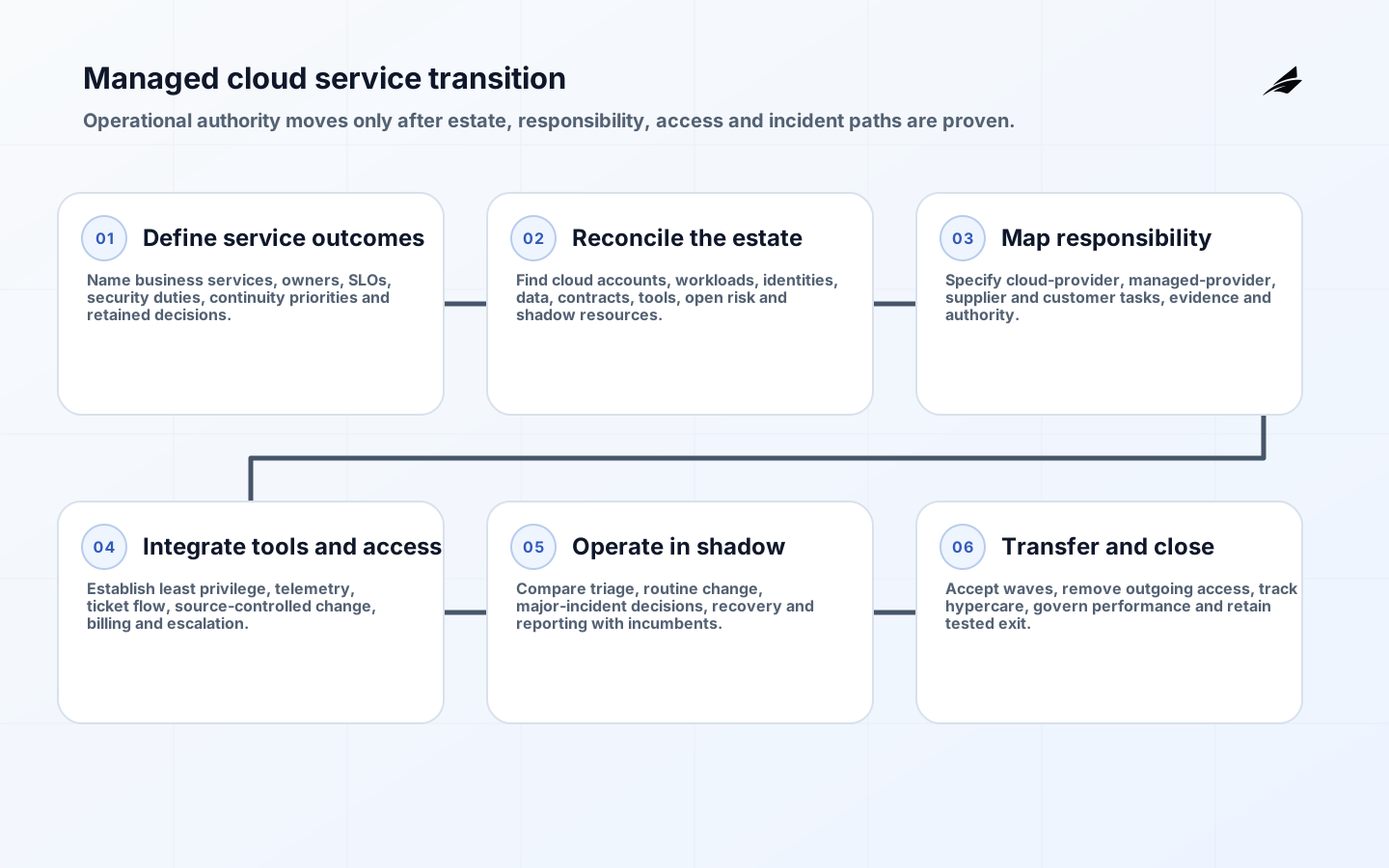
Use a six-stage managed cloud transition roadmap
Move through outcome framing, estate discovery, responsibility design, tool and access integration, shadow operation, and controlled transfer. Select a representative service that exercises identity, monitoring, change, incident and recovery paths with bounded business risk. During shadow operation, supplier and incumbent teams compare triage and decisions. Transfer authority only after evidence shows the new operating model can handle routine work and realistic disruption.

Each transition wave needs entry criteria, configuration baseline, open-risk register, knowledge plan, support rehearsal, rollback and exit from hypercare. Do not accept an asset because its monitoring agent is installed. Acceptance requires accurate ownership, actionable telemetry, approved access, current runbooks, successful restore or continuity evidence, cost allocation and demonstrated escalation. Remove outgoing provider access promptly after reconciled handover.
Integrate change, incidents and recovery
Define standard, normal and emergency change paths with authorization, testing, deployment evidence and rollback. The managed provider should work through the same source-controlled infrastructure and release mechanisms as internal teams where possible. Establish maintenance and freeze rules around critical periods. Measure failed-change recovery, change failure and unplanned work, but avoid incentives that suppress necessary change or misclassify incidents.
Major-incident plans should cover cloud control-plane impairment, privileged identity compromise, destructive change, data corruption, regional outage, supplier failure and ransomware. Assign authority for containment, failover, restoration and customer communication. Test backups by restoring infrastructure, identity, data and application dependencies into an isolated environment, then reconcile business records. Provider recovery of a managed database is only one step in recovering the service.
Model fees and cloud consumption together
Managed service cost may combine onboarding, recurring base fees, asset or account tiers, monitoring volume, service desk, engineering hours, project work, security operations, backup, premium support, after-hours response and exit. Add underlying cloud consumption, licenses, data transfer, observability and customer governance effort. Model growth, incident surges, temporary overlap and contract minimums. A low base fee can become expensive when routine changes are out of scope.
Apply the FinOps Framework as collaboration among business, finance and engineering. Require timely allocation, budgets, anomaly routing, forecasting and optimization decisions. The provider can identify waste and execute approved changes; business owners decide value and risk tradeoffs. Measure unit cost by business service and outcome. Make savings definitions explicit so avoided future spend is not reported as cash returned.
| Cost category | Contract question | Control metric |
|---|---|---|
| Onboarding | Which discovery, remediation and integrations are included? | Accepted assets per wave and unresolved risk |
| Recurring service | What drives tier, volume and annual increase? | Fee by owned business service |
| Cloud consumption | Who forecasts, approves and optimizes usage? | Unit cost, variance and anomaly time |
| Change | Which tasks are standard versus chargeable projects? | Demand, lead time and out-of-scope spend |
| Incidents | Are surge, forensics and after-hours actions included? | Event cost and restored-service time |
| Exit | What export, transition and access removal are priced? | Tested exit duration and residual fees |
Govern performance without outsourcing judgment
Run operational, service and executive reviews at appropriate cadences. Operational reviews address incidents, changes, vulnerabilities, capacity, backup and open actions. Service reviews assess SLOs, business impact, problem trends, cost and roadmap. Executive reviews resolve material risk, investment and contract decisions. Use one action register with owners and dates. Reports should show trends and exceptions rather than burying decisions in hundreds of activity metrics.
Retain enough internal architecture, security, finance and service knowledge to challenge recommendations and direct priorities. Maintain customer-controlled administrative recovery, source and configuration access, billing visibility, records and supplier contacts. Test data and configuration export. Concentrating operational access in a provider without customer oversight creates dependency precisely when leverage and speed are most needed.
Plan provider transition and service exit
Exit planning starts during procurement. Define ownership and format for documentation, tickets, telemetry, source, infrastructure state, inventories, reports, evidence and credentials. Specify transition assistance, knowledge transfer, data export, subcontractor closure, deletion confirmation and access revocation. Address licenses and tooling that may not transfer. Keep runbooks in a customer-accessible repository rather than only the provider's platform.
Exercise a limited exit before renewal: export an inventory and history, transfer one operational procedure, revoke and recreate access, and confirm another team can interpret evidence. Trigger exit planning for persistent service failure, strategic platform change, acquisition, financial distress, unacceptable security posture or inability to meet new obligations. A tested exit does not signal distrust; it is a continuity control.
Managed cloud services takeaways
- Scope business services, cloud estates and outcomes before tools.
- Map cloud, managed provider, supplier and customer duties at task level.
- Write SLOs around end-to-end service impact and tested authority.
- Transfer in waves after shadow operation and recovery evidence.
- Combine management fees, consumption and retained customer effort.
- Preserve customer decision capability and test provider exit early.
Frequently asked questions
Does end-to-end mean one supplier owns everything? No. It means the operating chain and accountability are integrated across explicit boundaries. Can managed services replace an internal cloud team? They can perform much work, but the customer needs service ownership, risk authority, architecture and commercial capability. Are hyperscaler SLAs enough? No. They cover defined provider resources, not the complete application and business process. Should the provider have permanent administrator access? Prefer narrowly scoped, monitored and time-bounded privilege where feasible.
How long does transition take? Estimate from estate discovery, remediation, integrations, access, knowledge and wave acceptance, not asset count alone. Who owns cloud cost? Business, finance and engineering share decisions; the provider supplies and acts on evidence within authority. What is the strongest acceptance test? A representative service change, incident, restore and billing explanation performed through the new model. When should a contract be renewed? After outcome, risk, cost, dependency and market options are reviewed, not automatically.
Conclusion
End-to-end managed cloud services work when service outcomes, responsibility, evidence and authority are designed together. Discover the real estate, establish baselines, integrate provider operations and transfer in tested waves. Govern end-to-end reliability and cost rather than ticket activity, and retain enough customer capability to make informed decisions. A clear, rehearsed exit completes the operating model and prevents convenience from becoming uncontrolled dependence.