A Google Cloud services plan is useful only when it turns a catalog of products into an owned business service. The plan should identify the user outcome, workloads and data in scope, the controls the customer must operate, the migration sequence, the expected cost range and the evidence required before production acceptance. Starting with products such as Compute Engine, Cloud Run, Google Kubernetes Engine or BigQuery reverses that logic. Service selection should follow workload evidence rather than become the purpose of the program.
This guide addresses the decisions that belong before and during delivery. Teams ready to turn those decisions into tasks can continue with the Google Cloud implementation checklist; architecture and operations questions are covered in the Google Cloud services FAQ. The central idea is traceability: every design choice should connect to an outcome, risk, owner, test and recurring operating cost.
Define outcomes and workload scope before choosing services
Create a workload register that names the product owner, users, business criticality, data classes, upstream and downstream dependencies, current service levels, release process, licensing constraints and retirement obligation. Measure a baseline such as transaction latency, release lead time, incident minutes, infrastructure cost per transaction or environment provisioning time. A target such as “migrate 80 servers” describes activity; “restore customer ordering within two hours and release weekly” describes a service result that architecture can support.
Separate confirmed facts from assumptions. Discovery tools can expose runtime and network evidence, but they do not reveal whether a nightly interface is financially critical, whether a dataset is the authoritative record or whether a manual reconciliation is a control. Interview service owners and operators, inspect incident and billing history, and trace representative transactions. Classify each workload for retain, retire, replace, rehost, replatform or refactor, recording confidence and the event that would change the decision.
| Scope area | Decision evidence | Acceptance measure |
|---|---|---|
| Business service | Owner, users, critical periods and baseline outcome | Named result improves without loss of control |
| Application | Runtime, release pattern, state and dependencies | Representative transaction passes in the target |
| Data | Authority, sensitivity, residency, retention and recovery | Records reconcile and restore within approved objectives |
| Operations | Support path, SLO, alert ownership and skills | Internal team diagnoses and changes the service |
| Legacy | Contracts, hardware, licenses, archives and interfaces | Obligations close after a verified cutover |
Build a governed Google Cloud foundation
Design organization, folder, project and billing-account boundaries around ownership and policy inheritance. Establish workforce and workload identities, group-based access, break-glass procedures, service-account lifecycle, network connectivity, DNS, logging, key management, secrets, approved regions, labels and budget attribution. The Google Cloud Well-Architected Framework organizes review around operational excellence, security, reliability, cost, performance and sustainability; use those perspectives as questions, then convert applicable decisions into version-controlled policy and infrastructure code.
A landing zone is not accepted because resources exist. Test whether a product team can create a compliant project, deploy through the standard pipeline, obtain a narrowly scoped identity, emit usable telemetry, recover a protected dataset and attribute spend. Keep exceptions explicit with an owner, rationale and expiry. A central platform team should provide a paved path and evidence, while service teams remain accountable for their application behavior and data.
Resolve security and shared responsibility
Managed services change the boundary of work; they do not transfer accountability for the business service. Google’s shared responsibility and shared fate guidance explains that customer duties vary by service model and configuration. Record who controls identity, data classification, application logic, network exposure, encryption choices, vulnerability response, audit review and incident decisions for every selected service. Contract terms and provider attestations supplement this map but cannot replace customer configuration evidence.
Prioritize attack paths rather than accumulating security products. Protect administrative identities with phishing-resistant multifactor authentication where feasible, avoid long-lived service-account keys, separate production duties, restrict egress and public exposure, centralize immutable-enough logs, and test alert routing. Threat-model internet entry points, CI/CD, software supply chain, privileged automation and data export. For each material scenario, identify prevention, detection, containment, recovery and an accountable decision maker.
Sequence a six-stage Google Cloud delivery roadmap
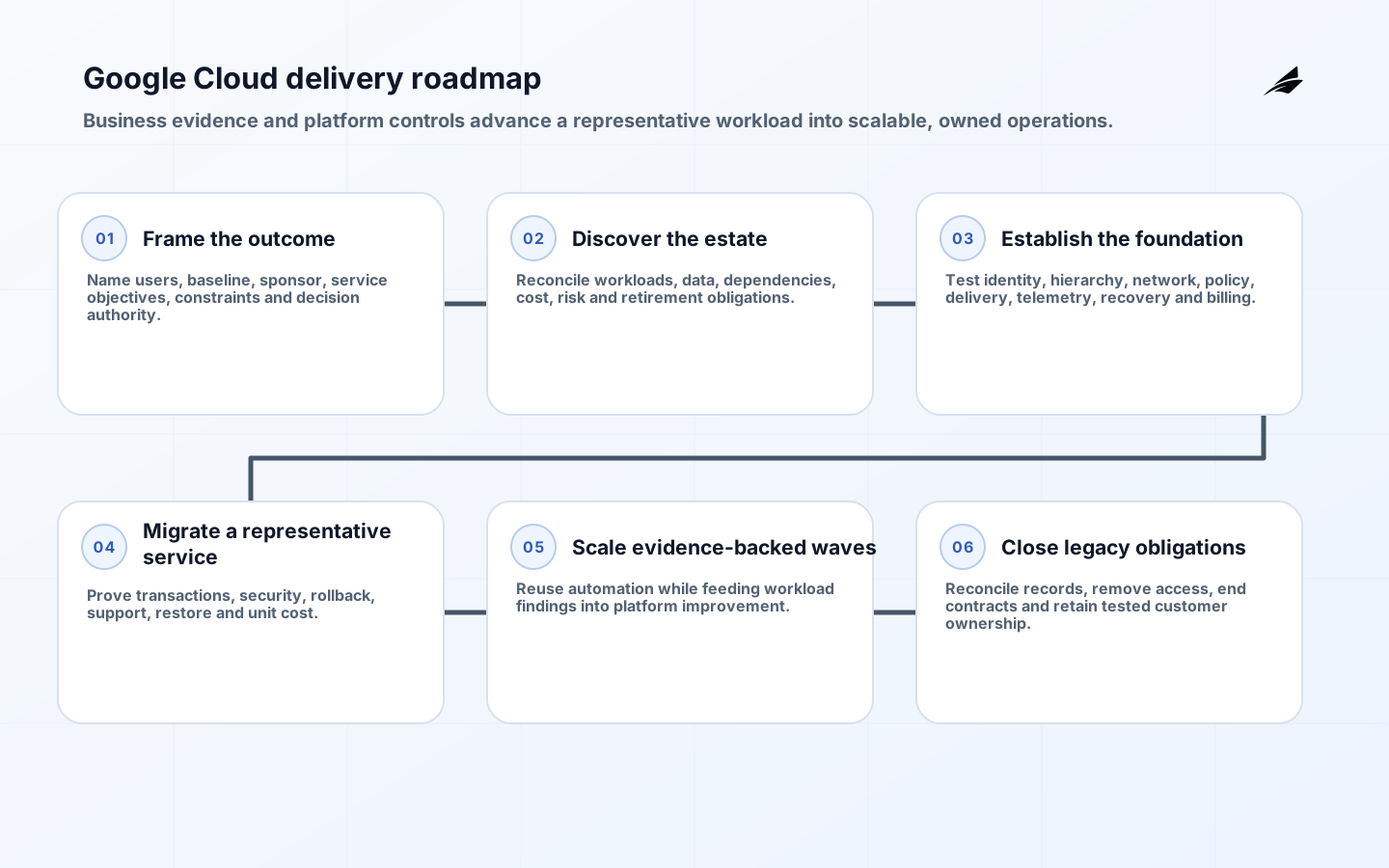
Use six evidence gates: frame the outcome, discover the estate, establish the foundation, migrate a representative workload, scale in waves and close legacy obligations. Google’s migration starting guidance similarly begins with assessment rather than an immediate cutover. Select the first workload because it exercises meaningful identity, network, data and support paths without concentrating intolerable risk. Feed its findings back into the platform before multiplying the pattern.
Each wave needs entry criteria, a dependency freeze, rehearsal, data reconciliation, a business validation script, rollback conditions and a hypercare exit. Avoid counting a workload as migrated while its old environment remains authoritative or required for recovery. The migration factory should accelerate repeated work through automation, but service owners must approve transaction correctness and operational readiness. Wave speed is secondary to reducing unresolved risk and retiring duplicate cost.
Model cost as demand, architecture and operations
Estimate cost from measurable demand: compute shape and duty cycle, storage volume and class, operations, backup generations, inter-region and internet transfer, observability ingestion, managed-service requests, support, licenses and migration overlap. Include growth and failure scenarios instead of presenting one precise monthly number. Commitments or reservations can reduce rates but create utilization risk; purchase them only after stable demand is visible. Serverless removes idle server management, not necessarily idle architectural cost.
The FinOps Framework emphasizes collaboration, accessible cost data and ownership of usage. Implement billing export, labels or other allocation rules, budgets and anomaly routing before broad migration. Report unit economics such as cost per order, learner, environment or pipeline run alongside reliability. Cost optimization is then a product decision: eliminate abandoned resources, tune retention, right-size sustained workloads, and change architecture when the measured business value supports the effort.
| Cost driver | Planning question | Control and metric |
|---|---|---|
| Compute | What demand shape, availability and scaling behavior are required? | Utilization, request cost and right-sizing owner |
| Storage | Which copies, classes, retention periods and restore speeds are necessary? | Growth, lifecycle transitions and restore tests |
| Network | Where do users, APIs and replicas move data? | Transfer by source, destination and product unit |
| Operations | What logging, support, security and engineering effort remains? | Telemetry value, support load and toil |
| Transition | How long will parallel estate, migration tools and licenses run? | Wave burn rate and dated retirement plan |
Engineer reliability and recovery around the service
Define service-level indicators from user-visible behavior, then set objectives and an error-budget policy. Availability of individual resources does not prove that authentication, DNS, queues, databases and third parties can complete a transaction. Choose zones and regions from impact analysis, latency, data obligations and recovery needs. Remove single points in customer-controlled design, and document what degrades when a dependency is unavailable. Continuous delivery should keep changes releasable through automation, testing and fast rollback, consistent with DORA guidance.
Backups are inputs to recovery, not evidence of it. Restore into an isolated environment, rebuild infrastructure and identities, recover data, reconnect dependencies and reconcile business transactions. Measure actual recovery time and recovery point from an exercise. Test accidental deletion, malicious encryption, regional impairment and lost administrative access separately because they need different controls. Assign authority for failover and customer communication before an incident, then improve runbooks after exercises and real events.
Accept operations and retain exit capability
Production acceptance should require deployed evidence: architecture and data-flow records, source-controlled infrastructure, access review, threat findings, monitoring and SLOs, restore results, capacity evidence, cost allocation, runbooks, support ownership and a rollback or exit path. Have the internal team release a change, investigate a symptom, restore data, rotate a secret and explain the bill. Training attendance alone does not demonstrate operating capability.
Preserve portability where it has business value, not as an absolute slogan. Own source, configuration, schemas, keys where appropriate, account administration and export procedures. Document service-specific dependencies and test a representative data export. Close temporary migration identities and supplier access. Decommission old resources only after reconciliation and retention checks, but do it promptly enough to realize cost and risk reduction.
Google Cloud services plan takeaways
- Define a service outcome and baseline before selecting Google Cloud products.
- Prove the landing zone through a real workload and operational tests.
- Map customer and provider responsibilities for each managed service.
- Estimate unit cost and migration overlap, not only steady-state list price.
- Accept migration only after transaction, recovery, support and retirement evidence passes.
Frequently asked questions
How long does a Google Cloud migration take? Duration depends on dependency discovery, data movement, controls, testing and retirement; estimate by evidence-backed waves rather than server count. Is Google Cloud automatically cheaper? No. Variable pricing creates options, while architecture, demand, transfer, commitments and operating discipline determine cost. Must every workload be modernized? No. Rehost or retain when refactoring lacks a defensible benefit.
Should a company use one region or several? Choose from business impact, data rules, latency and tested recovery objectives; multi-region design adds cost and failure modes. Who owns cloud security? Google and the customer own different layers, while the customer remains accountable for its service, identities, data and configuration. What is the best first workload? One that tests representative controls and dependencies with bounded business risk.
Conclusion
A credible Google Cloud services plan connects business value to foundation controls, migration evidence, recurring economics and internal ownership. Discover the real service, establish a consumable platform, migrate one representative workload and improve the pattern before scaling. Finish by proving recovery and operations and by closing the old obligations. That sequence produces a cloud service the organization can explain, fund, secure and change.