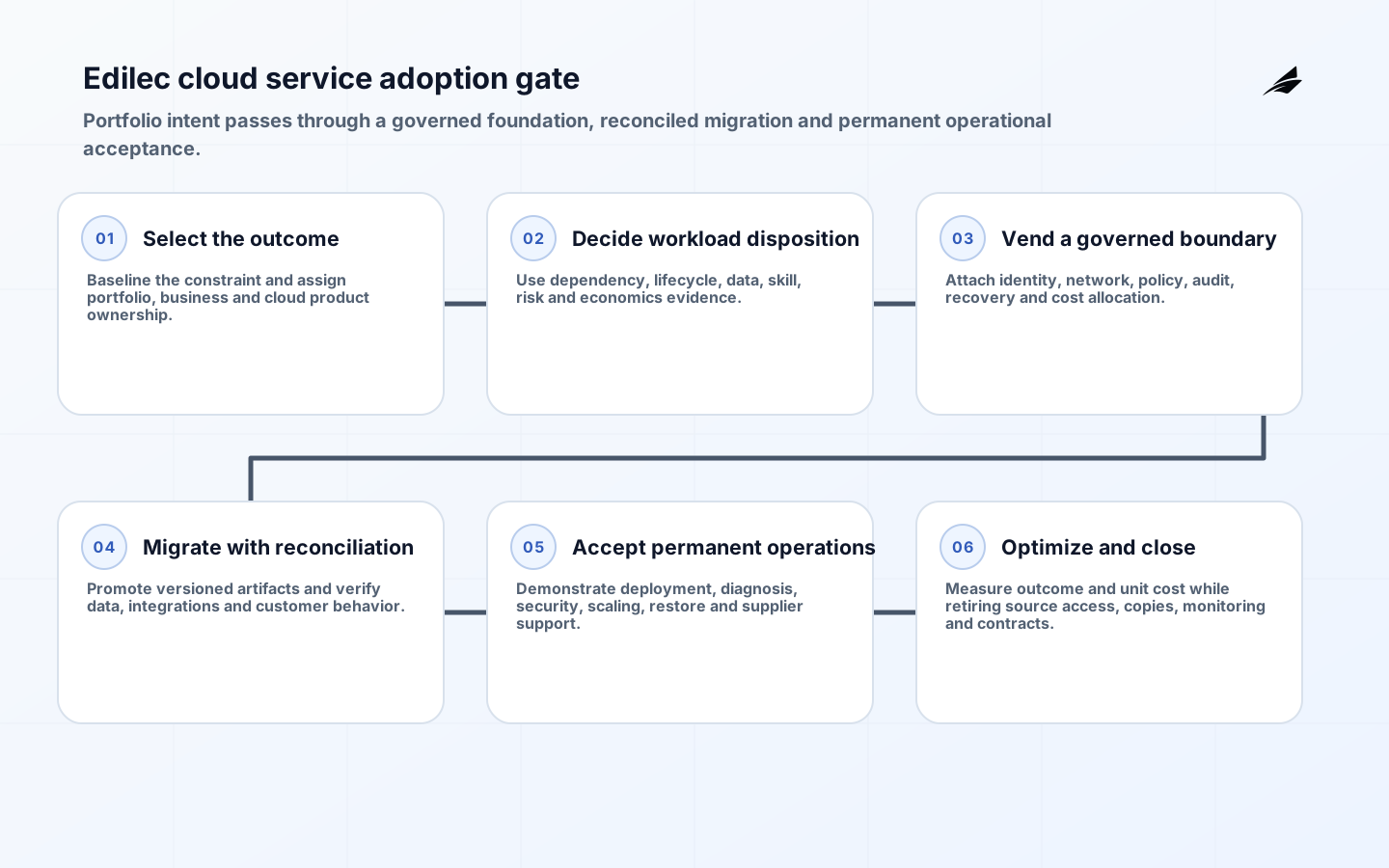
A cloud computing services implementation checklist should prove that a workload can use on-demand resources without losing ownership, security, reliability or cost control. NIST defines cloud computing through essential characteristics including on-demand self-service, resource pooling, rapid elasticity and measured service in SP 800-145. Those characteristics create value only when identity, network, policy, delivery, observability and recovery work as a coherent platform. The checklist therefore covers the operating system around cloud consumption, not just resource provisioning.
Use this guide for a first cloud foundation, a major expansion or a corrective program. Complete each item with an owner and objective evidence. Different workloads can choose IaaS, PaaS, SaaS or cloud-native services according to constraints; they should not inherit a migration pattern by default. The related cloud computing services scope and delivery plan helps define the business case, while the cloud computing services FAQ supports selection and governance discussions.
Confirm strategy, ownership and workload portfolio
State the constraint cloud services should change: environment lead time, resilience, global reach, data capability, product experimentation, cost transparency or legacy risk. Baseline the outcome and assign an executive sponsor plus cloud product owner. Define principles for service selection, data location, managed services, portability and supplier concentration. Build a portfolio inventory with business owner, architecture, dependencies, data class, criticality, lifecycle, cost, recovery objectives and technology support. Unknown ownership or dependency is a discovery risk, not a migration-ready status.
Choose a disposition for each workload based on evidence: retire, retain, replace, rehost, replatform or refactor. Compare business timing, application fitness, data movement, licensing, operational skills and source retirement. Treat shared databases, identity flows, batch schedules and file transfers as dependencies even when no API catalog records them. Define wave entry criteria and a business stop condition. Microsoft organizes adoption through strategy, plan, readiness, adoption, governance, security and management in its Cloud Adoption Framework, emphasizing that migration is one part of a longer lifecycle.
| Portfolio gate | Question | Required evidence |
|---|---|---|
| Outcome | Which measurable constraint should improve? | Baseline, target, owner and counter-metrics |
| Disposition | Why is this treatment better than alternatives? | Dependency, lifecycle, cost and risk assessment |
| Data | What moves, remains, replicates or retires? | Ownership, classification, volume and reconciliation plan |
| Operations | Who will deploy, support and recover the target? | Responsibility model and capability assessment |
| Exit | How will source obligations be closed? | Decommission, records, contract and access plan |
Build a governed cloud foundation before workload scale
Design organization, account or subscription hierarchy around lifecycle, ownership and policy boundaries. Automate account vending with required metadata, billing, identity, network, audit, security and backup services. Separate production from development and security administration from workload deployment. Define supported regions, service allowlists, naming, tagging and exception processes. Policies should prevent high-consequence conditions and detect the rest without producing unowned findings. Keep foundation code versioned and test changes in representative lower-risk boundaries before broad rollout.
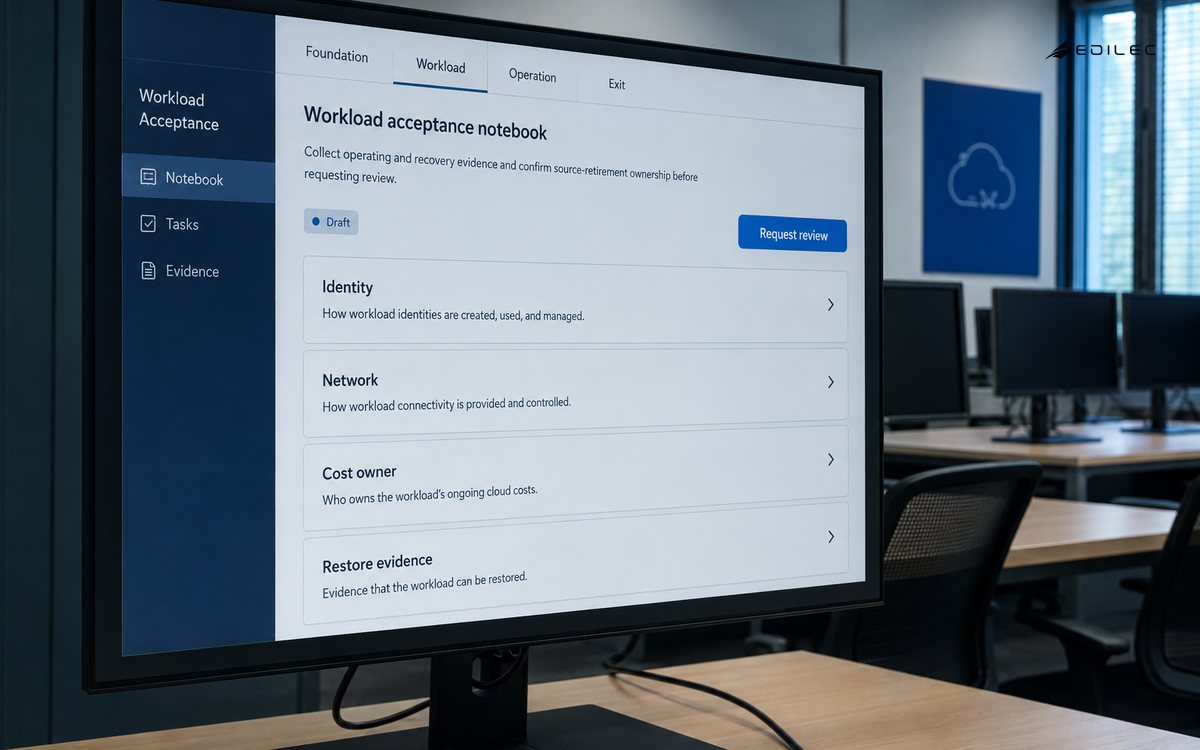
Provide platform products rather than a document of requirements: a connected account, approved ingress pattern, workload identity, deployment pipeline, logging route, secrets service, recovery pattern and cost allocation. Publish service levels and support ownership for the foundation itself. The Edilec six-stage cloud service adoption gate at this heading moves from portfolio intent through account boundary, controls, workload deployment, operational acceptance and continuous optimization. A landing zone is complete only when consumers can use and operators can recover it, not when a reference architecture has been deployed.
Implement identity, networking and data controls
Federate workforce identity, require strong authentication and assign roles through groups with reviewable ownership. Use separate workload identities with minimum permissions and short-lived credentials where possible. Restrict emergency access, monitor it and test recovery if the primary identity provider fails. Inventory keys, secrets and certificates with rotation owners. Cloud provider responsibility varies by service; AWS's shared-responsibility guidance makes clear that customer responsibilities change with the services selected. Build a task-level matrix for the actual architecture.
Map ingress, egress, east-west traffic, DNS, private connectivity and inspection. Prefer explicit service-to-service identity over trusting network location alone. Define data classification, approved regions, encryption, keys, replication, retention, deletion and backup. Record authoritative sources and reconciliation for migrated or synchronized data. Test quota and route failure. Central controls should not create a single fragile path without continuity. Log administrative and data-access events according to risk, protect the logs and ensure they reach responders who can act.
Migrate and modernize workloads with reconciliation
Select representative pilot workloads that exercise real identity, network, data, deployment and recovery paths without carrying the highest consequence. Create target architecture, nonfunctional requirements and rollback or forward-correction criteria. Rehearse migration using production-like volume. For data, reconcile record counts, financial or domain totals, relationships and application behavior. Control dual writes and change freeze. Measure cutover duration, error handling and support load. A technically successful copy is incomplete until users, integrations and downstream reports work against the expected state.
Use managed services where their operational benefit justifies service constraints and dependency. Assess support horizon, quotas, regional availability, backup behavior, observability, security responsibilities and exit. Refactoring should target a measured constraint rather than rewriting by fashion. Promote versioned artifacts through pipelines and manage infrastructure as code. Progressive release limits impact, while feature flags require ownership and retirement. After cutover, observe the workload through a defined period and close source compute, access, monitoring, data copies and contracts deliberately.
| Acceptance scenario | What to demonstrate | Failure evidence |
|---|---|---|
| Standard deployment | Reviewed artifact reaches production through the supported path | Rollback or correction preserves service and traceability |
| Identity failure | Emergency access and workload continuity follow policy | Alert, decision record and credential cleanup |
| Dependency outage | Application degrades or queues safely | No false success, uncontrolled retry or silent data loss |
| Restore | Infrastructure, configuration, keys and data meet objectives | Business reconciliation and elapsed-time record |
| Demand spike | Scaling and quotas support priority journeys | Graceful limits, cost signal and capacity action |
Verify security, observability and resilience
Threat-model workload and foundation trust boundaries. Scan code, dependencies, artifacts and infrastructure definitions, then verify effective runtime configuration. Centralize findings with asset, owner, exposure and due date. Exceptions require compensating controls and expiry. Instrument critical journeys with metrics, logs and traces, and test that alerts reach qualified responders. Separate control-plane availability from workload availability. Provider status is an input to diagnosis, not proof that the customer's service works. Preserve correlation across accounts and regions while respecting data boundaries.
Set recovery point and time objectives from business consequence. Design backup independence, retention, immutability where justified and key recovery. Restore applications with identity, configuration, data and dependencies, then reconcile business state. Multi-zone and multi-region choices should follow failure analysis and consistency needs. Exercise runbooks with the receiving operations team and capture manual steps, decision authority and communication. Google Cloud's operational excellence pillar links incident, problem, change and capacity management to continuous improvement; recovery evidence should feed the same backlog.
Establish FinOps and operational acceptance
Allocate cloud cost to accountable services using enforced metadata and billing hierarchy. Build budgets and anomaly routes that reach people able to investigate. Forecast commitments with demand and architecture plans. Track unit economics rather than celebrating lower spend without context. The FinOps Framework provides a cross-functional model for understanding and optimizing cloud value. Evaluate rightsizing, schedules, storage lifecycle, data transfer and commercial discounts together with reliability and roadmap constraints. Record accepted optimization decisions, including rational reasons to retain headroom.
Operational acceptance requires the permanent team to deploy, diagnose, patch, scale, respond, restore, report cost and engage suppliers. Verify inventories, dashboards, on-call routes, runbooks, access and open risks. Define service objectives and review cadence. Monitor foundation products as services with consumer feedback and version policy. Retire temporary migration privileges and tools. Measure whether original outcomes improve over 30, 60 and 90 days. Cloud implementation is complete when workloads operate through a maintainable model and obsolete source obligations are closed, not when the last cutover call ends.
Cloud computing implementation takeaways
- Tie cloud adoption to a measured business or delivery constraint and an owned workload portfolio.
- Offer a governed foundation as tested platform products with clear support responsibilities.
- Implement workforce and workload identity, explicit networking and lifecycle data controls.
- Migrate through representative pilots with data and application reconciliation, not copy completion.
- Exercise security response, dependency failure, scaling and complete application restoration.
- Accept workloads into operations with unit cost visibility and deliberate source retirement.
Frequently asked questions
Must a landing zone be finished before any workload starts? Establish the minimum identity, network, policy, logging, recovery and billing controls needed by the pilot, then evolve them from evidence. Avoid both uncontrolled workload deployment and an endless foundation program without consumers.
Is multicloud required to avoid lock-in? No. Multicloud can meet regulatory, acquisition or capability needs, but adds identity, network, skill and operating complexity. Manage dependency through informed service selection, data portability, contracts and tested recovery rather than provider count alone.
What is the most important cloud migration metric? No single metric is sufficient. Track the intended outcome plus reliability, security, delivery, cost and source-retirement measures. Workload count can show activity while concealing low value or unfinished obligations.
Conclusion
Cloud computing services become an enterprise capability when foundation, workloads and operations share one evidence path. Strategy selects the right constraints, landing-zone products make safe consumption repeatable, migration reconciles business state and permanent teams prove they can run and recover the service. Completing this checklist produces more than a cloud footprint: it creates an accountable operating model that can scale, adapt and explain its value.