An AWS platform service should make the secure, supported path the easiest way for product teams to obtain cloud environments. It is not a single portal or a one-time landing-zone installation. AWS platform service cloud work joins organization structure, federated identity, account vending, network and deployment products, observability, cost allocation and support. This guide scopes an initial platform around governed account creation and a paved deployment path, then explains how to price foundations separately from workload migration and ongoing platform operation.
Define the service boundary before selecting technology
Start with a small productized platform capability such as governed account creation and deployment. Observe real cases, including exceptions, reversals and incomplete inputs. Record who initiates the work, which system owns each fact, who may approve an outcome, what makes an action irreversible and how staff recover when an integration fails. This boundary prevents AWS platform engineering services from becoming a vague transformation program. It also exposes policy disagreements before software silently turns them into inconsistent behavior.
Acceptance criteria for account vending should specify organizational unit placement, owner, environment class, identity groups, permission sets, logging, budgets, tags, network connectivity and guardrails. The account must appear in inventory and security monitoring before a workload is deployed. For the deployment product, define supported runtime, artifact provenance, secrets interface, rollout and rollback, service telemetry and escalation. Exceptions need an approver and expiry. Existing accounts require an adoption path rather than an assumption that every control can be imposed immediately.
Architecture and ownership
The architecture must preserve authority across AWS Organizations, organizational units and account vending, identity federation, permission sets and guardrails, network, secrets, CI/CD and artifact services, observability, backup, cost allocation and support. Each component needs an owner, a versioned contract and observable failure behavior. Avoid direct point-to-point writes from an interface or model into a critical record. A narrow orchestration layer can validate identity, current state, policy and idempotency before an action proceeds, while an audit event records the evidence and rule version used.
| Architecture area | Required design decision | Evidence before release |
|---|---|---|
| AWS Organizations, organizational units and account vending | For this design choice, name the accountable owner, supporting evidence, exception route, and next measurable check. | Approved data-flow and owner |
| identity federation, permission sets and guardrails | Within this design choice, name the accountable owner, supporting evidence, exception route, and next measurable check. | Authorization and negative tests |
| network, secrets, CI/CD and artifact services | When implementing this design choice, name the accountable owner, supporting evidence, exception route, and next measurable check. | Versioned interface plus retry behavior |
| observability, backup, cost allocation and support | Before releasing this design choice, name the accountable owner, supporting evidence, exception route, and next measurable check. | Dashboard, alert and recovery runbook |
A six-stage delivery path
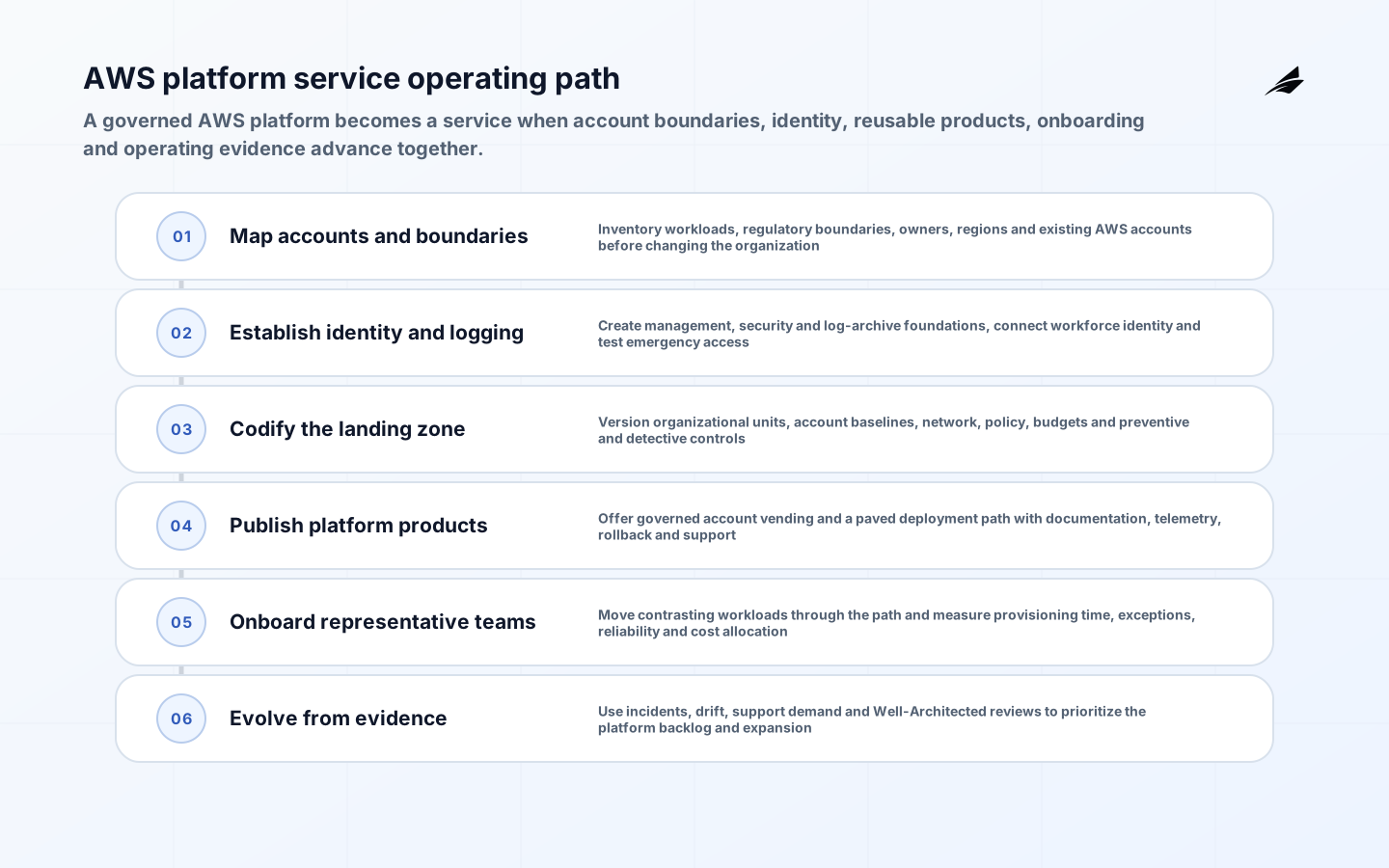
Establish the management, log-archive and security accounts first, then connect workforce identity and test emergency access. Codify the landing-zone baseline and validate controls against a disposable account. Publish one versioned account product through Account Factory or an equivalent pipeline. Pair it with a deployment reference that emits logs, metrics and ownership metadata by default. Onboard two product teams with different needs, capture where they leave the paved path and convert repeated exceptions into platform backlog decisions rather than private scripts.
- Map workloads, regulatory boundaries, ownership and existing AWS accounts.
- Establish the organization structure, identity model and logging accounts.
- Codify a landing-zone baseline with preventive and detective controls.
- Publish a versioned account and deployment product with documentation.
- Onboard representative teams and measure friction, exceptions and reliability.
- Expand capabilities through a platform backlog and regular Well-Architected review.
Controls and failure modes
Use organizational controls for broad boundaries and workload roles for least privilege. Central logs should be protected from workload administrators and carry enough context to identify account and owner. Shared network, DNS, CI/CD and observability services need explicit availability objectives because they can create a wider blast radius than one application. Baselines must be versioned and drift monitored. Platform administrators should use separate privileged identities, and break-glass access should be tested, alerted and reviewed rather than assumed available.
| Failure mode | Design response | Operating signal |
|---|---|---|
| Over-centralized bottleneck | Offer self-service products with policy guardrails and transparent exceptions. | Provisioning lead time |
| Control drift | Manage baselines as code and detect changes across accounts. | Noncompliant resources and time to remediate |
| Shared-service blast radius | Separate critical dependencies and design quotas, failover and ownership. | Platform-caused workload incidents |
| Unallocated spend | Require tags, account ownership and budget signals at provisioning. | Unowned or unclassified cost |
Measure outcomes, not activity
A dashboard should connect technical behavior to the intended operating result. Track lead time from approved request to usable account; deployment success and rollback rate on the paved path; control compliance and exception age; platform availability and product-team satisfaction. Segment results by workflow type and material risk instead of hiding poor tails inside a global average. Review a sample of accepted, corrected, escalated and failed cases. When a metric moves, retain enough trace evidence to identify whether the cause was source data, policy, interface behavior, model output, reviewer workload or downstream execution.
Measure how long an approved team waits for a usable account and first compliant deployment. Track deployment success, rollback, platform-caused incidents, control drift, exception age and unallocated spend. Adoption percentage matters only if the paved path meets team needs; forced usage can hide shadow infrastructure and manual work. Review support tickets by platform product to find unclear contracts. Cost measures should separate shared foundations, workload consumption and platform-team effort so product owners understand both their bill and the value of common controls.
Cost, timeline and commercial model
Separate foundational landing-zone work from reusable platform products and per-workload migration. Recurring costs include shared services, logs, security tooling, support, data transfer and the platform team. Model them by account and workload class. Timeline should be expressed as evidence-bearing stages: discovery, thin-slice build, controlled pilot and measured expansion. Procurement should require source access, documentation, data export, incident support and transition assistance. A lower quote is not cheaper if it omits evaluation, operating ownership or the path away from the chosen provider.
Rehearse the operating model before expansion
A useful rehearsal for AWS platform service cloud follows one representative case from intake through final evidence. The team should interrupt the exercise after each transition and ask which record is authoritative, whether the acting identity has permission, whether the rule is current, and whether retrying would create a duplicate outcome. Run the same case with a missing field, delayed dependency and unavailable reviewer. This reveals assumptions that unit tests and polished demonstrations often miss, especially where AWS Organizations, organizational units and account vending meets identity federation, permission sets and guardrails.
Next, simulate the two most consequential failure modes: over-centralized bottleneck and control drift. Operators should identify the alert, inspect the trace without broad production access, contain further actions, communicate with affected users and restore a known state. Record elapsed time and every manual workaround. If the team cannot determine what happened from the retained evidence, the workflow is not ready for a wider cohort, even if its normal path appears efficient.
An AWS platform release should include organization and account diagrams, identity and emergency-access procedures, control catalogue, baseline code, service quotas, dependency ownership, cost-allocation rules and recovery runbooks. Each platform product needs a version, support level and deprecation policy. Document existing-account differences and approved exceptions rather than presenting the estate as uniform. Well-Architected reviews should feed a prioritized backlog, with named owners for systemic risks that individual workload teams cannot solve alone.
Provision a disposable account, deploy the reference workload and then simulate a failed control, exhausted quota and unavailable shared pipeline. Verify that the team receives an actionable error, platform operators can trace the request and rollback does not leave privileged resources behind. Rotate an identity permission set and test break-glass access. Finally, calculate all generated shared and workload costs. This rehearsal exposes hidden manual steps and broad dependencies before the service becomes a prerequisite for many teams.
Practical takeaways
- Anchor AWS platform service cloud to one named outcome and accountable owner.
- Treat a small productized platform capability such as governed account creation and deployment as the first deliverable, not an assumption.
- Keep permissions, policy and irreversible actions in deterministic services with review evidence.
- Pilot with representative exceptions and retain a tested manual route.
- Measure lead time from approved request to usable account alongside quality, risk and human workload.
- Expand only when the current release is supportable, observable and recoverable.
Frequently asked questions
- What should the first engagement deliver? It should deliver a process map, data and authority model, risk register, thin-slice backlog, evaluation plan, cost range and explicit decision on what will remain manual.
- How long should a pilot run? Long enough to include ordinary cases, realistic exceptions and at least one controlled recovery exercise. Calendar duration matters less than representative evidence and a pre-agreed exit decision.
- Can a team buy a platform before discovery? A short technical trial can inform discovery, but procurement should follow the service boundary and control requirements. Otherwise the available product features begin defining the business process.
- Who owns the released service? A business owner is accountable for policy and outcomes; a technical owner is accountable for reliability and change; security, privacy and domain specialists approve relevant controls. A vendor can support these roles but should not replace them.
- How is success demonstrated? Compare the agreed baseline with completed outcomes, corrections, exceptions, failures, cost and user impact. Pair aggregate metrics with case review so a favorable average cannot conceal harmful edge cases.
Conclusion
AWS platform engineering creates leverage when reusable products carry governance, delivery and operational evidence together. Start with a well-defined account and deployment path, codify the baseline, expose exceptions and measure team friction as well as compliance. Price shared services and platform ownership transparently, and review architecture as usage grows. A platform that is observable, recoverable and responsive to product-team evidence can increase delivery speed without trading away security or cost accountability.