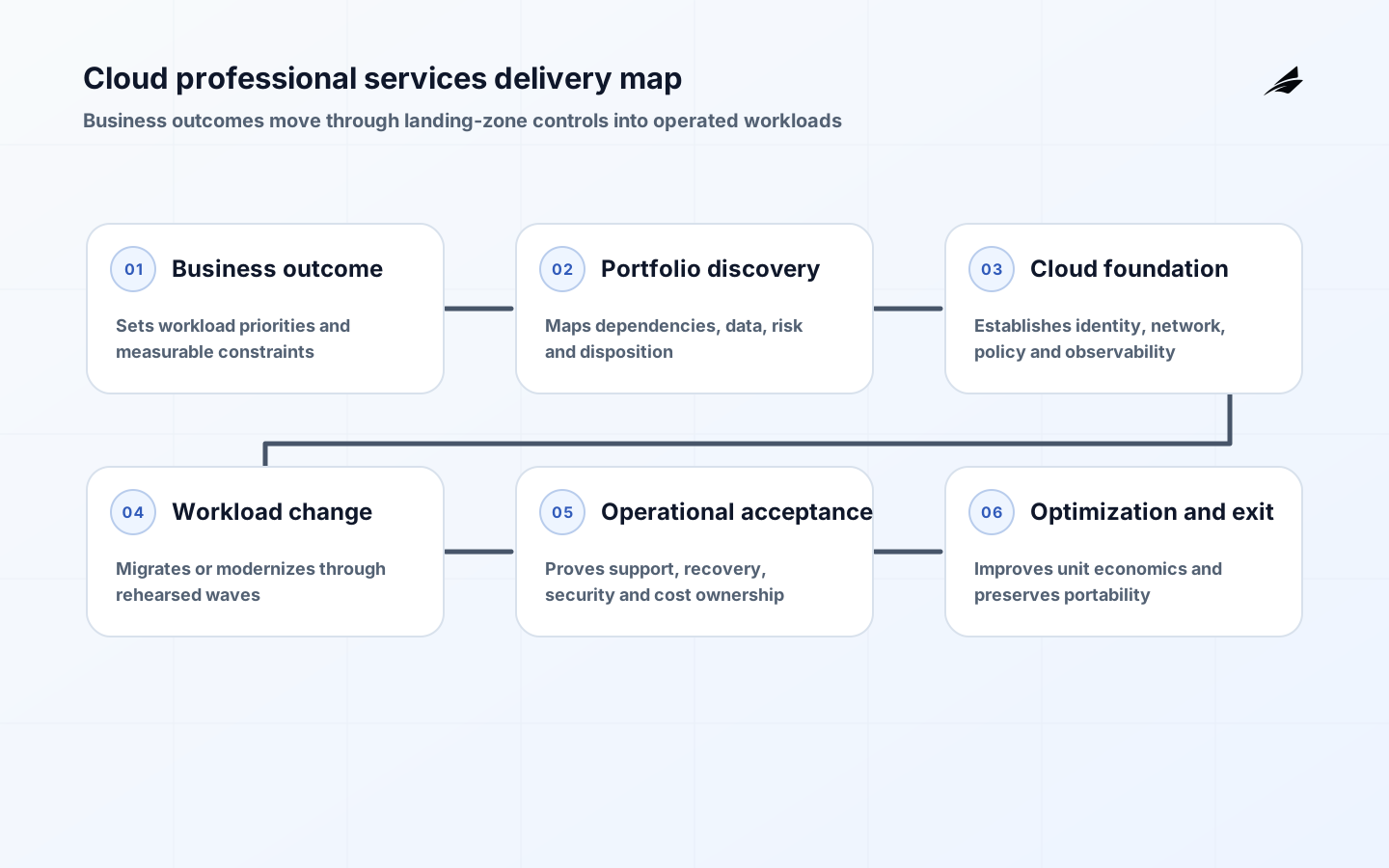
Cloud professional services create value when they improve a named workload outcome and leave behind a platform the client can operate with confidence. That sounds obvious, but many engagements still begin with a generic move to cloud mandate and a list of target services. The result is predictable: workloads are relocated before identity, networking, support, recovery and cost ownership are ready. A useful cloud services program starts from the workload, its users, its obligations and the consequences of failure. Only then can the team decide which foundations belong in the first wave and which migration choices are justified.
This framing matters because cloud work changes authority as much as infrastructure. Decisions about who owns identities, guardrails, service-level objectives, spend accountability and incident response are part of the delivery scope, not cleanup tasks for later. The major adoption frameworks from AWS, Microsoft and Google all reflect this point in different language: cloud transformation is an organizational operating model, not only a hosting change. This guide translates that principle into practical scope, architecture, cost and partner-evaluation questions for cloud professional services.
Scope the service from workloads and operating constraints
Start by identifying the workload or workload family being changed, the business outcome it supports, the users affected, the recovery objective, the data sensitivity and the cadence of change. A payroll batch system, an e-commerce API and an internal analytics platform each deserve different migration and operations choices because their latency, resilience, access and compliance needs differ. Use the workload as the unit of planning, not the technology tower. That approach exposes whether the service is primarily about migration, platform foundation, modernization, cost reduction, resilience improvement or a combination of those goals.
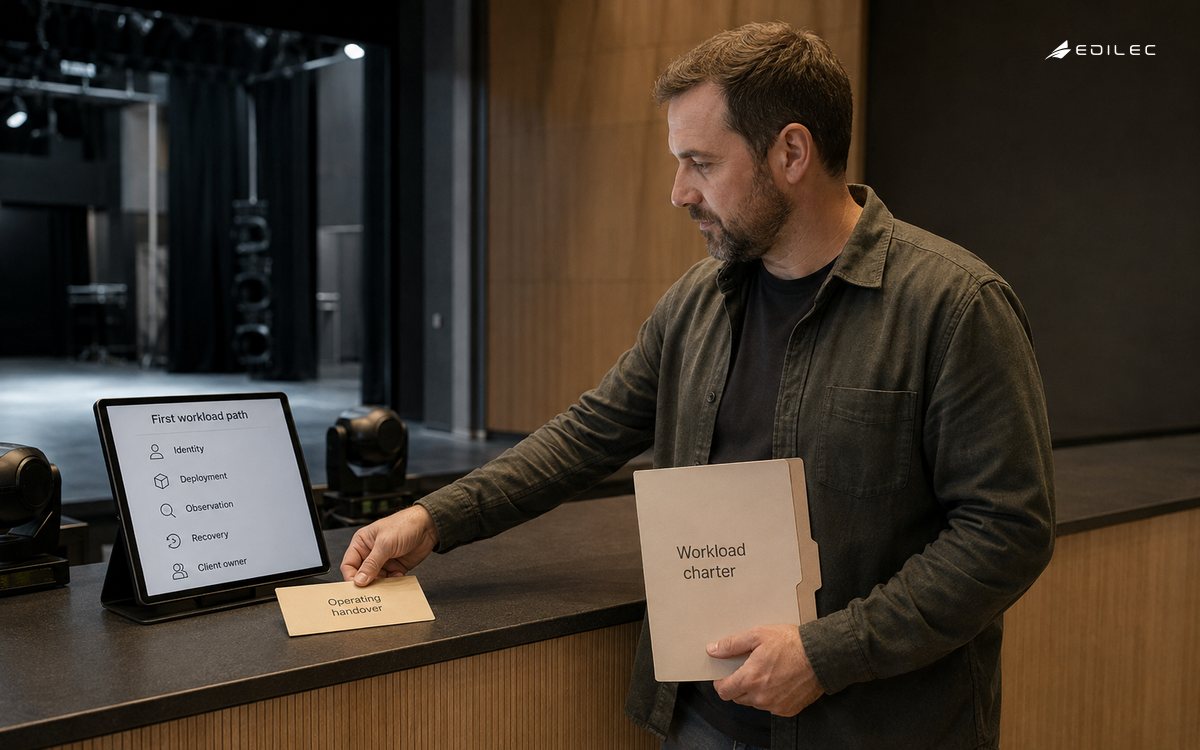
Bound the first release around a complete operational path. That path should include provisioning, identity onboarding, networking, deployment, observability, incident handling and rollback or fallback. It should also state what remains out of scope. Discovery is where many costly assumptions become visible: undocumented batch dependencies, hidden file exchanges, privileged local scripts, unowned DNS zones, oversized data transfers or unclear system-of-record boundaries. The service should not promise dates until those dependencies have been inspected closely enough to distinguish what is known from what is merely hoped.
| Scope layer | Decision to record | Acceptance signal |
|---|---|---|
| Workload outcome | What service behavior or business measure should improve | Named owner, baseline and target state |
| Criticality | What recovery, availability and change constraints apply | Documented service objectives and continuity rules |
| Dependencies | Which identities, data paths, integrations and teams are involved | Mapped ownership and tested failure signals |
| Foundation | Which landing-zone controls must exist first | Approved identity, network, policy and logging pattern |
| Migration method | Rehost, replatform, refactor, replace or retain | Evidence-based rationale per workload |
| Operations | Who supports, recovers and optimizes after cutover | Runbook, alert ownership and handover evidence |
Design landing-zone and workload architecture together
A cloud foundation is not a separate beauty project. Identity federation, account or subscription structure, network segmentation, policy enforcement, secrets handling, logging pipelines and break-glass access directly shape whether workloads can be migrated safely and operated consistently. The foundation should therefore be designed in parallel with the first representative workloads. Enterprise foundation guidance is useful here because it turns abstract governance into specific platform capabilities such as detective controls, preventive controls, resource hierarchy and authentication patterns.
Workload architecture decisions should follow change rate, coupling, data gravity and recovery needs rather than fashion. A direct rehost may be the right first step when the immediate goal is to remove data-center risk or improve resilience, provided observability and support can be established. A deeper refactor becomes justified when release speed, elasticity, developer productivity or service decomposition clearly require it. The cloud definition itself remains helpful because it reminds teams what they are really buying: measured service, rapid elasticity and pooled resources. If the new design cannot use those properties safely or economically, the service may be moving complexity without capturing the real benefits of cloud.
Build an evidence model for readiness and operation
Cloud professional services should define what evidence proves a workload is ready for scale. That usually includes deployment traceability, infrastructure change records, backup or replication verification, vulnerability handling, alert routing, capacity assumptions, cost allocation and recovery tests. Dashboards are useful only when each metric informs a decision. FinOps thinking strengthens this discipline by insisting that spend ownership, resource attribution and optimization are shared operating practices rather than after-the-fact reporting. The same principle applies to reliability and security: evidence must route to someone who can act.
Keep the evidence model close to the service boundary. Segment results by workload, environment, team and lifecycle stage. A portfolio-level average often hides the one service that is missing logging, the one subscription with unreviewed privileged access, or the one region driving unexpected egress cost. Productive cloud services teams do not collect everything. They define a small set of signals that explain whether a workload is governed, recoverable, observable and economical enough for the next decision gate.
| Operating concern | Useful evidence | Decision it should support |
|---|---|---|
| Deployment control | Versioned infrastructure and application changes | Whether the environment is ready for promotion |
| Reliability | Backup tests, failover evidence and service objective trends | Whether exposure to more traffic is acceptable |
| Security | Identity posture, policy drift and remediation age | Whether risk can be accepted or work must pause |
| Cost | Allocation by workload, unit cost and anomaly review | Whether scaling or redesign is justified |
| Support readiness | Alert ownership, runbooks and incident exercises | Whether operations can diagnose and recover |
| Portfolio visibility | Workload status by wave and dependency health | Whether the next migration wave should start |
Estimate cost across discovery, transition and run
There is no responsible universal price for cloud professional services because cost is shaped by portfolio condition, data movement, remediation depth, assurance requirements, landing-zone maturity, support coverage and migration method. Estimate from sampled workloads and disclose assumptions. Separate one-time work such as dependency discovery, landing-zone build, data transfer, modernization and cutover rehearsal from recurring consumption, licenses, support, observability and governance. A proposal that bundles all of this into one simple migration number usually hides which risks have not yet been inspected.
Commercially, the first trap is confusing cloud spend with service cost. Lower infrastructure spend does not guarantee lower total cost if engineering effort, support burden, egress charges or duplicated environments rise. The second trap is omitting internal labor. Business owners, security teams, network teams, support leads and finance all contribute real work during discovery, approvals, rehearsals and decommissioning. Good service planning exposes those commitments so the organization does not discover them through delay. Reforecast after the first slice, because uncertainty should fall once the team has traversed a real workload path.
| Cost layer | What usually drives it | Evidence to inspect |
|---|---|---|
| Discovery | Portfolio tracing, workload profiling and stakeholder workshops | Inventories, samples and dependency maps |
| Foundation build | Identity, network, policy, logging and account setup | Architecture decisions and reusable platform backlog |
| Workload change | Code remediation, data transfer, cutover rehearsal and testing | Application assessments and migration plans |
| Assurance | Security review, resilience testing and compliance mapping | Control requirements and remediation allowance |
| Run | Consumption, support, observability and license commitments | Traffic forecasts, retention rules and service hours |
| Exit and cleanup | Decommissioning, export, revocation and residual cost removal | Asset register and shutdown checklist |
Control the risks that shape cloud delivery quality
Cloud professional services usually fail for ordinary reasons: dependencies were underestimated, landing-zone controls were bypassed, migration waves were too large, teams inherited services they could not support, or cost and resilience assumptions were not validated under realistic load. The practical answer is to define early indicators and stop thresholds before work accelerates. Risk treatment should be owned jointly by the people who run the workload and the people who own the shared platform, because cloud problems often sit precisely at that boundary.
| Risk | Early evidence | Practical treatment |
|---|---|---|
| Hidden dependencies delay cutover | A representative case cannot be traced end to end | Expand discovery and prove the missing path before scheduling scale |
| Platform drift breaks consistency | Identity, policy or logging differs by environment | Automate the baseline and review exceptions with expiry |
| Oversized migration waves | Support teams cannot explain recovery for the next batch | Reduce wave size and require operational acceptance per workload |
| Unowned spend growth | Costs rise but nobody can attribute the change | Allocate by workload and make reviews part of operations |
| Weak recovery assumptions | Backup or failover steps were never exercised | Run recovery tests with realistic roles and timing |
| Incomplete handover | Client teams depend on supplier access for routine change | Use shadowing, joint operations and documented transfer gates |
Evaluate the provider on operating behavior, not only certifications
Ask a prospective cloud services partner to walk through a real workload and its landing-zone implications. Strong teams ask about identity, dependency uncertainty, recovery testing, cost ownership and support transition before offering a migration slogan. Review sample architecture decisions, incident reports, runbooks, cost dashboards and handover artifacts. Meet the people who will perform discovery and cutover, not only the account lead. Certifications and framework familiarity are useful, but they do not prove that the provider can make trade-offs coherently in your environment.
Reference checks should probe difficult moments: what happened when a migration wave slipped, when recovery testing failed, when cost deviated from plan or when the client wanted to take operations in-house. Contracts should clarify cloud account ownership, identity boundaries, logging access, automation artifact ownership, support hours, escalation paths, knowledge transfer and decommissioning assistance. If those items remain vague, the engagement may achieve deployment while still leaving the client operationally dependent on the supplier.
Use reversible waves with explicit operational gates
- Frame: name the target workloads, business outcomes, obligations and foundation prerequisites.
- Discover: trace dependencies, data movement, identity paths and operational constraints with real owners.
- Build foundation: establish the landing-zone controls required by the first representative workloads.
- Prove: migrate one end-to-end workload path, including deployment, logging, backup and rollback.
- Pilot: cut over a bounded set of workloads with expanded support and cost observation.
- Scale: add waves only when platform consistency, recovery evidence and support readiness remain healthy.
- Retire: remove duplicate infrastructure, credentials and contracts only after continuity and ownership are verified.
A cloud services wave is ready to expand when the client can build, deploy, observe, recover and cost-account the migrated workload without relying on hidden supplier knowledge. That test is stricter than simple uptime, and it should be. Durable cloud outcomes depend on whether the new platform can be governed after the project team leaves, not only on whether cutover weekend succeeded.
Key takeaways
- Scope cloud professional services from workloads, obligations and operating constraints.
- Design landing-zone controls in parallel with the first representative workloads.
- Use a small evidence model to govern readiness, support and cost ownership.
- Separate one-time migration work from recurring operating cost.
- Evaluate partners on recovery, handover and decision quality, not only frameworks.
- Scale through reversible waves that prove operations, not just deployment.
Frequently asked questions
How are cloud professional services different from managed cloud services?
Professional services focus on change: discovery, platform design, migration, modernization and transition. Managed services focus on ongoing operation. The same provider may offer both, but the buyer should separate the acceptance criteria. A good migration or foundation program still needs a clear plan for who owns day-two support.
How large should the first migration or modernization wave be?
Large enough to exercise the full operating path, small enough to reverse without enterprise-wide harm. Include one representative workload, its dependencies, monitoring, recovery and support model. A first wave that proves only provisioning or networking is too narrow to reduce meaningful uncertainty.
Should every workload be refactored for cloud-native patterns?
No. Rehost, replatform, refactor, replace and retain decisions should follow workload goals and constraints. Refactoring makes sense when release speed, elasticity or operational simplicity justify the effort. It is wasteful when the workload is stable, near retirement or not strategically important.
What proves that cloud handover is complete?
The receiving team must be able to deploy, observe, recover, cost-account and change the workload with transferred access and current documentation. Verify this through joint operations, shadowing and at least one real change or recovery exercise. Documentation alone is not operational independence.
Conclusion
Cloud professional services are most effective when they connect workload outcomes, platform controls and operating ownership into one accountable delivery path. Scope from the workload, build foundations that support real services, make cost and recovery visible, and expand only when the client can operate the result with confidence. That is how a cloud engagement becomes durable capability instead of an expensive relocation exercise.