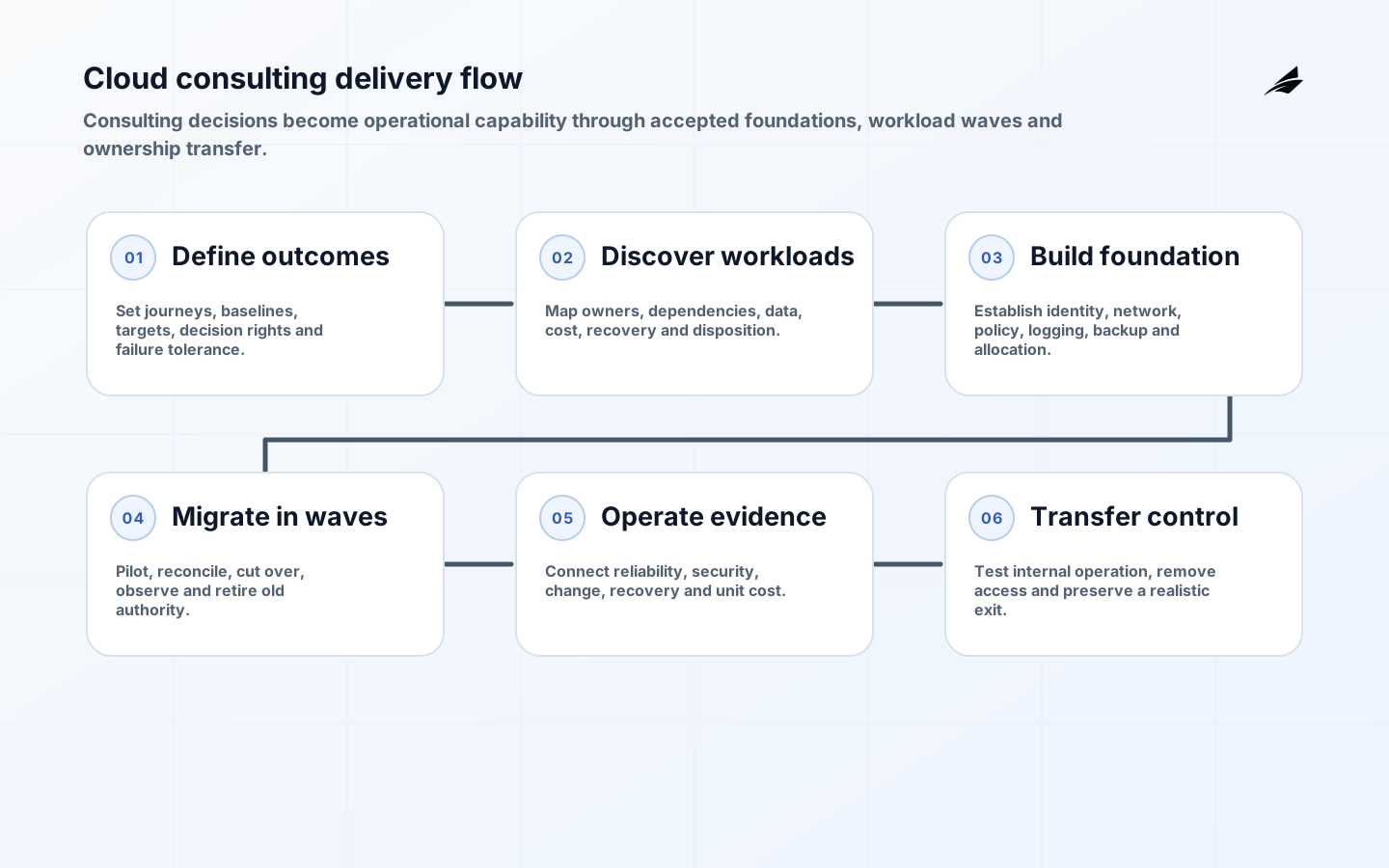
A cloud consulting services implementation checklist should produce more than target diagrams and a migration schedule. The work is complete when an organization can provision approved environments, move or build a representative workload, operate it against explicit service objectives, explain its cost, restore it, and continue improving it with internal ownership. Consulting should shorten the path to those capabilities while making decisions and responsibilities easier to inspect.
Cloud changes the allocation of technical responsibility, not the need for it. NIST SP 800-145 defines cloud computing through on-demand access, resource pooling, rapid elasticity and measured service across service and deployment models. Those properties can accelerate delivery and amplify unmanaged access, configuration and spend. Use this checklist beside the cloud consulting scope guide and cloud consulting FAQ to convert a proposal into verifiable implementation.
1. Define outcomes, scope and decision rights
Start with business and service outcomes rather than a provider preference. Name the customer journey or operational process that must improve, its current baseline, intended change and consequence of failure. A migration may target data-center exit, resilience, lead time or capacity flexibility; modernization may target a product capability. Tie every objective to a measure and an accountable owner who can accept trade-offs.
Create one boundary covering accounts or subscriptions, identity, networks, data, workloads, source repositories, delivery pipelines, observability, recovery, support and commercial commitments. Mark what the customer retains, consultant delivers, cloud provider supplies and other vendors support. Include exclusions and dependencies. Name who may approve architecture, grant privileged access, accept risk, stop a cutover and declare recovery.
| Decision | Required evidence | Accountable role |
|---|---|---|
| Outcome | Baseline, target, journey and failure consequence | Business service owner |
| Scope | Workloads, data, interfaces, environments and exclusions | Program owner |
| Architecture | Options, constraints and accepted trade-offs | Architecture owner |
| Security | Threats, responsibilities and expiring exceptions | Security owner |
| Operations | Service objectives, support and recovery authority | Service owner |
| Economics | Forecast, allocation and unit-cost hypothesis | Finance and product owners |
2. Discover the estate and choose workload dispositions
Build an evidence-backed inventory before sequencing work. For each workload, capture owner, users, criticality, data classification, architecture, dependencies, traffic pattern, software lifecycle, licensing, current cost, recovery objectives and operational debt. Validate discovery with application teams and network observations; configuration records often miss batch jobs, file exchanges, certificates, scheduled exports and support tools.
Choose a disposition workload by workload: retain, retire, replace, rehost, replatform, refactor or rebuild. Record why the option fits the objective and what would invalidate it. Group tightly coupled services into migration units. A small application with an unknown database or identity dependency can carry more cutover risk than a larger understood service. The cloud DevOps implementation checklist helps where the goal includes a repeatable delivery platform.
3. Build and accept the governed cloud foundation
Establish identity federation, environment separation, account hierarchy, network connectivity, name resolution, encryption and key ownership, secrets, centralized logging, approved regions, resource metadata, backup policy and emergency access before critical migrations. Express repeatable foundations as versioned infrastructure and policy. Policies need clear denial messages, a reviewed exception route, an owner and an expiry; controls that make routine work impossible invite hidden bypasses.
Provider frameworks are useful checklists, not substitutes for context. The Microsoft Cloud Adoption Framework organizes strategy, planning, readiness, adoption, governance, security and management. The AWS Well-Architected pillars and Google Cloud Well-Architected Framework connect operations, security, reliability, performance, cost and sustainability. Map relevant guidance to local acceptance tests rather than claiming blanket alignment.
| Foundation control | Acceptance test | Evidence retained |
|---|---|---|
| Federated access | Joiner, role change, revocation and emergency access | Identity and access records |
| Network boundary | Approved path works and prohibited path is denied | Flow and policy results |
| Policy enforcement | Unsafe resource is blocked with usable remediation | Policy test and exception register |
| Data protection | Key access, backup and representative restore succeed | Restore log and ownership record |
| Observability | Platform and workload signals reach named responders | Dashboard and route test |
| Cost allocation | Material resources map to owner, environment and service | Allocation report |
4. Deliver representative workloads in controlled waves
Use a pilot that represents real identity, data, dependency and operational complexity without carrying the highest consequence. Define entry criteria, data-copy method, compatibility window, validation, stop conditions, rollback or roll-forward path and observation period. Rehearse cutover with the people who will execute it. A runbook becomes trustworthy only after permissions, timing and signals have been exercised.
For new and modernized applications, apply secure development controls to infrastructure and pipeline code as well as application code. NIST SP 800-218 structures secure software work around preparing the organization, protecting software, producing well-secured releases and responding to vulnerabilities. Build one traceable artifact, test it, promote it between environments, record approvals proportionately and keep deployment reversible where the data model permits.
Scale by migration waves only after pilot findings are closed or consciously accepted. Sequence shared services before dependants, protect business blackout periods, and keep source systems authoritative until reconciliation passes. Validate record counts, checksums or business transactions, not merely machine health. Retire old paths, credentials, replicas and contracts after acceptance; indefinite dual running creates cost and ambiguity about the system of record.
5. Establish reliability, security and cost operations
Define service-level indicators around critical user journeys, objectives matching business tolerance and alerts leading to an owned action. Correlate incidents with deployments and configuration changes. Test loss of a zone, dependency, credential and restore path according to risk. Include provider status and support escalation in runbooks, while recognizing that a provider service-level agreement does not prove an end-to-end application objective.
Treat security posture as maintained state. Review privileged access, public exposure, vulnerabilities, unsupported components, key rotation, data movement and policy exceptions. Incident exercises should test containment authority and evidence preservation across customer, consultant and provider boundaries. Avoid dashboards that collapse many controls into one reassuring score; owners need the failing resource, consequence and corrective action.
The 2026 FinOps Framework defines FinOps as collaboration among engineering, finance and business teams to maximize technology value. Allocate spend to an owner and service, reconcile billing data, investigate anomalies and forecast demand. Use unit costs such as cost per active tenant or transaction alongside reliability and product outcomes. Commitments should follow a stable baseline, not substitute for removing idle or oversized resources.
6. Accept capabilities and transfer ownership
Acceptance should also test the commercial and architectural exit assumptions. Export a representative configuration and data set, identify provider-specific services that require redesign, and estimate the time, skills and transfer charges involved. Exit does not require every workload to be portable without change; it requires the organization to understand dependencies, preserve usable data and credentials, and retain enough authority to negotiate or move when business conditions change.
Review the engagement thirty days after the first production wave. Compare forecast with actual demand, cost, reliability, support effort and delivery lead time. Close temporary access and parallel infrastructure, confirm that exceptions still have owners and expiries, and turn recurrent manual work into an explicit improvement decision. A post-transition review catches the gap between a successful cutover and a sustainable operating service.
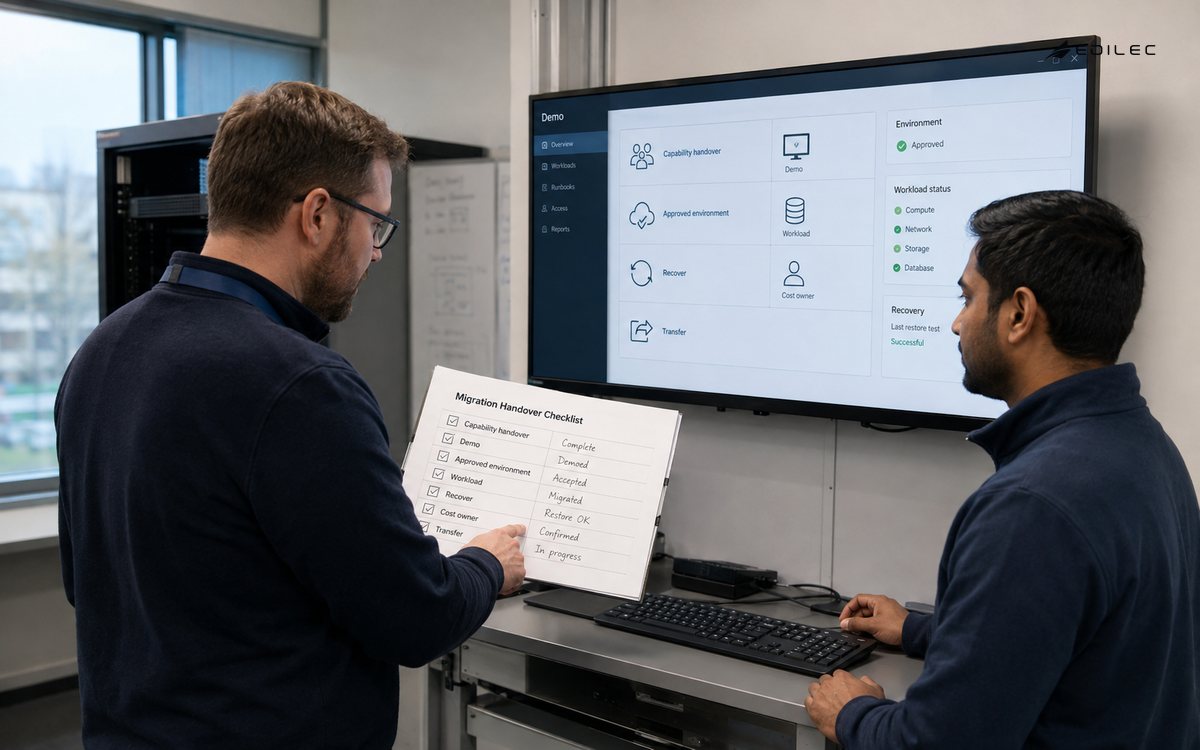
Run an end-to-end acceptance scenario. An internal engineer provisions an approved environment, deploys a change, observes it, handles a policy denial, follows an alert, restores representative data and identifies the resulting cost. The consultant observes and records gaps; the receiving team performs the work. Critical gaps in access, recovery or incident ownership remain open delivery items rather than disappearing into a generic backlog.
Transfer versioned platform modules, architecture decisions, source and pipeline administration, access reviews, exception registers, service objectives, dashboards, runbooks, restore evidence, supplier contacts, cost models and a prioritized improvement backlog. Define support expiry after transition. Ensure the customer can export configurations and data, rotate consultant credentials and operate without proprietary knowledge held only by individuals.
Define completion criteria for the consulting relationship itself. Track accepted capabilities, unresolved severity, knowledge-transfer exercises, credential removal and the receiving team owner for every recurring task. Commercial milestones should follow accepted evidence rather than document delivery alone. Where a managed service continues, separate the enduring service levels and access model from temporary project privileges. This gives procurement, engineering and operations one shared view of what has transferred, what remains supplied and what still blocks independent operation.
Keep architecture decisions small and current. Record the context, options, choice, consequence, owner and review trigger for decisions such as region, managed database, identity pattern or recovery design. Link each decision to implemented configuration and tests. When a provider capability, regulation, workload profile or price changes materially, revisit the affected decision instead of treating the original target architecture as permanent truth.
Key takeaways
- Define measurable service outcomes and decision rights before selecting migration patterns.
- Inventory hidden dependencies and choose a justified disposition for every workload.
- Accept the foundation through denial, revocation, observability and restore tests.
- Migrate in reconciled waves with explicit stop conditions and authority.
- Operate reliability, security and cost as connected responsibilities.
- Close only when the receiving team can perform the critical work.
Cloud consulting services FAQ
How long should implementation take?
Duration depends on estate discovery, identity and network readiness, regulatory constraints, data volume and application coupling. Plan around accepted increments: foundation, representative workload, migration wave and operating handover. This exposes risk earlier than one portfolio-wide completion date.
Should the consultant choose the cloud provider?
The consultant can facilitate evaluation, but the accountable organization should approve the choice against workload fit, skills, commercial terms, regulatory needs, interoperability and exit options. A provider preference is not a business case.
Does multi-cloud reduce concentration risk?
It can reduce some dependencies while adding identity, networking, data, skills and operating complexity. Use multiple providers where a specific requirement justifies the cost. Portability claims should be proven through a realistic recovery or relocation exercise.
Conclusion
Cloud consulting services succeed when advice becomes an operable, testable capability. Connect outcomes to workload decisions, build a governed foundation, migrate in evidence-backed waves, establish service and cost operations, and make the receiving team demonstrate control. That is the difference between a cloud project that ends and a cloud operating model that lasts.