Cloud computing services shift some infrastructure responsibility to a provider, but they do not transfer accountability for business data, identity, configuration or application behavior. The right service model depends on the workload: SaaS may remove most platform operation, PaaS may simplify runtime management, and IaaS may preserve control at the cost of more engineering. This FAQ gives business and technical owners a common way to compare service boundaries, plan migration, design recovery and understand recurring cost before committing a workload portfolio.
Define the service boundary before selecting technology
Start with one workload portfolio with explicit data, availability, recovery and commercial requirements. Observe real cases, including exceptions, reversals and incomplete inputs. Record who initiates the work, which system owns each fact, who may approve an outcome, what makes an action irreversible and how staff recover when an integration fails. This boundary prevents managed cloud services from becoming a vague transformation program. It also exposes policy disagreements before software silently turns them into inconsistent behavior.
Define requirements in terms a provider and internal owner can verify: data classification and location, identities, integrations, peak demand, latency, availability, recovery point, recovery time, retention and exit. Map each control to provider evidence, customer configuration or application implementation. For a customer portal, managed database durability does not replace application authorization or tested restoration. Document which team receives alerts, patches dependencies, approves network change and communicates an incident. Unnamed shared responsibility is an operating gap.
Architecture and ownership
The architecture must preserve authority across identity, accounts and policy governance, network, compute, data and managed service choices, delivery automation and environment controls, observability, resilience, backup and financial operations. Each component needs an owner, a versioned contract and observable failure behavior. Avoid direct point-to-point writes from an interface or model into a critical record. A narrow orchestration layer can validate identity, current state, policy and idempotency before an action proceeds, while an audit event records the evidence and rule version used.
| Architecture area | Required design decision | Evidence before release |
|---|---|---|
| identity, accounts and policy governance | For this design choice, name the accountable owner, supporting evidence, exception route, and next measurable check. | Approved data-flow and owner |
| network, compute, data and managed service choices | Within this design choice, name the accountable owner, supporting evidence, exception route, and next measurable check. | Authorization and negative tests |
| delivery automation and environment controls | When implementing this design choice, name the accountable owner, supporting evidence, exception route, and next measurable check. | Versioned interface plus retry behavior |
| observability, resilience, backup and financial operations | Before releasing this design choice, name the accountable owner, supporting evidence, exception route, and next measurable check. | Dashboard, alert and recovery runbook |
A six-stage delivery path
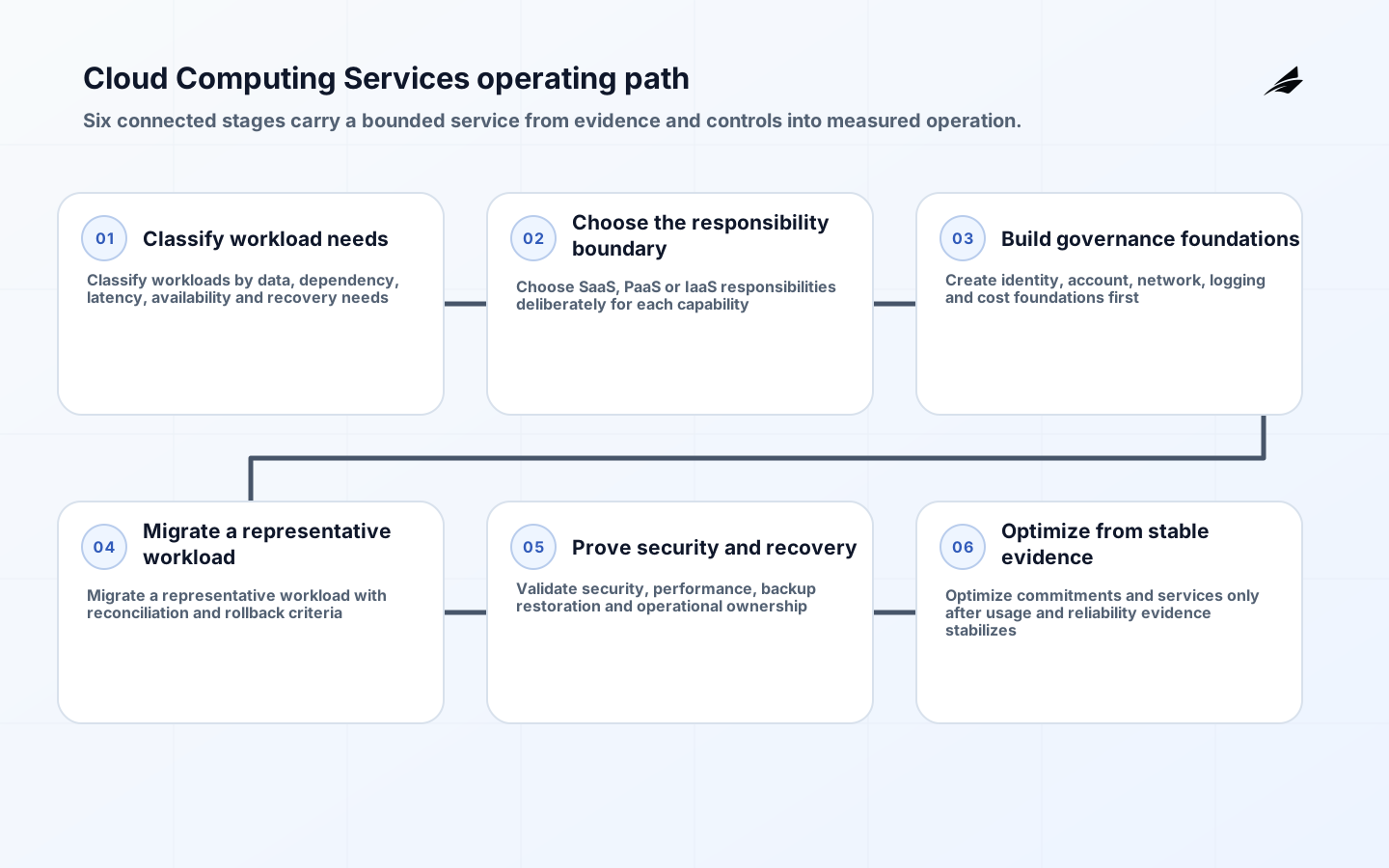
Build cloud foundations before migrating production. Establish account hierarchy, federated identity, centralized logging, network boundaries, encryption and cost ownership. Move a representative workload whose dependencies and data can be reconciled. Automate environment creation and deploy one immutable artifact through test and production. Exercise scaling, dependency loss, backup restoration and rollback. Compare observed performance and cost with the model, then adjust architecture before moving a larger portfolio. Migration waves should be based on dependency and risk, not an arbitrary server count.

- Classify workloads by data, dependency, latency, availability and recovery needs.
- Choose SaaS, PaaS or IaaS responsibilities deliberately for each capability.
- Create identity, account, network, logging and cost foundations first.
- Migrate a representative workload with reconciliation and rollback criteria.
- Validate security, performance, backup restoration and operational ownership.
- Optimize commitments and services only after usage and reliability evidence stabilizes.
Controls and failure modes
Security controls vary with the consumed service. In SaaS, focus on identity, tenant configuration, data use, integration and vendor assurance. In PaaS, add application code, secrets and service configuration. In IaaS, operating systems and network controls remain substantial customer work. Central policy can set broad boundaries, but workload owners still need least privilege, vulnerability handling and incident playbooks. Keep logs in an independently protected location and test access during provider or identity disruption.
| Failure mode | Design response | Operating signal |
|---|---|---|
| Shared responsibility gap | Document provider, platform and application obligations per service. | Controls without a named owner |
| Cost surprise | Allocate spend, set budgets and review unit cost with product owners. | Unallocated spend and forecast variance |
| Unproven recovery | Restore data and exercise failover against stated objectives. | Recovery test success |
| Provider concentration | Identify portable data, exit dependencies and realistic transition time. | Untested exit components |
Measure outcomes, not activity
A dashboard should connect technical behavior to the intended operating result. Track availability and latency tied to user journeys; recovery point and recovery time test results; change failure and mean restoration time; cost per transaction, tenant or business service. Segment results by workflow type and material risk instead of hiding poor tails inside a global average. Review a sample of accepted, corrected, escalated and failed cases. When a metric moves, retain enough trace evidence to identify whether the cause was source data, policy, interface behavior, model output, reviewer workload or downstream execution.
Track user-facing availability and latency, change failure, restoration time, backup recovery and security exceptions alongside spend. Financial operations should allocate cost to a product or service owner and explain commitment coverage, idle resources, data transfer and observability charges. Unit cost per transaction or tenant is often more useful than a total bill. Review reliability and cost together: an optimization that removes redundancy may lower spend while violating the agreed recovery objective. Decisions should retain this tradeoff explicitly.
Cost, timeline and commercial model
Cloud pricing combines consumption, commitments, support, data transfer, observability and people. Compare total operating cost at realistic utilization, include migration and exit work, and avoid treating an introductory rate as a steady-state forecast. Timeline should be expressed as evidence-bearing stages: discovery, thin-slice build, controlled pilot and measured expansion. Procurement should require source access, documentation, data export, incident support and transition assistance. A lower quote is not cheaper if it omits evaluation, operating ownership or the path away from the chosen provider.
Rehearse the operating model before expansion
A useful rehearsal for cloud computing services follows one representative case from intake through final evidence. The team should interrupt the exercise after each transition and ask which record is authoritative, whether the acting identity has permission, whether the rule is current, and whether retrying would create a duplicate outcome. Run the same case with a missing field, delayed dependency and unavailable reviewer. This reveals assumptions that unit tests and polished demonstrations often miss, especially where identity, accounts and policy governance meets network, compute, data and managed service choices.
Next, simulate the two most consequential failure modes: shared responsibility gap and cost surprise. Operators should identify the alert, inspect the trace without broad production access, contain further actions, communicate with affected users and restore a known state. Record elapsed time and every manual workaround. If the team cannot determine what happened from the retained evidence, the workflow is not ready for a wider cohort, even if its normal path appears efficient.
A cloud service decision record should include the service model, shared-responsibility matrix, data flow, provider regions, identity model, recovery design, cost assumptions, support tier and exit dependencies. For migration, add reconciliation results, cutover criteria and rollback evidence. Record managed-service limits and quotas rather than relying on marketing descriptions. Contracts and architecture should agree on data return, deletion and incident cooperation. These artifacts help future teams understand why a service was chosen and when reconsideration is warranted.
Test a realistic failure chain: revoke a workload credential, interrupt a regional dependency and restore the latest approved backup into an isolated environment. Operators should locate logs, identify the responsible team, meet the communication path and verify data consistency. Then model a large traffic event and unexpected data-transfer pattern to test budgets and quotas. A cloud design is credible when staff can recover it under constrained access and explain the resulting cost, not merely when the provider advertises resilience.
Practical takeaways
- Anchor cloud computing services to one named outcome and accountable owner.
- Treat one workload portfolio with explicit data, availability, recovery and commercial requirements as the first deliverable, not an assumption.
- Keep permissions, policy and irreversible actions in deterministic services with review evidence.
- Pilot with representative exceptions and retain a tested manual route.
- Measure availability and latency tied to user journeys alongside quality, risk and human workload.
- Expand only when the current release is supportable, observable and recoverable.
Frequently asked questions
- What should the first engagement deliver? It should deliver a process map, data and authority model, risk register, thin-slice backlog, evaluation plan, cost range and explicit decision on what will remain manual.
- How long should a pilot run? Long enough to include ordinary cases, realistic exceptions and at least one controlled recovery exercise. Calendar duration matters less than representative evidence and a pre-agreed exit decision.
- Can a team buy a platform before discovery? A short technical trial can inform discovery, but procurement should follow the service boundary and control requirements. Otherwise the available product features begin defining the business process.
- Who owns the released service? A business owner is accountable for policy and outcomes; a technical owner is accountable for reliability and change; security, privacy and domain specialists approve relevant controls. A vendor can support these roles but should not replace them.
- How is success demonstrated? Compare the agreed baseline with completed outcomes, corrections, exceptions, failures, cost and user impact. Pair aggregate metrics with case review so a favorable average cannot conceal harmful edge cases.
Conclusion
Cloud computing services are useful because they let teams consume capabilities on demand, but value depends on choosing the right responsibility boundary and operating it deliberately. Classify workloads, establish governance, migrate in evidence-bearing waves and test recovery before scale. Connect financial ownership to reliability and security decisions, and preserve a realistic exit path for critical data. With those practices, cloud adoption becomes a managed service strategy rather than a collection of provider subscriptions.