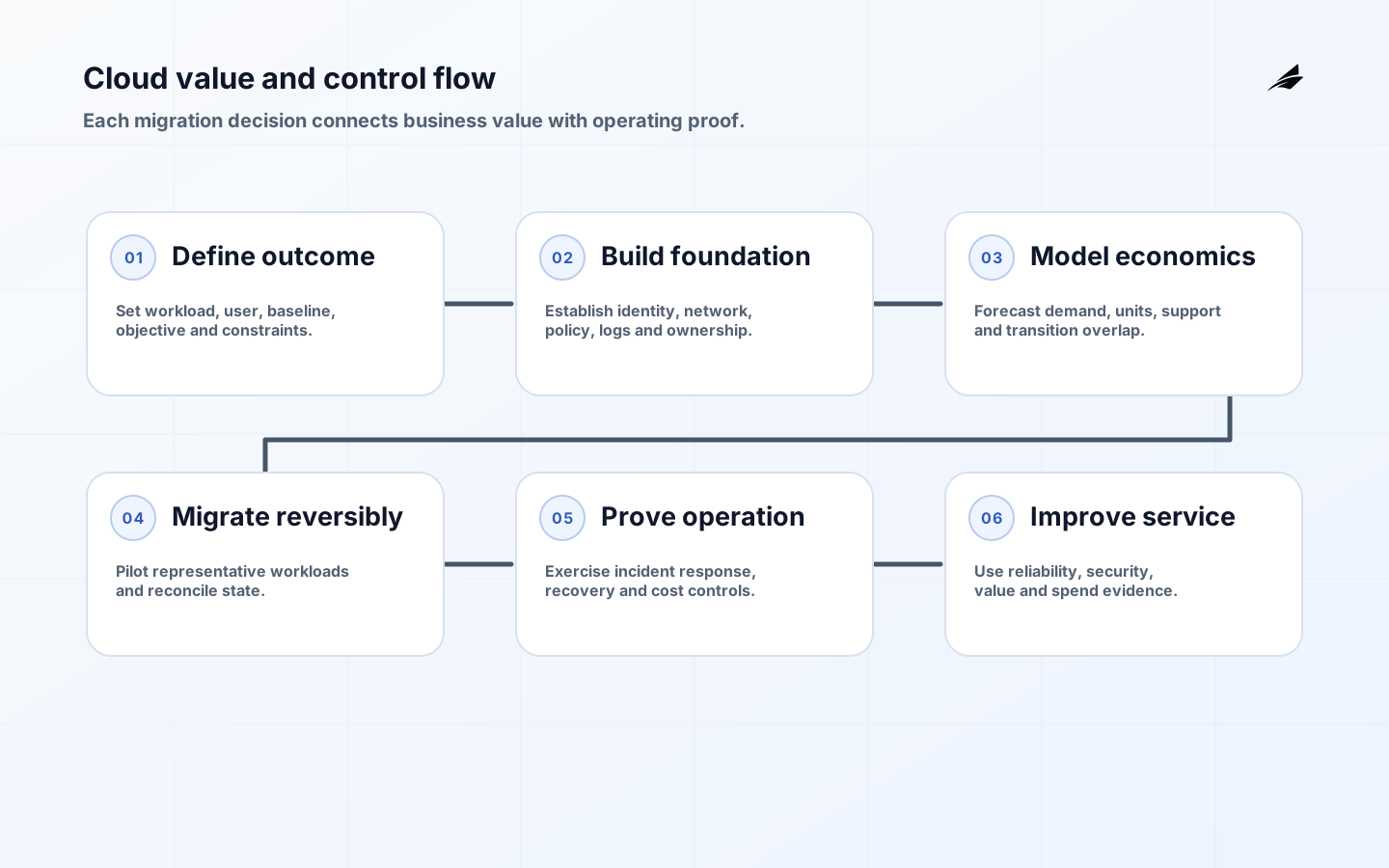
Cloud computing services should turn elastic infrastructure and managed capabilities into a reliable business service. A useful plan defines which workloads move, which responsibilities stay with the customer, how cost will be governed and what evidence permits each migration wave. It does not begin with a provider logo or a target percentage of applications in cloud. This guide gives buyers and delivery leaders a practical scope, cost model, risk register and sequence for moving from assessment to stable operation.
Use the cloud computing implementation checklist for execution detail and the cloud computing services FAQ for decision support. Teams comparing advisory models can also read the cloud computing consulting delivery plan. Together, these resources frame cloud as an operating change across product, finance, security and support, not a one-time infrastructure relocation.
Define cloud scope in business and workload terms
Start with a portfolio inventory that names the service owner, users, business criticality, data classification, architecture, dependencies, current cost, recovery objectives, release frequency and end-of-life constraints. Validate the inventory through logs, network flows and owner interviews; configuration databases often miss shadow services and batch dependencies. The NIST cloud definition remains a useful vocabulary for essential characteristics, service models and deployment models. Use it to clarify what a supplier is actually offering rather than treating every hosted environment as equivalent.
Select a first wave with meaningful value and bounded risk. Good candidates have known owners, testable interfaces, manageable data movement and a clear improvement such as shorter environment lead time, better recovery or retirement of unsupported hardware. Avoid choosing only trivial workloads: they prove connectivity but not the operating model. Also avoid making a fragile, undocumented system the first migration merely because its infrastructure is expensive. Discovery and stabilization may be the appropriate first investment.
| Scope decision | Questions to answer | Artifact | Approval evidence |
|---|---|---|---|
| Business outcome | Which customer or operational measure improves? | Outcome brief | Baseline, target, guardrail and owner |
| Workload boundary | Which applications, data and dependencies move together? | Dependency map | Critical paths observed and reconciled |
| Service model | Which layers does provider operate and which remain ours? | Responsibility matrix | Every control and incident task has an owner |
| Migration wave | What sequence limits business interruption? | Wave plan | Entry, exit and rollback criteria are testable |
| Operations | Who supports, pays for and improves the service? | Operating model | On-call, budget and change authority are assigned |
Build a minimum viable cloud foundation
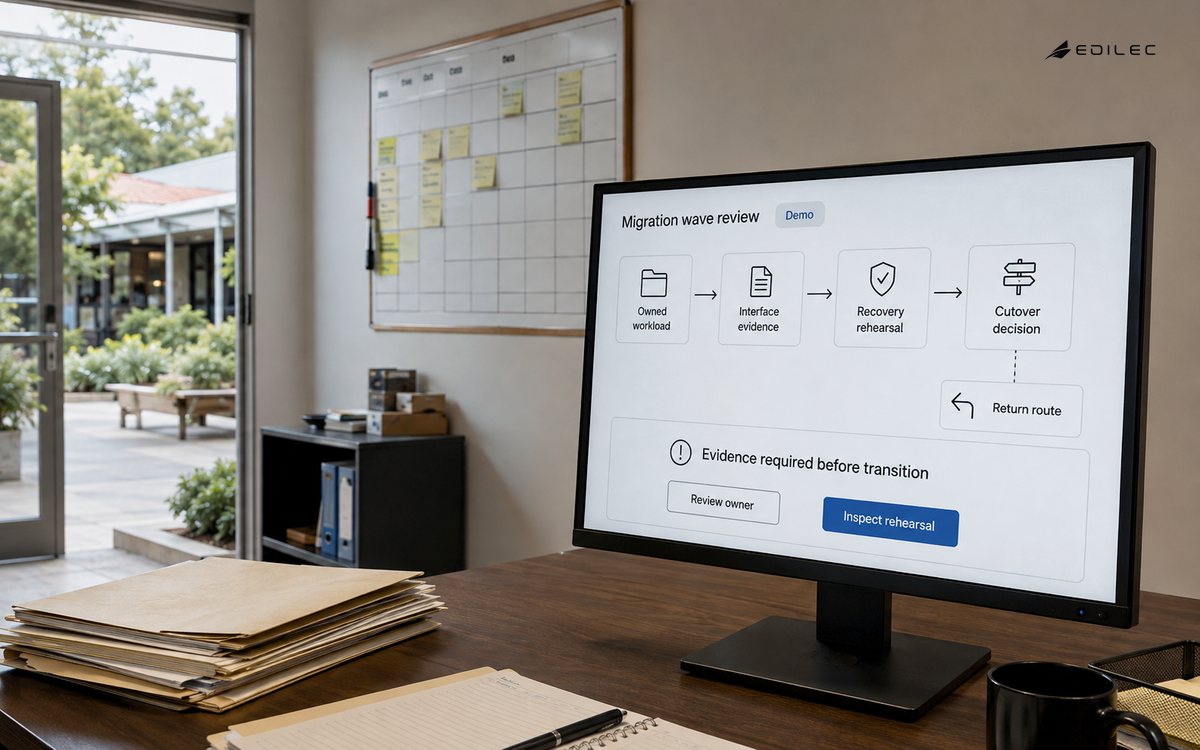
Create a repeatable foundation before production waves: organization and account structure, identity federation, privileged access, network connectivity, DNS, encryption keys, centralized logs, policy enforcement, approved images, backup patterns and cost allocation. Keep the first version small enough to operate. A foundation with dozens of mandatory services and no clear owner becomes a platform bottleneck. Encode configuration in version control, review exceptions and test that a new account or subscription can be provisioned from the approved baseline.
The CISA cloud security technical reference architecture describes shared services, migration and posture management considerations that are useful beyond federal deployments. Translate principles into your environment: centralized visibility without a universal administrator, service identities rather than embedded credentials, controlled egress, policy checks before deployment and continuous discovery after deployment. Document where provider-native controls are sufficient and where independent controls are required.
Model cost before negotiating discounts
Build a unit-cost model per workload. Include compute shape and schedule, storage capacity and requests, data transfer, managed-service operations, observability volume, support, licenses, backup, security tooling and engineering labor. Add one-time discovery, remediation, migration, parallel running and decommissioning costs. Compare against the avoidable portion of current cost, not the entire data-center budget. Buildings, contracts and staff do not disappear on the day one application moves.
Create allocation tags or account boundaries that map spend to product, environment and owner. Establish anomaly thresholds before migration and give product teams timely usage data. The FinOps Framework treats technology value as a collaboration among engineering, finance, product, procurement and leadership. That operating idea matters more than a monthly savings meeting. Teams need authority to resize, schedule, redesign or stop unused services, while finance needs forecasts that explain demand and committed rates.
Turn cloud risks into design decisions
Maintain a risk register tied to architecture and migration evidence. Common risks include excessive privilege, public exposure, unmanaged keys, data residency mistakes, provider concentration, unpredictable transfer cost, quota exhaustion, configuration drift and an untested exit. The NIST public cloud security and privacy guidance emphasizes accountability and careful evaluation of provider controls. Requirements vary by sector and jurisdiction, so legal and compliance owners should map the applicable obligations for each dataset and service.
Do not record “vendor lock-in” as a generic red risk. Identify the actual dependency: proprietary database behavior, event format, identity model, operational API, egress volume or staff skill. Decide whether the benefit justifies that dependency and define a proportionate exit mechanism. Portability can mean a tested data export and transition plan, not necessarily identical deployment across three clouds. Multi-cloud without a business requirement usually multiplies identity, networking, observability and support work.
Deliver migrations as reversible service changes
For each workload, choose an explicit treatment: retire, retain, rehost, replatform, refactor or replace. Record why, expected value and technical debt carried forward. Rehearse data transfer with production-scale samples and verify counts, checksums and business records. Define freeze windows, replication lag, in-flight transaction handling, user communications, rollback triggers and authority. A rollback plan must explain what happens to data created after cutover; restoring the old server image is not sufficient.
Use progressive exposure where possible. Route internal users or a small traffic segment first, compare errors and latency, then increase. Test capacity, dependency failure and recovery in the target environment. Decommission only after retention, audit and fallback requirements are satisfied. Leaving the old platform running “temporarily” can erase the business case and create two vulnerable estates. Assign a dated decommission owner before the migration begins.
| Cost or risk signal | How to calculate | Decision it supports | Guardrail |
|---|---|---|---|
| Unit service cost | Monthly run cost divided by completed business units | Architecture and pricing changes | Quality and reliability remain within target |
| Forecast variance | Actual minus forecast as a percentage of forecast | Budget model and demand assumptions | Explain large variance by workload owner |
| Change lead time | Commit to production elapsed time | Platform and pipeline priorities | Do not bypass required evidence |
| Change fail rate | Deployments needing rollback or immediate repair divided by deployments | Release readiness | Segment by service and change type |
| Recovery proof | Successful exercises meeting RTO and RPO | Resilience investment | Use restored business data, not job completion alone |
| Exposure exceptions | Open high-risk findings beyond approved age | Security remediation | Critical exceptions require named acceptance |
Operate reliability, security and change together
Assign a service owner for every production workload and platform capability. Define service-level objectives, alert ownership, escalation, maintenance, patching, backup and recovery. Instrument user outcomes and dependencies, not only resource utilization. Review provider incidents and service changes that may affect architecture. Run access recertification, restore exercises and key-rotation tests on a schedule. The cloud provider operates selected layers; the customer still owns configuration, data use and service behavior according to the chosen model.
Measure delivery as a balance. The current DORA metrics cover throughput and instability, including change lead time, deployment frequency, failed deployment recovery time, change fail rate and deployment rework rate. Use them for one service over time rather than as team rankings. Pair them with unit cost, user success, availability, security exceptions and recovery proof. Faster deployment is valuable only when the service remains correct and recoverable.
A practical 90-day delivery plan
In days 1-30, confirm outcomes, inventory the portfolio, map dependencies, establish governance and select the pilot. In days 31-60, provision the minimum foundation, implement identity and logging, build cost allocation, rehearse migration and run threat modeling. In days 61-90, migrate progressively, exercise recovery, monitor outcome and guardrail metrics, and complete the first decommission decision. Keep unresolved exceptions visible with owners and dates; do not hide them in a generic backlog.
The 90-day point is a control gate, not an arbitrary transformation deadline. Continue only if the team can provision consistently, attribute spend, respond to incidents, recover data and show improvement for the selected workload. Otherwise, repair the operating model before increasing portfolio volume. Scaling a weak foundation makes every later migration slower and harder to govern.
Key takeaways
- Define cloud scope by workload, dependency and business outcome.
- Make shared responsibility concrete for every control and incident task.
- Model unit economics and migration cost before negotiating commitment discounts.
- Treat migration as a reversible data and service change.
- Prove recovery, cost allocation and support before scaling waves.
- Measure delivery speed beside instability, security, user outcome and cost.
Cloud computing services FAQ
How long does a cloud computing services program take?
A bounded foundation and pilot may be delivered in roughly one quarter, while a portfolio program often spans multiple waves. Timeline depends on dependency discovery, data volume, regulatory review, remediation and decommissioning. Plan by exit evidence for each wave rather than one enterprise finish date.
Is cloud computing always cheaper?
No. Cloud can improve value through elasticity, managed capabilities and faster change, but poor sizing, idle resources, transfer patterns and duplicated tools can raise cost. Compare unit economics and avoidable current cost while preserving reliability and security requirements.
Should a business choose one provider or several?
Choose according to workload, regulatory, resilience, commercial and capability needs. One primary provider can reduce operating complexity. Multiple providers are justified when a specific requirement exceeds that added complexity. Document the dependency and exit plan either way.
Conclusion
Cloud computing services succeed when the organization can connect each workload to value, operate the control boundary and explain the full cost. Build a small repeatable foundation, migrate with rollback and data reconciliation, then scale on evidence. That sequence creates a cloud capability that can keep improving after the migration project ends.