A cloud solutions implementation checklist should prove that a workload can deliver its intended outcome securely, reliably and economically under a named operating model. Creating an account and moving servers is not cloud adoption. Teams must decide responsibility, identity, network and data boundaries, deployment, recovery, observability, cost allocation and exit before customers or critical operations depend on the new environment.
This guide is for technology leaders and delivery teams preparing a first cloud workload, a migration wave or a governed platform. It complements the cloud solutions scope and delivery plan, the cloud operations FAQ and the enterprise cloud DevOps plan. Apply it per workload; portfolio standards cannot replace workload-specific evidence.
Define outcomes and classify the workload portfolio
State why each workload should change: faster product release, resilience, geographic reach, retirement risk, capacity elasticity, data capability or cost transparency. Establish a baseline and target with guardrails. Inventory business owner, technical owner, users, data classification, dependencies, availability need, recovery objectives, latency, compliance, lifecycle and present cost. Unknown ownership or dependency should lower migration priority, not disappear into a generic wave.
Choose a disposition per workload: retire, retain, repurchase, rehost, replatform, refactor or relocate. A rehost may reduce data-center deadlines but preserve operational debt; a refactor can improve changeability but adds delivery risk. Separate the migration objective from modernization ambition and define the evidence for each. Pilot with a representative workload that teaches the platform without placing the highest-consequence service in the first experiment.
| Assessment area | Evidence | Decision | Blocker example |
|---|---|---|---|
| Business | Owner, baseline and target | Priority and funding | No measurable reason to move |
| Application | Runtime, state and dependencies | Disposition pattern | Unsupported component |
| Data | Class, residency, retention and flow | Location and protection | Unknown regulated fields |
| Reliability | SLI, RTO, RPO and failure modes | Architecture and recovery | No tested restore |
| Operations | Skills, support and suppliers | Responsibility model | No production owner |
| Economics | Usage, licenses and transition cost | Budget and guardrails | Unallocated shared spend |
Choose a cloud operating model and decision rights
Decide whether central, shared or decentralized teams own identity, networking, policy, security operations, platform services, workload reliability and cost. Microsoft CAF describes strategy, plan, ready and adopt as foundational methods, with govern, secure and manage continuing during operation. Translate that lifecycle into a responsibility matrix with primary and backup owners. Provider responsibility never removes the customer's duty to configure services and govern identities, data and workloads.
A platform team should offer supported capabilities as products: account or subscription vending, identity integration, network patterns, delivery pipelines, telemetry and policy guardrails. Publish interfaces, service expectations and escalation. Workload teams remain accountable for application behavior, data and service objectives. Avoid both extremes: an ungoverned account where every team invents controls, and a central ticket queue that prevents teams from making routine, reversible changes.
Build and test the landing foundation
Establish organization hierarchy, accounts, billing, identity federation, privileged access, network topology, DNS, key management, logging, policy and baseline configuration through version-controlled infrastructure. Separate production from development and security administration. Prevent public exposure by default where the service permits it. Central logs must be protected from workload tampering. Keep emergency access independent enough to work during an identity or network incident and review every use.
Test foundation capabilities before onboarding multiple workloads. Provision a clean environment from code, apply policies, deploy a sample service, emit telemetry, rotate a secret, restore data, isolate a compromised component and remove the environment. Confirm quotas and regional service availability. Document exceptions with owner and expiry. A landing zone is not finished after initial deployment; provider features, threats, organizational structure and product needs keep changing.
Design each workload against failure and change
Use a well-architected review across operational excellence, security, reliability, performance, cost and sustainability, adapting emphasis to the workload. Map request and event paths, authoritative state, synchronous dependencies, queues, scheduled jobs and external callbacks. Add timeouts, bounded retries and idempotency where repeated actions could cause harm. Define capacity assumptions and degradation. Managed services still expose limits, maintenance behavior, version changes and regional constraints that need owners.
Set service-level indicators from user outcomes, then choose objectives that guide design and operations. Define RTO as acceptable time to restore a business capability and RPO as acceptable data loss measured in time; validate both with exercises. Replication can improve availability but also replicate deletion or corruption, so keep recovery copies and protected credentials. Test loss of a dependency, zone or region only when the architecture promises tolerance to that boundary.
Implement security and data controls by design
Apply least privilege to human and workload identities, use short-lived credentials, encrypt transport and sensitive stored data, control keys, patch owned layers and scan configuration continuously. Build detection and response for actual cloud events such as public exposure, credential misuse, destructive changes and unusual data access. NIST CSF 2.0 organizes outcomes across Govern, Identify, Protect, Detect, Respond and Recover; use it to connect technical controls to enterprise risk.
Map data collection, location, processors, backups, retention, deletion and export. Select regions and services from residency, latency and resilience needs. Rehearse key loss and access revocation as well as infrastructure failure. Validate that logs and snapshots do not retain sensitive data beyond policy. Include supplier and service dependencies in threat models and incident contacts. Confirm legal and regulatory interpretations with qualified owners rather than treating a provider compliance badge as application compliance.
Migrate with compatibility, reconciliation and rollback gates
Create a runbook for data transfer, synchronization, configuration, identity, cutover, validation, communication and fallback. Rehearse with representative volume and measure duration. Use checksums, counts and business invariants to reconcile data. Define a change freeze only where needed. A rollback must account for writes, messages and external actions after cutover; routing traffic back does not reverse data. Where reversal is unsafe, plan forward repair and containment.
Deploy through versioned, reviewed automation and trace artifacts to source. Separate deployment from feature exposure for risky behavior. Validate customer journeys, accessibility, security, observability and support lookup before full traffic. Stabilize each wave long enough to close incidents, tune alerts, verify bills and transfer ownership. Do not migrate the next wave merely because the project calendar says so when the platform team is still manually repairing the previous one.
| Production gate | Required proof | Stop condition | Owner |
|---|---|---|---|
| Foundation | Policy, identity, network and logs tested | Unknown privileged path | Platform owner |
| Workload | Journeys and failure modes pass | Unbounded dependency failure | Workload owner |
| Data | Transfer and restore reconcile | RPO or integrity breach | Data owner |
| Cutover | Thresholds, command and fallback ready | No safe decision authority | Release owner |
| Operations | Alerts, runbook and support exercised | No responder or access | Service owner |
| Cost | Tags, budgets and anomaly path active | Spend cannot be attributed | FinOps owner |
Operate cost, reliability and change continuously
Allocate cost to products, environments and owners with consistent account structure and tags, while handling shared services transparently. Establish budgets and anomaly routing before migration. Review unit economics such as cost per order, tenant or data volume, not only total spend. FinOps is a collaboration among engineering, finance and business; optimization decisions must consider performance, resilience and labor. Commit discounts only after stable demand is understood.
Run service reviews covering objectives, incidents, vulnerabilities, backup evidence, policy exceptions, capacity, cost and provider changes. Reduce noisy alerts and fund recurring operational pain. Patch and deprecate continuously. Keep architecture and ownership records current. Exercise provider outage, compromised credential and restore scenarios. Exit readiness requires exportable data, infrastructure definitions, dependency inventory, contractual rights and a tested way to rebuild or transfer essential capability.
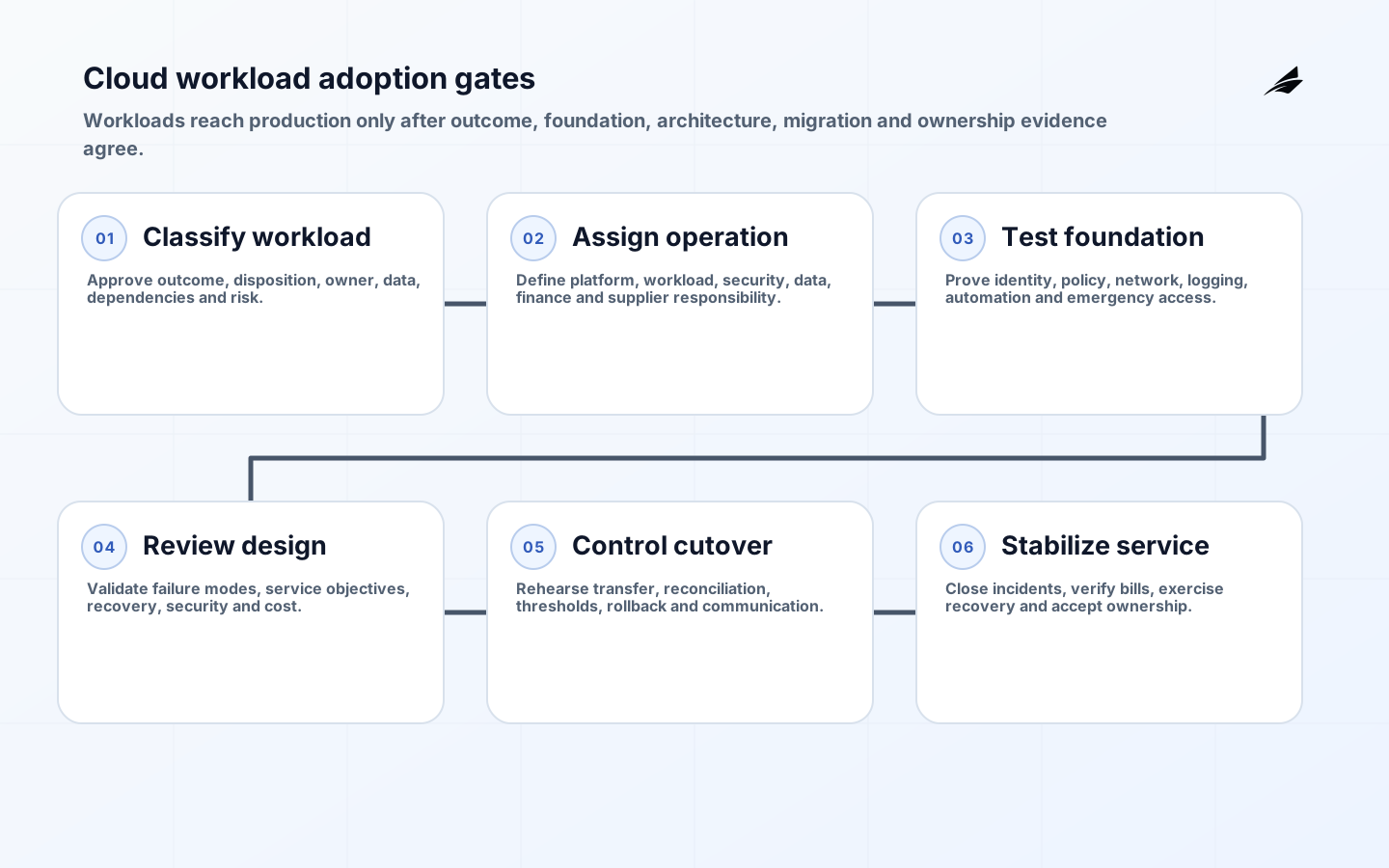
Use six cloud adoption gates
- Approve workload outcome, baseline, owner, disposition and risk classification.
- Establish operating responsibilities, landing controls and policy exceptions.
- Review architecture, data, security, service objectives and recovery design.
- Build through automation and rehearse migration, restore and incident access.
- Cut over under explicit thresholds, reconciliation and rollback authority.
- Stabilize operations, cost and ownership before expanding the next wave.
Key takeaways
- Move workloads for explicit outcomes and choose a disposition individually.
- Define platform, workload, security, data and financial responsibility before scale.
- Test the landing foundation as a product, including emergency and recovery paths.
- Use business-safe migration gates with data reconciliation and decision authority.
- Operate reliability, security, cost and exit as continuous cloud capabilities.
Frequently asked questions
Should the foundation support multiple clouds from day one?
Only when regulatory, acquisition, product or resilience needs justify the added skills and control surface. Portable interfaces and exportable data are useful, but forcing identical services across providers can erase managed-service benefits without creating practical failover.
Is Kubernetes required for cloud adoption?
No. Choose runtime from workload and team needs. Managed application, function, container or virtual-machine services may be simpler. Kubernetes is appropriate when its scheduling and platform capabilities solve real requirements and the team can operate its security and lifecycle.
What makes a good first workload?
Choose a meaningful but bounded service with a committed owner, representative identity and data needs, manageable dependencies and measurable outcomes. A toy proves little; the most critical legacy system creates excessive first-wave risk.
Include workforce and sustainability in the workload decision. Confirm that teams can support chosen services across their lifecycle, and budget training before production ownership transfers. Review utilization, data movement and idle capacity because efficient architecture can reduce both spend and resource consumption. Record these tradeoffs with reliability and performance so an isolated optimization does not weaken the service.
Conclusion
Cloud implementation is an operating-model change expressed through workload evidence. Classify the portfolio, build a tested foundation, design for failure, migrate under explicit gates and stabilize ownership and cost. When those capabilities work repeatedly, the organization has adopted cloud rather than merely relocated infrastructure.