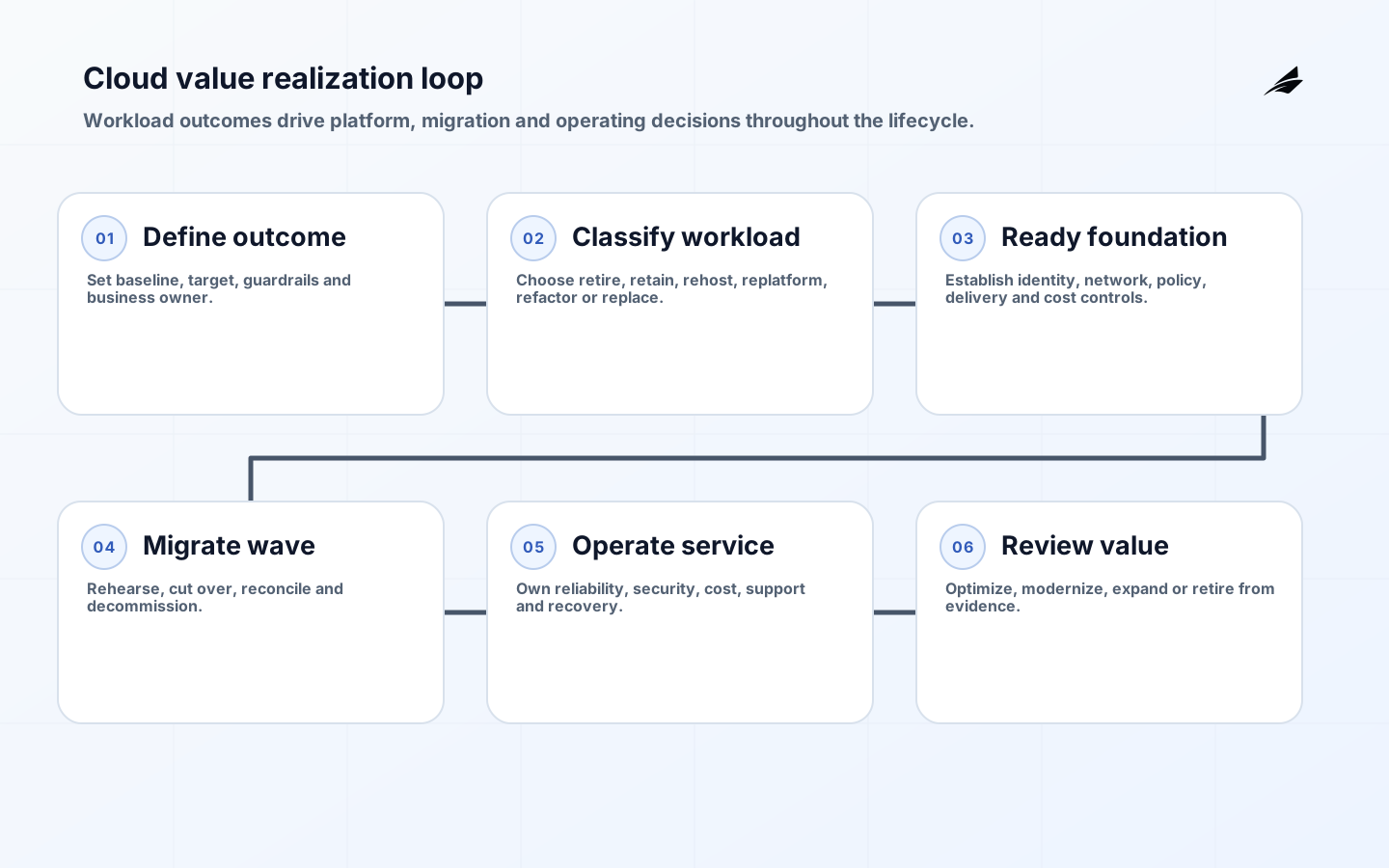
Cloud services bring on-demand access, measured consumption, elasticity and managed capabilities, but those characteristics do not automatically create business value. A cloud services implementation checklist must connect each workload to a measurable outcome and establish identity, network, data, delivery, cost, resilience and operating ownership before scale. Moving an unchanged system can relocate cost and risk without improving the service.
Use the scope, cost and risk plan, the architecture and operations FAQ and the broader cloud transformation checklist. NIST defines essential cloud characteristics; provider adoption frameworks organize transformation from different perspectives. The checklist below remains deliberately portable across providers.
Define the value hypothesis and constraints
For each candidate workload, name the user or business outcome, current baseline, target, guardrails and decision owner. Outcomes may include faster environment delivery, improved recovery, global reach, variable demand handling or access to a managed data service. “Move to cloud” is not an outcome. Record regulatory, residency, latency, integration, licensing, skills and exit constraints before selecting a service model.
Create a workload portfolio with criticality, dependencies, lifecycle, technical condition, data class and business calendar. Decide whether to retire, retain, rehost, replatform, refactor, replace or repurchase based on evidence. Sequence a thin but complete business service before large migration counts. Include process and organization change; cloud provisioning without product ownership and cost accountability often creates sprawl.
| Driver | Useful measure | Guardrail |
|---|---|---|
| Delivery speed | Lead time to tested environment or feature | Change failure and security |
| Resilience | Recovery objective and tested restoration | Data correctness and cost |
| Elasticity | Demand served within objective | Capacity and spend limits |
| Managed service | Operational work removed | Portability, limits and supplier risk |
| Market reach | Latency and regional adoption | Residency and support coverage |
Choose an operating model and decision rights
Define responsibilities across business owner, workload team, platform, security, finance, data, service desk and provider. A centralized model can suit a small estate; shared management lets a platform team provide guardrails while workload teams own services; decentralized operation requires mature teams and strong assurance. Document who approves accounts, regions, services, exceptions, budgets, production changes and incidents.
Treat the platform as a product with users, service levels, roadmap and support. Offer standard account or subscription vending, identity, networking, logging, deployment and cost allocation. Avoid a central team becoming a ticket bottleneck. Measure adoption and developer outcomes while preserving workload accountability. Train people on the chosen operating model, not only provider tools.
Build a secure, observable cloud foundation
Establish organization hierarchy, accounts, identity federation, multifactor authentication, privileged access, network boundaries, DNS, key management, logging, policy enforcement, approved regions and break-glass access. Use infrastructure as code and reviewed changes for repeatability. Separate production and nonproduction with appropriate controls. Central logs and asset inventory should exist before workloads depend on the environment.
Map shared responsibility for each IaaS, PaaS and SaaS choice. A managed service changes which layers the provider operates; the customer still owns data, access, configuration and use. CISA cloud guidance emphasizes secure migration, shared services and posture management. Threat-model management planes, pipelines, identities and data paths. Test alert routing and evidence access before go-live.
| Foundation capability | Acceptance evidence | Owner question |
|---|---|---|
| Identity | Federation, MFA, least privilege and access review | Who can change production? |
| Network and data | Approved paths, encryption and residency controls | Where can information flow? |
| Delivery | Versioned infrastructure and traceable artifact | Can change be reproduced? |
| Observability | Logs, metrics, traces and actionable alerts | Who responds and with what context? |
| Cost | Allocation, budgets and anomaly response | Who owns each unit of spend? |
Migrate in evidence-producing waves
Map dependencies using configuration, telemetry and owner interviews. Choose a representative first wave with meaningful value and bounded blast radius. Rehearse data transfer, validation, cutover and rollback. Define dual-running rules and the authoritative writer during transition. Test user journeys, integrations, performance, security, backup and recovery under realistic conditions.
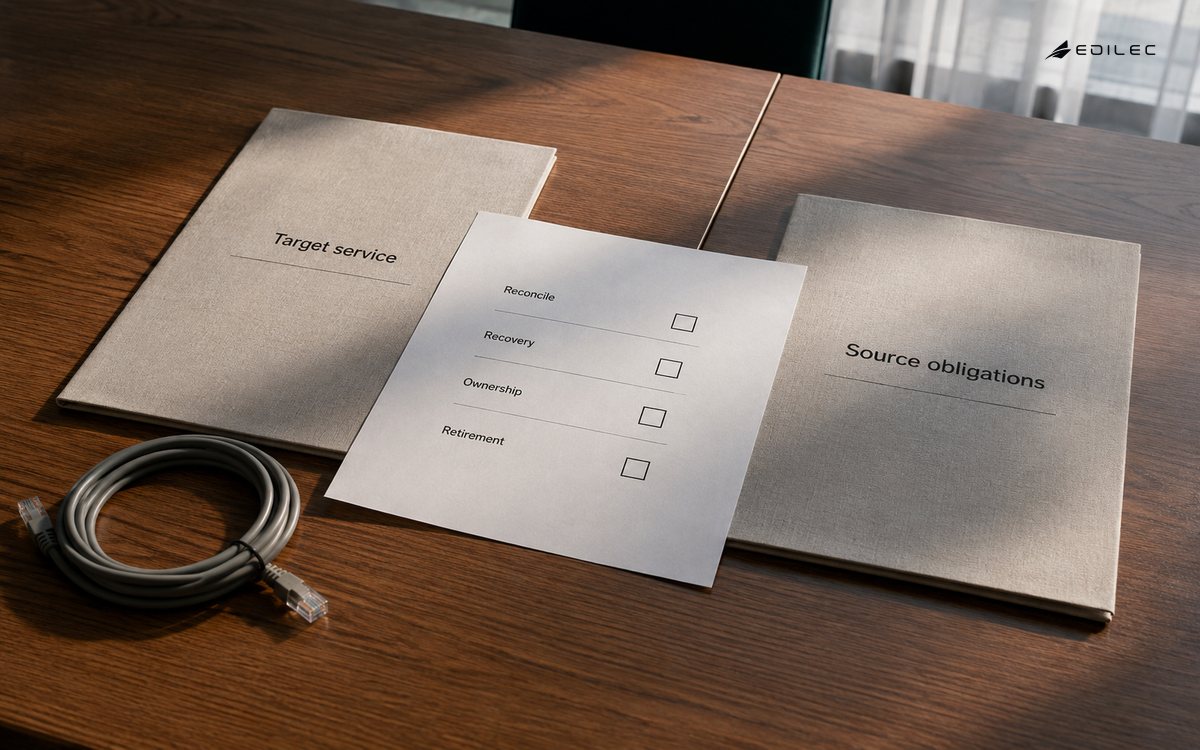
Do not claim completion when virtual machines start. Reconcile records and queues, confirm service objectives and decommission old assets, licenses, network routes and credentials. Capture lessons into the platform and next-wave plan. Modernize only where the outcome justifies change; combining every migration with a full rewrite can delay evidence and multiply risk.
- Classify portfolio and dependencies.
- Approve target pattern and foundation controls.
- Rehearse migration and data reconciliation.
- Cut over with stop and rollback thresholds.
- Verify business journeys and recovery.
- Decommission old capability and improve the next wave.
Make cost a design and product decision
Implement allocation tags or account structures, budgets, anomaly detection and unit measures from the start. Review commitment discounts only after usage is understood. Architecture affects spend through data transfer, logging, replicas, idle environments, managed-service pricing and licensing. Show teams cost alongside reliability and product demand so optimization does not become indiscriminate resource cutting.
FinOps is a collaborative operating practice across engineering, finance and business. Forecast major changes, assign anomaly response and review waste such as unattached storage, oversized capacity and forgotten experiments. Measure cost per useful unit where possible. A lower bill is not success if latency, recovery or delivery deteriorates; report trade-offs and approved exceptions.
Engineer and test resilience across failure domains
Set service objectives and recovery requirements from business impact. Design backups, replication, queues, timeouts and degradation around actual provider and application failure modes. Multi-zone or multi-region architecture adds cost and complexity and should follow justified recovery needs. Provider availability does not ensure application recovery or data correctness.
Run restoration and failover exercises. Include expired credentials, quota exhaustion, region or dependency loss, bad deployment, ransomware and operator error. Verify customer communication, access and decision authority. Record recovery time and missing evidence. Keep exit and portability plans for critical data and configuration even when switching providers is unlikely.
Operate, measure and retire continuously
Give every workload a service owner, runbook, support route, patch and dependency process, access review, capacity plan and incident path. Monitor user journeys, saturation, queue age, security posture, configuration drift and cost. Alerts need severity, owner and action. Review provider changes and service limits. Protect break-glass access and test it without normalizing permanent privilege.
At regular value reviews, compare the original hypothesis with delivery speed, reliability, adoption, cost and support evidence. Decide whether to optimize, modernize, expand, retain or retire. Remove unused services, data, keys and network paths under policy. Cloud value compounds when the organization learns and standardizes; risk compounds when resources outlive ownership.
Approve each workload with a cloud service dossier
Before production, assemble the value hypothesis, dependency map, target architecture, shared-responsibility decisions, data classification, identity and network evidence, infrastructure definitions, migration reconciliation, service objectives, cost forecast, backup and recovery result, runbook and decommission plan. Link exceptions to an owner and expiry. Provider compliance reports can support assurance but do not prove the workload configuration or business process is correct.
Require the business owner, workload owner, platform, security, finance and operations representatives to accept their responsibilities. After the first operating period, compare unit cost, incidents, delivery speed and customer outcomes with the baseline. Decide whether the workload should be optimized, modernized, expanded or retired. This prevents migration completion from becoming a permanent substitute for value realization.
Include quota, capacity and regional availability checks for every managed dependency. Request increases before cutover, test throttling behavior and document which features are unavailable in recovery regions. Managed services can fail through limits as well as outages. The workload should shed optional demand, queue safely or present a clear degraded mode instead of retrying until cost and saturation compound.
Verify decommissioning as carefully as migration. Search for residual data copies, snapshots, DNS, certificates, service identities, firewall rules, monitoring, licenses and supplier contracts. Preserve records required for audit while revoking operational access. Compare the final run-rate with the approved forecast and explain variance. A workload that runs in cloud while its predecessor remains funded and reachable has not completed its business transition.
Maintain a current service catalog that shows approved cloud capabilities, owners, data classifications, regional availability, support level and retirement notices. Workload teams can choose supported patterns without rediscovering controls, while the platform team can see demand and remove offerings that no longer justify maintenance. Version the catalog alongside platform changes and migration guidance. Publish quotas, expected provisioning time, cost-allocation requirements and escalation routes with each offering. Sample real consumers periodically to confirm the documented path still works and does not drive teams toward unmanaged accounts or unsupported substitutes.
Key takeaways
- Tie each workload move to a measurable value hypothesis and guardrails.
- Choose an operating model with explicit business, platform, security and finance rights.
- Build identity, policy, observability and cost allocation before scale.
- Migrate in waves that reconcile data and decommission old capability.
- Test recovery and review value throughout the workload lifecycle.
Frequently asked questions
Is cloud always cheaper than on-premises?
No. Cloud changes the cost model and can improve utilization and managed capability, but architecture, licensing, transfer, support and governance determine total cost. Compare like-for-like service outcomes.
Should every workload be modernized during migration?
No. Modernize where it creates justified value or resolves a blocking constraint. Rehosting can be a deliberate step, but record the limits and the decision for later improvement.
Do we need multiple cloud providers?
Only when business, regulatory, resilience or product needs justify the added skills and controls. Avoid multicloud as a slogan; portability has different meanings for data, identity, applications and operations.
What proves a migration is complete?
Users complete critical journeys, data and financial records reconcile, recovery is tested, ownership is accepted and old infrastructure, access and cost are retired or explicitly retained.
Conclusion
What cloud services bring depends on how an organization implements and operates them. On-demand capability becomes value only when workload outcomes, platform guardrails, secure migration, cost accountability and tested resilience reinforce one another. A strong checklist closes the loop by measuring results and retiring resources whose purpose has ended.