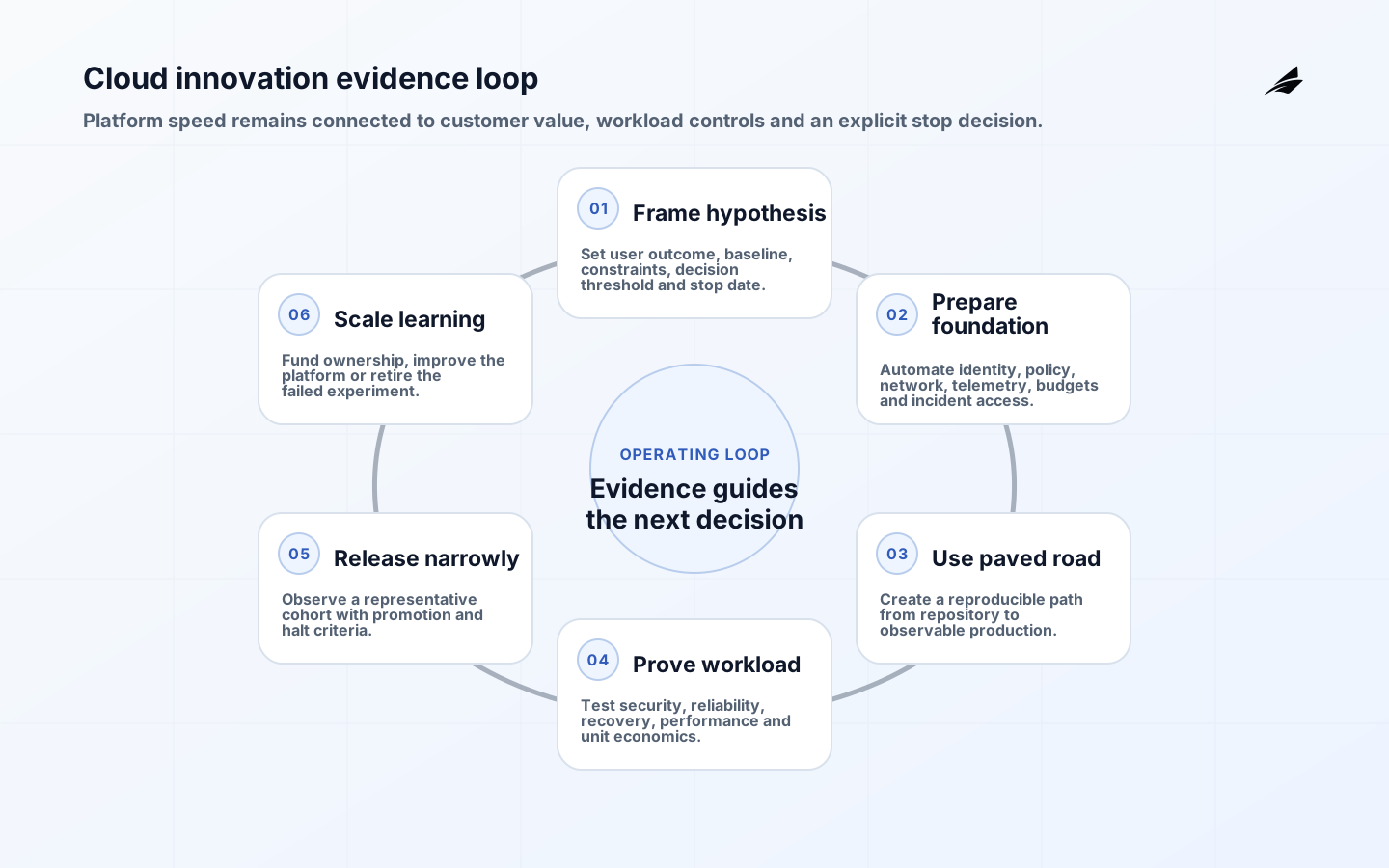
Cloud solutions empowering innovation do not create innovation by moving servers or opening an unlimited service catalog. They create useful leverage when a team can test a valuable hypothesis quickly inside clear security, reliability, data and cost boundaries. The implementation unit is therefore a product experiment on a production-capable platform, not a cloud account. This checklist links business evidence, platform readiness, delivery flow and operating responsibility so speed does not depend on bypassing controls.
Pair it with the cloud innovation scope and cost guide, the cloud innovation FAQ, the cloud solutions delivery plan and its implementation checklist. Keep business, platform, security, finance and workload owners involved, with one accountable owner for the customer outcome.
1. Approve a measurable innovation hypothesis
Name the user, unmet need, present baseline, proposed intervention and earliest evidence that would justify more investment. Define constraints and a stop date before choosing services. A useful hypothesis might target release lead time, experiment throughput, customer completion, forecast quality or time to recover; “use serverless” is a solution preference. Document data sensitivity, geography, availability, latency, integration and exit requirements. Select the smallest vertical slice that can test the risky assumption without pretending a disposable prototype is ready for sensitive production traffic.
| Decision | Evidence before build | Gate to continue |
|---|---|---|
| Customer value | Observed problem and baseline | Representative users complete the journey |
| Cloud fit | Demand, data, latency and skills profile | Chosen model improves a named constraint |
| Risk boundary | Impact, obligations and prohibited actions | Controls and owners are testable |
| Economics | Unit forecast with uncertainty | Measured unit cost supports the case |
| Operations | Minimum service and recovery target | Team can detect and recover failure |
2. Prepare a governed cloud foundation
Establish organization and account boundaries, federated identity, least-privilege roles, network and DNS patterns, approved regions, encryption and key ownership, centralized logs, configuration evidence, budgets and incident access. Express the foundation as version-controlled infrastructure and policy. Separate production from experimentation while giving experiments a legitimate path to approved data and services. A landing zone is a starting environment, not proof that every workload is secure; workload teams retain responsibility for application authorization, data use, resilience and service operation.
Provide automated environment vending and short-lived developer access. Default-deny controls should protect high-consequence boundaries, while advisory checks can guide lower-risk choices. Every exception needs an owner, rationale, expiry and compensating evidence. Test the foundation with a representative workload that uses identity, networking, secrets, telemetry, backup and cost allocation. The platform team should publish supported capabilities and response expectations as a product, then measure whether teams can use them without private setup channels.
3. Build a reusable delivery path
Create templates for repositories, infrastructure, build provenance, dependency scanning, tests, deployment, telemetry, runbooks and service ownership. Keep templates small enough to understand and allow justified escape routes. Use immutable artifacts promoted across environments rather than rebuilding production differently. Protect branches and production credentials, separate deployment authority from runtime identity, and preserve an audit trail. The first successful team should leave behind a documented capability that shortens the next team’s path, not a bespoke platform only its creators can operate.
4. Design and test the workload
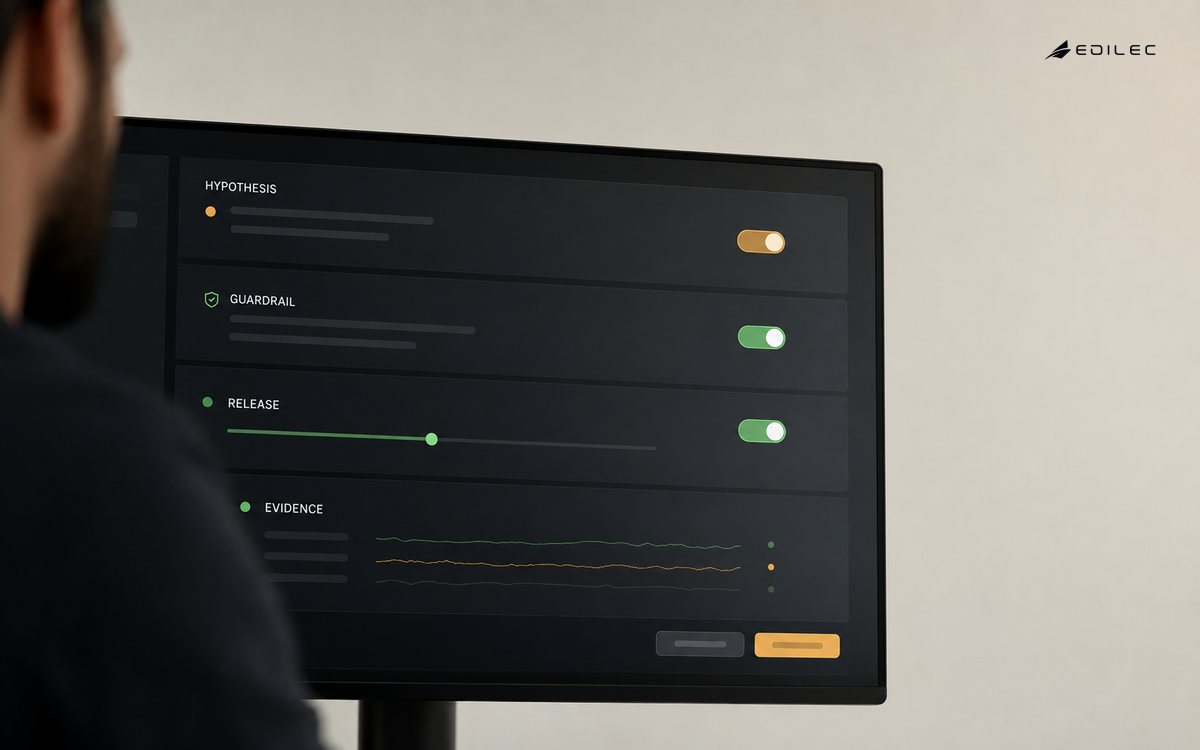
Review operational excellence, security, reliability, performance efficiency, cost and sustainability together, as the AWS and Google well-architected frameworks encourage. Define service-level indicators around the user journey, dependency timeouts, retries with jitter, idempotency, queue limits and degraded modes. Threat-model identities, data flows, administration and supplier boundaries. Test authorization at the resource level, restore from an isolated copy, validate capacity assumptions and inject credible dependency failures before exposing the workload broadly.
| Control area | Implementation evidence | Operational signal |
|---|---|---|
| Identity | Federation, scoped roles and reviewed service identities | Denied and privileged actions |
| Data | Classification, retention, encryption and deletion tests | Access anomalies and deletion failures |
| Reliability | Objectives, dependency policy and restore exercise | User success and error-budget use |
| Delivery | Reproducible artifact and progressive release | Lead time and change failure |
| Cost | Tags, allocation, budgets and unit model | Cost per useful transaction |
| Exit | Portable data, configuration and dependency inventory | Export and replacement exercise |
5. Release a bounded cohort and learn
Start with users who represent real demand and can receive close support. Define promotion, rollback and stop criteria before launch. Observe customer outcome, reliability, security, support effort, delivery flow and unit cost together. Reconcile cloud telemetry with business events so a technically successful request is not confused with a completed outcome. Record unexpected manual work and policy exceptions. When evidence contradicts the hypothesis, narrow or stop the experiment rather than increasing architecture complexity to defend the original idea.
Use feature controls or traffic segmentation to limit impact, but keep a tested data-reconciliation plan because code rollback does not automatically undo writes or external actions. Notify support and incident teams, set ownership for every alert and verify dashboard freshness. Review the first release within days, not at the end of a quarter. Decide explicitly whether to continue learning, harden for scale, redesign the hypothesis or retire the workload and remove data, credentials, resources and supplier commitments.
6. Scale the capability, not only the workload
A successful experiment enters a product lifecycle. Fund service ownership, capacity, vulnerabilities, dependency updates, accessibility, privacy requests, support, resilience exercises and cost optimization. Improve the platform using measured developer friction and recurring incidents. Track time from approved idea to first production evidence, adoption, outcome change, recovery, policy exceptions, unused resources and unit economics. Avoid ranking individuals by delivery metrics; use signals to improve the system that turns an idea into a safe service.
Run a 30-day innovation evidence review
Write a one-page experiment charter before creating cloud resources. State the user problem, current baseline, smallest testable change, eligible cohort, severe failure, maximum spend and decision date. Give each metric a data source and owner. For a document-intake experiment, for example, the outcome might be the proportion of complete cases ready for review within one business day, not the number of documents processed. Guardrails could include zero cross-customer disclosure, a maximum false-acceptance rate, a review queue limit and a fixed cost per accepted case. This prevents infrastructure activity from masquerading as validated demand.
During the first week, deploy through the paved road into an isolated environment and prove identity, data classification, logs, budget alerts, restore and emergency access. Use synthetic or approved data until the security and privacy owners accept the flow. Run the deterministic baseline and proposed solution on the same representative tasks. Record accepted outcomes, severe errors, review minutes, latency and unit cost. When the workload needs an exception to a platform control, document the reason, owner, expiry and compensating measure; recurring exceptions are evidence that either the workload is unsuitable or the platform product needs a deliberate change.
Release to a small, informed cohort only after technical acceptance. Review evidence at least twice during the bounded period, because a month-end average can hide a concentrated incident. Segment results by task type, user group and dependency version. Reconcile application events with the business system so retries and abandoned sessions are not counted as success. Support contacts, manual corrections and operator workarounds belong in the result. If the service improves cycle time but doubles specialist review, it has shifted cost rather than created the intended value. Maintain a live stop decision that any authorized owner can invoke.
At the decision date, choose among stop, extend the experiment, harden one capability or fund a product. Extension needs a newly named uncertainty and capped budget; it must not become a default response to weak results. Product funding requires an owner, service objectives, threat treatment, accessibility, support, capacity, supplier plan and recurring cost. A stopped experiment must delete resources, revoke identities, close commitments and retain only approved evidence. Feed reusable findings into templates and policies. The review succeeds when it changes a decision, including a well-supported decision not to scale.
Keep the evidence review auditable without making it ceremonial. Store the charter, architecture decision, control exceptions, evaluation definition, release version, metric query and final decision together. Recalculate a small sample from source events to catch dashboard or denominator errors. Ask a reviewer who did not build the experiment to explain why the evidence supports the decision. If that explanation depends on private context, the record is not yet durable enough for later investment, incident response or retirement review.
- Define the baseline, target, severe failure, cohort, spend ceiling and stop date.
- Use one evidence owner and an authoritative source for every release metric.
- Compare against a simple baseline on identical representative tasks.
- Count review effort, support work, exceptions and abandoned transactions.
- Require a new uncertainty and budget for any experiment extension.
- Retire failed resources and incorporate reusable learning into the paved road.
Key takeaways
- Start with a falsifiable customer hypothesis and stop rule.
- Prove the landing zone with a representative workload rather than policy documents alone.
- Offer reusable delivery paths with explicit ownership and escape criteria.
- Measure outcome, reliability, security, delivery and unit cost in one review.
- Retire failed experiments completely so abandoned resources do not become lasting risk.
Frequently asked questions
Do guardrails slow innovation?
Poorly designed approval queues do. Automated, risk-based controls and ready-made environments usually reduce waiting while making dangerous actions and exceptions visible.
Does innovation require multicloud?
No. Choose deployment boundaries from customer, regulatory, resilience and exit needs. Duplicating every service across providers can consume the capacity intended for learning.
When can a prototype enter production?
Only after ownership, data controls, security testing, observability, support, recovery and lifecycle cost meet the workload’s consequence. Rename and rebuild it when disposable assumptions cannot be removed safely.
What is the best innovation metric?
Use a small set: time to trustworthy customer evidence, the outcome changed, cost per useful outcome and the exposure created. No single infrastructure metric captures value.
Conclusion
Cloud innovation becomes repeatable when teams move through one evidence loop: frame value, prove the foundation, use a paved delivery path, test the workload, release narrowly and scale what was learned. This creates room for experimentation while keeping customer trust, operational ownership and financial decisions attached to every deployed idea.