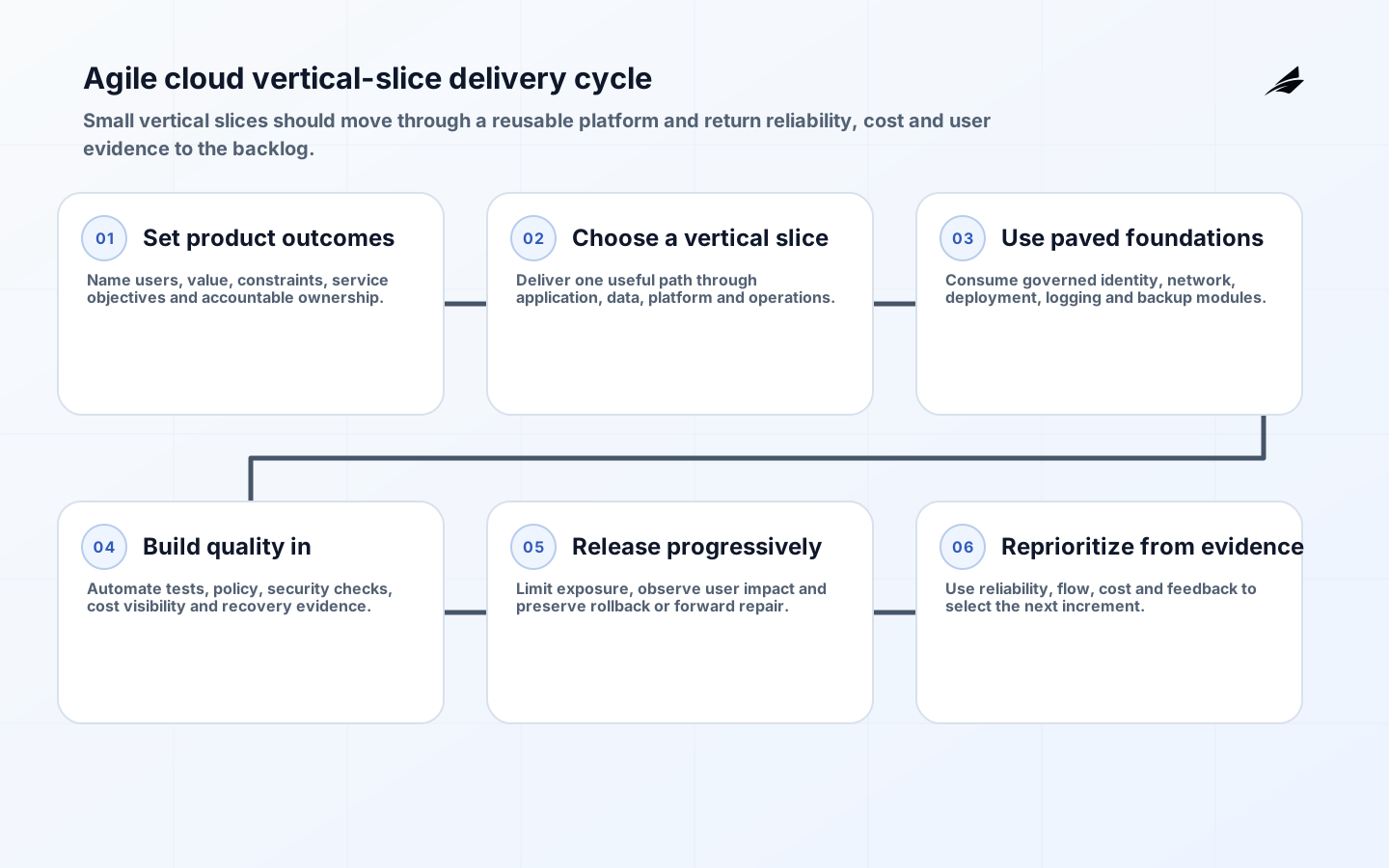
A cloud services agile implementation checklist is not a plan to divide a large migration into two-week infrastructure tasks. Agility comes from delivering a usable cloud outcome in a small slice, observing how it behaves, and changing the next investment from that evidence. A slice may be a deployable application path, a self-service platform capability or a recoverable data service, but it must reach the people who use or operate it. Backlogs full of accounts, networks and clusters can show activity for months without proving that delivery became safer or faster.
This playbook follows the scope choices in the agile cloud services delivery plan and complements the cloud services agile FAQ. It is intended for product, platform, security, operations and finance leaders working as one delivery system. The checklist preserves cloud governance and reliability inside each increment, so “agile” does not become a reason to postpone access controls, recovery or cost accountability until a transformation program is nearly over.
Give the cloud service a product boundary
Name the user and the decision the service improves. A platform landing zone might serve application teams that need an approved environment within hours; a migration slice might serve customers who need one journey to remain available during retirement of a legacy component. Assign a product owner with authority over value, risk and backlog order, plus technical owners for runtime operation. The owner should be able to decline cloud work that adds inventory but does not improve a user outcome, control or learning objective.
Write a short product intent containing target users, current friction, measurable outcome, service boundary, constraints and explicit non-goals. The principles behind the Agile Manifesto emphasize early delivery, working software, technical excellence and regular adaptation. For cloud services, “working” includes deployment, identity, telemetry, support and recovery. Architecture diagrams and provisioning scripts are inputs; a supported capability used successfully by a real team is evidence of progress.
| Question | Example answer | Evidence after release |
|---|---|---|
| Who receives value? | Teams launching regulated internal APIs | Named teams complete onboarding without bespoke access work |
| What changes? | Approved environments arrive in one business day | Lead time from request to usable endpoint |
| What must remain true? | Identity, logs and backups meet policy | Automated conformance and restore result |
| What is outside the slice? | Application redesign and data reclassification | Non-goals remain with named owners |
| What decides the next increment? | Adoption friction and failed control evidence | Backlog order references observed results |
Choose a thin path that reaches production
Map the end-to-end path from request or code change to a customer or operator outcome. Select the smallest coherent segment that crosses application, data, platform and operations. For migration, route one low-blast-radius but representative journey through the target environment. For a platform, onboard one real workload using a narrow self-service path. Include a meaningful dependency and exception so the slice tests the operating model rather than presenting an isolated demonstration.
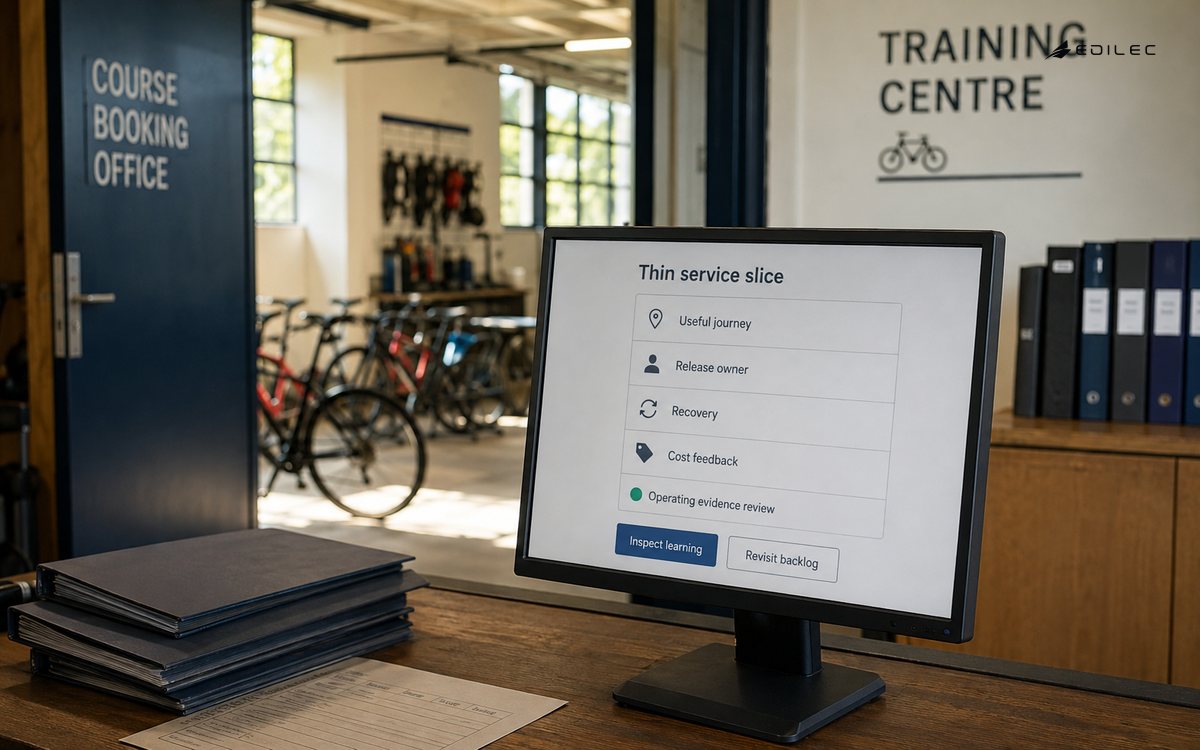
Keep decomposition vertical. Separate tickets can track networking, identity, deployment and observability, but they should converge on one accepted outcome within the increment. Horizontal waves that build all networks, then all clusters, then all pipelines delay integration risk and user feedback. Limit work in progress and finish one slice through support readiness before starting several more. When uncertainty is high, use a time-bounded discovery experiment with a decision and expiry, not an open-ended architecture phase.
Run the platform as a reusable service
Build paved capabilities for recurring needs: account or project vending, federated identity, network connectivity, secrets, deployment, policy evaluation, logs, metrics, backup and cost allocation. Each capability needs a supported interface, version, owner, service expectation, adoption documentation and deprecation path. Start with the needs observed in the first slices instead of attempting a universal platform. Standardization should remove repeated decisions while leaving product teams responsible for their application behavior and data use.
Track platform demand like product demand. Measure onboarding completion, wait time, failed requests, support burden, upgrade adoption and the proportion of teams leaving the paved path. Interview teams that build workarounds; their reasons often reveal missing capability, unclear documentation or a control that does not fit the workload. Avoid treating every request as a permanent option. A small platform team stays effective by offering a coherent service and publishing extension points, not by owning bespoke stacks for every application.
Put reliability, security and cost in the definition of done
For each slice, define customer-facing success, expected load, data classification, access model, observability, recovery target, cost owner and safe release method before implementation starts. Convert these into automated checks and acceptance exercises. Google's chapter on service level objectives starts from behavior users care about; use that approach to avoid declaring an increment healthy because resources exist. A successful request, durable write or completed business process is a better acceptance signal than CPU utilization alone.
Security and governance should supply reusable policy, threat patterns and fast consultation. Product teams should see policy results in their normal delivery path, with an owner and exception route. Estimate consumption before release, add allocation metadata at creation and set a practical anomaly threshold. A complete increment has enough evidence for an accountable person to accept its residual risk. Documentation, operational ownership and recovery are part of the deliverable, not follow-up tasks assigned after the team moves on.
Release gradually and read the resulting signals
Use feature flags, traffic percentages, tenant cohorts or parallel execution to limit exposure. Verify business results and system behavior at each step, then widen or stop. The AWS Operational Excellence Pillar promotes operations as code, small reversible changes and learning from events. In practice, the team needs a tested rollback or forward-repair path, an operator authorized to pause, and a record linking the observed release to the configuration and artifact that produced it.
Review delivery flow and stability together. The DORA Four Keys provide measures for deployment frequency, lead time for changes, change failure rate and recovery time. Use them at service or team level to identify constraints, not to rank individuals or reward change volume. Add product adoption, SLO performance, support demand and control outcomes. A fast pipeline that ships an unused capability or creates a recurring incident is not agile cloud value.
| Signal family | What to inspect | Backlog response |
|---|---|---|
| User outcome | Adoption, completion, wait time and qualitative friction | Simplify the path or change the capability boundary |
| Delivery flow | Lead time, queue time, batch size and deployment frequency | Remove the dominant handoff or automation gap |
| Stability | SLO consumption, failed changes and recovery duration | Fund reliability work or reduce release exposure |
| Governance | Policy failures, exceptions, access drift and restore evidence | Improve the paved control or resolve accepted debt |
| Economics | Forecast variance, idle capacity and unit cost | Tune architecture, allocation or service tier |
Let cloud economics reshape the backlog
Cloud cost is a design signal available soon after release. Allocate consumption to product, environment and major workload driver; then compare actual spend with the estimate and achieved outcome. The FinOps Framework brings engineering, finance and business roles into these decisions. A product owner should be able to choose whether lower latency, regional resilience or managed-service labor justifies the premium, while engineers explain the available technical options and their operational consequences.
Prefer unit measures that follow demand, such as cost per active tenant, transaction, build minute or processed record. Review idle resources and anomalies, but avoid optimization that damages lead time or reliability for trivial savings. Reserve discounts only after demand is understood, and keep architectural improvements in the same backlog as features and control work. Cost acceptance belongs in each slice because a design that is affordable for a pilot may fail when traffic, retention or regional replication grows.
Use a cadence that joins product and operations
Hold a brief weekly service review around evidence, not status narration. Product, platform and operations owners inspect user outcomes, SLO movement, delivery constraints, security exceptions, cost variance and unresolved support demand. Decisions should change backlog order, an operating policy or an owner. Keep a monthly architecture and investment review for cross-service choices that a delivery team cannot settle, such as retiring a platform version, changing a recovery tier or funding a shared capability.
- Demo a working path with its dashboards, controls and recovery evidence.
- Review the oldest blocked item and remove the system constraint behind it.
- Inspect one incident, exception or support pattern for product learning.
- Compare expected and actual consumption for the latest increment.
- Select the next slice from outcome evidence and retire stale backlog items.
Retrospectives should improve the delivery system itself. If approval waits dominate, clarify decision rights or automate low-risk policy. If teams repeatedly bypass the platform, repair the service gap before adding enforcement. If incidents cluster around large migrations, reduce slice size and improve compatibility tests. Assign each improvement an owner and verify its effect in subsequent work. Reflection without an observable process change is only a meeting record.
Scale by proven patterns and end the program deliberately
Expand a capability after several different workloads have used it successfully, not after the first pilot. Package the learned pattern as modules, policy, examples, support routes and migration guidance. Train domain teams through real onboarding and contribution, then federate ownership where boundaries are stable. Protect platform maintainers from becoming a ticket queue by keeping self-service interfaces and product feedback central. Variation that serves a real domain need can remain; accidental variation should be migrated or retired.
A transformation program should have closure conditions. Define which workloads will move, which will remain, what legacy assets can be retired, who funds the platform and which teams own steady-state reliability. Reconcile temporary connections, duplicated data, migration tools, elevated access and transitional contracts. Publish unresolved debt with owners and dates. The work is finished when ordinary product governance can prioritize cloud services without a separate transformation office holding the system together.
Key takeaways
- Define cloud capabilities around a user and an observable service outcome.
- Deliver vertical slices that include application, platform and operational readiness.
- Grow the platform from repeated demand and manage it as a supported product.
- Include reliability, security, recovery and allocation in every increment.
- Combine user, flow, stability, governance and cost evidence when reprioritizing.
- Scale proven patterns and close temporary transformation structures explicitly.
Frequently asked questions
Does agile cloud delivery require Scrum sprints?
No. Teams may use Scrum, Kanban or another flow model. The essential behavior is to deliver small complete outcomes, expose constraints, obtain real feedback and change priorities. A sprint boundary does not compensate for horizontal work that never reaches a user.
How much architecture should happen before the first slice?
Decide the costly or irreversible boundaries needed to proceed safely, such as identity, data location and connectivity, then test the design through a representative slice. Defer choices that can be made with better evidence later and record the assumptions that would trigger reconsideration.
Can regulated cloud work still be agile?
Yes. Translate obligations into reusable controls and evidence, involve control owners early and deliver bounded increments that can be assessed. Small changes can improve traceability and reduce review risk when the approval model is proportional and explicit.
Conclusion
Agile cloud services emerge from a delivery system that can finish small, useful increments. Product ownership defines value, the platform removes repeated work, and each release carries the identity, telemetry, recovery, security and cost evidence needed for real operation. Feedback then changes the next slice instead of merely decorating a fixed migration schedule.
The practical test is straightforward: a team can use the capability, operators can support it, owners can explain its risk and economics, and the organization can stop or redirect investment without abandoning half-built foundations. That is how cloud delivery becomes adaptive while remaining accountable.