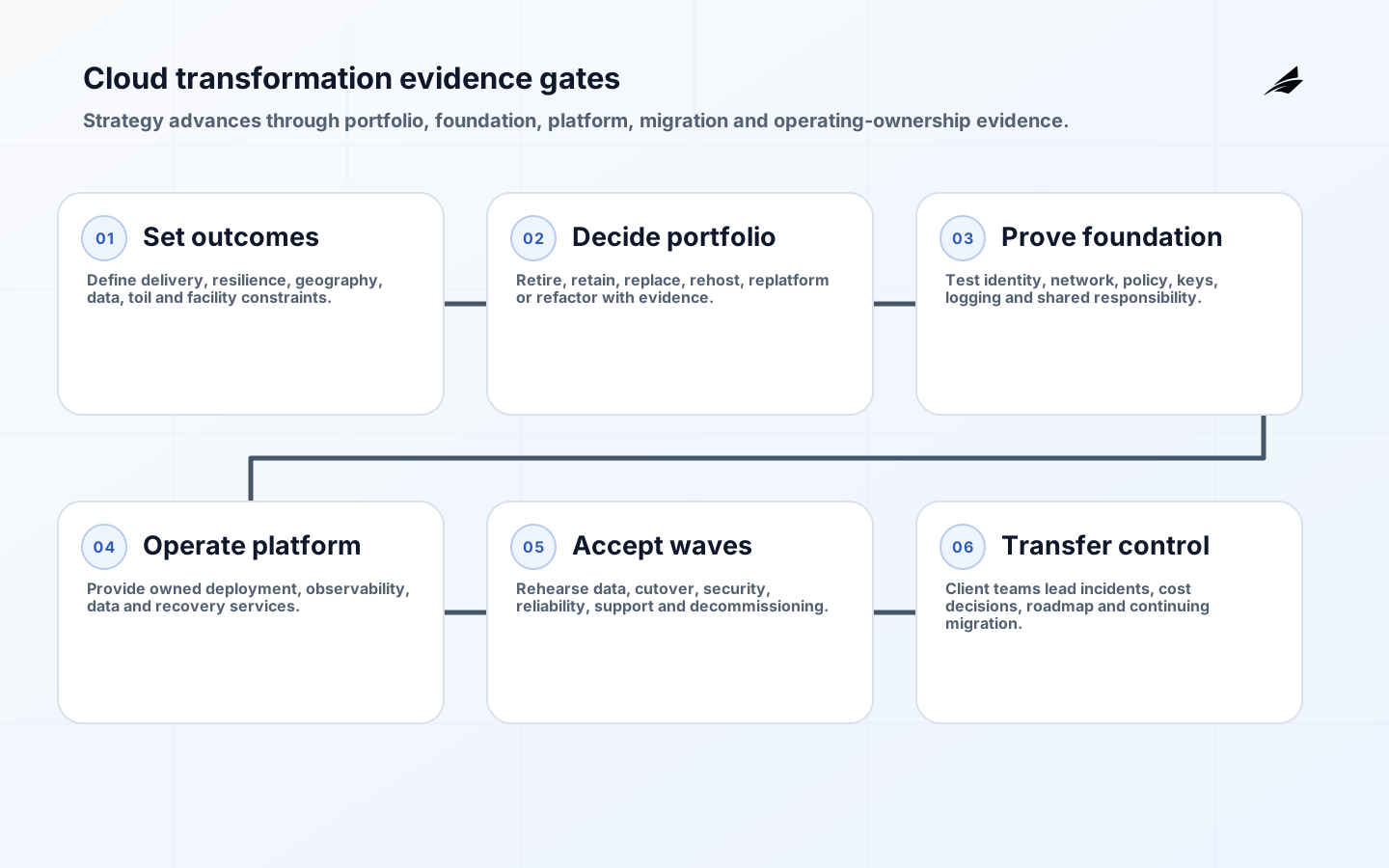
Consulting cloud transformation should change how an organization delivers and operates digital services, not simply move servers. NIST defines cloud through capabilities such as on-demand self-service, resource pooling, rapid elasticity and measured service. Those capabilities create leverage only when portfolio decisions, security, reliability, finance and team ownership change with the technology.
This implementation checklist gives client and consulting teams evidence gates from strategy through transition. It avoids the common pattern in which a target architecture is approved without a funded migration, product owners or operating controls. Each phase should produce decisions the organization can continue without permanent consultant dependence.
1. Define transformation outcomes and constraints
Name the constraints cloud should improve: environment lead time, release frequency, resilience, geographic reach, data capability, platform toil or facility exit. Establish current measures and a target horizon. Avoid “cloud-first” as the outcome. Some workloads may remain, retire or move to software services.
Record regulatory, data residency, latency, licensing, contractual, recovery and workforce constraints. Identify the executive sponsor and accountable technology and business owners. Set principles for managed services, provider concentration and portability. Define how exceptions are approved and reviewed.
2. Build a dependency-aware portfolio
Inventory applications, owners, users, data, integrations, environments, cost, lifecycle, incidents, recovery needs and technical health. Validate the inventory against network, identity, monitoring and financial records. Group tightly connected systems so a migration plan does not separate an application from the services it needs.
Choose a disposition for each workload: retire, retain, replace, rehost, replatform or refactor. State the business reason and preconditions. Rehosting may meet a data-center deadline; replatforming may reduce operating work; refactoring may enable scale or resilience. Do not turn every application into a modernization program.
| Disposition | Use when | Evidence before approval | Primary risk |
|---|---|---|---|
| Retire | Capability is unused or duplicated | Usage and dependency confirmation | Hidden consumer |
| Retain | Placement still fits constraints | Cost, lifecycle and risk rationale | Deferred debt |
| Replace | SaaS meets the business need | Process and data fit | Vendor dependency |
| Rehost | Time or facility exit dominates | Compatibility and cost model | Debt remains |
| Replatform | Managed capability reduces toil | Service limits and migration test | Lock-in or behavior change |
| Refactor | Business outcome needs redesign | Funded product case | Scope and delivery risk |
3. Establish a secure cloud foundation
Design account or subscription boundaries, organization policies, identity federation, privileged access, network connectivity, DNS, regions, encryption, key management, secrets, logging and policy enforcement. Separate production and non-production. Provision through reviewed infrastructure code and protected pipelines.
NIST SP 800-144 recommends planning security and privacy before implementing public cloud. Map shared responsibility per service. The provider may operate infrastructure or runtime, while the customer still controls identities, configuration, applications, data and use. Test guardrails through real deployment paths and document controlled exceptions.
4. Create platform services with product ownership
Offer repeatable paths for environments, deployment, observability, secrets, data services, backups and policy. Treat the platform as a product with users, roadmap, service objectives and support. Standardize common controls while allowing justified workload variation. A landing zone that only a consultant can modify is not a sustainable platform.
Measure adoption, environment lead time, failed provisioning, exceptions and team satisfaction. Provide documentation, examples and consultation. Keep platform abstractions thin enough that workload teams can diagnose behavior. Retire unused golden paths rather than accumulating layers that obscure the cloud service.
5. Select and rehearse migration waves
Choose a representative pilot that matters but can be recovered. Validate identity, connectivity, deployment, monitoring, support, performance and cost. Then group waves by dependency, business calendar and learning. Do not use application count as the only progress measure; migrated capability must be accepted and old infrastructure retired where intended.

Create a runbook for data transfer, synchronization, cutover, verification, communication, abort and rollback. Rehearse with realistic volumes. Reconcile records by identity, count, value and freshness. Preserve evidence that recovery objectives and customer journeys were tested, not only that resources were created.
| Area | Evidence | Abort condition |
|---|---|---|
| Function | Critical journeys pass | Material workflow failure |
| Data | Count, value and permission reconciliation | Unexplained mismatch |
| Reliability | Load, failover and restore exercise | Objective cannot be met |
| Security | Access, configuration and logging review | Uncontrolled exposure |
| Operations | On-call, runbook and provider escalation | No accountable response |
| Cost | Forecast and allocation tags | Unowned material variance |
6. Engineer reliability and recovery
Define indicators and objectives around successful customer work, latency and freshness. Map zones, regions, identity, network and third-party dependencies. Choose redundancy from approved recovery needs. Test timeout, retry, queue and idempotency behavior so partial failure does not create duplicate work or cascading load.
Backups are not complete until restored and reconciled. Exercise provider, region and identity outages. Define degraded service and decision authority. Track detection, restoration and full business recovery separately. Connect incidents and objective burn to platform and architecture improvements.
7. Embed financial accountability
Create ownership tags, budgets, anomaly detection and allocation before scale. Measure cost by product, environment or business transaction where useful. Forecast data transfer, managed-service, support and observability charges. Rightsize from evidence and schedule disposable resources without weakening availability.
The FinOps Framework emphasizes collaboration among engineering, finance and business around value. Give teams timely cost information and decision authority. Pair savings with reliability and delivery measures. Commit discounts after usage stabilizes, and include decommissioning so transformation does not pay for old and new indefinitely.
8. Define the cloud operating model
Assign responsibility among platform, product, security, operations, finance, procurement and providers. Define service intake, architecture decisions, exceptions, on-call, incidents and vulnerability response. Product teams remain accountable for workload behavior; platform teams provide paved paths and shared controls.
Set forums by decision: operational health, platform roadmap, portfolio investment and risk. Avoid a central cloud team becoming an approval bottleneck. Automate deterministic policy while keeping accountable review for material exceptions. Record decisions and expiry.
9. Transfer skills and organizational ownership
Assess skills by role and upcoming work, then combine training with paired delivery. Client engineers should build and operate the pilot under guidance, not merely attend courses. Include product owners, finance, security and support because cloud choices change their decisions too.
Keep architecture records, code, runbooks, cost models and risk evidence in client-controlled systems. Define when consultants step back and how specialist support continues. Test handover through deployment, incident and restore exercises led by client teams. Revoke temporary access at transition.
10. Govern benefits and remaining decisions
Track environment lead time, deployment, objective attainment, recovery, exposure, policy exceptions, unit cost, decommissioning and team adoption against baseline. Separate migration output from business outcome. Explain variance and stop initiatives whose assumptions no longer hold.
Review provider roadmaps, concentration and exit. Preserve data export and service substitution plans for material dependencies. Portability does not require avoiding every managed service; it requires deliberate dependency, known switching cost and a credible continuity decision.
11. Govern the consulting engagement and exit
Define consultant authority, client counterparts, repositories, access, subcontractors and decision forums before foundation work. Consultants may propose standards and implement automation, while client owners approve architecture, risk and production changes. Use named accounts with expiry. Keep cloud organizations, billing, domains and source repositories under client control.
Measure the engagement through accepted platform and migration evidence, decision quality, resolved risk and client capability. Workshops and diagrams are inputs, not outcomes. Surface disagreements and assumptions in a decision log. Review whether methods are accelerating teams or creating a parallel governance layer that will disappear at contract end.
Plan exit from the beginning. Identify artifacts, open work, knowledge transfer, support period, credential revocation, data return and unresolved provider commitments. Have client teams lead the final migration, incident and restore exercises. Transformation is not complete while routine production decisions still require a consultant who holds unique knowledge or access.
Schedule a post-engagement review after teams have operated independently. Compare service objectives, platform demand, cost allocation, policy exceptions and unresolved migrations with the closure baseline. Correct gaps in ownership or documentation while context remains available. This review tests whether capability transfer survived ordinary work rather than only a rehearsed handover.
Related reading
Use Managed Cloud Architecture, the Cloud Migration Checklist, and Managed Cloud Services Scope and Cost to deepen platform and migration planning.
Frequently asked questions
Is cloud transformation the same as migration? No. Migration changes placement; transformation also changes delivery, platform, operating responsibility, finance and product capability.
Should every workload move? No. Use a portfolio decision based on value, dependency, lifecycle, risk and economics. Retain, retire or replace where appropriate.
What should consultants leave behind? Client-owned decisions, code, platform patterns, runbooks, cost models, risk evidence, trained teams and a clear remaining backlog.
How is transformation progress measured? Measure accepted capability and business outcomes such as faster environments, reliable services, controlled cost and retired legacy—not server counts alone.
Key takeaways
- Define measurable transformation constraints before selecting migration targets.
- Make portfolio decisions with dependencies and disposition evidence.
- Build secure foundations and platform products before broad migration.
- Rehearse data, cutover, recovery, operations and cost in each wave.
- Transfer authority and skills so the client can sustain the result.
Conclusion
Cloud transformation consulting is complete when the organization can choose, deliver, operate and finance cloud services with its own accountable teams. A dependency-aware portfolio, secure foundation, tested migration waves and measurable operating model turn strategy into durable capability. Consultant value lies in accelerating that learning and control, not becoming the permanent control plane.