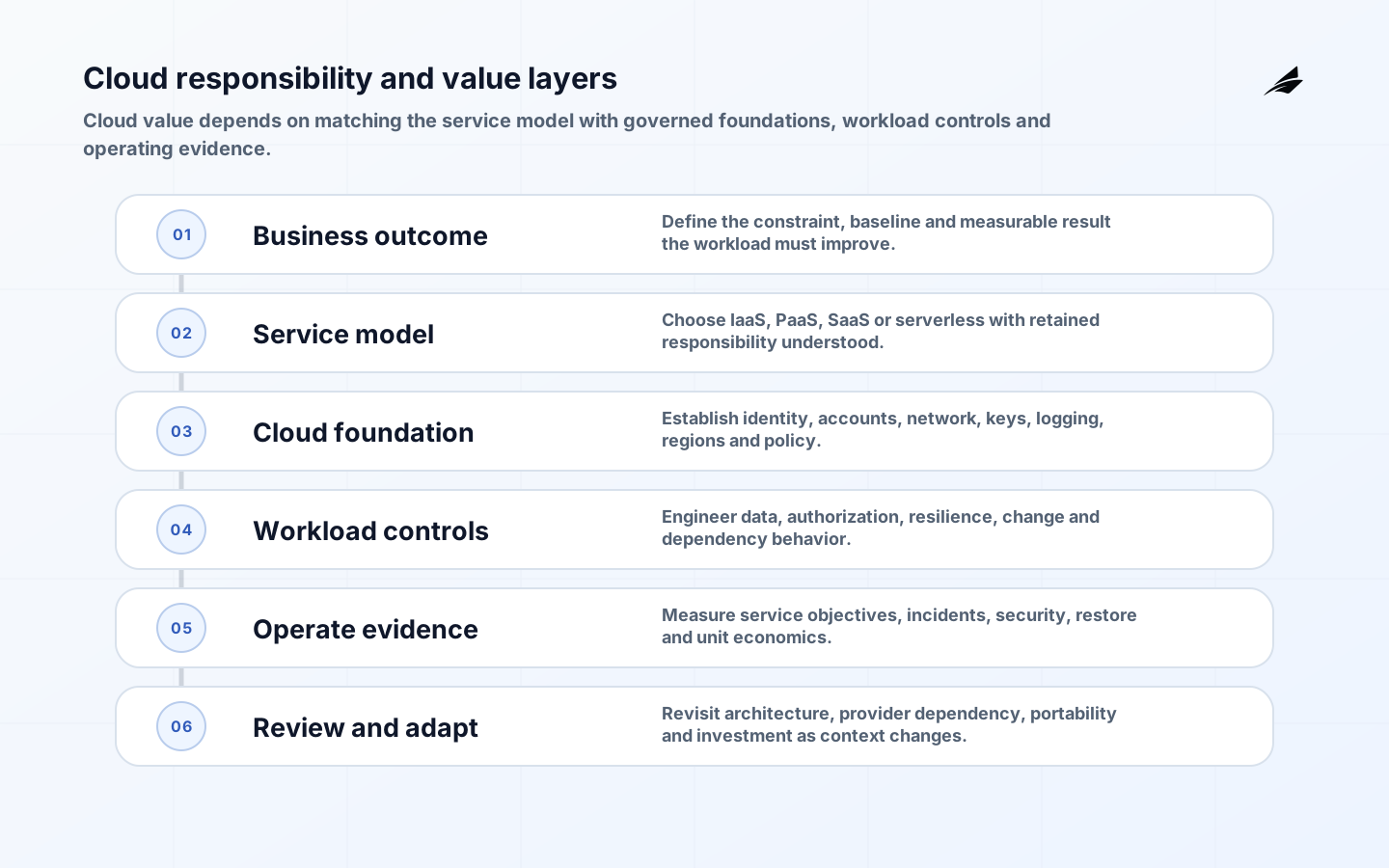
Cloud services for business provide on-demand access to shared computing resources that can be provisioned and released with less manual infrastructure work. NIST identifies characteristics including broad network access, resource pooling, rapid elasticity, measured service and on-demand self-service. Those capabilities can accelerate delivery, but only when applications and teams are designed to use them responsibly.
Cloud is not a single destination or an automatic cost reduction. Infrastructure, managed platforms and software services transfer different operating responsibilities. The business must still own architecture, data, access, configuration, continuity, supplier risk and customer outcomes. This guide explains the value cloud can bring and the controls needed to realize it.
Connect cloud capability to a business constraint
Start with a constraint such as slow environment delivery, limited geographic reach, unpredictable peaks, weak recovery or excessive platform toil. Define the outcome and baseline. A migration that leaves release lead time, reliability and ownership unchanged has moved infrastructure without delivering transformation.
Cloud can convert some capital planning into measured consumption, provide managed building blocks and make automation repeatable. It can also increase dependency, data-transfer cost and architectural complexity. Evaluate value per workload. Stable specialized hardware, strict locality or legacy licensing may favor a different placement than bursty digital services.
| Model | Provider commonly operates | Customer still owns |
|---|---|---|
| IaaS | Facilities, hardware and virtualization | OS, network configuration, applications, identity and data |
| PaaS | Infrastructure and managed runtime | Application, configuration, identity, data and use |
| SaaS | Application platform and service operation | Tenant configuration, users, data use, integrations and governance |
| Serverless | Runtime scaling and infrastructure | Code, permissions, event design, data and cost behavior |
Classify workloads before choosing a landing zone
Inventory applications, data, users, interfaces, availability needs, latency, regulatory constraints, skills, lifecycle and cost. Group dependencies so tightly connected systems are not migrated independently without a bridge. Identify authoritative records and data flows. Retire or consolidate unnecessary systems before paying to reproduce them.
Choose a disposition: retain, retire, replace, rehost, replatform or refactor. Rehosting can reduce data-center urgency but usually preserves operational debt. Managed services can reduce toil while increasing service-specific dependency. Refactoring deserves a business reason tied to scale, resilience or delivery, not a blanket preference.
Build a governed cloud foundation
Create account, subscription or project boundaries that separate environments and ownership. Establish identity federation, privileged access, network patterns, DNS, encryption, keys, secrets, logging, policy and approved regions. Provision through versioned infrastructure code. A foundation should make the secure path easier, while allowing documented exceptions.
Tag or label resources with owner, product, environment and cost allocation. Centralize audit evidence while preserving workload context. Protect organization-level administration and recovery access. Test guardrails against actual deployment workflows. Policies that engineers routinely bypass are not effective controls.
Make shared responsibility operational
The provider protects the parts of the service it operates; the customer configures and uses the service securely. The boundary changes by service. Managed databases remove hardware and engine operations but do not decide who can read business records, whether retention is lawful or whether application queries are authorized.

Create a responsibility matrix for identity, configuration, patching, vulnerability response, backups, restore, monitoring, incident notification and data deletion. Map provider evidence and contractual commitments to your controls. NIST cloud security guidance emphasizes understanding these responsibilities and assessing provider arrangements rather than assuming outsourcing removes accountability.
| Control | Design decision | Operating evidence |
|---|---|---|
| Identity | Federation and least privilege | Access and elevation review |
| Data | Classification, encryption and region | Key, access and lifecycle events |
| Resilience | Failure domains and recovery targets | Failover and restore exercise |
| Change | Versioned pipeline and policy | Deployment and exception record |
| Cost | Allocation and budget ownership | Unit cost and anomaly review |
Engineer reliability across failure domains
Define service-level indicators and objectives from customer journeys. Map regional, zonal and external dependencies. Use redundancy only where it meets an approved recovery need; duplicated components without tested failover can create false confidence. Design queues, timeouts, retries and idempotency so partial failure does not amplify load or duplicate work.
Backups must be isolated, retained and restored in exercises. Recovery time includes application, data reconciliation, identity and communication, not just resource creation. Test provider and identity outages, lost connectivity and destructive credentials. Document which degraded features remain available and who can declare recovery.
Protect data, software and the management plane
Use strong federation, MFA and time-bound privilege. Minimize public exposure and service permissions. Encrypt sensitive data, manage keys separately where risk requires and rotate secrets. Scan infrastructure, containers and dependencies. Centralize security events and preserve provider activity logs against unauthorized alteration.
Threat-model the management plane because compromised automation can change the entire estate. Separate build and production authority, protect pipeline credentials and approve high-impact policy changes. Review data egress, support access and subcontractors. Incident plans should coordinate provider escalation with internal containment and customer obligations.
Manage cloud economics continuously
Cloud bills reflect architecture and behavior. Establish allocation, budgets and anomaly detection before migration. Track cost by product, tenant or transaction where useful. Rightsize after observing demand, schedule non-production resources, manage storage lifecycle and review network egress. Commit discounts only after usage becomes predictable.
The FinOps Framework treats value as collaboration among engineering, finance and business. Pair spending with outcomes such as active customers, successful jobs or throughput. A cost reduction that harms reliability is not optimization. Give teams timely data and decision authority while retaining portfolio governance.
Migrate through rehearsed waves
Pilot a representative but recoverable workload. Build connectivity, observability, support and rollback before cutover. Rehearse data transfer and validate count, value, permissions and freshness. Define freeze, final synchronization, DNS or routing change, verification and abort thresholds. Avoid redirect chains and undocumented temporary bridges.
Move in waves based on dependency and learning. After each wave, compare reliability, release speed, security findings, cost and support burden with the baseline. Decommission old resources only after retention and recovery obligations are met. Update operating documentation from actual incidents and migration outcomes.
Create a cloud operating model
A platform team can provide approved patterns, automation, observability and consultation. Product teams own workload behavior and customer outcomes. Security sets guardrails and investigates risk; finance supports allocation and value decisions. Define support tiers, on-call, provider escalation and architecture exceptions.
Measure environment lead time, deployment frequency, objective attainment, recovery performance, security exposure, policy exceptions and unit cost. Review service changes from providers and test critical assumptions. Cloud adoption matures when teams can explain ownership and recover a workload, not when the account count grows.
Plan portability and provider exit realistically
Portability does not require every workload to run unchanged on every provider. It requires the organization to understand dependencies, preserve its data and configuration, and maintain a credible continuity or exit path for material services. Classify dependencies by substitutability, migration time, data-export method, contractual assistance and minimum service needed during transition.
Test exports for completeness, format, identifiers and encryption. Retain infrastructure definitions, application artifacts and operating documentation outside a single fragile control plane where appropriate. Review domain, certificate, key and identity dependencies that can block movement even when data is available. Confirm secure deletion and evidence after exit.
For a managed proprietary service, price the switching cost honestly against the value of reduced toil and faster delivery. Avoid rebuilding commodity platform functions solely for theoretical portability. Instead, put stable contracts around the business domain, keep authoritative data semantics explicit and select high-risk dependencies for contingency testing.
Provider governance should include roadmap changes, service deprecation, region availability, subcontractors, incidents and support performance. Review concentration across applications: apparent diversity may still depend on one identity, DNS or network service. The exit plan becomes credible when a tabletop or technical exercise proves the first actions and decision authority.
Keep an architecture decision record for major managed-service choices. State the workload need, alternatives, data and availability implications, expected operating reduction, portability constraints and review trigger. Revisit the decision after material price, scale, regulation or service change. This avoids two extremes: accidental lock-in that nobody accepted and expensive abstraction layers built without a credible exit scenario. Deliberate dependency is often reasonable when its value and contingency are visible.
Data governance continues after migration. Catalog sensitive datasets, owners, approved regions, retention and lawful use. Verify replication and backup locations against policy. Managed analytics and AI services can create additional copies, logs or indexes, so include them in lifecycle and deletion design. Periodically test that a retention or customer-deletion request reaches derived stores and exports rather than stopping at the primary database.
Related reading
Continue with Managed Cloud Architecture, Planning Managed Cloud Architecture, and the Cloud Migration Checklist for delivery details.
Frequently asked questions
Do cloud services always reduce cost? No. They may reduce capital investment and platform toil, but idle resources, data transfer, licensing and unmanaged consumption can cost more. Compare complete cost with reliability and delivery outcomes.
What is shared responsibility? The provider secures and operates defined service layers. The customer remains responsible for its configuration, identities, applications, data and use according to the selected service model.
Should every application move to cloud? No. Classify each workload by value, dependencies, latency, regulation, lifecycle and economics, then choose whether to retain, retire, replace, rehost, replatform or refactor it.
What should be tested before migration? Test connectivity, identity, monitoring, data transfer and reconciliation, performance, restore, failure behavior, provider escalation and the complete cutover rollback path.
Key takeaways
- Tie cloud adoption to a measurable business constraint.
- Choose a service model and workload disposition deliberately.
- Document shared responsibility for every material control.
- Test restore, failover, identity outage and migration rollback.
- Manage reliability, security and unit economics as continuing operations.
Conclusion
Cloud services bring elasticity, automation and managed capabilities, but value appears only through sound workload choices and disciplined operation. A governed foundation, explicit responsibility, resilient architecture, secure delivery and transparent economics turn cloud consumption into a dependable business platform. The result is not less ownership; it is better leverage over the parts the organization chooses to own.