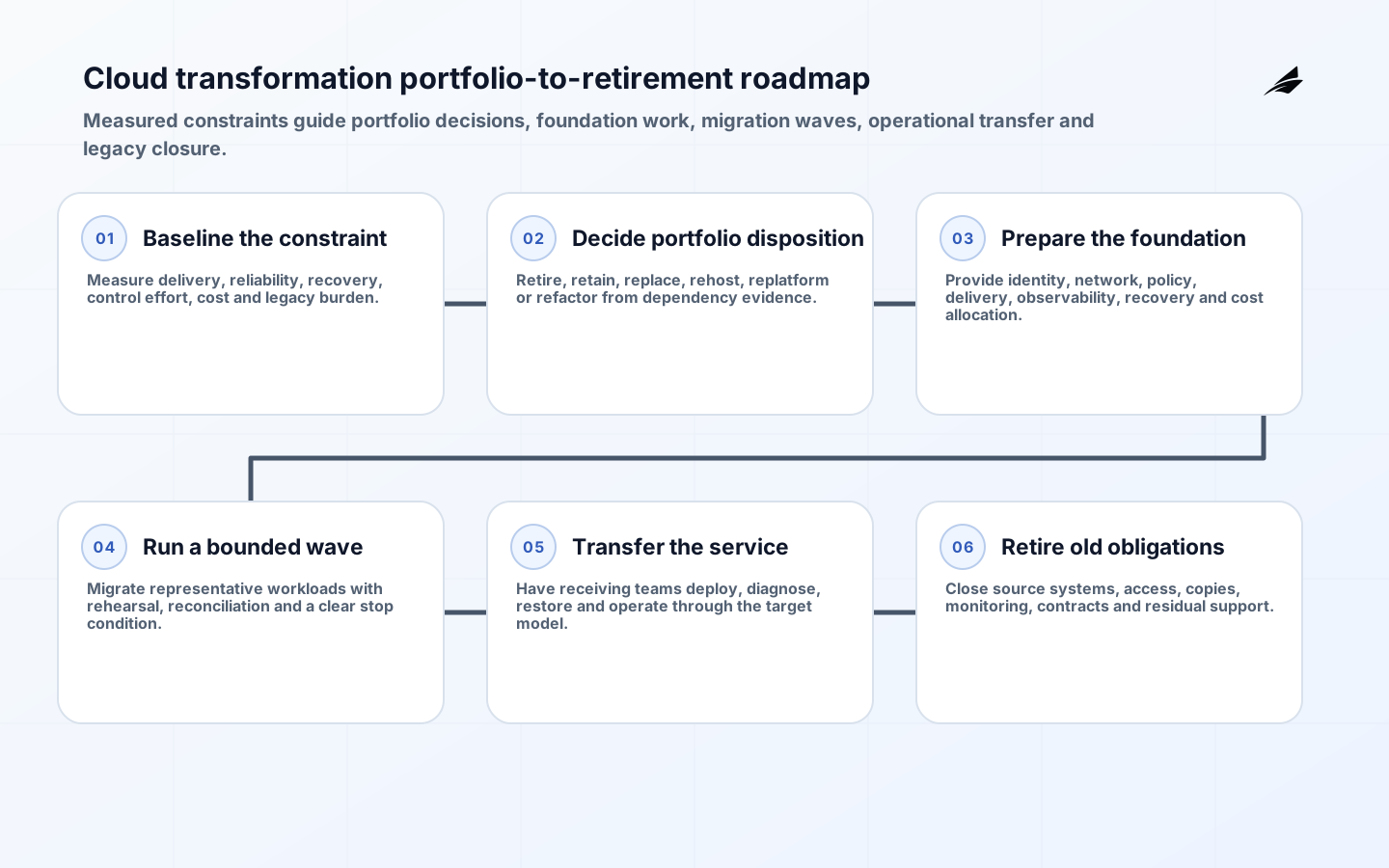
A cloud transformation solutions implementation checklist should connect a business constraint to an application change, a platform capability and an operating result. Moving servers to a provider does not by itself shorten delivery lead time, improve recovery or reduce product risk. Transformation occurs when teams change how applications are owned, released, observed, secured and financed, while removing the legacy obligations that no longer provide value. The checklist therefore begins with measurable outcomes and portfolio evidence rather than a migration-volume target.
This guide covers the path from baseline and application portfolio through landing zone, migration waves, modernization, data, security, FinOps and operational acceptance. Use it alongside the cloud transformation solutions scope and delivery plan and cloud transformation solutions FAQ. It is designed to produce decisions and evidence that survive changes in vendor or implementation tooling.
Set transformation outcomes and baseline evidence
Name the business capability being improved and the constraint visible today. Useful baselines include release lead time, failed-change recovery, environment wait time, customer-impacting incident minutes, batch completion, audit effort and cost per transaction. Record measurement definitions and owners before the program changes systems. Avoid a single cost-reduction promise; cloud unit cost can rise while the business gains valuable elasticity or delivery speed, and it can fall while reliability deteriorates.
Define guardrails for customer impact, data residency, regulatory commitments, service continuity and financial exposure. State which outcomes may trade off and who decides. A transformation charter should distinguish mandatory platform foundations from optional modernization. It should also identify nontechnical dependencies such as operating procedures, supplier contracts and skills. These constraints shape migration sequence and prevent architecture teams from optimizing only the target diagram.
| Outcome | Baseline evidence | Transformation acceptance |
|---|---|---|
| Delivery speed | Time from approved change to production by application. | Representative teams release safely through the new path within target time. |
| Reliability | Incident impact, recovery time and recurring failure classes. | Recovery exercises and production indicators meet the agreed objective. |
| Security | Control gaps, identity fragmentation and evidence effort. | Standard controls are active, tested and owned in the target environment. |
| Cost transparency | Spend mapped to products and demand drivers. | Owners can explain unit cost, shared allocation and material variance. |
| Legacy reduction | Systems, contracts and manual processes still required. | Source service and dependent obligations are formally retired. |
Build an evidence-based application portfolio
Create one record per application or service with owner, users, business capability, criticality, lifecycle, technology, interfaces, data classes, recovery objectives, cost and confidence. Map runtime and organizational dependencies: identity, DNS, certificates, schedulers, file exchanges, licensing, support and specialist knowledge. Automated discovery helps, but interviews and incident history reveal dependencies that traffic scans miss. Mark unknowns explicitly and fund investigation rather than converting assumptions into migration dates.
Choose a disposition for each application: retire, retain, replace, rehost, replatform, refactor or rebuild. The label is a hypothesis until tested against the outcome and dependencies. An application with low change demand may be safely rehosted; a revenue service constrained by release coupling may require decomposition or data change. Group decisions by business capability so the program does not modernize one component while leaving its critical handoffs unchanged.
Establish the cloud foundation before migration scale
Implement organization and account or subscription structure, federated identity, network and DNS, logging, key management, policy, backup, asset inventory and cost allocation. Package these foundations as reproducible code with conformance tests. A landing zone is a starting environment, not proof that every workload is secure. Define responsibility between platform and product teams for operating systems, managed services, secrets, vulnerabilities, recovery and incident communications.
Build a small catalog of workload patterns with deployment, observability and security integrated. Product teams should be able to request an environment through reviewed inputs and understand the controls applied. Keep exceptions visible and time-bound. Test platform failure modes before onboarding critical services: identity-provider outage, policy regression, network partition, logging interruption and unavailable build infrastructure. Emergency access must not depend entirely on the failed control plane.
Design migration waves around dependencies and learning
Create waves that are small enough to recover and broad enough to exercise the end-to-end platform. Sequence shared dependencies before consumers, but avoid moving every foundational service at once. Each wave needs entry criteria, migration method, data synchronization, change freeze, cutover, validation, rollback or forward-repair decision and source retirement plan. Rehearse with production-like volume and least-privileged identities. Treat business verification as part of cutover, not a later sign-off.

Use early waves to test assumptions about network latency, service limits, deployment, monitoring, backup, licensing and support. Feed findings back into platform products and estimates before increasing volume. Track blocked applications by cause; a recurring identity or data constraint is a program-level issue, not ten separate project delays. Maintain an authoritative migration state so finance, security, operations and application owners agree on which environment carries responsibility.
| Wave gate | Required evidence | Stop condition |
|---|---|---|
| Ready | Owner, dependency map, target pattern and recovery objectives are approved. | Critical dependency or data classification remains unknown. |
| Built | Target environment passes security, connectivity and observability checks. | Control exception lacks owner or expiry. |
| Rehearsed | Migration, validation and recovery run with representative volume. | Recovery exceeds the business window or loses required data. |
| Cut over | Users, integrations and service indicators confirm target operation. | Material reconciliation, latency or authorization defect appears. |
| Stabilized | Incidents, cost and performance remain within agreed bounds. | Recurring failures require continued source dependence. |
| Retired | Data, contracts, access and monitoring for the source are closed. | Unresolved consumer or legal-retention obligation remains. |
Control data movement and modernization decisions
For each dataset, identify authority, schema, quality rules, residency, retention, encryption, consumers and reconciliation. Define how changes are captured during migration and how conflicts are resolved. Database replication can move bytes without proving that downstream reports, permissions and business semantics still agree. Use checksums, row or object counts and application-specific controls together. Restrict production copies in test environments and preserve lawful deletion through temporary migration stores.
Modernize where it removes a measured constraint. Managed databases may reduce patching but can change extensions, backup behavior and network dependencies. Containers can standardize packaging without improving a tightly coupled release. Serverless services can scale efficiently but introduce quotas and event semantics. Record the expected benefit, architecture change, new failure modes and exit considerations for each decision. Prove the smallest end-to-end slice before committing the whole application.
Embed security and resilience in the target service
Map controls to identities, data paths, configurations and operating actions. Use federated access, least privilege, workload identity, protected secrets, encrypted transport and centralized evidence. Test public exposure, cross-environment access, administrative paths and supplier integrations. Preventive policy should be staged because an incorrect organization-wide rule can become an outage. Detective controls need accountable routing and response times; findings without owners become background noise.
Set availability, recovery time and recovery point by business service, then design redundancy and backup to those objectives. Provider availability does not guarantee application recovery. Exercise zone or region impairment, corrupted deployment, accidental deletion and unavailable identity or key services. Verify communications and decision authority during the exercise. Keep recovery artifacts and dependencies accessible when the primary platform is degraded.
Integrate FinOps and supplier controls
Allocate cloud spend to accountable products and expose demand drivers such as requests, users, data volume or environments. Establish budgets and anomaly routing, but focus on unit economics and business context rather than indiscriminate reduction. Commitments and reservations should follow stable demand and ownership. Shared platform costs need a transparent allocation rule. Product teams should see the cost effect of architecture and scaling decisions before release.
Review contracts for data location, support, incident notification, portability, minimum commitments, egress and termination. Transformation may replace one hardware dependency with several managed-service dependencies. Maintain an exit record for critical services: export format, configuration source, data volume, recovery keys and estimated transfer time. This does not require avoiding provider capabilities; it requires making concentration and switching risk an explicit business decision.
Transfer ownership before declaring completion
Define product, platform, security, service desk and supplier responsibilities for routine changes and incidents. Update support catalogs, on-call routes, runbooks, asset records and access reviews. Train through operation: have receiving teams deploy, observe, restore and troubleshoot the target service while delivery specialists are available. Classroom completion alone does not prove readiness. Record unresolved risks and temporary support arrangements with expiry dates.
Stabilization should compare target indicators with the original baseline. Investigate unexpected cost, latency, incident and manual-work changes. Close the migration only when the source environment, access, monitoring, contracts and data copies are retired or deliberately retained. Legacy decommissioning often creates the financial and security value promised by the program, so it needs its own owner and acceptance evidence.
Cloud transformation implementation takeaways
- Anchor the program in measured business, delivery, reliability and risk outcomes.
- Use a dependency-rich application portfolio to choose dispositions and sequence.
- Build identity, network, controls, observability and cost foundations before migration scale.
- Move through evidence-based waves with tested recovery and explicit source retirement.
- Modernize only when a change removes a defined constraint.
- Transfer operations and close legacy obligations before claiming transformation value.
Frequently asked questions
Should cloud transformation start with a landing zone? A fit-for-purpose foundation is needed before production scale, but outcome and portfolio work should begin in parallel so the landing zone reflects real workload needs rather than abstract standards.
Is rehosting a failed transformation strategy? No. Rehosting can be appropriate when time, hardware risk or data-center exit dominates. It becomes a problem when the program claims delivery or operating improvements that the unchanged application cannot produce.
How should progress be measured? Use accepted capabilities, production waves, target service indicators, control evidence, unit economics and retired legacy obligations. Server or application counts alone reveal little about the quality of the new operating model.
Conclusion
Cloud transformation is complete when applications operate through a safer, faster and more transparent model and the old constraints have actually been removed. A disciplined checklist connects outcomes, portfolio decisions, platform foundations, migration evidence, modernization, financial ownership and operational transfer. That connection keeps the program focused on durable capability instead of infrastructure movement.