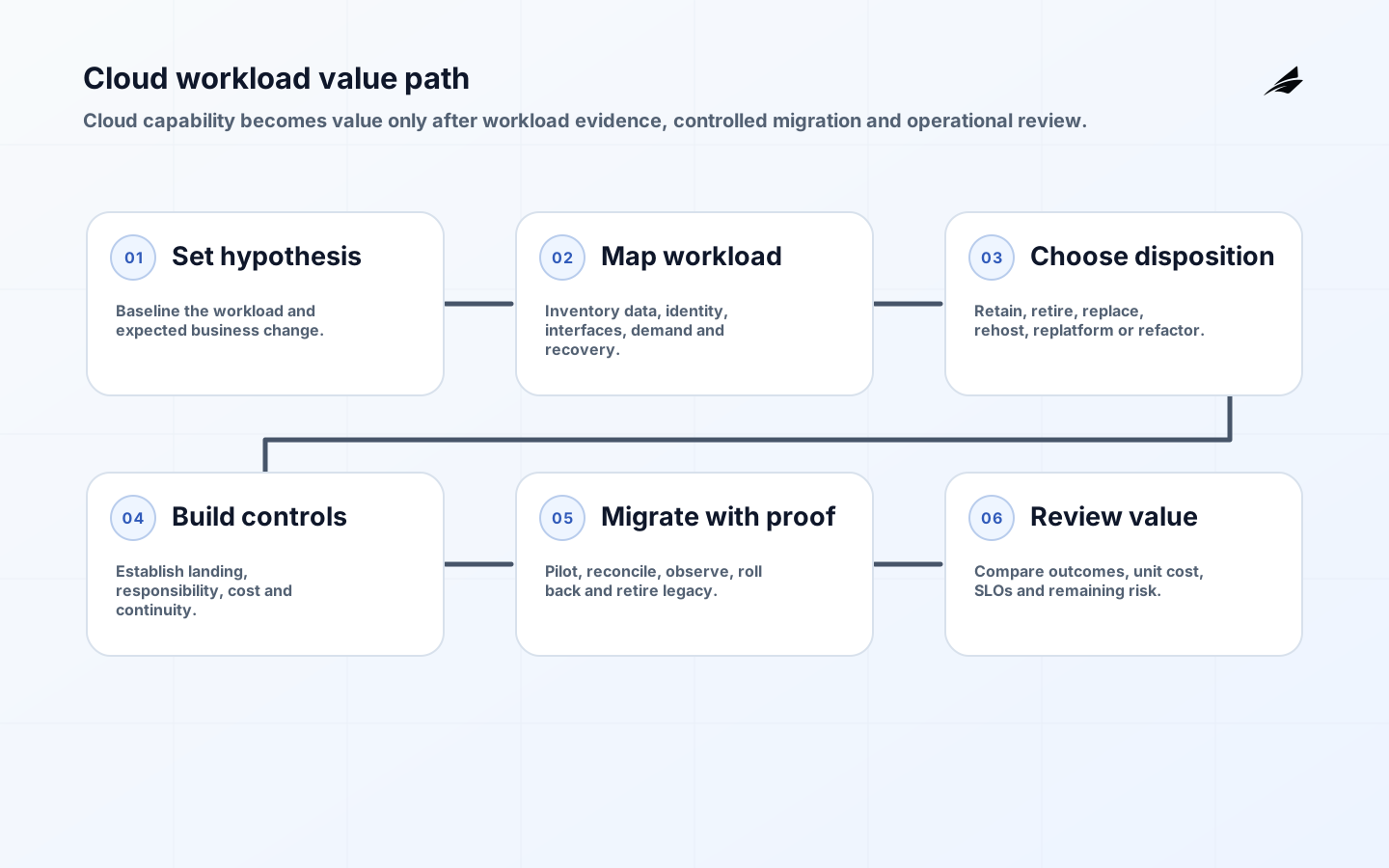
What cloud services bring is conditional, not automatic. On-demand provisioning, pooled resources, elasticity and measured use can shorten infrastructure lead time and expose consumption, but they do not by themselves improve an unsuitable application, weak ownership or unreliable delivery. A workload gains value only when the service model, architecture, controls and operating practices fit its users, data, demand and recovery needs. This plan turns a broad cloud ambition into workload-level decisions and acceptance evidence.
Pair this plan with the cloud value implementation checklist, the cloud services architecture FAQ and the small-business cloud DevOps plan. NIST's cloud definition distinguishes service and deployment models; use that vocabulary to clarify responsibility, not to assume that every workload belongs on public cloud.
Define the workload value hypothesis
Select a business capability and document its present baseline: release lead time, incident impact, capacity delay, availability, recovery evidence, unit cost and constraints. State the expected change and how it will be measured. Possible benefits include faster experimentation, managed platform capability, geographic reach, elastic demand or more automated recovery. Reject goals such as move to cloud or become scalable when they lack a user outcome and decision threshold.
Inventory application components, interfaces, data, identities, background jobs, licenses, operational dependencies and manual work. Classify data and applicable residency, retention and access rules. Identify latency, hardware, offline, sovereignty and supplier constraints. Map business criticality and recovery needs. This workload record prevents a visible web tier from migrating while an unexamined batch job, identity feed or file exchange remains the true constraint.
| Cloud capability | Potential value | Condition to verify |
|---|---|---|
| On-demand provisioning | Shorter environment lead time | Policy and automation support safe self-service |
| Elasticity | Capacity follows variable demand | Workload can scale and unit cost remains viable |
| Managed service | Less undifferentiated operation | Limits, exit and provider dependency are accepted |
| Global regions | Lower latency or stronger continuity | Data and service are available in required regions |
| Measured use | Cost visibility | Allocation metadata and owners are enforced |
Choose disposition and target architecture
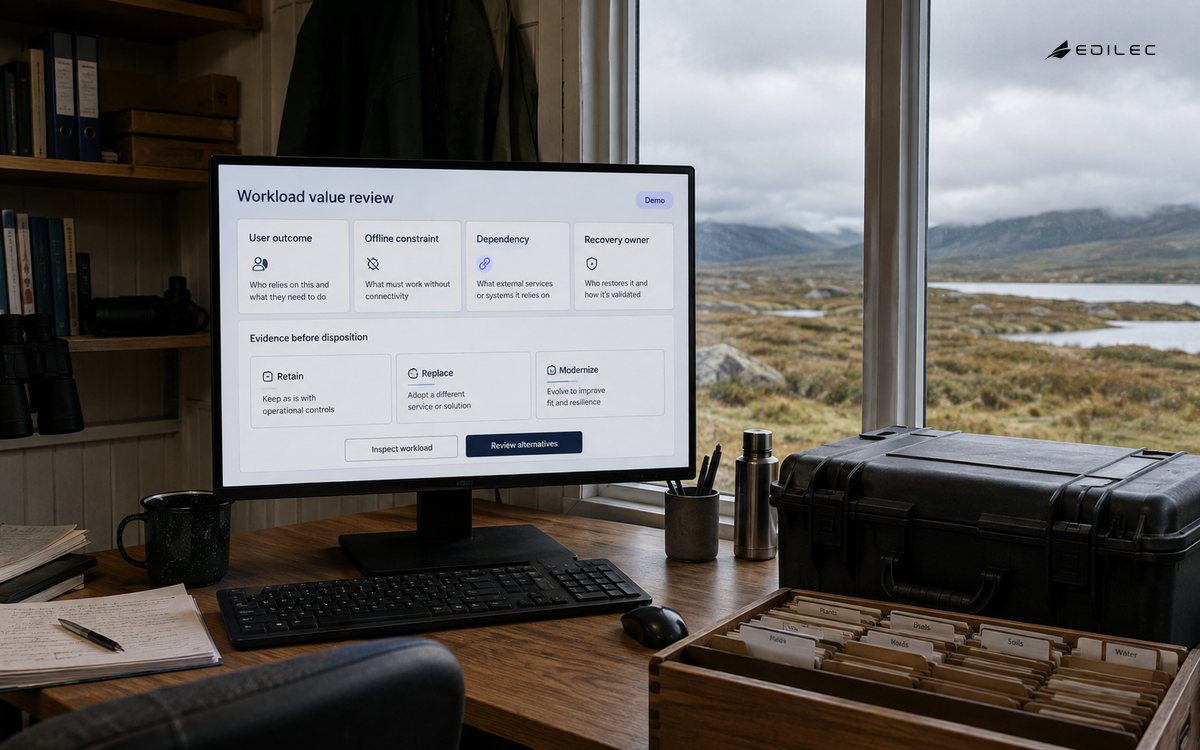
For each component decide whether to retain, retire, replace, rehost, replatform or refactor. Rehosting can meet a deadline but preserve operational burden; a managed service may reduce maintenance while increasing migration and dependency. Make the choice from evidence, not a universal modernization hierarchy. Design accounts, network, identity, keys, logging, backup, deployment and service boundaries together. Use provider well-architected guidance as review prompts, then tailor it to the workload and jurisdiction.
Document shared responsibility at the control level. A provider may secure physical infrastructure while the customer retains identity, data, configuration and application responsibilities. Managed services shift tasks but not accountability. Define who patches each layer, responds to alerts, restores data, approves privileged access, rotates keys and handles provider incidents. Test the boundaries through scenarios; a responsibility matrix that no operator has rehearsed will not resolve a production event.
Model total and unit cost
Build a workload model from traffic, compute shape, storage growth, operations, data transfer, requests, backup, logs, support, security services and environments. Include migration labor, dual running, data transfer, licenses, training and retirement. Use low, expected and high demand rather than one monthly number. Compare against the avoidable cost of the current state, not accounting totals that remain after migration. State currency, region, discounts, tax and price date.
Define unit economics tied to the product: cost per active account, transaction, site or data volume. Enforce ownership labels and budget alerts before migration. Commitments and reserved capacity can reduce rates for stable demand, but premature commitments transfer forecast risk to the buyer. Serverless and managed services can reduce operating effort while increasing variable charges. Include engineering time in the decision; optimize total value, not only the provider invoice.
Design security, privacy and continuity
NIST SP 800-144 recommends planning security and privacy before engaging public cloud services. Establish identity federation, least privilege, separation of duties, encryption, secrets management, secure baselines, configuration policy, vulnerability handling, logging and incident coordination. Protect the provisioning pipeline and cloud control plane. Avoid long-lived shared credentials and public exposure by default. Record provider subservices and locations that matter to legal or contractual obligations.
Set recovery objectives from business impact, then design backup, replication, failover and restoration accordingly. Multi-zone deployment is not the same as tested recovery, and multi-region architecture adds cost and complexity. Protect backups from workload credentials and destructive actions. Run restore and dependency-loss exercises before cutover. Document degraded modes and manual continuity where the business can operate safely without full service.
| Risk | Control before cutover | Evidence |
|---|---|---|
| Cost growth | Budgets, ownership and unit forecast | Scenario report and alert test |
| Privilege misuse | Federation, least privilege and access review | Denied-path and revocation test |
| Data loss | Protected backup and reconciliation | Timed restore exercise |
| Provider dependency | Export, replacement and exit design | Sample export or portability proof |
| Operational gap | Runbooks, telemetry and on-call ownership | Incident rehearsal |
Deliver through evidence-based waves
Create a landing foundation before workload migration: identity, account structure, network, policy, logging, keys, cost allocation and deployment automation. Pilot a representative but bounded workload. Validate normal use, security denial, load, restore, rollback, support and billing. Convert findings into improved platform patterns. A pilot that uses exceptional manual access and one-off configuration does not prove the repeatable path.
Plan subsequent waves by dependency and business risk, not server count. Define data synchronization, freeze, reconciliation, traffic shift, observation and rollback. Keep owners and communication ready during cutover. Retire old environments, routes, accounts and licenses after acceptance; otherwise expected savings and risk reduction will not appear. Update inventory and control evidence as part of closure.
Measure value and improve operations
After release, compare the original hypothesis with observed lead time, reliability, recovery, security, cost and user outcome. Review architecture as usage and provider capability change. Microsoft, AWS and Google frameworks all treat governance and optimization as continuing work. Assign improvement owners and preserve margin for reliability, security and cost work. A migration program ends; cloud service ownership does not.
Use SLOs and error budgets for reliability decisions, unit cost and forecast variance for financial decisions, and policy exceptions and access age for governance. Review major provider changes and price shifts. Keep exit artifacts current enough to be useful. Optimization that removes resilience or staff capability can increase total exposure, so test each change against workload objectives rather than celebrating a percentage reduction in isolation.
A ten-step workload adoption procedure
Use one decision record per workload and update it at discovery, pilot, cutover and value review. This procedure keeps business value, architecture and operating ownership connected while allowing different components to take different migration paths.
- Name the workload owner, user outcome, current baseline, cloud hypothesis, protected constraints and stop criteria.
- Inventory components, interfaces, data, identities, schedules, licenses, operators, failure dependencies and current recovery evidence.
- Classify information and document jurisdiction, residency, retention, encryption, access, records and supplier obligations.
- Choose disposition for every component and record why retain, retire, replace, rehost, replatform or refactor best fits.
- Design the landing pattern, shared responsibility matrix, deployment route, telemetry, backup, incident and cost-allocation controls.
- Forecast migration and recurring cost under low, expected and high demand, including dual running and legacy retirement.
- Build a representative pilot through normal provisioning and authorization rather than relying on privileged one-off configuration.
- Test user journeys, denied access, peak load, dependency failure, restore, rollback, support escalation and billing attribution.
- Cut over through synchronization, reconciliation, traffic control, observation and accountable rollback, then communicate the outcome.
- Retire old infrastructure and permissions, compare measured value with the hypothesis and fund remaining operational improvement.
Key takeaways
- Tie cloud adoption to a workload baseline and measurable business hypothesis.
- Choose retain, retire, replace, rehost, replatform or refactor component by component.
- Model migration, operation, engineering effort and exit as total cost.
- Make shared responsibilities executable through controls and rehearsed scenarios.
- Retire the old route and continue reviewing value after migration.
Frequently asked questions
Is cloud always cheaper?
No. It can improve elasticity, automation and access to managed capability, but cost depends on architecture, demand, operations, discounts and retirement of old spend. Compare total cost and business value.
Is rehosting a bad strategy?
Not when it addresses a real deadline or facility risk and the retained limitations are understood. Record whether later modernization is funded and avoid claiming benefits the rehost cannot deliver.
Does multicloud prevent lock-in?
It may reduce concentration for selected capabilities, but duplicated platforms can add cost and operational risk. Use portability and exit evidence targeted to material dependencies instead of assuming every workload must run everywhere.
Plan people and process change with the architecture. Application, platform, security, finance, procurement and support teams need clear responsibilities, training and access before migration. Update incident, change, capacity and vendor-management procedures to reflect provider boundaries. Measure blocked work and manual cloud operations during the pilot; they reveal missing platform capability. Avoid declaring transformation complete while teams still depend on a few migration specialists for routine releases, access or diagnosis.
Maintain a dependency and exit register for managed services. Record data format, interface, replacement options, export time, transfer cost, contractual support and the last tested evidence. Not every dependency needs active dual-provider deployment, but critical assumptions should be tested proportionately. Exit planning improves current incident and negotiation readiness even when migration is unlikely. Review the register after major architecture or provider changes.
Document modernization debt intentionally retained at cutover. Record obsolete runtimes, manual scaling, unsupported components, broad permissions and fragile integrations with owner, consequence and target decision. Migration can reduce one risk while preserving another. Making retained debt visible prevents the new cloud location from being mistaken for a completed architecture and gives later investment a defensible order.
Conclusion
Cloud services bring useful capabilities when architecture and operations convert them into a measured workload outcome. Define value, understand the workload, choose disposition, model total cost, establish shared controls, migrate in tested waves and measure the result. That is a cloud delivery plan; moving infrastructure without those decisions is only relocation.