Consulting cloud advisory strategy work should convert business goals and workload evidence into funded placement, governance and operating decisions. It should not end with a provider comparison or a generic maturity score. A useful engagement identifies what should move, modernize, remain, retire or be replaced; establishes the platform and control capabilities needed; and sequences change within the organization's skills, risk tolerance and financial constraints.
This guide is for executives, enterprise architects, security, finance and platform leaders preparing a cloud roadmap. Use the cloud advisory implementation checklist and cloud strategy FAQ for execution, then compare the broader cloud advisory scope guide when selecting engagement boundaries.
Set business outcomes and decision rights
Name the outcomes cloud change must support: faster product delivery, geographic expansion, data capability, resilience, data-center exit, security improvement or variable capacity. Attach a baseline, target indicator, guardrails and an executive owner. 'Move to cloud' is an activity. 'Reduce environment provisioning delay while meeting recovery and cost constraints' is a decision frame. Record constraints such as residency, latency, licensing, capital commitments and application end-of-life.
Establish who decides workload placement, exceptions, platform standards, security policy, financial commitments and risk acceptance. Include business, technology, security, finance, procurement and operations. Provider frameworks consistently connect strategy to organizational capability; Google emphasizes leadership, learning, scale and security, while Microsoft's current framework covers strategy, planning, readiness, adoption, governance, security and management. Use them as prompts, not as substitute governance.
| Advisory output | Decision enabled | Required evidence |
|---|---|---|
| Outcome charter | Why change and what success means | Baseline, owner, target and guardrails |
| Portfolio inventory | What to assess and in what order | Workload, dependency, cost and lifecycle data |
| Placement principles | Where workloads may run | Approved risk, value and constraint criteria |
| Target operating model | Who builds, governs and operates | Roles, service boundaries and escalation |
| Wave roadmap | What is funded next | Readiness, dependencies and acceptance gates |
Assess the portfolio and its dependencies
Inventory applications, data, infrastructure, interfaces, users, owners, service objectives, support status, security classification, spend, licenses and lifecycle. Map shared identity, network, database, middleware, batch, file-transfer and vendor dependencies. Validate records with service owners and telemetry; configuration databases often omit informal data flows and manually operated jobs. Unknown ownership and unsupported technology should be visible findings, not silently filled assumptions.
Group workloads by business capability and transition dependency, then assess value, technical health, risk, change windows and team readiness. Select a disposition such as retire, retain, replace, rehost, replatform, refactor or rebuild based on current evidence. Do not force a migration classification before understanding the desired business outcome. A stable system nearing retirement may be retained while a smaller bottleneck is modernized first.
Choose placement and architecture principles
Define principles for managed services, portability, data location, resilience, integration, identity and service ownership. Evaluate provider services against workload needs and exit constraints. Multicloud can satisfy specific regulatory, acquisition or product requirements, but duplicating every workload across providers usually increases identity, networking, observability, skills and recovery complexity. Portability should be purchased where its business option value exceeds that cost.
Use well-architected guidance from the selected provider to review operational excellence, security, reliability, performance, cost and sustainability, while retaining organization-specific controls. Decide the target resilience pattern from business impact and dependencies, not a default diagram. Define recovery point and time objectives, test method and degraded operation. Architecture decisions should identify assumptions and the evidence that would trigger revision.
Design the landing zone and guardrails
A landing zone should provide account or subscription organization, identity federation, privileged access, network patterns, logging, encryption and key services, policy enforcement, approved regions, tagging, budgets, image or artifact controls and incident integration. Build reusable workload onboarding paths through infrastructure as code. Separate platform and workload responsibilities so teams know which controls are inherited and which they must implement.
CISA's Cloud Security Technical Reference Architecture addresses shared services, migration and cloud security posture management. Translate relevant principles into control objectives and automated evidence. Guardrails should prevent high-consequence misconfiguration while giving product teams a supported path. An exception process needs owner, reason, compensating control, expiry and review; permanent undocumented exemptions become a parallel platform.
Define the cloud operating model and service catalog
Choose a model that fits current scale: centralized platform ownership, federated standards with product teams, or a deliberate hybrid. Define platform products such as accounts, network connectivity, deployment pipelines, observability, secrets, databases and backup as services with interfaces, objectives, support and lifecycle. A cloud center of excellence can accelerate standards, but it should transfer reusable capabilities rather than become an approval queue for every deployment.
Clarify incident command, on-call boundaries, vulnerability management, backup verification, change authority, supplier escalation and architecture governance. Build skills through paired migrations and operational exercises. Measure platform adoption, lead time, failed onboarding, policy exceptions, recovery tests and product-team satisfaction. Advisory work is incomplete if the roadmap assumes capabilities that no funded team owns.
| Risk | Advisory response | Acceptance evidence |
|---|---|---|
| Business case based only on hosting cost | Include delivery, risk, exit and operating value | Scenario model with stated assumptions |
| Hidden dependencies | Telemetry-backed service mapping | Owner-validated dependency map |
| Landing-zone overdesign | Start from first workload needs and scale triggers | Pilot workload passes onboarding |
| Shared-responsibility gap | Control ownership by platform, provider and workload | Control matrix with test evidence |
| Cost drift | Allocation, budgets, forecasts and anomaly response | Unit-cost dashboard with owners |
| Migration without operations | Runbooks, SLOs and failure exercises | Receiving team operates rehearsal |
Run the cloud advisory decision cycle
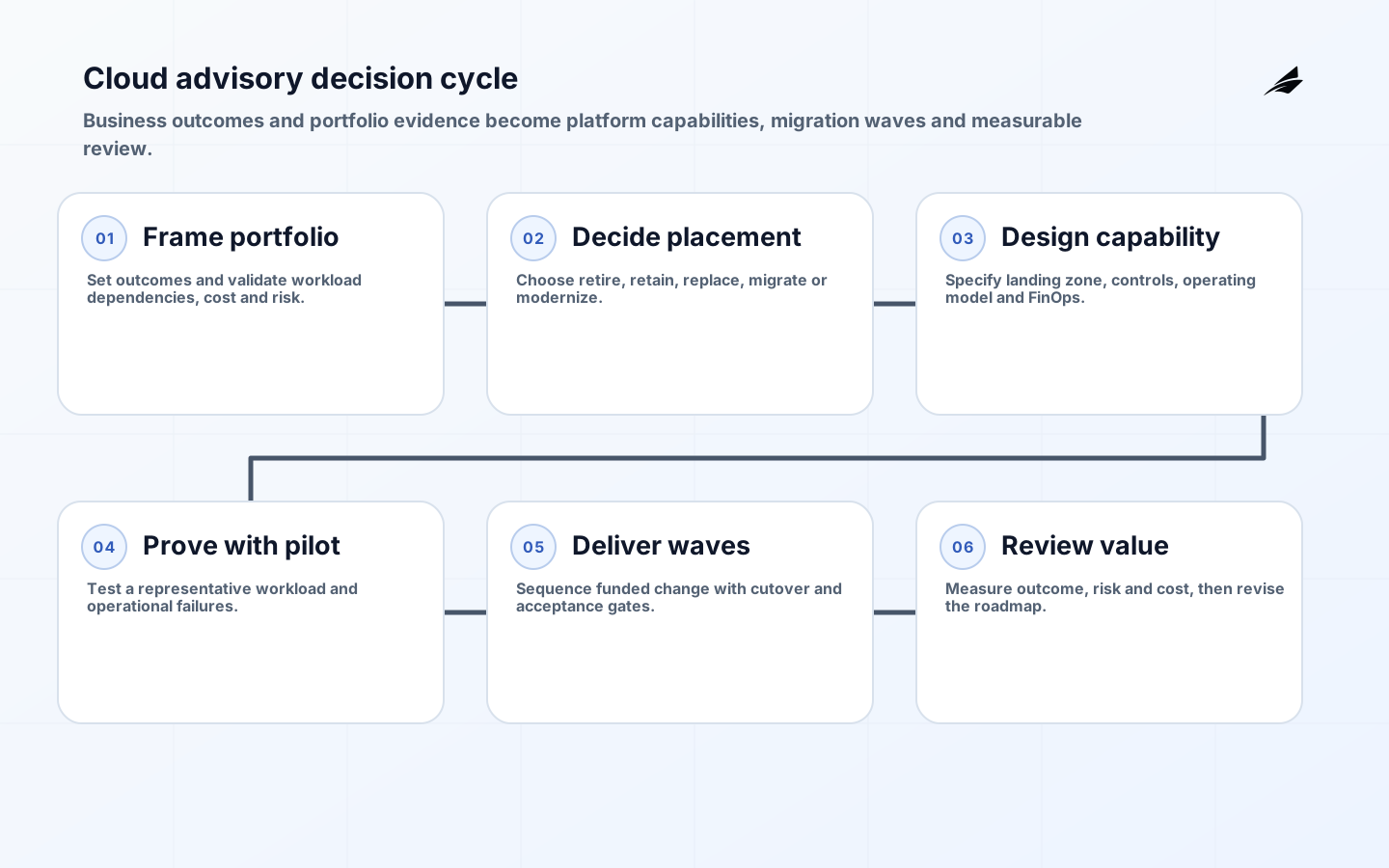
- Frame measurable business outcomes, constraints and decision authority.
- Discover portfolio, dependency, cost, risk and lifecycle evidence.
- Decide workload disposition and placement using approved principles.
- Design landing-zone, security, financial and operating capabilities.
- Prove the approach with a representative pilot and failure exercises.
- Sequence migration and modernization waves with explicit acceptance gates.
- Measure value, risk and cost, then revise the portfolio roadmap.
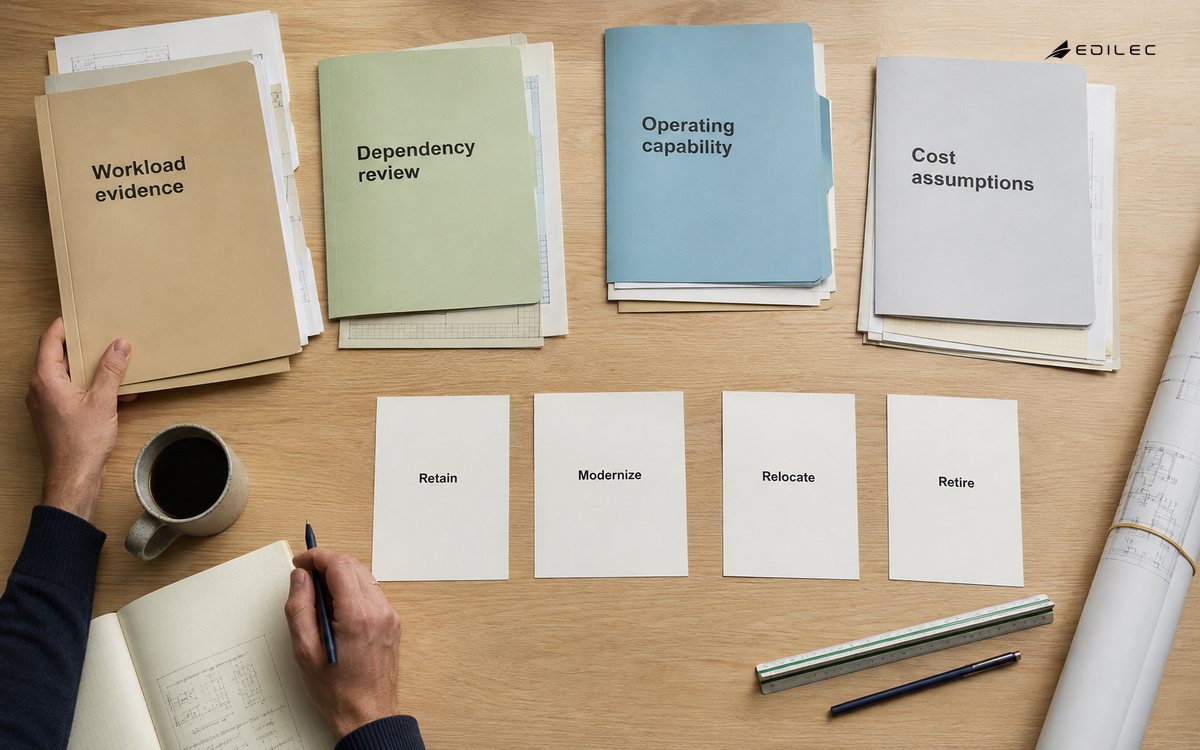
Select a pilot that is representative enough to test identity, network, data, deployment, observability and support, but bounded enough to recover. Define acceptance before build: customer behavior, service objective, security evidence, operating ownership and unit cost. Capture friction as platform backlog. A showcase workload that avoids every enterprise dependency may look successful while teaching little about the migration system.
Each wave should have business sponsor, service owner, dependency plan, data and security acceptance, cutover method, rollback or forward-repair criteria, support transition and benefits review. Include retirements and license exits; otherwise the program may add cloud cost without removing legacy cost. Reassess later waves with evidence from earlier ones rather than preserving an outdated multi-year sequence.
Build the cost model and FinOps practice
Separate advisory and transformation cost from recurring cloud, network, software, support and internal labor. Model current baseline, migration overlap, growth, pricing commitments, data transfer, resilience, observability and security tooling. Use ranges until inventory and usage are reliable. Include the cost of retaining or retiring systems, not only the target bill. Provider calculators estimate resources; they do not prove business value or operating effort.
The 2026 FinOps Framework describes technology-value management across public cloud, SaaS, data centers, AI and other categories through collaboration among engineering, finance, product, procurement and leadership. Establish allocation, forecasting, budgets, anomaly response and unit economics early. Optimize architecture and rates without undermining service objectives. A cost recommendation should name the owner, expected value, implementation risk and verification period.
Specify advisory deliverables and acceptance
A useful final package includes the outcome charter, evidence-scored portfolio, dependency maps, disposition and placement decisions, target architecture principles, security responsibility matrix, landing-zone backlog, operating model, skills plan, FinOps model, wave roadmap, risk register and pilot results. Every recommendation should identify evidence, owner, decision date and next action. Editable inventories and decision records matter more than polished slides alone.
Accept the engagement through executive and operator reviews. Leaders should understand investment, risk and options; platform and workload teams should be able to execute the next wave; finance should reproduce cost assumptions; security should trace controls; and operations should rehearse a representative failure. Record unresolved questions explicitly. Advisory quality is demonstrated when teams can make and revisit decisions after the consultants leave.
Plan portability and exit proportionately
Identify workloads and data for which supplier exit, acquisition or regulatory change is a material scenario. Document data export, configuration ownership, identity dependencies, proprietary services, transfer time, fees and the skills needed to recover elsewhere. Test a representative export and restoration for high-consequence systems. Portability does not require avoiding every managed service; it requires understanding and pricing the chosen dependency.
Assign review triggers such as contract renewal, major architecture change, provider service retirement or unacceptable concentration risk. Keep exit artifacts current through ordinary operations. A theoretical multicloud diagram is weaker evidence than a tested backup, reproducible infrastructure and a clear decision about which capabilities would be rebuilt, replaced or retained during exit.
Key takeaways
- Tie cloud decisions to measurable business outcomes and explicit constraints.
- Assess workloads with dependencies, lifecycle, ownership and operating evidence.
- Design landing-zone guardrails and shared responsibilities around real pilot needs.
- Fund the operating model, skills and FinOps capabilities alongside migration.
- Use wave acceptance and benefits review to revise the roadmap continuously.
Frequently asked questions
Should cloud advisory be provider-neutral?
The business, portfolio and placement assessment should be vendor-neutral enough to expose tradeoffs. Detailed landing-zone and service design must become provider-specific. Declare commercial relationships and compare against approved requirements rather than pretending all platforms are interchangeable.
How long should a cloud advisory engagement take?
Duration depends on portfolio size, evidence quality, stakeholder availability and whether a pilot is included. Time-box discovery by decision scope, but do not claim portfolio certainty from unvalidated records. Deliver usable decisions incrementally rather than waiting for one final report.
Will cloud adoption automatically reduce cost?
No. Savings depend on workload shape, architecture, pricing, operating model and legacy retirement. Cloud may be justified by delivery speed, resilience or capability even when raw hosting cost is not lower. Model scenarios and verify unit economics after migration.
Conclusion
A credible cloud advisory strategy is an evidence-backed decision system. It connects business outcomes to portfolio placement, platform controls, accountable operations, financial governance and migration waves. The engagement creates value when the organization can execute the next workload, measure the result and revise its choices without depending on static recommendations.