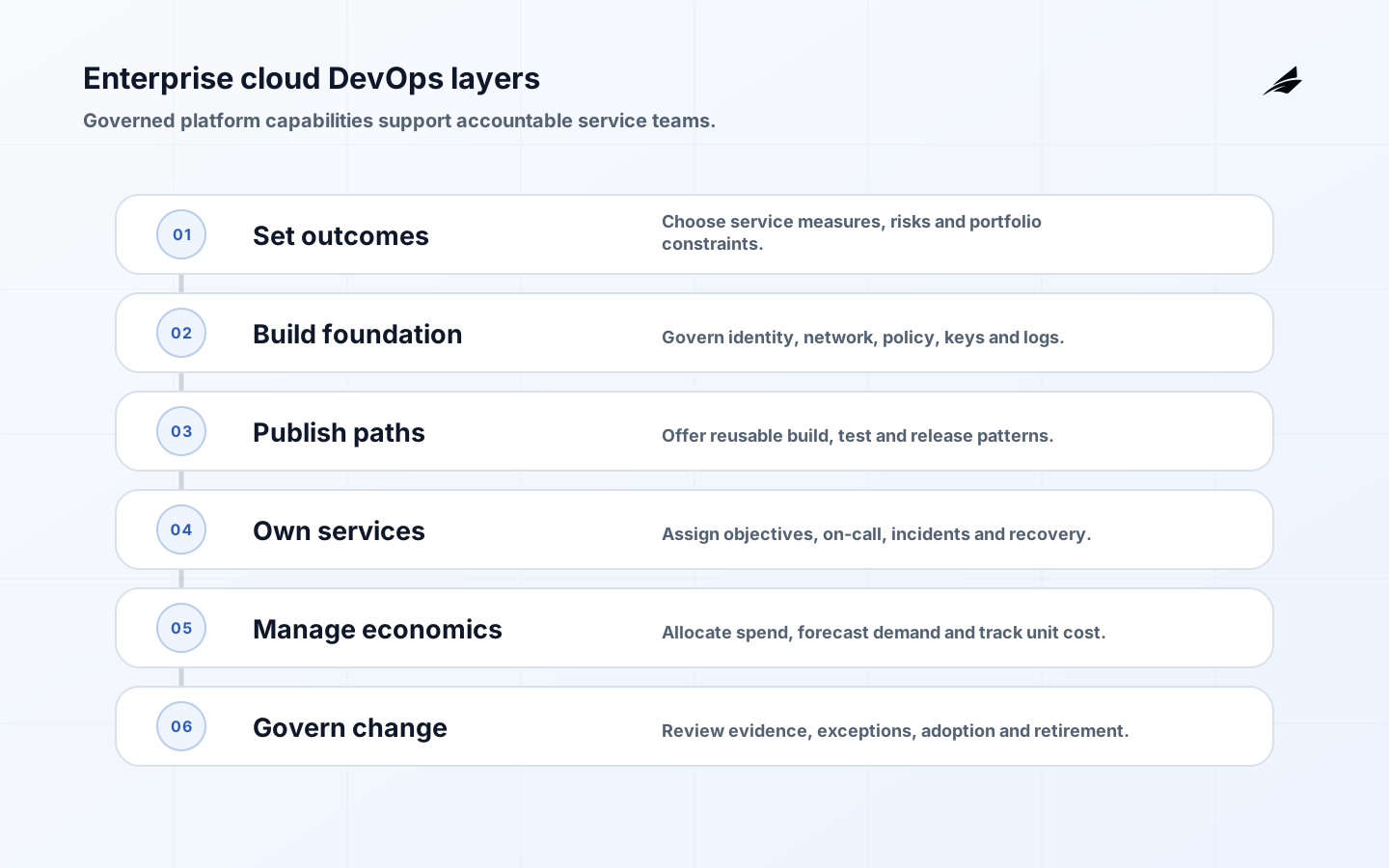
Cloud DevOps services for enterprise teams should create a governed way for many product groups to build and operate cloud services without turning a central platform team into a ticket queue. The engagement joins cloud foundations, reusable delivery paths, security evidence, service ownership, reliability and cost management. Its success is measured in safer product change and sustainable operations, not the number of accounts, pipelines or dashboards created.
Leaders need to compare scope, cost, risk and delivery plans before selecting a partner. This guide defines the buying decisions and acceptance evidence. Teams ready for detailed execution can continue to the enterprise cloud DevOps implementation checklist and enterprise cloud DevOps FAQ.
Start with enterprise outcomes and service boundaries
Select a small portfolio of representative services: for example, a customer-facing digital journey, a regulated data service, a batch workload and an internal application. Baseline change lead time, failed releases, incident recovery, platform wait time, control exceptions and unit cost. Set target outcomes that matter to service owners, such as reducing an approval queue while improving deployment recovery or making spend attributable to a product.
NIST defines cloud through characteristics including on-demand self-service, resource pooling, rapid elasticity and measured service. The NIST cloud definition is deliberately technology-neutral, which is useful during procurement: clarify the required service characteristics and responsibility boundary before choosing implementation products. Record which duties remain with cloud providers, the DevOps partner, central enterprise functions and workload teams.
| Scope decision | Questions to settle | Accountable owner | Acceptance evidence |
|---|---|---|---|
| Portfolio | Which services, regions and environments are included? | Technology portfolio owner | Named inventory and representative pilot set |
| Foundation | Who owns identity, network, policy, keys and logs? | Cloud platform owner | Responsibility matrix and tested controls |
| Delivery | Which source, build, test and release patterns are supported? | Engineering enablement owner | Working paved path for each agreed pattern |
| Operations | Who holds service objectives, on-call and incident authority? | Service owners | Runbooks, escalation and exercised recovery |
| Economics | How are shared and direct costs allocated? | FinOps or finance owner | Allocation coverage and forecast model |
| Handover | Which assets, access and decisions become client-owned? | Program sponsor | Repository, rights, skills and acceptance ledger |
Define the enterprise platform product
The platform should offer a small set of supported paths rather than one universal stack. A path can combine account or subscription provisioning, identity federation, network policy, encryption, secrets, logging, build, artifact storage, deployment and service templates. Publish its consumers, supported use cases, service levels, roadmap, deprecation rules and contribution model. Product teams remain accountable for application behavior and data even when the platform supplies controls.
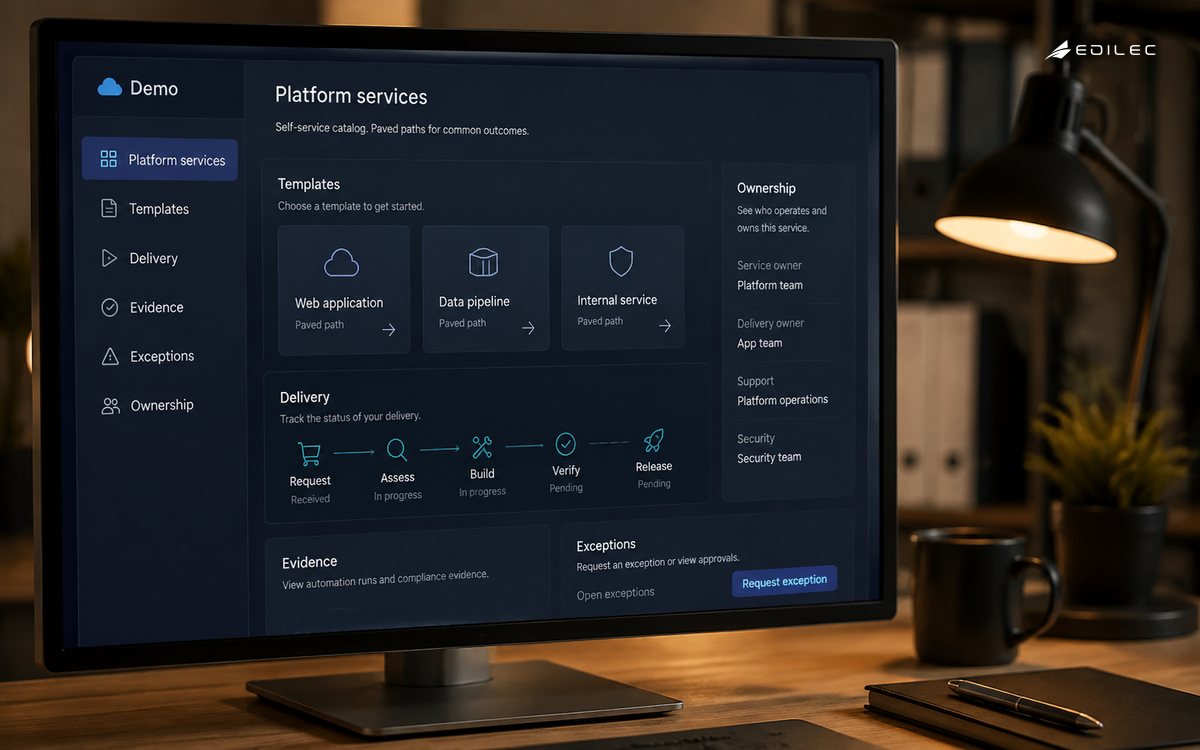
Design self-service with policy at creation time. A team should be able to provision an approved environment without routine administrator intervention, while disallowed regions, public exposure, missing ownership or unsafe identity are rejected with understandable remediation. Maintain a time-bounded exception process. Policy that cannot express a legitimate workload creates manual bypasses; policy with permanent silent exceptions creates false assurance.
Build secure delivery and evidence into the platform
Standardize the controls that benefit every team: protected source, isolated builds, declared dependencies, secret handling, immutable artifacts, provenance, policy checks and environment authorization. NIST's SSDF supplies a common vocabulary for secure development practices. Implementation should let a reviewer trace a release to source, builder, tests, inventory, artifact digest, approval, target and observed result without reconstructing the story from unrelated consoles.
Use progressive delivery according to reversibility. Stateless services may use canary or blue-green exposure; schema and data changes need compatibility, backfill checkpoints and roll-forward plans. Define stop conditions before release. Protect administrative paths and separate the power to alter pipeline policy from the power to approve a consequential promotion. Give teams local flexibility inside clear enterprise guardrails and review recurring exceptions as platform demand signals.
Choose an operating model with explicit decision rights
A common model has a central platform product team, federated security and reliability specialists, and stream-aligned service teams. The platform team owns reusable capabilities and their service health. Workload teams own application objectives, data, releases and first-line operation. Enterprise architecture and risk functions set outcomes and sample evidence. Managed service providers may operate components, but the client retains risk acceptance, product priority and enough technical authority to change suppliers.
Define support hours, escalation, incident command, maintenance windows, vulnerability response, provider contact and emergency access. Central teams should not become mandatory intermediaries for ordinary delivery. Conversely, self-service does not mean unsupported service teams must diagnose every control plane failure. Track platform incidents and consumer friction as product work, then publish status and changes so teams can plan around shared dependencies.
| Risk | Early signal | Contract or design control | Measure |
|---|---|---|---|
| Central bottleneck | Growing platform ticket age | Self-service paths and product capacity | Provisioning lead time |
| Fragmented tooling | Duplicate runners and policies | Supported patterns with deprecation plan | Adoption by eligible service |
| Weak ownership | Alerts and costs lack service owner | Mandatory service metadata and escalation | Owner coverage |
| Supply-chain exposure | Unknown build inputs or mutable output | Isolated build, inventory and provenance | Verified release coverage |
| Migration disruption | Long dual running and unreconciled state | Pilot, cutover gates and retirement owner | Legacy cost retired |
| Vendor dependence | Client lacks repositories or admin rights | Export, documentation and handover clauses | Recovery without supplier access |
Model cost and commercial structure realistically
Enterprise cost depends on estate diversity, organizational change and assurance more than raw workload count. Price discovery separately enough to map identity, network, application patterns, regulatory evidence, existing contracts, skill gaps and migration constraints. Then estimate platform build, workload onboarding, application remediation, transition overlap, licenses, telemetry, support and training. State assumptions for service-team participation; missing internal capacity can become the critical path even with a well-staffed partner.
The FinOps Framework emphasizes collaboration among engineering, finance and business roles. Require ownership metadata, allocation rules, forecasts and unit economics in the operating design. Evaluate commitments and discounts only after demand and migration timing are credible. Include the cost of resilience, security evidence, egress and retained legacy systems. A lower cloud bill can still be a poor outcome if manual work or outage exposure rises.
Deliver in accepted portfolio slices
Begin with discovery and a thin foundation, then onboard representative services end to end. For each slice, prove provisioning, delivery, telemetry, support, recovery, cost allocation and ownership before expanding. Use migration waves based on technical dependency and business readiness, not application count alone. Keep a decision log for deviations so temporary migration accommodations do not silently become permanent platform variants.
Handover starts during build. Pair client engineers with the delivery team, keep source and decisions in client-controlled repositories and rotate operational roles. The general cloud DevOps scope guide provides additional contract questions, while the managed cloud enterprise guide helps separate platform creation from ongoing managed operations.
Measure flow, reliability, control and value together
DORA's five delivery metrics describe throughput and instability at the application or service level. Use them to improve a service over time, not rank teams with different contexts. Add platform adoption, self-service success, policy exception age, critical-service objective attainment, restore results, allocation coverage and unit cost. A platform is succeeding when consumer teams deliver more safely with less coordination burden.
Use telemetry that joins customer journeys, services, dependencies and releases. OpenTelemetry provides a vendor-neutral model for traces, metrics and logs. Define data minimization, retention and access before centralizing signals. Review measures with service owners and finance, selecting one portfolio constraint at a time. Dashboards without a decision cadence create visibility but not improvement.
Evaluate providers and accept the capability
A strong provider can show how its reference patterns adapt to client boundaries without creating an unmaintainable fork. Ask for evidence of platform product management, secure delivery, migration reconciliation, recovery exercises, FinOps and organizational handover. Examine named personnel, subcontractors, licensing, data access, administrative dependencies and exit procedures. Product certifications can inform due diligence but do not replace architecture and operating evidence.
Acceptance should be scenario-based. Have a client team provision a service, release a change, identify it in telemetry, respond to a simulated fault, restore data, attribute spend and revoke partner access. Sample the Cloud Controls Matrix where a structured control catalog helps, but map each selected control to the enterprise's actual responsibility boundary and evidence. Carry unresolved limitations into an owned, dated backlog.
Key takeaways
- Frame the engagement around representative service outcomes and portfolio constraints.
- Treat the platform as a product with consumers, service levels, roadmap and deprecation rules.
- Keep workload accountability clear while centralizing reusable controls and evidence.
- Model professional fees, cloud consumption, transition overlap and internal capacity together.
- Roll out through complete, accepted service slices rather than disconnected foundation components.
- Require the client team to demonstrate delivery, operation, recovery and cost ownership before closure.
Cloud DevOps services for enterprise teams FAQ
Does an enterprise need one toolchain? Usually not. It needs a limited set of supported patterns with common evidence and ownership. Standardize interfaces and controls where they reduce risk; permit justified variation where workload needs differ.
Is platform engineering the same as DevOps? Platform engineering applies product practices to shared technical capabilities. It can enable DevOps outcomes, but service teams still need shared ownership of build, run and improvement.
Should migration and DevOps transformation be one contract? They may be coordinated, but their outcomes and acceptance should remain separable. Otherwise workload movement can be reported as success while delivery and operations remain unchanged.
How much should be outsourced? Outsource execution or specialist operation where it adds value, but retain architecture knowledge, risk authority, repositories, evidence access and a tested supplier-exit path.
Conclusion: create governed autonomy
Cloud DevOps services for enterprise teams are effective when product groups gain a faster approved path and enterprise leaders gain better evidence, without confusing central standards with central ownership of every service. Define the boundary, build a small platform product, onboard representative workloads, prove operation and expand from measured results. That produces governed autonomy rather than a larger collection of cloud tools.