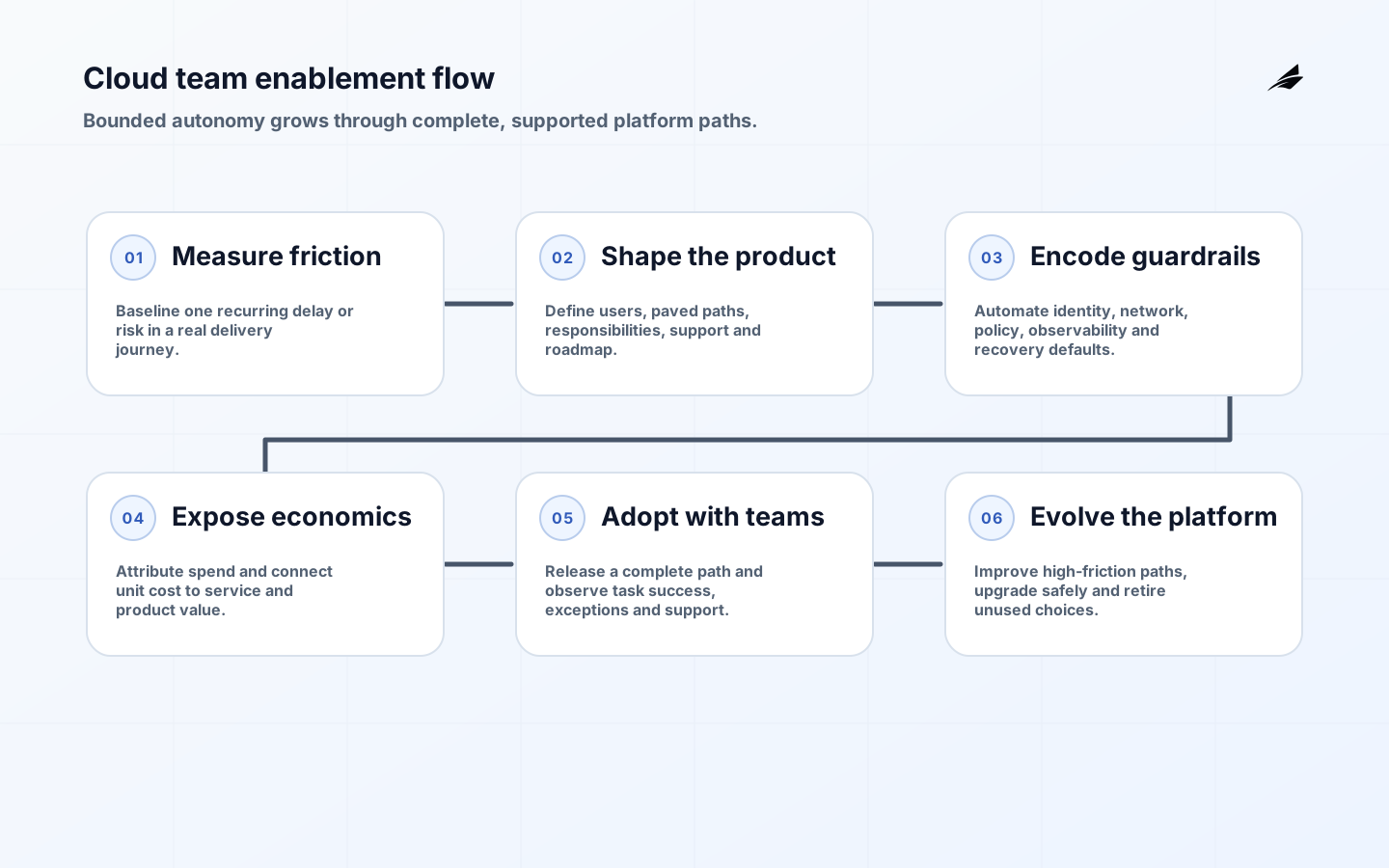
Cloud solutions that empower teams do more than move infrastructure behind an API. They give product teams a supported way to provision, deploy, observe and recover services while preserving organization-wide security, financial and reliability controls. The goal is bounded autonomy: routine decisions become fast and repeatable, while exceptional or high-risk choices receive deliberate review. That outcome depends on platform products, ownership and feedback loops, not on a cloud account alone.
This delivery plan works with Edilec's cloud solutions implementation checklist, team enablement cloud FAQ and cloud innovation delivery guide. Use it to decide what the platform should standardize, what teams may choose and how investment will be measured after launch.
Set team outcomes before choosing cloud services
Name the friction to remove: environment lead time, inconsistent identity setup, fragile releases, delayed observability or unclear cost. Capture the baseline from real work and define a target with an owner. The NIST cloud definition highlights on-demand self-service, broad network access, resource pooling, rapid elasticity and measured service. Those characteristics become useful only when the organization turns them into safe workflows for its own teams.
Segment users by jobs rather than organizational labels. An application team may need a web-service path, a data team a governed pipeline, and an experimentation team a short-lived sandbox. Interview representative users and review support tickets, deployment records and architecture exceptions. Select one or two high-volume paths for the first platform release. Trying to satisfy every workload at once produces a catalog with many options but no dependable paved path.
| Outcome | Baseline measure | Useful target |
|---|---|---|
| Environment access | Elapsed request-to-ready time | Approved standard environment in hours |
| Release safety | Change failure and rollback effort | Automated checks and repeatable recovery |
| Developer focus | Time spent on platform tickets | More delivery through self-service paths |
| Cost ownership | Spend without product attribution | Material spend mapped to accountable teams |
Design the cloud platform as a product

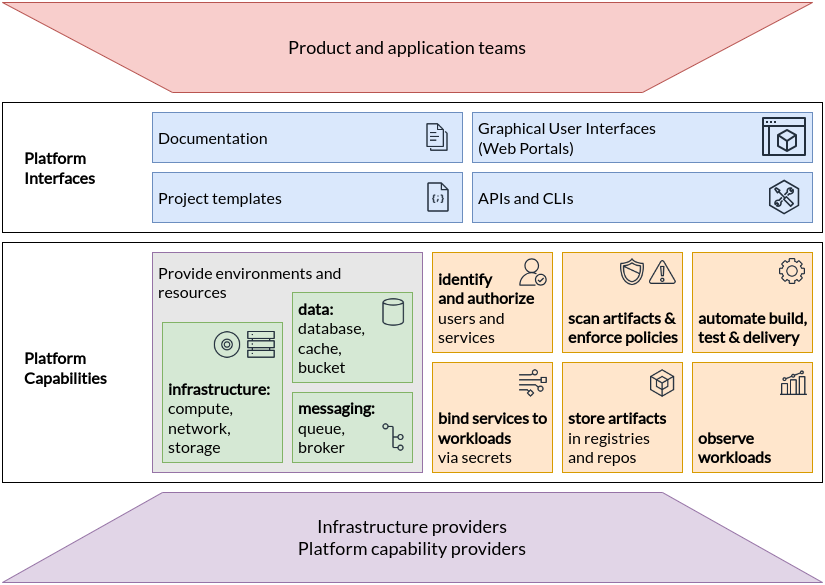
Define platform customers, supported use cases, service levels, roadmap and feedback channel. Offer opinionated templates that assemble identity, networking, encryption, logging, deployment and cost metadata into a working starting point. Each template needs versioning, documentation, automated tests and an upgrade path. Self-service without support creates abandonment; support without standardization turns the platform team into a ticket queue. Track adoption and task success as product measures.
Make boundaries explicit. Product teams should own application behavior, data use, service objectives and on-call response. A platform team can own landing zones, shared identity integration, policy engines, base observability and deployment primitives. Security, finance and risk teams define controls and review material exceptions. Microsoft's current cloud adoption strategy guidance emphasizes measurable business outcomes and cross-functional alignment; encode that alignment in a responsibility matrix and service catalog.
Build guardrails into the architecture
Establish account, subscription or project vending with approved identity, network, region, logging, backup and billing defaults. Use infrastructure as code so environments are reviewable and reproducible. Separate production from experimentation, management from workload traffic, and human administration from service identities. Policy as code can prevent prohibited regions, public storage or unencrypted resources while allowing teams to choose within supported patterns. Publish an exception path with an owner and expiry.
Assess every reference architecture across operational excellence, security, reliability, performance, cost and sustainability. The AWS Well-Architected Framework provides one first-party expression of those tradeoffs, but teams should keep requirements provider-neutral. Set workload-specific service objectives, recovery targets, data classifications and scaling limits. A managed service reduces some operating tasks; it does not transfer accountability for configuration, data use or business continuity.
The CISA cloud security reference architecture is useful for examining shared services, migration and cloud security posture management. Convert principles into platform tests: deny unapproved public endpoints, detect privileged-role drift, centralize security events, scan templates and verify backups. Guardrails should provide actionable remediation. A policy that merely blocks a deployment without explaining the supported path replaces security risk with delivery delay.
Estimate cost and create financial ownership
Model costs in three layers: platform build and operation, workload consumption, and migration or change. Include engineering, security, support, connectivity, observability, data transfer, backup, commercial tools and training. Forecast a range using baseline, growth and failure scenarios rather than one precise total. Platform investment should be allocated transparently; forcing every shared charge into a simplistic team bill can create arguments that obscure genuinely controllable usage.
The FinOps Framework treats technology value as a collaboration among engineering, finance and business teams. Implement cost attribution at provisioning, show unit measures such as cost per transaction or active customer, and set anomaly ownership. Give teams timely data and safe actions: shut down expired sandboxes, adjust retention, rightsize capacity or review commitments. Savings without a service-level check can remove the resilience or performance the business intended to buy.
| Cost component | Estimation driver | Owner decision |
|---|---|---|
| Shared platform | Accounts, clusters, tools and support coverage | Which capabilities are standard products |
| Workload run cost | Traffic, storage, retention and service tier | What unit-cost target preserves service quality |
| Migration | Application complexity, data movement and testing | Rehost, replatform, refactor or retire |
| Risk reserve | Uncertainty, dual running and rollback window | How much contingency and when to release it |
Deliver in thin, usable platform releases
Begin with a reference team and one production-shaped workload. Release account vending, deployment, observability, identity and cost attribution as a coherent journey. Measure time to first deployment, failed steps, support demand and policy exceptions. Pair platform engineers with users during early adoption, then turn repeated assistance into documentation, automation or a design change. Expansion should follow demonstrated capacity to support the path, not the number of services available in the catalog.
Use acceptance criteria that exercise operations: restore data, rotate a secret, investigate an alert, revoke access, roll back a release and explain a bill. Rehearse provider and dependency outages. Record residual risks and temporary controls. Promote a template only after another team can use it without its author. Maintain compatibility windows and migration guidance so platform upgrades do not transfer hidden work to every product team at once.
Example: launch a self-service web-service path
Suppose teams wait ten business days for a production account and repeat the same identity, logging and network tickets. The first platform product can accept a small set of inputs such as product owner, data class, service tier and cost center, then create a governed environment, repository template, deployment pipeline, dashboards and on-call route. The path should expose supported customization points and explain which requirements trigger security or architecture review.
Recruit two application teams with different but compatible workloads. Ask each to deploy, rotate credentials, scale, restore data, investigate an alert and attribute its bill. Capture every manual intervention and classify it as necessary review, missing automation, unclear documentation or unsupported demand. Compare elapsed time and support effort with the baseline. Check that platform defaults survive direct configuration changes and that teams can diagnose policy failures without privileged access.
Before general availability, assign service objectives for environment vending and shared capabilities, publish escalation, and price the platform's central cost. Create an upgrade rehearsal for the template and a deprecation window for old versions. Expansion is justified when another team succeeds through the documented path, controls remain effective and support capacity scales. This makes enablement a measurable product outcome rather than a claim based on the number of automated resources.
Manage the risks of team autonomy
Common failure modes include a central platform that becomes a gatekeeper, unrestricted self-service that fragments controls, templates that nobody can upgrade, and showback data without decision rights. Watch lead time, exception age, unsupported service use, privileged access, adoption by eligible teams, change failure, recovery performance and attributed spend. Review metrics together because optimizing one can damage another; faster provisioning is not progress if incident exposure rises.
Create a quarterly platform review with product, platform, security, finance and operations representatives. Retire unused catalog items, improve the highest-friction paths and challenge controls that add work without reducing material risk. Publish decisions and deprecation dates. Cloud empowerment is a continuing operating model: teams need stable interfaces and room to act, while the platform needs evidence about actual usage to evolve safely.
Cloud team enablement takeaways
- Measure a specific delivery friction before funding a platform capability.
- Build complete paved paths around user jobs, not a large catalog of disconnected services.
- Encode security, identity, observability and cost defaults in reusable infrastructure.
- Assign application and platform responsibilities explicitly.
- Release with reference teams and test recovery as part of acceptance.
- Review autonomy, risk, adoption and unit economics as one operating system.
Frequently asked questions
Does a cloud center of excellence own every workload?
It should not by default. A central group can establish strategy, shared capabilities and guardrails, while product teams retain responsibility for workload outcomes and operations. The exact split depends on skills and risk. Document decisions at capability level and revisit them as teams mature.
How soon should a platform show value?
A thin path should improve a real workflow within weeks or a few months, even if the broader platform takes longer. Use a baseline such as environment lead time or support demand. Avoid claiming enterprise value from infrastructure completion; confirm that eligible teams adopt the path and deliver safely through it.
Conclusion
Cloud solutions empower teams when self-service arrives with supported patterns, clear ownership and meaningful choices. Scope the platform around measurable friction, embed guardrails in the path, expose costs in business terms and learn from production use. The durable result is neither central control nor unrestricted freedom; it is an operating model in which teams can move quickly because the common hard parts are dependable.