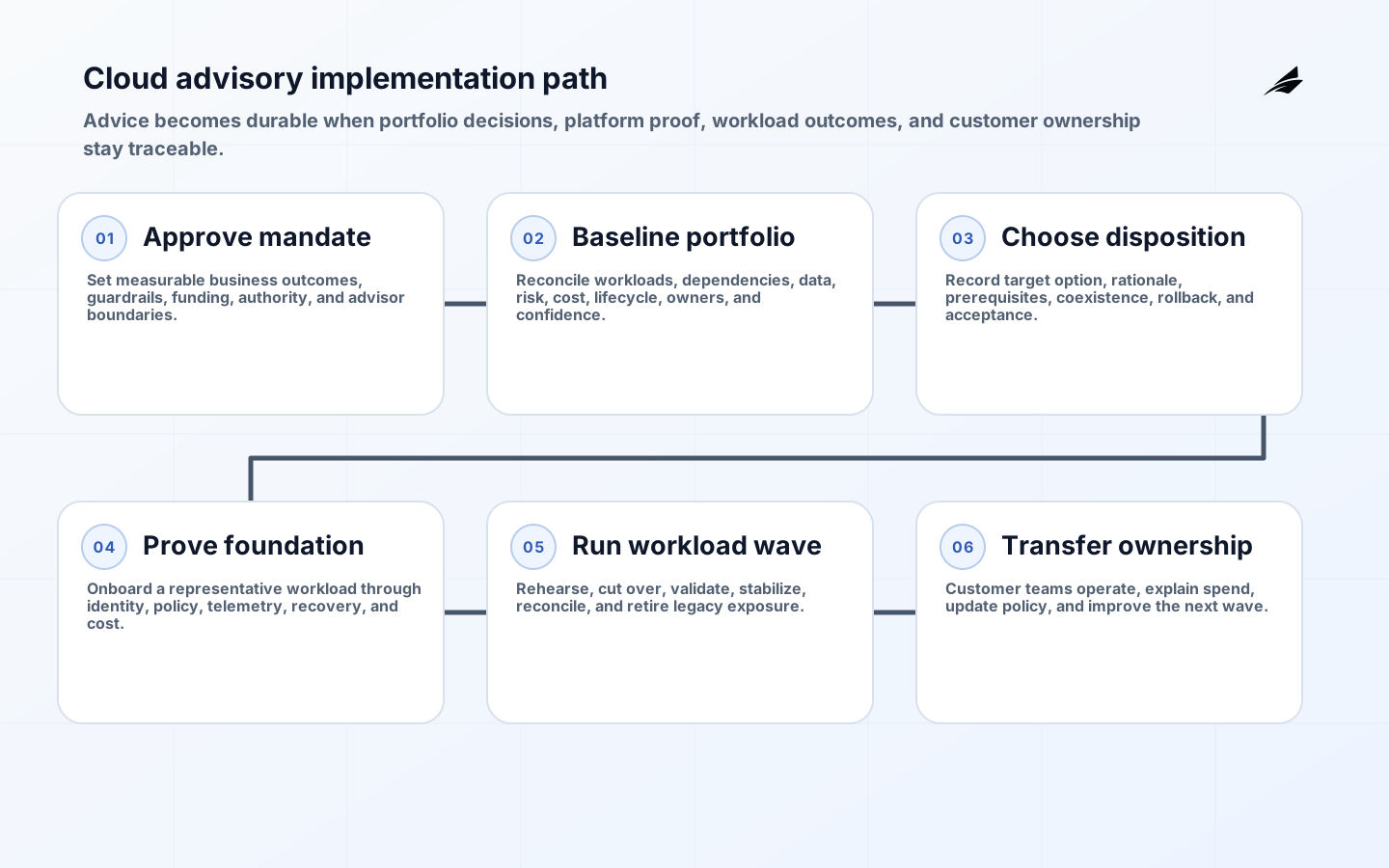
A cloud advisory consulting implementation checklist should turn recommendations into owned decisions, guardrails, funded waves, and measurable workload outcomes. A maturity assessment or target diagram has little value if application teams cannot enter a prepared environment, finance cannot explain spend, security cannot verify controls, and operations cannot recover the service. The engagement should leave a repeatable decision system that works after the advisors depart.
Use the cloud advisory scope and delivery guide to set commercial boundaries, the cloud advisory strategy guide to frame the broader transformation, and the strategy implementation checklist when coordinating portfolio governance. This checklist focuses on acceptance evidence for a consulting engagement.
Approve the mandate and business outcomes
Write why cloud is being considered: faster product delivery, resilience, data capability, market entry, datacenter exit, security improvement, acquisition integration, or variable capacity. Translate each motivation into a baseline, target, guardrail, owner, and review date. Avoid “move to cloud” as the outcome. Microsoft’s current strategy guidance begins with readiness, motivations, mission, objectives, team, and organizational preparation; AWS CAF similarly spans business, people, governance, platform, security, and operations.
Set decision rights for business sponsorship, portfolio, architecture, platform, security, data, finance, procurement, operations, and workload ownership. Define advisor authority and exclusions. Record regulatory and contractual constraints without assuming they mandate one provider or architecture. Establish a decision log and evidence repository under customer control. Advisors should recommend and challenge; accountable leaders must accept tradeoffs and fund the operating model.
| Advisory decision | Evidence required | Acceptance owner |
|---|---|---|
| Business case | Baseline, target outcomes, guardrails, and sensitivity | Executive sponsor |
| Workload disposition | Dependencies, risk, value, lifecycle, and option rationale | Business and application owners |
| Platform foundation | Control requirements and tested workload path | Platform owner |
| Migration wave | Readiness, rollback, operations, and user acceptance | Workload service owner |
| Operating model | Roles, service objectives, cost, security, and improvement cadence | Technology leadership |
Build a decision-grade workload portfolio
Reconcile application, infrastructure, network, identity, data, supplier, contract, cost, incident, repository, and business-owner records. For each workload, capture purpose, users, critical journeys, lifecycle, dependencies, data classification and location, service objectives, recovery, technical health, change rate, licensing, cost, skills, and exit constraints. Confidence matters: mark observed, owner-confirmed, inferred, and unknown facts instead of turning incomplete discovery into a precise score.
Choose a disposition per workload or component: retire, retain, repurchase, rehost, relocate, replatform, refactor, or rearchitect. State the outcome, prerequisites, migration pattern, coexistence, data method, acceptance, rollback, and owner. Sequence by dependencies and organizational readiness, not only by infrastructure affinity. A simple workload can be a poor pilot if it proves none of the required security, data, or operating capabilities; choose a representative but bounded first slice.
Prove the landing zone and policy guardrails
Define organization hierarchy, account or subscription vending, identity federation, privileged access, network, DNS, logging, security monitoring, key management, data protection, approved regions, tagging, budgets, quotas, backup, policy, and break-glass recovery. Implement through versioned automation with review and drift detection. Guardrails should prevent unacceptable states and make approved paths easy, while documented exceptions identify risk owner, compensating controls, expiry, and remediation.
Do not accept a landing zone because resources exist. Onboard a representative workload through self-service or documented workflows, deploy it from source, exercise identity and network paths, generate audit and telemetry evidence, trigger and handle a policy violation, restore data, roll back a change, attribute cost, and remove the environment. Record elapsed time and manual intervention. This proves whether the foundation supports teams rather than merely satisfying a reference diagram.
| Foundation control | Test | Pass condition |
|---|---|---|
| Identity | Joiner, mover, leaver, privileged, workload, and emergency access | Current least privilege with attributable evidence |
| Policy | Attempt an unapproved region, service, exposure, or configuration | Prevent or detect according to approved control design |
| Observability | Trace a user journey and a platform change | Service and audit evidence reaches owned destinations |
| Recovery | Restore a workload component in an isolated path | Business validation meets the selected objective |
| Cost | Create, use, scale, and retire resources | Spend maps to owner, service, environment, and useful unit |
Embed security, resilience, and FinOps in decisions
Use NIST CSF 2.0 or the organization’s approved framework to connect governance, identification, protection, detection, response, and recovery. Map control objectives to automated guardrails and workload responsibilities. Threat-model identity, administration, data, software supply chain, network, and provider dependencies. Define service objectives, RPO, RTO, degraded service, incident command, provider escalation, and evidence retention. Shared responsibility must be specific to each service model.
FinOps is a collaborative operating practice, not a late cost-cutting project. Define billing ownership, allocation metadata, budgets, forecasts, anomaly response, commitment decisions, unit economics, and optimization cadence before migration. Model run cost plus migration, coexistence, data transfer, licenses, support, security, training, and exit. Use ranges and sensitivity for uncertain demand. Optimization decisions must preserve reliability and customer outcomes; deleting apparent idle capacity without context can remove recovery margin.
Design the cloud operating model and team interfaces
Define what platform teams provide, what workload teams own, what security and finance govern, and how suppliers support. Create service catalogs, paved paths, support levels, architecture decisions, exception workflows, vulnerability processes, change controls, incident roles, and review cadences. The Google Cloud Adoption Framework’s lead, learn, scale, and secure themes reinforce that cloud readiness includes leadership and skill, not only technology. Fund product-like ownership for shared platform capability.
Assess skills through demonstrated tasks, then plan training, pairing, hiring, and managed services against named capability gaps. Avoid a central cloud team that becomes a ticket queue or holds all privileged knowledge. Workload teams need enough autonomy to deliver within guardrails; platform teams need usage evidence to improve the path. Define after-hours support, segregation of duties, and how local teams escalate provider incidents.
Move one workload wave from recommendation to operation
- Confirm the workload outcome, owner, dependencies, data, controls, objectives, cost baseline, and disposition.
- Close landing-zone, supplier, skills, licensing, and connectivity prerequisites with test evidence.
- Rehearse application, infrastructure, data migration, coexistence, rollback, and communication at realistic scale.
- Cut over through one accountable plan with decision thresholds and retained timestamps.
- Validate user journeys, data, security, performance, recovery, support, cost, and legacy reconciliation.
- Stabilize operation, close residual risk, retire old access and cost, and feed lessons into the next wave.

Accept advisory outputs and transfer capability
Require a traceable package: mandate, portfolio with confidence, business case, principles, target and transition architecture, risk register, control mapping, landing-zone code, policy, operating model, wave backlog, cost model, skills plan, supplier decisions, runbooks, metrics, and unresolved assumptions. Every recommendation should name decision owner, evidence, consequence, and next action. Customer teams must control repositories, cloud access, and records throughout the engagement.
Measure outcome progress, workload lead time, platform task success, deployment and recovery performance, service objectives, control compliance, incident learning, allocation coverage, forecast accuracy, unit cost, and team capability. Complete handover when the customer provisions an environment, onboards and operates a workload, handles an incident, explains spend, and updates policy through normal governance. Advisor presentations are not operating evidence.
Key takeaways
- Anchor advisory work in measurable business outcomes and accountable customer decisions.
- Build a workload portfolio that records evidence confidence and real dependencies.
- Prove landing-zone controls through a representative workload lifecycle.
- Design security, resilience, FinOps, skills, and operations before migration waves scale.
- Accept the engagement only when customer teams can run and improve the resulting system.
Frequently asked questions
Should cloud advisory begin with a multicloud strategy?
Begin with business, regulatory, resilience, supplier, data, and capability requirements. Multiple providers may be justified, but they add identity, network, policy, skills, support, data, and cost complexity. Use more than one cloud where a specific benefit exceeds that operating cost. Portability should be defined for selected workloads and data, not asserted as a universal architecture slogan.
How long is a cloud readiness assessment valid?
Only while its evidence reflects the estate and organization. Acquisitions, provider changes, incidents, regulation, staffing, new data uses, and completed migrations can alter readiness quickly. Version the assessment, record confidence and collection date, and refresh material areas before funding each wave. Treat readiness as a maintained portfolio view rather than a one-time score.
Must the advisor be independent of cloud providers?
Not necessarily, but incentives and assumptions must be transparent. Require option rationale, whole-life cost, risk, customer-controlled evidence, and exit implications. Provider expertise can be valuable; decision governance should still prevent credits, partner targets, or preferred products from replacing workload requirements. The customer remains accountable for architecture and risk acceptance.
Use architecture principles as decision tests, not slogans. For example, “managed service preferred” should require a comparison of operating effort, portability, data, recovery, service limits, and supplier risk; it should not force every workload onto the newest platform feature. Record when a workload departs from a principle and why. Review exceptions together to learn whether the principle, platform capability, or application plan needs to change.
Close each migration wave financially and operationally. Remove legacy capacity and licenses only after rollback closes, update forecasts and commitments, confirm support ownership, archive decisions, and compare realized outcomes with the business case. Benefits do not appear automatically at cutover. A named owner must capture avoided cost, improved flow, resilience, or product value and explain variance before the next wave repeats the same assumptions.
Conclusion
Cloud advisory creates value when it converts uncertainty into a working governance and delivery capability. Approve outcomes and authority, reconcile the portfolio, prove the foundation with a real workload, and integrate security, resilience, FinOps, skills, and operations. Move in evidence-based waves and close the engagement through customer demonstration. The durable output is not a cloud target state; it is an organization that can choose, migrate, operate, optimize, and retire workloads deliberately.