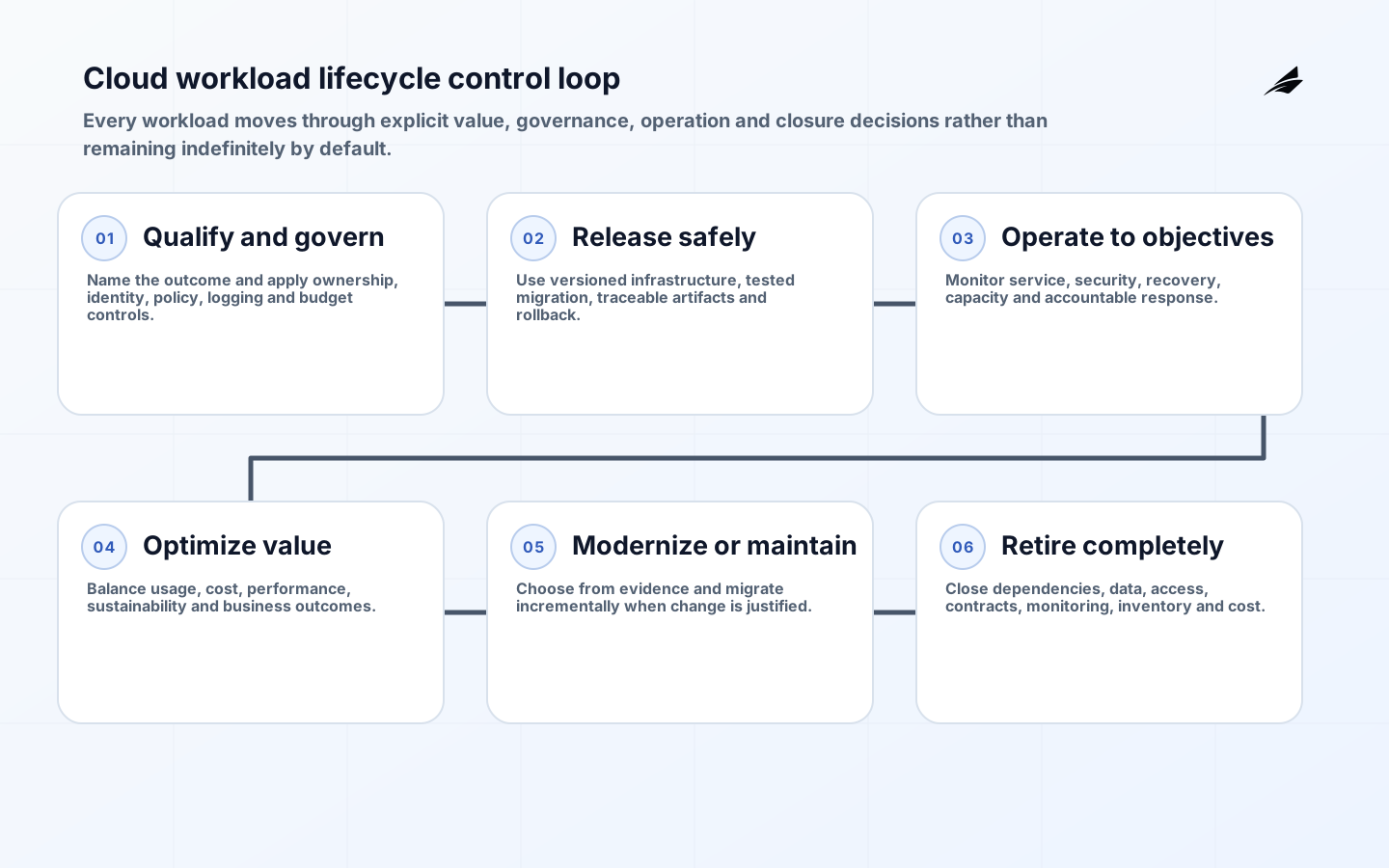
Cloud lifecycle management services govern a workload from initial demand through design, provisioning, operation, optimization, modernization and retirement. The checklist matters because unmanaged cloud estates rarely fail at creation; they accumulate unclear ownership, broad access, drift, idle resources, untested recovery and data that nobody is authorized to delete. Lifecycle control makes every workload explainable, supportable and removable.
Use this implementation checklist with the cloud lifecycle management FAQ, Cloud DevOps services checklist and Cloud DevOps services FAQ. Apply it at workload level first; estate-wide governance becomes credible when individual owners can produce evidence.
Qualify demand and assign ownership
Require a business owner, technical owner, data classification, intended users, criticality, expected lifetime and measurable outcome before provisioning. Estimate demand, availability, recovery, residency, integration and support needs. Record why cloud is appropriate and what would cause modernization or retirement. Temporary experiments need expiration dates and spending ceilings; “temporary” resources without automated review become permanent risk.
Define central platform, security, finance and workload responsibilities. Microsoft Cloud Adoption Framework separates sequential strategy and adoption work from ongoing governance, security and management. Reflect that split in responsibility records. A managed-service provider can perform tasks, but the organization still needs accountable owners for risk, data, cost and exit decisions.
| Lifecycle gate | Required evidence | Approval question | Exit condition |
|---|---|---|---|
| Demand | Outcome, owner, classification, estimate | Is value and responsibility clear? | Rejected or time-boxed |
| Ready | Landing zone, access, policy, recovery design | Can it be governed safely? | Controls accepted |
| Operate | Objectives, telemetry, runbooks, support | Can failure be detected and handled? | Stable service |
| Optimize | Usage, cost and value evidence | Does change improve total value? | Benefit verified |
| Retire | Dependencies, retention, archive and deletion | Can it be removed without harm? | Closure evidence stored |
Prepare a governed cloud foundation
Establish account or subscription hierarchy, identity federation, least privilege, privileged-access controls, network patterns, logging, key management, approved regions, budgets, tags and policy enforcement. Use infrastructure and policy as code with review. Start automated policy with essential controls, test impact and provide exception workflow; Microsoft guidance recommends automation where feasible while recognizing that some controls require manual review.
Create standard workload templates that include owner, environment, data class, cost center and expiration metadata. Ensure logs and security records reach protected central destinations. Separate production from development and use synthetic or protected test data. Document service limits and provider responsibilities. A landing zone is not complete because accounts exist; teams must be able to deploy through it without bypassing controls.
Build and release through controlled change
Version infrastructure, application and configuration. Protect repositories, scan dependencies and artifacts, test policy, and keep secrets out of code and state output. Plan migration with source authority, mapping, reconciliation and rollback. Use immutable artifacts and progressive exposure where risk warrants it. Record the relationship between source, artifact, deployment and approval.
AWS reliability guidance treats demand changes, deployments and patches as changes a workload must accommodate. Add monitoring, alarms, runbooks, functional and resilience tests to the release path. Define data-safe rollback or forward repair; restoring old code may not reverse a schema or external side effect. Rehearse one failed deployment before launch.
| Operational control | Implementation | Evidence | Review cadence |
|---|---|---|---|
| Reliability | Objectives, alerts, capacity and failure tests | Objective report and drill | Monthly or after incident |
| Security | Access, exposure, vulnerability and keys | Access review and remediation | Risk based |
| Recovery | Backup, restore and dependency plan | Timed restoration result | At least scheduled |
| Cost | Allocation, anomaly and unit economics | Owner-reviewed cost report | Monthly |
| Change | Automated deployment and rollback criteria | Release and recovery record | Every release |
Operate with objectives and evidence
Define service-level indicators and objectives tied to user outcomes. Monitor latency, errors, correctness, saturation, queues and dependencies, with logs and traces sufficient for diagnosis. Every alert needs severity, owner and response; avoid paging on conditions that do not require immediate action. Keep runbooks executable and access tested. Review incidents for systemic actions rather than individual blame.
Apply NIST CSF 2.0 outcomes across governance, inventory, protection, detection, response and recovery. Maintain asset and dependency inventory, patch by risk and active exploitation, review access, rotate secrets and test incident communication. Framework alignment is a management aid, not evidence that every regulatory requirement is met. Record exceptions and residual acceptance by an authorized owner.
Optimize value without weakening service
Allocate spend to accountable workloads and useful business units. Review idle resources, schedules, elasticity, rightsizing, storage classes, data transfer, licenses and commitments. FinOps Usage Optimization emphasizes matching resources to actual demand while balancing cost, performance and sustainability. Require a value-versus-effort case and verify realized savings instead of reporting every provider recommendation as available value.
Optimization can include architecture and operations, not only resizing. Reduce noisy telemetry, batch suitable work, remove duplicate data and modernize a constraint when expected benefit exceeds migration risk. Preserve capacity and recovery margins. A rightsizing action that creates paging or customer latency merely transfers cost. Track cost per useful transaction together with objectives and incident impact.
Modernize or retire through explicit gates
Trigger modernization from evidence such as unsupported technology, recurring objective failure, material security exposure, delivery constraint or unfavorable unit economics. Compare retain, rehost, replatform, refactor, replace and retire options. Pilot the riskiest assumption, migrate incrementally and reconcile authoritative data. Preserve rollback until the new path proves stable and dependencies have moved.
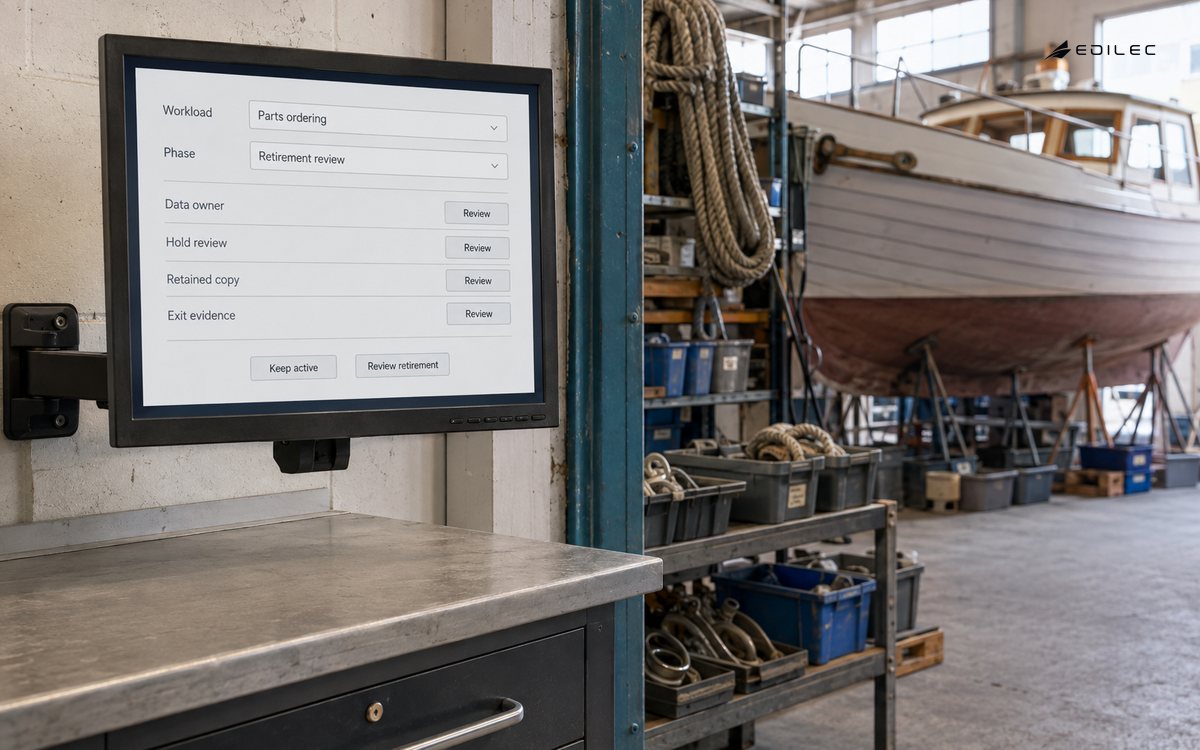
Retirement requires owner approval, dependency confirmation, traffic and job cessation, contract and commitment review, required archive, verified deletion, credential revocation, monitoring update and inventory closure. Watch for residual DNS, snapshots, keys, queues, backups and vendor exports. Store evidence of what was retained, deleted and why. Decommissioning is complete only when cost, access and data obligations are closed.
Run a recurring lifecycle review
- Confirm workload owner, business outcome, criticality and lifecycle state.
- Review inventory, dependencies, data, access, exceptions and support contacts.
- Compare objectives, incidents, vulnerabilities, capacity and recovery evidence.
- Analyze cost allocation, unit economics, waste and commitment exposure.
- Choose one treatment: maintain, remediate, optimize, modernize or retire.
- Assign decision, test, due date and rollback or closure evidence.
- Verify the outcome and update architecture, inventory and operating records.
Example: govern an analytics sandbox through retirement
A product team requests a cloud analytics sandbox for a ninety-day experiment. Demand qualification names the product owner, platform owner, permitted pseudonymized dataset, region, budget ceiling, expiration date and success decision. The landing-zone template creates a separate subscription or account, federated access, private data path, central logs, approved services, mandatory tags and a policy that blocks public storage. Infrastructure code and a data manifest make the environment reproducible.
During operation, the team monitors job completion, query latency, spend and access. Nonproduction compute stops on schedule, but storage and metadata remain available for the agreed work. An anomaly alert routes to the named owner. Monthly review compares cost with experiments completed rather than treating lower utilization as the only goal. If demand grows, the team assesses production requirements separately instead of promoting the sandbox with temporary controls and experimental data paths.
At day ninety, the owner chooses extension, production adoption or retirement. Extension requires a new value case and date. Production adoption creates a migration plan, service objectives, recovery tests, support ownership and stronger change controls. Retirement disables jobs, confirms consumers have moved, exports approved results, deletes source copies according to policy, revokes identities and keys, removes DNS and integrations, closes commitments and stores deletion evidence.
Accept a lifecycle management service on evidence
When an external provider operates the lifecycle, define measurable responsibilities for inventory accuracy, provisioning lead time, policy exceptions, patch and vulnerability handling, backup verification, incident cooperation, optimization review and retirement. Require customer access to native accounts, logs, infrastructure definitions, cost data and service records. The contract should state subcontractors, data locations, escalation, change notice and exit assistance.
Test the service before renewal. Sample assets against inventory, trace one privileged change, restore representative data, investigate an alert, reconcile an optimization claim and retire a noncritical workload. Record elapsed time, missing access and manual dependencies. Service reports are useful summaries, but these exercises prove whether the provider and customer can execute responsibilities together when conditions are less tidy than a monthly meeting.
Key takeaways
- Do not provision without a business and technical owner.
- Embed identity, policy, cost and telemetry in the cloud foundation.
- Treat release, demand and patching as reliability-relevant change.
- Optimize against business value and service guardrails together.
- Retire access, data, dependencies and cost with retained evidence.
Frequently asked questions
Is a configuration database enough for lifecycle management?
No. Inventory is necessary, but lifecycle management also requires decisions, owners, operating evidence, financial accountability and verified change. Automate discovery where possible and reconcile it with declared ownership and purpose.
How often should workloads be reviewed?
Use risk and change frequency. Critical or fast-changing workloads need frequent operational review; low-risk stable systems may use a longer cadence. Incidents, major releases, ownership changes and material cost anomalies should trigger an additional review.
Can a managed provider own the whole lifecycle?
A provider can execute many controls, but the customer should retain accountable risk, data, financial and exit owners. Contracts need measurable responsibilities, evidence access, incident cooperation, subcontractor visibility and a tested transition path.
Create a lifecycle dashboard that shows decisions rather than decorative inventory totals: workloads without owners, expired exceptions, overdue restore tests, unallocated spend, unresolved anomalies and retirement candidates awaiting approval. Every item should lead to an accountable queue. A smaller dashboard with executable actions is more useful than exhaustive resource counts nobody reviews.
Conclusion
Cloud lifecycle management turns an expanding estate into a portfolio of owned decisions. Qualify demand, provide a governed foundation, operate to objectives, optimize verified value and retire completely. The result is lower ambiguity and risk, not simply more automation or a larger inventory.