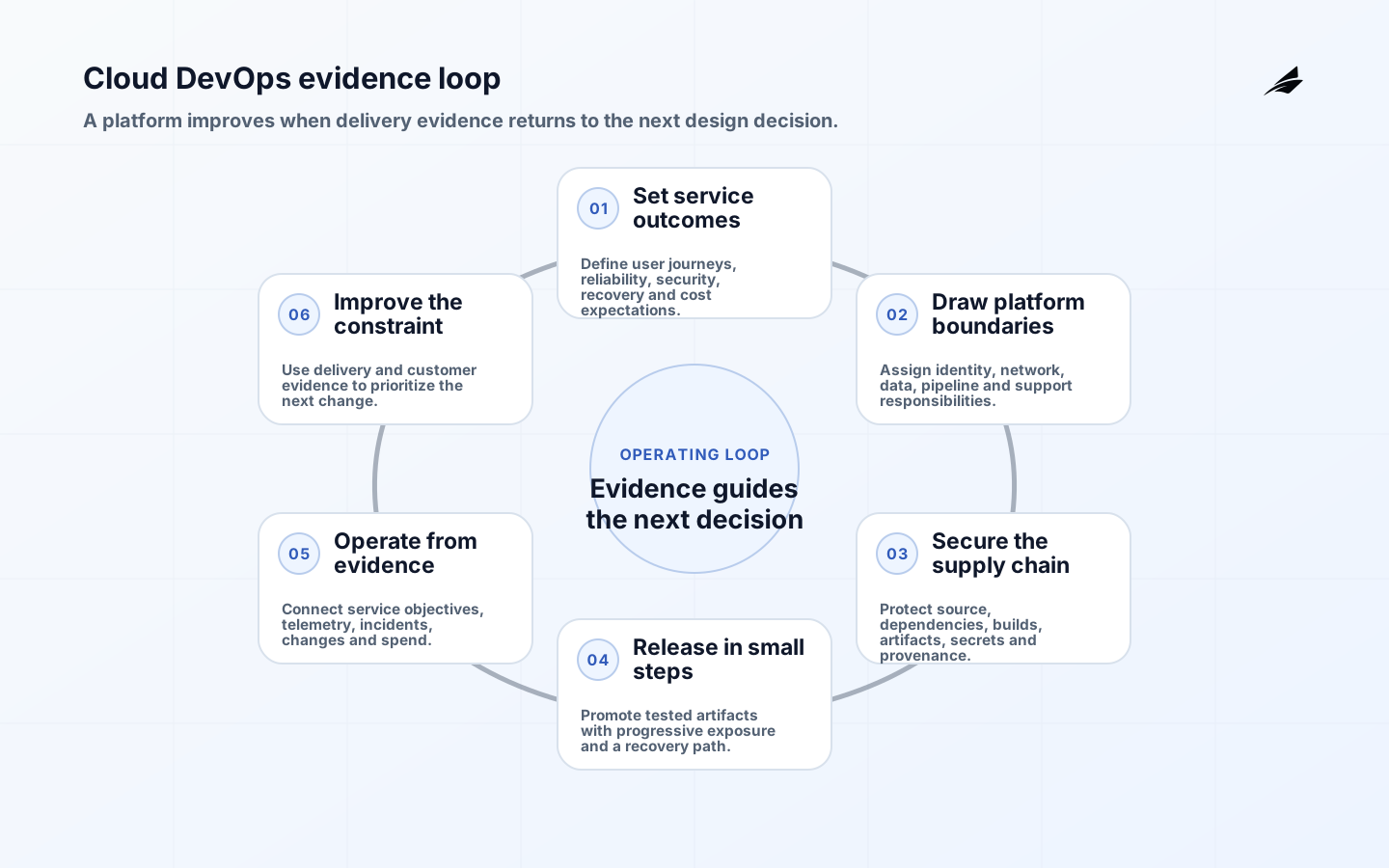
A cloud DevOps services implementation checklist should prove that teams can change a cloud service quickly without losing security, reliability, cost visibility or operational control. It is not a shopping list of pipeline products. The implementation joins a cloud foundation, software supply chain, release process, service ownership and feedback system. Each part needs a named owner, an acceptance test and evidence that remains available after the consultants leave.
NIST defines cloud computing through characteristics including on-demand self-service, resource pooling, rapid elasticity and measured service. Those properties make infrastructure flexible, but they also make unmanaged access and spend scale quickly. Use this checklist to build a repeatable operating capability around that flexibility. The companion cloud DevOps services FAQ helps buyers compare service boundaries, while the enterprise scope guide covers larger portfolio decisions.
1. Set outcomes and define the service boundary
Start with two or three user journeys whose failure has a material consequence: account creation, checkout, case submission, data export or an internal operational task. For each journey, define availability, latency, recovery, data protection and support expectations. Add delivery outcomes such as a shorter validated lead time or fewer high-risk manual steps. Avoid promising a deployment count in isolation; frequent deployment is useful only when released changes are safe and valuable.
Draw the responsibility boundary across customer, cloud provider and DevOps partner. Name who controls identity, subscriptions or accounts, network policy, runtime, data, source repositories, build workers, artifacts, secrets, observability, incident command, backup restoration and cost allocation. Record exclusions and retained customer duties in the statement of work. The shared-responsibility boundary must also appear in runbooks and access roles, not only in contract prose.
| Decision | Evidence required before build | Accountable owner |
|---|---|---|
| Service outcome | Critical journey, baseline, target and failure consequence | Product or service owner |
| Platform boundary | Architecture and responsibility matrix covering build and run | Platform owner |
| Risk tolerance | Threats, recovery objectives and accepted exceptions | Business and security owners |
| Delivery scope | Repositories, environments, pipelines, applications and exclusions | Engineering owner |
| Operating model | Support hours, escalation, change authority and supplier contacts | Service owner |
| Economics | Budget, allocation model, forecast and unit-cost hypothesis | Finance and product owners |
2. Establish the cloud platform and access model
Build a small set of governed platform patterns. Separate production from lower environments and isolate high-impact workloads where policy or blast radius requires it. Federate workforce identity, remove routine shared accounts, make privileged access time bounded, and maintain a tested emergency path. Define approved regions, network ingress and egress, encryption, keys, secrets, logging destinations, resource metadata and backup policy as code where the provider supports it. Policy checks should reject unsafe configuration before deployment and produce an understandable remediation message.
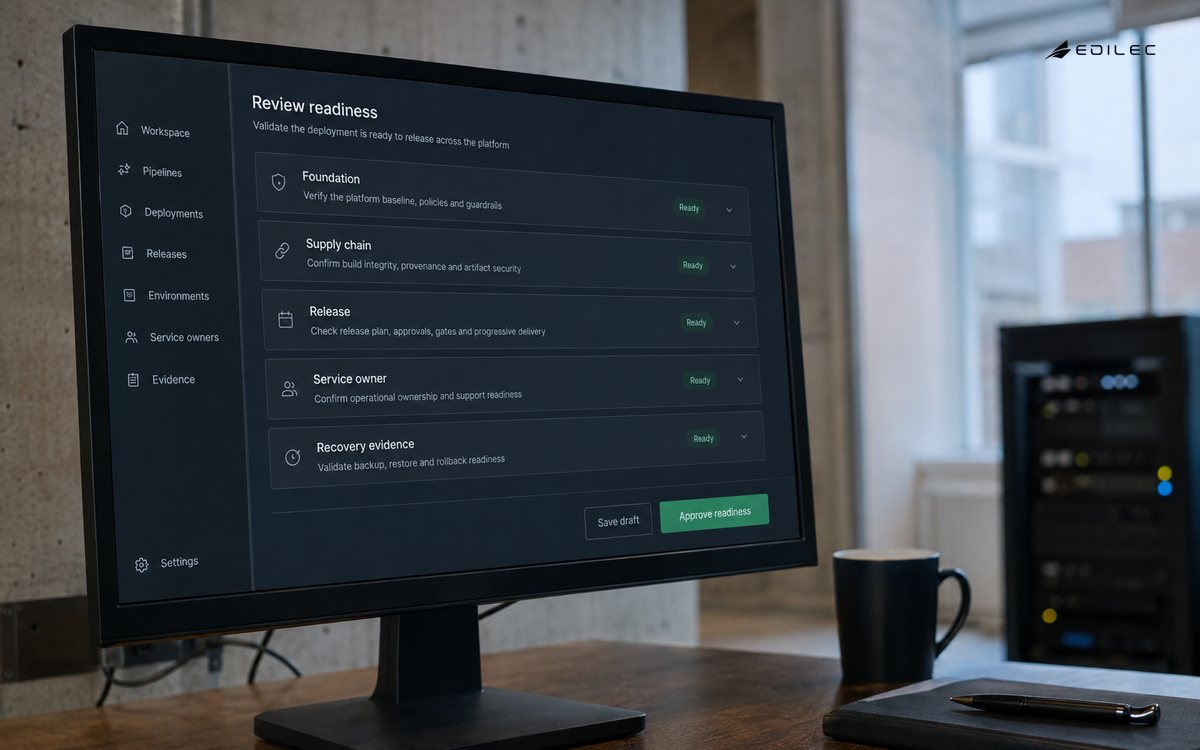
Foundation acceptance tests
A foundation is ready when a team can provision an approved service without manual administrator intervention, trace every privileged change, rotate a secret, revoke a user, identify an exposed resource, restore representative data and attribute material spend. Test denial paths as deliberately as success paths. A policy that blocks all work creates bypass pressure; a policy that silently permits exceptions creates hidden risk. Give every exception an owner, reason, expiry and compensating control.
3. Build a secure, reproducible delivery pipeline
Version application and infrastructure changes together with tests and review policy. Protect the main branch, use isolated and ephemeral build workers where practical, pin or verify dependencies, keep credentials out of source, and produce an immutable artifact once. Promote that same artifact between environments rather than rebuilding it with different inputs. NIST's Secure Software Development Framework organizes practices around preparing the organization, protecting software, producing well-secured software and responding to vulnerabilities.
Treat the pipeline itself as a production system. NIST SP 800-204D describes integrating software supply-chain security into CI/CD, including source, build, packaging and deployment stages. Record the source revision, dependency and tool versions, test results, policy decisions, artifact digest, approver and deployment target. Protect artifact stores against overwrite. Separate the ability to alter pipeline definitions from the ability to approve a production promotion, especially for consequential services.
| Pipeline gate | Minimum implementation detail | Failure behavior |
|---|---|---|
| Source | Protected branch, review, signed or attributable change and secret scanning | Block merge and identify the file or rule |
| Build | Isolated worker, declared dependencies, reproducible inputs and immutable output | Discard output and retain diagnostic evidence |
| Verification | Unit, integration, authorization, policy and risk-based security checks | Prevent promotion; route an owned exception |
| Artifact | Digest, provenance, inventory and write-protected repository | Reject unknown or altered artifacts |
| Deployment | Environment authorization, progressive exposure and health criteria | Pause, roll back or roll forward by tested rule |
| Post-release | Journey checks, telemetry validation and change record | Escalate customer impact and preserve release context |
4. Release progressively and prove recovery
Choose a deployment method according to reversibility and customer impact. A stateless service may support canary or blue-green exposure; a data migration may require expand-and-contract schema changes, compatibility across versions, backfill checkpoints and a roll-forward plan. Feature controls can separate deployment from customer exposure, but they need ownership, expiry and tests for both states. Define measurable stop conditions before the release begins, including error rate, latency, failed journeys, queue growth and data inconsistency.
Recovery is an implemented capability, not a document. Restore a representative dataset into an isolated environment, re-establish configuration and secrets, and have the service owner complete a critical journey. Exercise loss of an identity provider, artifact repository, region or key dependency. Record actual recovery time and data loss against objectives. The enterprise cloud DevOps checklist provides additional portfolio-level gates for migration and continuity.
5. Operate with service, delivery and cost evidence
Define service level indicators around customer experience, then set objectives and an escalation policy. Instrument critical paths so operators can connect a user symptom to the relevant service, dependency and release. OpenTelemetry distinguishes traces, metrics and logs; implementation should correlate them with service, environment, version, tenant or cohort where appropriate, without leaking sensitive data. Alerts need an owner, response action and tested route. Remove alerts that repeatedly produce no useful action.
Use DORA's current delivery measures as a balanced view of throughput and instability: deployment frequency, change lead time, failed-deployment recovery time, change fail rate and deployment rework rate. The DORA guidance cautions against treating unlike applications as one population. Review a service over time, pair delivery data with reliability and product outcomes, and use it to find constraints rather than rank individuals.
Cost is another operating signal. The FinOps Framework connects engineering, finance and business decisions through accessible cost data and accountability. Require ownership metadata at provisioning, report unallocated spend, investigate anomalies and relate cost to a useful unit such as active account, transaction or processed job. Include support, observability, egress, resilience and commercial commitments in decisions; the cheapest runtime line item may create more total operating cost.
6. Accept the capability and transfer ownership
Run an end-to-end acceptance exercise with the people who will own the service. A developer changes application and infrastructure code; the pipeline builds and verifies one artifact; a controlled release exposes it to a small cohort; telemetry identifies the version; an injected failure triggers the documented response; the team recovers; and finance can attribute the resulting resources. Capture gaps as owned backlog items with severity and due date. Do not close the engagement with unresolved critical access, restore or incident responsibilities.
Make acceptance repeatable after the engagement. Store the scenario, test data, expected signals and recovery checkpoints beside the platform code, then rerun it after material identity, network, provider or pipeline change. This converts a one-time demonstration into a regression control. Review failures for whether the platform contract, application behavior or operating procedure changed, and update the responsible layer rather than weakening the acceptance threshold to recover a green result.
Handover should include versioned platform modules, architecture decisions, source and pipeline ownership, access review, exception register, service objectives, dashboards, runbooks, restore evidence, cost model, supplier contacts and a prioritized improvement backlog. Pair documentation with observed operation. The receiving team should perform the work while the consulting team watches, because a polished runbook does not prove that permissions, knowledge and authority are in place.
Key takeaways
- Begin with customer journeys and operating outcomes, then define the cloud and delivery boundary.
- Treat source, builds, artifacts and pipeline policy as part of the production attack surface.
- Promote one traceable artifact and release it through measurable, reversible exposure steps.
- Test restore, access revocation and incident response with the people who will own them.
- Interpret delivery, reliability, security and cost evidence together.
- Accept the engagement only when the customer team can operate and improve the capability.
Cloud DevOps implementation FAQ
How long does a cloud DevOps implementation take? A narrow platform path for one representative service can often be established before a broad rollout, but duration depends on identity, network, compliance, application architecture and team readiness. Plan in accepted slices rather than promise one date for every workload.
Should a company buy a platform or build one? Usually both choices contain configuration and integration work. Prefer managed provider capabilities and established tools for undifferentiated functions, then build the thin product-specific path that makes approved delivery easy. Evaluate exit, skills, evidence and operating cost before standardizing.
Does DevOps remove change approval? No. It moves repeatable evidence and low-risk decisions into automation while preserving explicit authority for exceptional or consequential change. Approval should be based on risk and evidence, not a meeting required for every deployment.
What should be implemented first? Choose one important but recoverable service. Build its foundation, secure pipeline, progressive release, telemetry and restore path end to end. That slice reveals organizational and technical constraints more reliably than creating disconnected enterprise standards.
Conclusion: make cloud delivery an owned system
Cloud DevOps services create durable value when the organization can explain how a change moves from source to customer, who owns each control, how failure is contained and how evidence improves the next decision. Implement one complete path, prove it under failure, transfer authority and expand only from operating results.