Cloud Lifecycle Management Services: Govern Workloads from Strategy to Retirement begins with an operating question, not a shopping list: what outcome must improve, who owns it, and what evidence will justify continuing investment? For cloud leaders, platform teams, workload owners, finance and security partners, the goal is to keep each cloud workload secure, reliable, economical and supportable from initial decision through controlled retirement. That requires a service view spanning people, process, data, software, suppliers and controls. A polished interface or successful deployment is only one part of the result; the changed workflow must remain understandable and supportable when demand rises, a dependency fails or an exceptional case reaches an operator.
Planning cloud workload lifecycle management should follow workload value, landing-zone policy, consumption economics, resilience and a defined retirement condition. Scope decisions need to reflect the consequences of error and the evidence available to operators, not a generic maturity model. The first proof should target the uncertainty most likely to change architecture or investment. Official guidance supplies a baseline, while actual controls must be calibrated to the service, its users and its obligations.
Define the cloud lifecycle management services boundary
Start with strategy, account structure, identity, networking, data, delivery, observability, resilience, cost allocation, compliance, supplier dependencies and exit. Draw the current path from trigger to durable outcome, including queues, approvals, manual work, scheduled jobs and failure handling. Name the authoritative record for every important state and the owner who can resolve a disagreement. This prevents a common scope error: changing the visible step while leaving the surrounding operating problem intact.

The charter for cloud workload lifecycle management should name the workload owner, business capability, placement rationale, data classes, service objectives, account and network boundary, cost allocation, recovery target, supplier dependencies and exit condition. Record exclusions beside included work so adjacent needs do not enter unnoticed. Link every requirement to a user outcome, policy, failure scenario or operating constraint; untraceable requirements should remain proposals until an accountable owner supplies the rationale and acceptance test.
| Boundary question | Decision to record | Evidence |
|---|---|---|
| Outcome | What changes for the user or operation? | Baseline journey and target behavior |
| Authority | Which system and owner decide each state? | Record map and decision rights |
| Access | Who can view, create, approve or administer? | Role and object-level policy |
| Dependency | What must respond, and what happens when it does not? | Contract, timeout and fallback |
| Operation | Who supports the service after release? | Runbook, service levels and escalation |
| Exit | How can a component or old path be retired? | Data, contract and decommission criteria |
Design architecture and controls together
A practical architecture for this topic is a governed landing-zone foundation with workload ownership, policy automation, infrastructure as code, service-level telemetry and recoverable data paths. Keep policy decisions close to the protected action and enforce them on the server side. Treat browsers, model output, files, messages and partner responses as untrusted inputs. Use explicit schemas, bounded payloads, idempotency where requests may repeat, and correlation identifiers that let operators follow a transaction without copying sensitive content into every log.
Identity design for cloud workload lifecycle management must distinguish workload identities, human operators, platform automation, break-glass administrators and cross-account roles governed through the cloud organization. Authentication establishes a principal, but each protected object and action still needs an authorization decision. Administrative and emergency privileges require separate approval, short lifetimes and review. Audit events should preserve actor, target, decision, policy context and outcome without scattering confidential payloads through operational logs.
Expected failure modes include configuration drift, quota exhaustion, regional impairment, failed infrastructure changes, broken backups and deletion that leaves data or paid resources behind. Define which operations may retry, how duplicate work is detected, when partial state is compensated and who receives an exception. Recovery must re-establish business truth, not merely restart compute. Test the dependency order and reconciliation steps with the permissions, contacts and time pressure that will exist during a real disruption.
Estimate lifecycle cost and evaluate delivery options
The credible cost model includes migration and build, platform services, consumption, licensing, support, data transfer, assurance, resilience, optimization, commitments and retirement. Estimate from a work breakdown and state confidence ranges. Separate one-time change, recurring operation and transition or exit. Include internal product, security, legal, operations and subject-matter time because their availability often constrains delivery more than coding capacity. Reforecast after discovery and after the proof slice replaces assumptions with observed throughput and exception data.
Sourcing deserves a workload-specific comparison: lifecycle services may combine an internal platform, cloud-provider capabilities, managed operations and FinOps support; workload accountability cannot be outsourced. Evaluate candidates with the same difficult case and ask who controls code, configuration, records, vulnerabilities, telemetry and exit. Include internal participation and omitted assurance work in total cost. Contract language is useful only when the team can observe service performance and obtain the artifacts needed to change provider.
| Cost or selection area | Evidence to request | Decision signal |
|---|---|---|
| Discovery | Sampled cases, dependency inventory and unresolved rules | Unknowns are visible and owned |
| Delivery | Backlog, architecture decisions and verified increments | Progress produces usable evidence |
| Assurance | Threat model, quality plan and remediation process | Controls are tested, not asserted |
| Operation | Service levels, telemetry, support and recovery | The service can be run by named people |
| Commercial | Rates, consumption, licenses and change terms | Cost scales predictably with demand |
| Exit | Export, knowledge transfer and decommission plan | The organization can change direction |
Manage the risks that shape the design
The main risks are orphaned resources, unclear ownership, privilege sprawl, cost without value, configuration drift, untested recovery, provider concentration and retained data after closure. Put them in a living register with cause, consequence, owner, treatment, evidence and review date. Avoid labels such as “security risk” that do not guide action. A useful entry states the failure scenario, affected service and record, existing safeguards, how detection works, and the condition that permits release.
The central tradeoffs are concrete: standard landing-zone controls improve consistency but can delay unusual workloads; long commitments reduce rates but create waste when demand or architecture changes. Document the selected balance, the evidence considered and the condition that would reopen it. This makes constraints visible to future maintainers and prevents an early convenience from quietly becoming a permanent risk posture.
Prove a narrow vertical slice
A strong proof is one representative workload whose owner, service objective, cost allocation, controls, recovery requirements and retirement conditions can be made explicit. It should cross the real technical and operational boundaries rather than mock away every difficult part. Include an unhappy path, a permission denial, a dependency failure, support visibility and rollback. The proof is intended to retire uncertainty: it may show that the architecture works, that users understand the workflow, or that the economics are not attractive enough to continue.
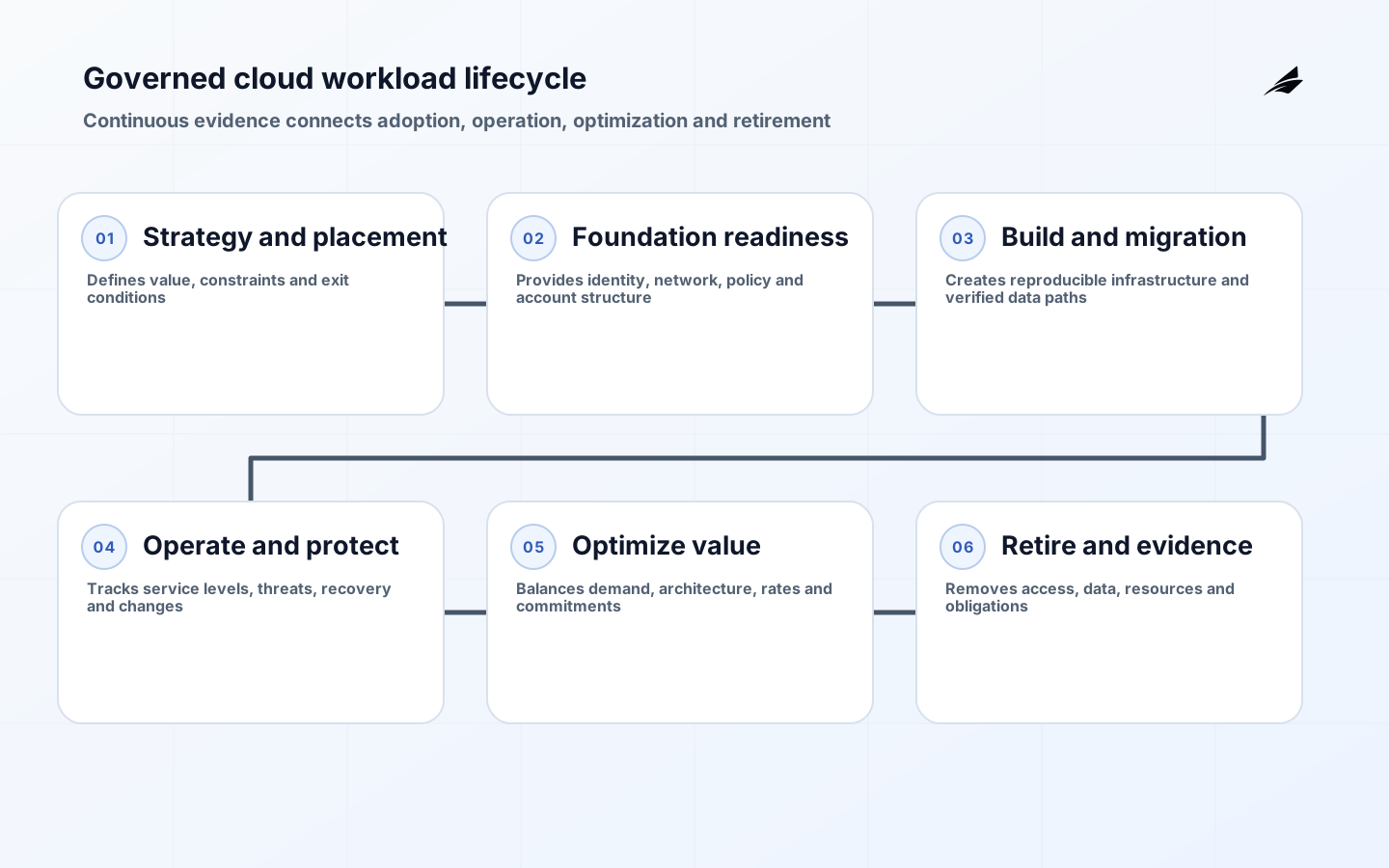
Use a delivery sequence suited to cloud workload lifecycle management: placement decision, foundation readiness, infrastructure-as-code proof, migration wave, service-level operation, recurring optimization and evidence-led retirement. Each transition needs a named decision-maker and evidence covering outcomes, controls and operation. Limit early exposure through reversible boundaries that fit the service. Do not keep a former path indefinitely; set reconciliation, support and decommission criteria before coexistence begins.
- Observe real work and collect normal, edge and failure cases.
- Agree the service charter, quality attributes and risk acceptance authority.
- Map records, trust boundaries, dependencies and operational ownership.
- Build and evaluate a complete vertical slice with production-like controls.
- Pilot with bounded exposure, support coverage and rollback authority.
- Expand only when outcome, control and operational evidence meet the gate.
- Retire old access, data paths, infrastructure and contracts with proof.
Measure outcomes, controls and operability
For cloud lifecycle management services, track service-level attainment, change failure, restoration, policy compliance, recovery tests, unit economics, utilization, allocation coverage, carbon signals where available and retired waste. Define each measure precisely: population, numerator, denominator, source, owner and review cadence. Segment user outcomes where aggregate figures can conceal a failing cohort. Pair speed with quality and reliability so faster throughput cannot disguise rework, unsafe behavior or support burden.
Measurement should change decisions. For cloud workload lifecycle management, review service-level attainment, policy compliance, recovery tests, allocation coverage, unit economics, commitment utilization and resources removed at retirement. Define population, source, owner and cadence for every measure, and segment results where an aggregate can hide a failing user or workload class. Establish thresholds from service consequence and baseline evidence. Record the action taken when a threshold is crossed so monitoring becomes part of governance.
Key takeaways
- Frame cloud lifecycle management services as an owned service outcome, not a package of features.
- Map authoritative records, identities, dependencies, exceptions and recovery before committing architecture.
- Estimate change, operation and exit; show assumptions and uncertainty separately.
- Use a complete, reversible proof slice to retire the most consequential unknowns.
- Treat security, accessibility, reliability and support as acceptance evidence.
- Measure live user outcomes and control effectiveness, then use the evidence to govern expansion.
Related published articles
- CLODEV-0127 - related planning and architecture guidance in the published knowledge base.
- KM-CLD-0007 - related planning and architecture guidance in the published knowledge base.
- KM-CLD-0010 - related planning and architecture guidance in the published knowledge base.
- GEN-CLD-0009 - related planning and architecture guidance in the published knowledge base.
Frequently asked questions
What is the first step for cloud lifecycle management services?
Start by choose one representative workload and document its owner, customer effect, accounts, data, network paths, dependencies, consumption drivers, recovery order and conditions for shutdown. Include successful, prohibited and degraded examples rather than documenting only the happy path. The resulting map should reveal the authoritative state, decision owner and most consequential unknown, which gives the first proof a precise question to answer.
How should the budget be estimated?
Estimate cloud workload lifecycle management from migration and engineering, shared platform allocation, cloud consumption, licenses, observability, security, recovery capacity, data transfer, commitments, optimization and retirement. Keep change, recurring operation and exit as separate views. State assumptions about volume, service level and internal availability, then replace them with observed figures after discovery and a vertical proof. A precise early total without this evidence is usually an allocation of hidden contingency, not certainty.
Should the team buy, build or use a delivery partner?
The build-or-buy decision is specific to this capability: use native managed services when operational benefit exceeds portability cost, build shared platform capabilities for repeated needs, and engage managed operations only with observable service and exit terms. Compare options against the same quality attributes, hard cases, operating model and exit test. Product category alone cannot decide fit; the organization must understand which behavior differentiates it and which dependency it is prepared to inherit.
What evidence shows the service is ready to expand?
Expansion is justified when infrastructure is reproducible, policy exceptions expire, telemetry covers user outcomes, recovery is rehearsed, costs map to an owner and retirement removes access, data and commitments. Confirm the conditions under realistic demand and failure, not only in a scripted demonstration. The accountable service and risk owners should review unresolved exceptions and authorize increased exposure; delivery completion by itself is not evidence that operation is ready.
Conclusion
Cloud Lifecycle Management Services: Govern Workloads from Strategy to Retirement is ultimately a governance discipline. The team defines a meaningful boundary, makes authority visible, tests difficult behavior and connects delivery to live operations. That approach leaves room to change technology without losing the records, controls and knowledge that make the service trustworthy.
Cloud lifecycle management connects architecture and daily economics to an accountable workload. The discipline is complete only when teams can place, operate, improve and retire services with verifiable evidence. Begin with representative cases, test the highest-risk boundary end to end, and use observed outcomes to govern the next increment. Preserve clear authority for exceptions and remove obsolete paths only after state, access and operational obligations have been reconciled.