Cloud lifecycle management services coordinate decisions from initial demand through retirement. The lifecycle includes discovery, architecture, provisioning, delivery, security, reliability, cost, change, support, modernization and disposal. It is broader than monitoring and more durable than a migration project. The objective is to keep every workload connected to an owner, purpose, policy, service level, cost signal and exit decision while the estate changes.
This FAQ complements the cloud lifecycle implementation checklist and the broader managed cloud services checklist. Organizations can implement the model with internal teams, a provider or both. Outsourcing activities does not outsource accountability for customer outcomes, data, risk acceptance or the decision to continue funding a workload.
What belongs in cloud lifecycle management?
At minimum, lifecycle management maintains a current workload register, disposition, architecture and data ownership; provides governed environments; controls identity and change; operates service levels and incidents; allocates and forecasts cost; manages vulnerabilities and dependencies; validates recovery; and retires resources and records. The exact service boundary depends on whether the platform is IaaS, PaaS, SaaS or a hybrid. NIST’s cloud synopsis helps distinguish service and deployment models, which is necessary before assigning duties.
Treat the lifecycle as a set of decisions, not a waterfall. A production incident may send a workload back to architecture; a contract renewal can trigger replacement; a new data class can require a different region; and sustained demand may justify a commitment. Each decision needs current evidence and a named authority. Stage labels are useful only when the handoff preserves context instead of throwing documents over an organizational boundary.
| Lifecycle state | Decision | Evidence |
|---|---|---|
| Demand | Adopt, replace, retain or reject | Outcome, baseline, owner, risk and alternatives |
| Foundation | Approve a consumable platform path | Policy tests, identity, network, logging and billing |
| Delivery | Release or migrate a bounded change | Automated checks, reconciliation and rollback |
| Operation | Continue, improve or constrain | SLO, incidents, controls, cost and user result |
| Retirement | Delete, archive, export or retain | Dependency closure, records rule and disposal proof |
How should a cloud portfolio be governed?
Maintain a federated inventory linked to authoritative cloud APIs, billing, repositories, service catalogs and business ownership. Required fields should be few enough to remain current: purpose, owner, criticality, data class, environment, dependencies, SLO, cost center, support team, lifecycle state and next review. Unknown ownership is a risk condition, not a harmless blank. Automated discovery finds resources; accountable people explain why they exist.
Review the portfolio by business service, not only account or subscription. One customer transaction may span several platforms and suppliers. Use disposition confidence to focus discovery: high-cost, unsupported, exposed or ownerless workloads deserve attention. Portfolio governance should produce funded actions such as retire, patch, modernize, renegotiate or accept risk. A dashboard that never changes a decision adds reporting work without managing the lifecycle.
What should the platform automate?
Automate repeatable controls with clear feedback: account vending, baseline identity, network patterns, encryption settings, telemetry, budget attribution, policy checks, backup enrollment and pipeline templates. Keep infrastructure and policy versioned, reviewed and promoted through environments. Provide exception workflows for legitimate variation, including owner and expiry. A paved path earns adoption by shortening delivery and making the secure behavior easier, not merely by enforcing central preference.
Automation needs product ownership. Measure platform adoption, provisioning lead time, failed changes, policy escape, support demand and developer experience. Test the platform through real workloads and failure exercises. Do not automate ambiguous deletion or broad remediation without bounded authority and recovery. A policy bot that removes a resource it cannot classify can turn governance debt into an outage.
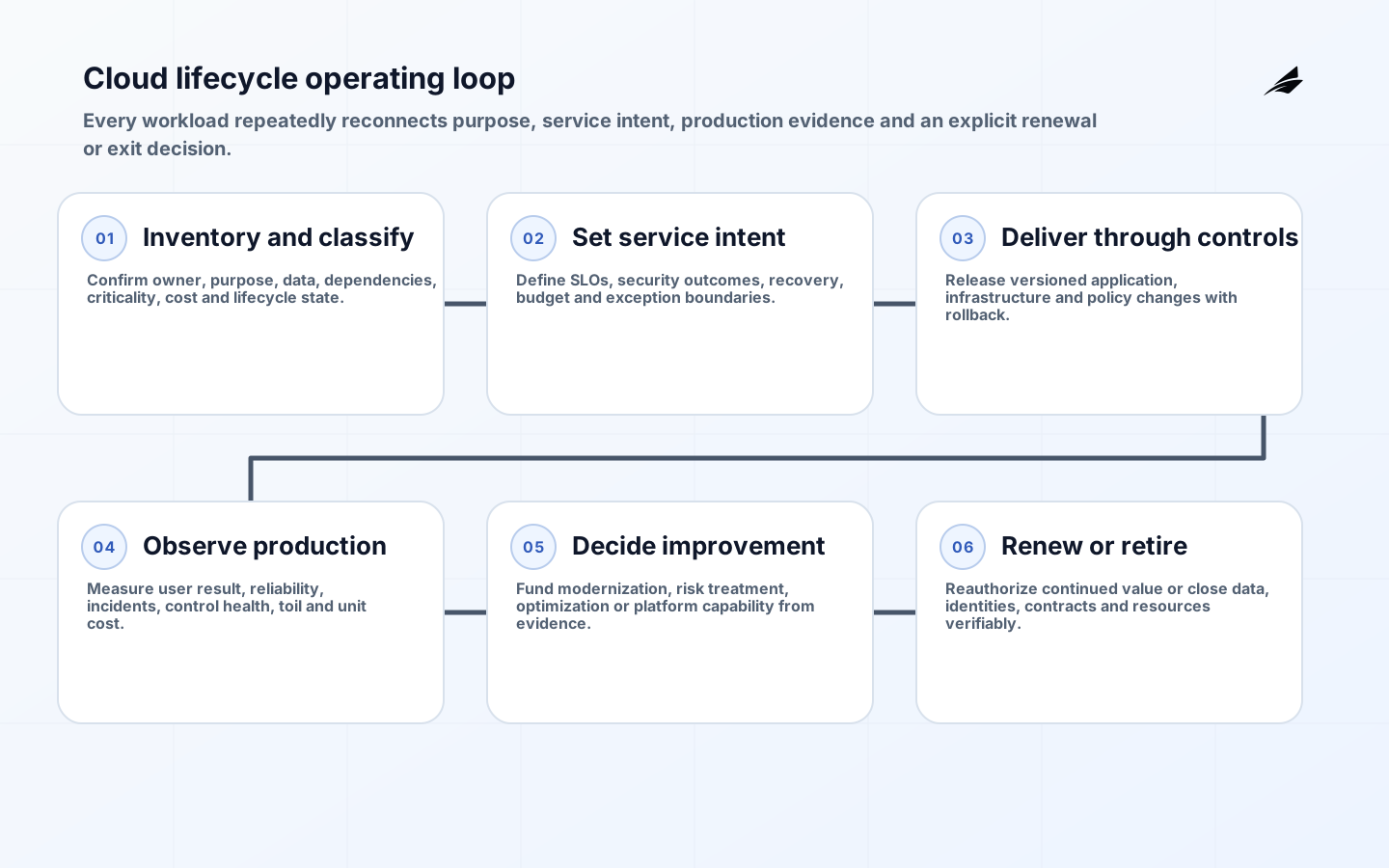
Run a six-stage cloud lifecycle operating loop
The loop is: inventory and classify, set service intent, deliver through controls, observe production, decide improvement, and retire or renew. Every cycle refreshes ownership and assumptions. Workloads with rapid change may loop continuously; stable systems can use a slower cadence, but critical controls and vulnerabilities still need event-driven review. Connect review dates to material events such as incidents, provider changes, demand shifts, audit findings and contract renewal.
Use one backlog for reliability, security, cost, feature work and toil so tradeoffs are visible. DORA’s continuous delivery guidance supports small, testable and releasable changes. Change governance should evaluate risk using evidence from automation, observability and rollback readiness. Requiring the same meeting for every change hides high-risk work in a queue and slows routine improvements.
How do SLOs and recovery guide operations?
Define service-level indicators around user-visible transactions and set realistic objectives. Google SRE’s SLO guidance explains why objectives should support decisions rather than promise perfection. Use error budgets to balance release pace and reliability investment. Resource uptime and ticket closure are secondary signals; they do not prove that customers can complete the service.
Recovery objectives should follow business impact. Map infrastructure, identity, data, DNS, certificates, pipelines, support and third parties required to restore the transaction. Exercise rebuild and restore, including the authority to declare disaster and communicate. Measure actual recovery point, time and reconciliation. A successful backup job is insufficient because the catalog, key, account or integration needed for restoration can still fail.
How is security sustained across the lifecycle?
Use the NIST Cybersecurity Framework to connect governance, identification, protection, detection, response and recovery outcomes. Translate those outcomes into platform defaults and workload evidence. Track privileged identities, public exposure, data movement, software provenance, vulnerabilities, provider advisories and configuration drift. Controls need owners and health signals; a policy documented once can silently fail as services and teams change.
Integrate incident learning with lifecycle decisions. Preserve timelines and evidence, identify contributing system conditions and fund changes. Review whether alerts were actionable, access was sufficient but not excessive, recovery artifacts worked and suppliers responded. Avoid reducing every event to individual error. Repeated manual mistakes usually indicate unclear interfaces, weak defaults or unsafe automation that the platform team should improve.
How does FinOps fit the lifecycle?
Cost is a design and product signal throughout the lifecycle. The FinOps Framework centers collaboration and business value. Allocate spend to accountable teams and meaningful products, forecast from demand, detect anomalies, and discuss unit economics with performance and reliability. Tagging helps, but shared platforms, support, commitments and transfer need explicit allocation rules. Publish data soon enough for engineers to act.
Optimization choices include stopping waste, right-sizing, scheduling, storage lifecycle, architecture, licensing and rate commitments. Validate whether the change alters user experience, resilience or engineering effort. Savings that increase incident risk or manual toil may destroy value. Record the expected benefit and verify it after implementation. Mature lifecycle management also prevents new waste by putting estimates, budgets and ownership into the delivery path.
| Signal | Decision it should support | Weak substitute |
|---|---|---|
| SLO performance | Release, reliability investment or degradation response | Provider uptime alone |
| Unit cost | Architecture, pricing or product demand decision | Total bill without allocation |
| Change failure | Improve testing, scope or rollback | Number of approved tickets |
| Control health | Repair failed preventive or detective coverage | Annual policy attestation |
| Recovery exercise | Fund dependency and runbook fixes | Backup success percentage |
When and how should cloud workloads retire?
Trigger retirement when a service is replaced, unused, unsupported, legally unnecessary or no longer worth its risk and cost. Confirm users, dependencies, data authority, records obligations, legal holds, exports, contracts and rollback period. Communicate the date and owner. Disable entry points before deletion where appropriate, monitor for unexpected use, then remove compute, storage, identities, keys, DNS, pipelines, licenses and monitoring deliberately.
Retirement acceptance needs evidence: records archived or deleted correctly, downstream consumers moved, supplier and privileged access closed, spend stopped, inventory updated and recovery copies handled according to retention. Retaining an undocumented snapshot indefinitely is not responsible exit. Keep only what has a purpose and owner. Feed retirement findings into future architecture, especially where hidden dependencies or difficult export increased delay.
Cloud lifecycle management takeaways
- Keep every workload tied to a purpose, owner, SLO, cost and lifecycle state.
- Automate paved paths and make exceptions visible and temporary.
- Use production evidence to prioritize reliability, security and cost in one backlog.
- Exercise recovery as a complete business service.
- Treat retirement and disposal as acceptance work, not an administrative afterthought.
Frequently asked questions
Is lifecycle management the same as managed cloud? No. A managed provider may perform lifecycle activities, but the governance model can be internal or shared. How often should workloads be reviewed? Use a risk-based cadence plus event triggers. Must every control be centralized? No. Central teams can provide standards and platforms while product teams own service-specific implementation.
What is the best lifecycle metric? No single measure is sufficient; combine user outcome, SLO, change, risk, unit cost and retirement progress. Can optimization wait until after migration? Basic allocation and demand estimates should start before migration, while deeper tuning follows real usage. Who approves retirement? The accountable service and data owners, with records, security, finance and technical evidence appropriate to the workload.
Conclusion
Cloud lifecycle management keeps adoption, operation and exit connected. Build a current portfolio, offer a tested platform, deliver small changes, operate from service evidence and close resources when their purpose ends. When ownership and decisions travel with the workload, the organization can evolve its cloud estate without losing reliability, financial accountability or control.