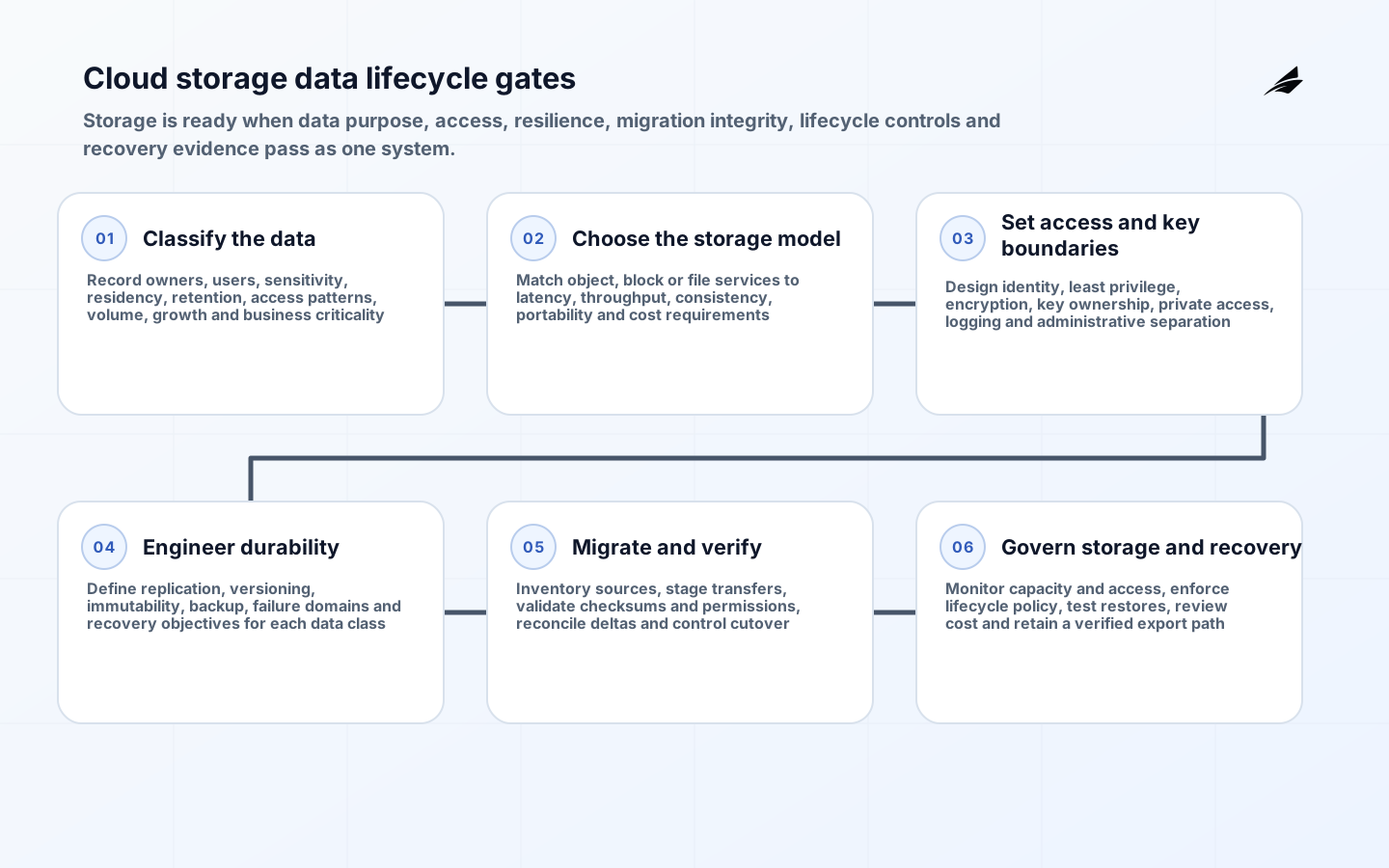
A cloud storage services implementation checklist must cover more than creating a bucket, file share or managed database. The organization is changing where authoritative data lives, who can act on it, how applications observe consistency, what failure means and when information should disappear. Storage becomes dependable only when those decisions are explicit across creation, use, protection, recovery and disposal.
Use this checklist with the storage scope and delivery plan and the cloud storage FAQ. Assign every item to a named data, application, security or platform owner; a provider supplies technical durability features, but the customer still controls configuration, identity, classification, retention and restore acceptance.
1. Define the data and workload requirements
Inventory datasets by owner, business purpose, sensitivity, authority, volume, growth, access pattern, latency and residency obligations. Distinguish system-of-record data from replicas, caches, analytics copies, logs and user exports. Record expected object size, request concurrency, transaction behavior and egress. These facts determine service fit far better than a generic preference for object, block or file storage.
Set recovery time and recovery point objectives from business impact. Identify legal holds, deletion commitments, immutable retention and geographic constraints with counsel or records specialists. Include the application semantics: a platform can report durable bytes while the service remains unusable because indexes, encryption keys, identity or dependency order were not restored. Define acceptance at the business transaction level.
| Storage pattern | Best fit | Key implementation question |
|---|---|---|
| Object | Documents, media, backups, data lakes and immutable artifacts | How are namespace, versioning and event retries controlled? |
| Block | Low-latency volumes for hosts and stateful engines | How are crash consistency and snapshots coordinated? |
| File | Shared hierarchical access and legacy protocols | How are permissions and locking semantics preserved? |
| Managed database | Queries and transactions with provider-operated engines | Who controls schema, backup, logs, keys and failover? |
2. Select storage architecture and failure boundaries
Compare candidate services against required semantics, not headline durability. Document consistency, availability-zone and region behavior, quotas, API limits, maximum object or volume sizes, replication delay and maintenance behavior. Decide which failures the application must absorb. Retry logic needs bounded backoff and idempotency; otherwise a transient timeout can produce duplicate writes, conflicting versions or an expensive request storm.
Map dependencies needed to read and recover data: identity provider, key service, network path, domain name, catalog, metadata database, backup controller and deployment code. Keep critical recovery material in an appropriately isolated administrative boundary. The CISA Cloud Security Technical Reference Architecture is federal-focused but provides useful vendor-neutral reasoning about shared services, migration and cloud security posture.
3. Implement identity, encryption and data protection
Deny public access by default and authorize through workload and human identities with the narrowest resource scope. Separate readers, writers, lifecycle administrators, backup operators and key administrators where consequence warrants it. Avoid long-lived embedded credentials. Review cross-account trusts, pre-signed links, access points and support roles as carefully as direct policy because they often create the effective access path.

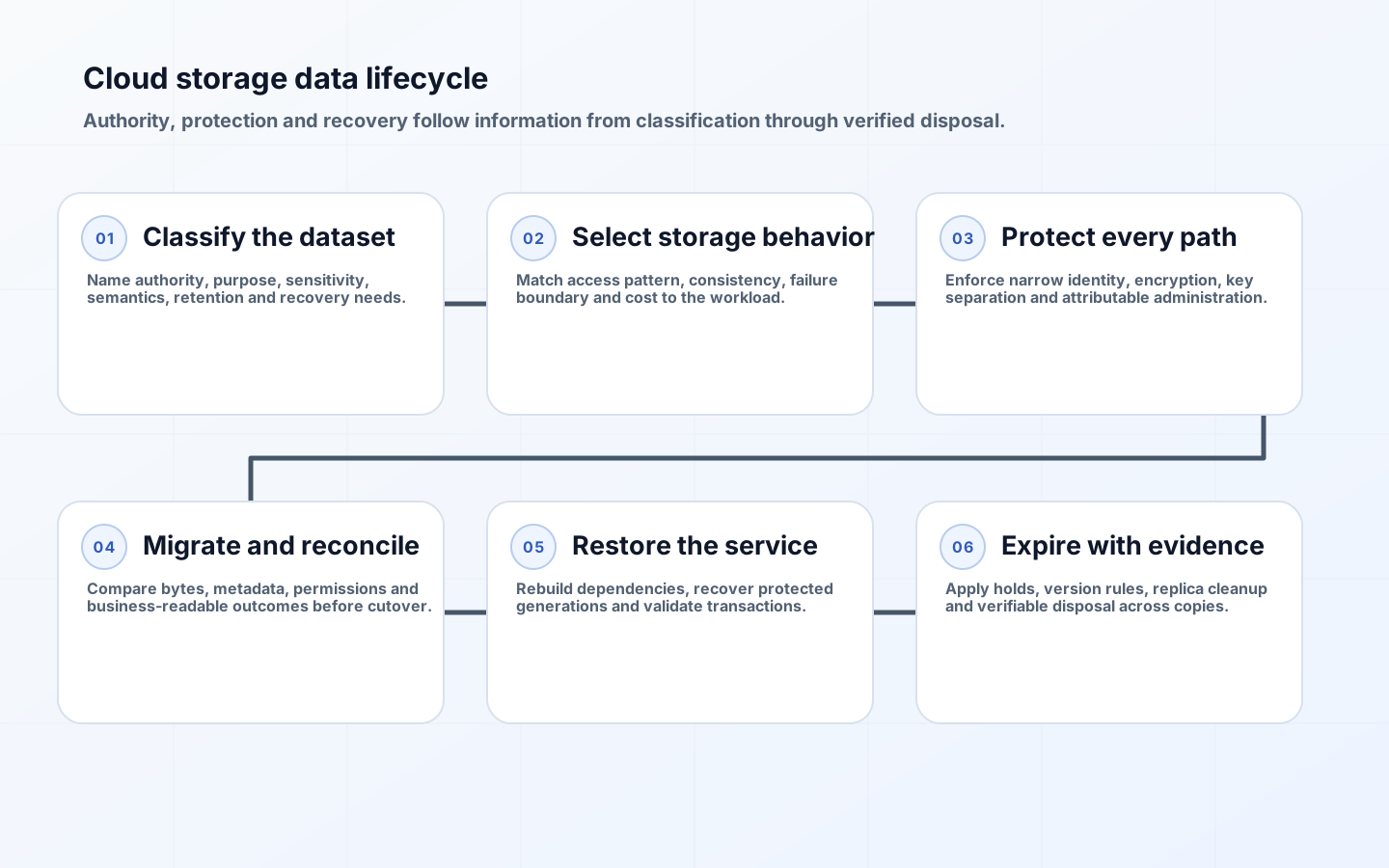
Use encryption in transit and at rest, then design the key lifecycle: ownership, rotation, disablement, deletion protection and recovery. Encryption cannot compensate for an overly broad authenticated user. NIST SP 800-209 covers storage-specific concerns including isolation, restoration assurance and data protection alongside authentication, configuration and incident response. Translate relevant recommendations into tested configuration and evidence.
4. Configure retention, versioning and deletion
Create lifecycle rules from approved record classes, not a single organization-wide age. Specify when data becomes inactive, changes tier, expires or remains under hold. Include incomplete multipart uploads, noncurrent versions, snapshots, replicas and derived indexes, which can silently defeat deletion and cost expectations. Test rule behavior on representative objects before broad activation and monitor the volume eligible for each transition.
Define deletion as a verifiable workflow. Application deletion, provider tombstones, replication, backup expiry and key disposal may happen at different times. Preserve enough evidence to show policy execution without retaining the sensitive content itself. For customer-controlled deletion, explain exceptions and completion time honestly. An undocumented backup copy can violate both user expectations and incident-containment plans.
5. Migrate and reconcile data
Profile the source before moving it. Measure counts, bytes, names, permissions, checksums, timestamps, unsupported characters, sparse files, links and duplicate identifiers. Select online replication, bulk transfer appliances or phased application migration based on volume, available bandwidth and acceptable coexistence. Encrypt transfer, protect manifests and throttle the process so migration does not starve production workload.
Reconciliation requires more than a successful copy command. Compare record counts, byte totals and cryptographic digests where appropriate; sample business-readable objects; verify metadata, permissions and application queries. Freeze or capture deltas during cutover. Keep rollback criteria and a source retention period tied to acceptance, then remove obsolete access after approval rather than leaving two writable authorities indefinitely.
| Gate | Evidence | Stop condition |
|---|---|---|
| Design | Classification, service fit, failure model and cost estimate | Required semantics or residency cannot be met |
| Pilot | Representative load, access tests, restore and lifecycle behavior | Material data or permission mismatch |
| Cutover | Delta capture, reconciliation, monitoring and rollback owner | Unexplained checksum or transaction variance |
| Closure | Business acceptance, legacy access removal and disposal record | Old authority or uncontrolled copy remains |
6. Prove backup, restore and ransomware resilience
Replication protects availability but can replicate deletion or corruption. Create backups aligned to the recovery point objective, isolate their administration, restrict destructive actions and retain protected generations. CISA's ransomware guidance recommends tested backups and emphasizes that recovery preparation is part of defense. Monitor backup completion, but treat a completed restore test as the stronger signal.
Run restore exercises from a defined incident scenario. Rebuild identity and keys, restore data in dependency order, validate application transactions and reconcile work that occurred around the failure. Measure actual recovery time. Include compromised administrator credentials and region loss in tabletop or technical exercises. Record gaps as owned work and repeat the test after remediation; a recovery plan that has never crossed an account boundary is an assumption.
7. Monitor access, integrity, performance and cost
Collect administrative changes, denied access, unusual downloads, public exposure, key events, replication lag, restore results, capacity, latency and error rates. Route alerts to owners with enough context to act. Define log retention and protect logs from the same identities they observe. NIST's Cybersecurity Framework helps connect governance and asset knowledge with protection, detection, response and recovery.
Model cost from capacity by tier, operations, replication, backup, retrieval, egress and support. Attribute spend to a dataset or service owner and track useful units such as cost per retained case or processed media hour. Set anomaly alerts, but investigate application loops and lifecycle drift before demanding blanket deletion. Cost optimization that breaks retention or recovery objectives is simply transferred risk.
Test application behavior when storage reaches quotas, rate limits or a temporary read-only state. Confirm that clients distinguish a timeout from a failed write, queues do not grow without bounds and operators can identify the affected dataset. Capacity planning should include object counts, request distribution and metadata limits, not only total bytes. For archival tiers, measure retrieval lead time against investigation and continuity needs before committing large volumes.
Document the evidence package for periodic review: current classification, owner, policy, access analysis, key status, lifecycle execution, restore result, cost trend and unresolved exceptions. Review after application redesign, acquisition, new jurisdiction or material provider change. Remove stale test buckets and abandoned snapshots through an approved process. Storage sprawl is both a cost problem and a map of forgotten sensitive data, so closure deserves the same operational attention as provisioning.
Assign a named steward for shared datasets that serve several applications. That owner coordinates schema and lifecycle changes, communicates maintenance, resolves conflicting retention needs and approves new consumers. Review stewardship during reorganizations and require a successor before an owner departs. Without stewardship, each application creates its own copy and interpretation, making access review, correction, recovery and eventual disposal slower and less reliable.
Cloud storage implementation takeaways
- Classify data and define business recovery before choosing a storage product.
- Test authorization through every direct, delegated and temporary access path.
- Treat keys, identity, metadata and indexes as recovery dependencies.
- Reconcile migrations with technical and business-readable evidence.
- Govern versions, replicas, backups and deletion as one data lifecycle.
Frequently asked questions
Is provider durability a backup? No. Durability reduces the chance of infrastructure data loss; backup provides separate recovery points and administrative isolation. Should every dataset use customer-managed keys? Not automatically. Choose key control from threat, compliance, separation and operating capability. A complex key design that the team cannot recover can reduce availability without improving meaningful control.
Can storage migration be zero downtime? Some workloads can use replication and a short logical cutover, but transaction semantics and dependency changes still need testing. What should be tested first? Restore one representative service, including keys and application validation. It reveals more operational truth than a dashboard showing successful snapshot jobs.
Conclusion
Cloud storage is an information service, not a capacity purchase. A strong implementation connects workload semantics, least-privilege access, lifecycle rules, migration reconciliation and exercised recovery. Begin with the most consequential dataset, document its authority and dependencies, then prove read, write, delete and restore behavior under failure. Repeat that evidence pattern before expanding the migration.