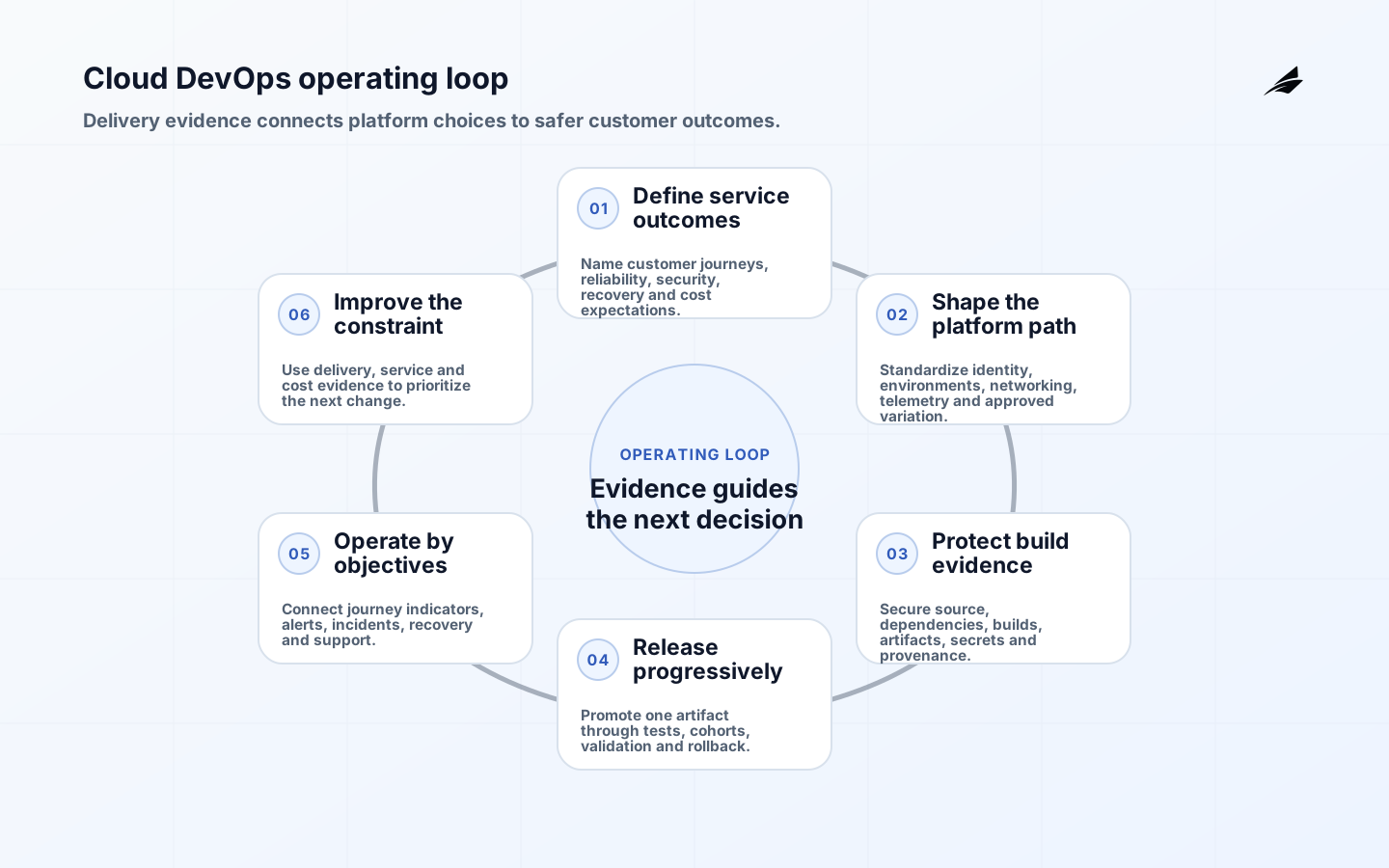
Cloud DevOps services combine platform engineering, delivery automation, security and production operations around one goal: moving useful changes into service without losing control. A provider may supply a team, a managed platform or specialist help, but the buyer still needs clear service ownership, release authority and measurable outcomes. This cloud DevOps services FAQ explains what to buy, how to govern it and what evidence should exist before responsibility changes hands.
Use the cloud DevOps implementation checklist when a program is ready for detailed gates. Enterprise buyers can compare the broader cloud DevOps delivery plan and the enterprise implementation checklist. Those guides complement this FAQ by turning the operating questions below into accepted evidence.
What do cloud DevOps services actually include?
A credible scope starts with product journeys and the cloud capabilities that support them. Typical work includes account or subscription foundations, identity, network patterns, infrastructure as code, build and deployment pipelines, artifact management, secrets, observability, backup, recovery, vulnerability handling, cost allocation and operational support. It may also include migration, developer enablement and an internal platform. The label DevOps does not itself define which team owns any of these responsibilities.
Request a responsibility map by capability and environment. For every item, name who designs the standard, provisions it, approves change, monitors it, responds after hours, pays the bill and accepts residual risk. The CISA Cloud Security Technical Reference Architecture emphasizes shared services, cloud migration and security posture management. Its central practical lesson is that cloud adoption needs explicit responsibility and visibility across the provider and customer boundary.
| Service area | Provider evidence | Client decision |
|---|---|---|
| Platform foundation | Versioned modules, policy checks and environment inventory | Which patterns are mandatory and who may grant exceptions? |
| Delivery path | Pipeline definitions, test results and artifact provenance | Who may promote, pause or roll back a release? |
| Reliability | Service indicators, objectives, alerts and recovery exercises | Which user journeys receive higher protection? |
| Security | Threat decisions, access records, findings and response workflow | Who accepts risk and owns remediation deadlines? |
| Economics | Tagged usage, allocation rules and optimization decisions | Which team owns consumption and budget tradeoffs? |
Which operating model should a buyer choose?
Choose according to the capability the organization must retain. In an advisory model, specialists establish architecture and working practices while employees operate them. A co-managed model places provider engineers inside a shared backlog and on-call arrangement. A managed model transfers defined operational tasks under service objectives, but product and risk accountability should remain named on the customer side. Staff augmentation adds capacity without necessarily creating a platform or outcome.

Avoid separating development and operations with a contractual wall. Product teams need a supported route to production, and operators need context about user impact. Define one workflow for requests, changes, incidents and improvement. The provider should work in client-controlled repositories and service systems where practical. A managed service is healthier when knowledge, telemetry and recovery authority are available to both parties rather than held inside private provider tools.
How much standardization is appropriate?
Standardize repeated, risky decisions: identity integration, network exposure, encryption, logging, deployment, backup, policy checks and environment creation. Offer these as paved paths with versioned templates and documented support. Leave product teams room to choose within an approved envelope. A platform that forces every workload into one runtime can become a bottleneck; a catalog with no constraints simply relocates complexity to each team.
Treat the platform as a product. Identify users, publish supported capabilities, measure adoption and failure demand, and maintain a deprecation process. Platform changes need compatibility tests and migration windows. Exceptions should record the reason, owner, compensating control and review date. The related enterprise cloud DevOps FAQ addresses governance across larger portfolios, where multiple platforms or regulatory boundaries may be justified.
What does secure delivery require?
Security belongs in the normal delivery path. The NIST Secure Software Development Framework groups practices around preparing the organization, protecting software, producing well-secured software and responding to vulnerabilities. Translate those outcomes into repository protection, peer review, dependency controls, isolated builds, signed artifacts, environment policy and a vulnerability response process. A scanner is useful evidence, but it is not the whole control system.
Build once and promote the same immutable artifact. Keep deployment identity separate from developer identity, issue short-lived credentials, protect production approvals and record every promotion. The SLSA specification provides a vocabulary for artifact provenance and build integrity. Teams can adopt it incrementally: start by producing trustworthy provenance, then harden the build platform and verification policy according to the consequence of compromise.
- Protect source branches, review rules, build definitions and artifact registries.
- Inventory direct and transitive dependencies and define update ownership.
- Separate build, deployment and workload identities with least privilege.
- Run unit, integration, security, policy and recovery checks at appropriate gates.
- Keep exceptions time-bound and visible to release and risk owners.
- Test how a compromised credential, dependency or runner is contained and replaced.
How should reliability and incident work be measured?
Begin with user journeys, not infrastructure averages. An indicator describes observed behavior such as the proportion of valid checkout requests completed within a latency threshold. An objective sets the acceptable level over a window. Google's service level objective guidance recommends working backward from what users care about and using an error budget rather than demanding perfect availability. That makes reliability a product decision instead of an unlimited technical aspiration.
Alerts should identify conditions that require action and include ownership, impact context and a runbook. Exercise rollback, regional failover, data restoration and dependency failure before relying on them. After an incident, preserve a timeline, contributing conditions, customer impact and assigned improvements. Review whether detection and decision paths worked, not merely who executed the last change. Provider contracts should define communication and authority during a major event.
| Measure | What it reveals | Common misuse |
|---|---|---|
| Deployment frequency | How often completed changes reach users | Treating more releases as value by itself |
| Change lead time | Elapsed path from committed change to production | Comparing teams with unlike work and controls |
| Failed deployment recovery time | Speed of restoring service after a deployment failure | Ignoring prolonged customer degradation |
| Change fail rate | Share of deployments requiring remediation | Hiding rollbacks or hot fixes from the definition |
| Rework rate | Effort spent correcting avoidable delivery defects | Using it to rank individuals rather than improve systems |
How are value, cost and provider performance assessed?
The current DORA delivery metrics balance throughput and instability through deployment frequency, change lead time, failed deployment recovery time, change fail rate and deployment rework rate. Use trends at the service or value-stream level, with customer outcomes, reliability and cost. A provider should improve the path that produces these results, not optimize one number or compare unrelated teams.
Price the whole operating model. Include setup, licenses, cloud consumption, observability, security services, support coverage, migration, training and exit. Fixed fees fit a stable managed scope; time and materials fit uncertain modernization; a retainer can cover specialist capacity. Tie acceptance to working evidence such as a reproducible environment, successful recovery drill or reduced lead time. Avoid outcome fees based on measures the provider cannot control alone.
What should selection and handover prove?
Ask candidates to walk through a comparable service from commit to customer and from alert to recovery. Inspect sample infrastructure modules, test evidence, incident records, architecture decisions and service reports with confidential details removed. Meet the people who will deliver the work. Confirm cloud, security and on-call experience, subcontractor use, staff continuity and escalation access. Product partnerships and certificates can support due diligence, but they do not replace evidence of sound engineering.
Handover begins on day one. Keep code, configurations, dashboards, runbooks, inventories and decisions in agreed systems. Pair client staff in releases and incident exercises. Before exit, the client should be able to deploy a change, restore data, rotate access, diagnose a failure and explain the bill. Revoke provider access, transfer accounts and subscriptions, export service history, document open risks and verify supplier contacts. Operational acceptance is stronger than a document inventory.
Key takeaways
- Buy a defined operating capability with named outcomes and responsibilities.
- Standardize the high-risk repeated path while allowing governed product variation.
- Integrate software supply-chain security into normal build and release work.
- Measure user journeys with service objectives, tested recovery and actionable alerts.
- Use delivery measures as system signals alongside customer, reliability and cost outcomes.
- Require client-controlled evidence and a demonstrated handover from the start.
Further cloud DevOps services FAQ
Is DevOps a team or a method? It is an operating approach that joins product, development, security and operations around delivery and service outcomes. A platform or enablement team can support it, but creating a department called DevOps does not remove shared ownership.
Does every company need Kubernetes? No. Choose a runtime from workload, team and operating constraints. Managed application platforms or serverless services can reduce undifferentiated work. Containers and Kubernetes are justified when their portability, control or workload capabilities exceed the lifecycle cost.
Can a provider own production completely? A provider can perform most operational tasks, yet the customer should retain accountable owners for product impact, data, risk, budget and supplier decisions. The contract must provide visibility, escalation and exit capability.
How long does improvement take? A narrow path can improve within weeks, while portfolio-wide platform and operating changes take longer. Set 30-, 60- and 90-day evidence targets around one representative service, then expand from measured results rather than promising a universal transformation date.
Conclusion
Cloud DevOps services work when they make delivery safer, recovery faster and ownership clearer. Define the user outcome, draw the operating boundary, secure the path, measure service behavior and keep the evidence accessible. A buyer that can inspect and eventually operate the capability is purchasing durable engineering, not rented activity.