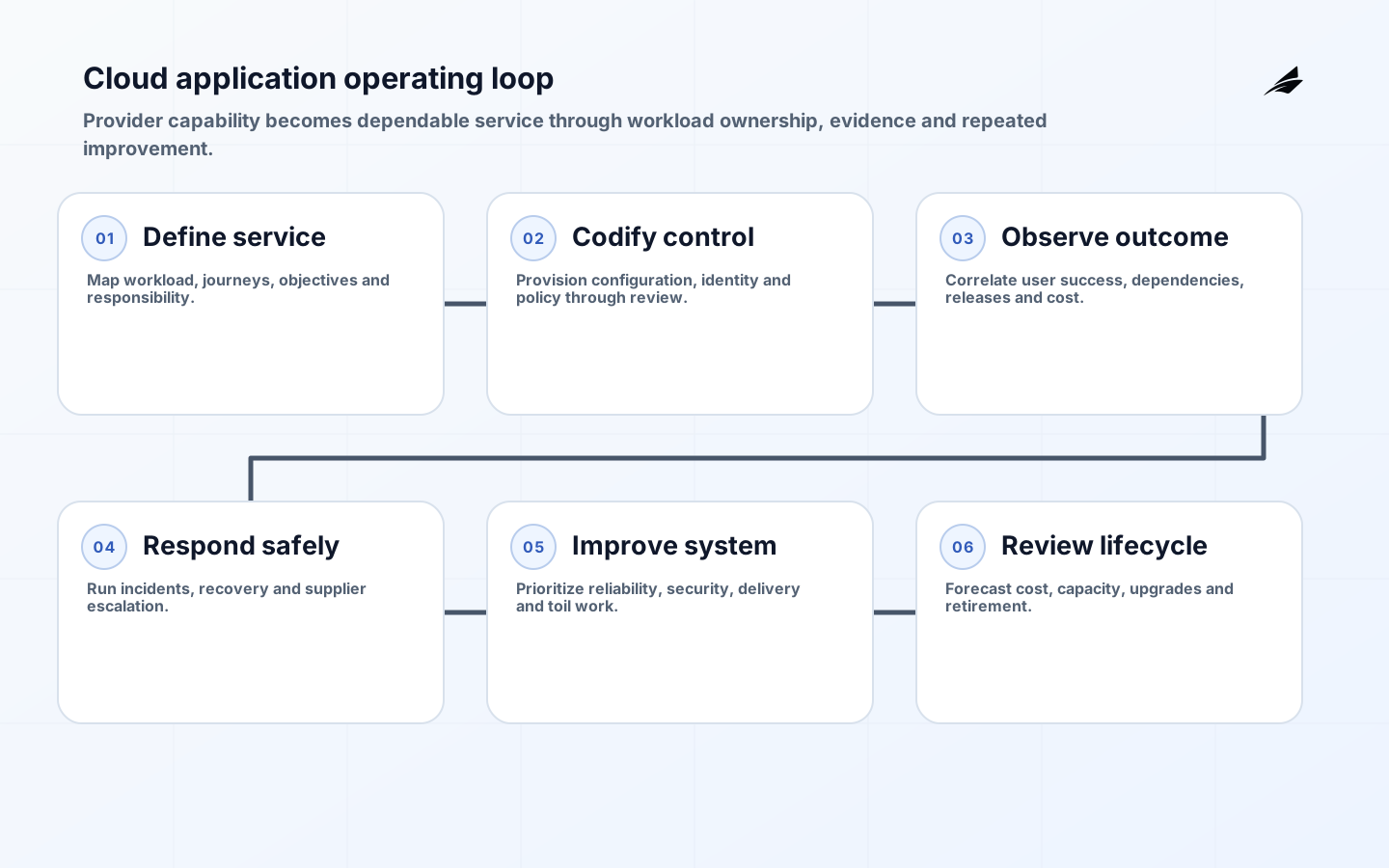
Cloud application management is the operating system around a workload: ownership, service objectives, configuration, access, releases, observability, incident response, resilience, cost and lifecycle change. Cloud services automate infrastructure tasks, but they do not decide which customer journey matters, who accepts risk or how the application should recover. An implementation checklist must connect provider capabilities to an accountable workload team and verifiable operating evidence.
Use this checklist when taking over an existing workload, moving into managed operations or standardizing a cloud estate. It complements the cloud application management guide, the cloud application management FAQ and the cloud lifecycle management checklist. Apply provider-specific well-architected guidance to the actual services in use.
Define the cloud application service boundary
Inventory accounts or subscriptions, regions, environments, compute, storage, databases, queues, networks, identities, secrets, certificates, observability, pipelines, data stores and external services. Link resources to an application, environment, owner, data classification and lifecycle state through tags and authoritative catalogs. Detect unowned and manually created resources. Include SaaS and third-party APIs because their failure and cost can dominate the user journey.
Write a shared-responsibility matrix for provider, platform team, workload team, security, data, finance and suppliers. Microsoft’s Cloud Adoption Framework separates foundational adoption from continuing Govern, Secure and Manage practices; use the pattern without assuming one provider’s tooling. Define escalation and decision authority for incidents, emergency access, spending anomalies and risky releases.
| Capability | Platform responsibility | Workload responsibility |
|---|---|---|
| Identity and access | Federation, baseline policy and privileged tooling | Roles, service identities, reviews and application authorization |
| Network | Approved connectivity patterns and shared controls | Required flows, endpoint policy and dependency testing |
| Observability | Collection platform, retention and access | Instrumentation, service indicators, alerts and runbooks |
| Resilience | Regional patterns and backup services | Recovery objectives, data correctness and exercises |
| Delivery | Pipeline templates and artifact services | Tests, approvals, migration and rollback behavior |
| Cost | Billing data and allocation standards | Forecast, unit economics and architecture tradeoffs |
Set user-centered service objectives and support ownership
Map critical journeys and define indicators for success, latency, correctness, freshness and durability. Google SRE’s SLO guidance recommends starting from what users care about and using a small representative set. Define eligible events, measurement location, window and target. Distinguish internal SLOs from contractual SLAs and state what happens when the objective is at risk.
Create an on-call and escalation model proportional to criticality. Every page should require timely human action and link to a current runbook. Define incident roles, severity, communication, customer status authority and supplier contacts. Track restoration from user impact to verified recovery. Review repeated incidents and operational toil; convert recurring manual work into engineering backlog with a measurable elimination target.
Control configuration, identity and cloud security
Provision infrastructure through reviewed code and policy, with drift detection and controlled exceptions. Separate environments and production privileges, use workload identities instead of long-lived keys, centralize secrets, rotate certificates and restrict emergency access. Protect the management plane as a critical system. Back up configuration and account dependencies needed to rebuild, not just application data.
Use the NIST Cybersecurity Framework 2.0 to organize target outcomes and provider-specific controls to implement them. Threat-model public endpoints, identity federation, CI/CD, metadata services, storage exposure, dependency compromise and cross-account trust. Continuously evaluate configuration but require human risk ownership for exceptions. Verify that security telemetry reaches the response team and can support investigation.
| Production gate | Evidence | Recovery question |
|---|---|---|
| Configuration | Reviewed infrastructure plan, policy checks and drift baseline | Can the environment be reproduced without console memory? |
| Identity | Role tests, service-identity inventory and access review | Can compromised access be revoked quickly? |
| Data | Backup result, restore test and retention policy | Is restored business state complete and correct? |
| Release | Traceable artifact, tests, migration and exposure control | What happens to writes during reversal? |
| Observability | Journey indicators, alerts, dashboards and runbooks | Can operators diagnose an unfamiliar failure? |
| Dependency | Limits, timeout, fallback and supplier escalation | How does the user journey degrade safely? |
Instrument the application for diagnosis and action
Collect metrics, logs and traces across user entry, services, data stores, queues and dependencies with a correlation strategy. The OpenTelemetry observability primer frames observability as the ability to ask questions about system behavior, including novel problems. Avoid sensitive payloads and unbounded high-cardinality labels. Record release and configuration versions so a behavior change can be tied to change.
Monitor latency percentiles, error ratios, saturation, queue age, dependency failures and user outcome correctness. Add freshness and reconciliation for data products. Test alerts by injecting controlled failures and confirming routing, access and runbooks. Keep dashboards for investigation separate from service reviews. Delete unused telemetry after confirming it has no security, audit or reliability purpose; uncontrolled collection creates cost and privacy risk.
Engineer resilience and a repeatable release path
Define recovery point and time objectives from business impact, then map failure domains and dependencies. Use redundancy only where it protects the intended operation. Rehearse zonal or regional loss, database restoration, queue backlog, identity outage and provider API failure. The AWS Well-Architected Framework is one provider’s structured review across operational excellence, security, reliability, performance, cost and sustainability; equivalent reviews should end in owned actions.
Build once and promote immutable artifacts. Require tests and policy checks, separate deployment from exposure where useful, and choose canary, rolling or blue-green based on workload behavior. Database and event-schema changes need compatibility and rollback planning. Rehearse smoke tests and recovery. Track delivery with balanced throughput and stability measures and stop releases when reliability evidence shows the service cannot safely absorb more change.
Manage cost, capacity and lifecycle as product concerns
Allocate cost to applications, teams, environments and shared services with disclosed rules. Forecast from demand and architecture, set anomaly ownership and review commitments, idle resources, storage tiers, network transfer and licensing. The current FinOps Framework extends financial accountability through collaboration among engineering, finance and business. Use unit cost where it supports a decision, such as cost per completed workflow, not as a decorative ratio.
Maintain a lifecycle calendar for runtimes, operating systems, databases, managed-service versions, certificates, dependencies and provider deprecations. Fund upgrades before support deadlines. Test retirement by removing access, schedules, routes, alerts, backups and billing while preserving required records. Multi-cloud should be justified by a specific resilience, regulatory or commercial need; duplicating platforms without portable operation often increases risk.
Implement cloud application management in eight steps
- Inventory the workload, dependencies, data, environments, spend and accountable owners.
- Define critical journeys, service objectives, coverage, escalation and risk appetite.
- Approve shared responsibility, infrastructure standards, identity and data controls.
- Instrument user outcomes, components, dependencies, releases and cost allocation.
- Rehearse deployment, rollback, backup restore and representative dependency failures.
- Transition on-call and service work through shadow and reverse-shadow exercises.
- Run a bounded stabilization period with daily evidence and explicit exit criteria.
- Operate monthly improvement and lifecycle reviews tied to reliability, security, value and cost.
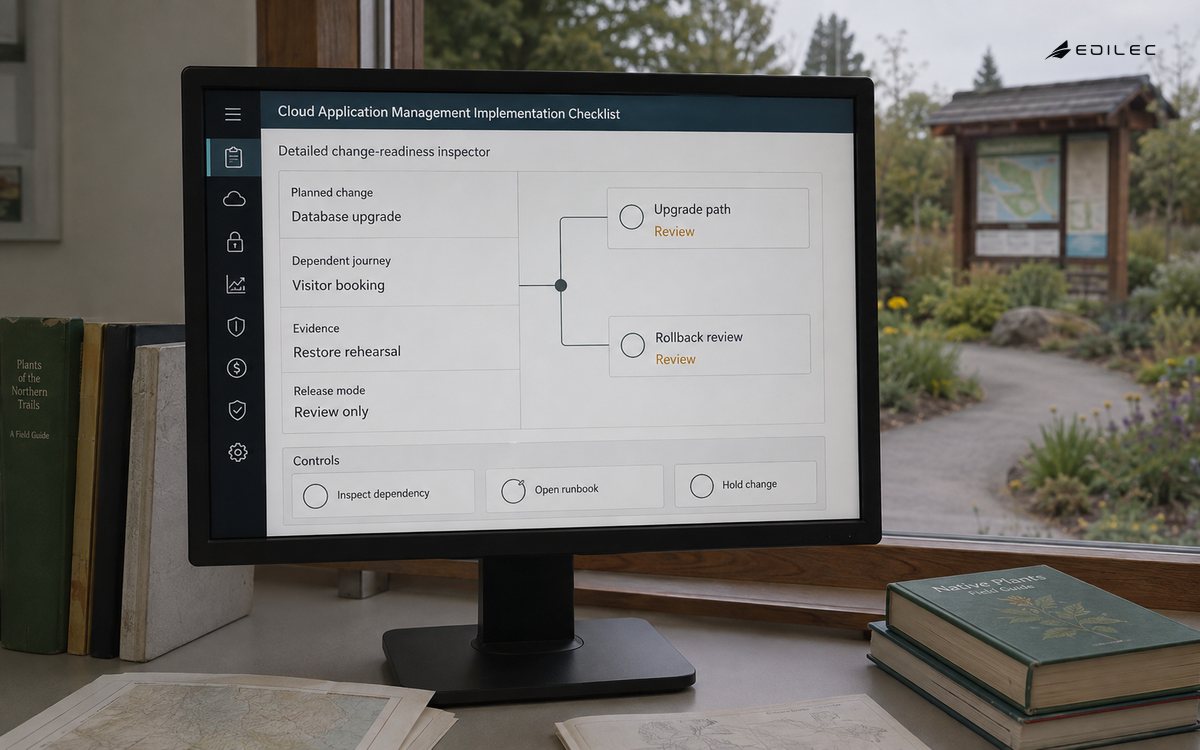
Example: prepare a managed database upgrade
For a managed database major-version upgrade, inventory application drivers, extensions, parameter differences, replication, backup format and provider support deadlines. Rehearse a production-sized snapshot in an isolated environment, run compatibility and performance tests, and validate monitoring. Define whether the change uses in-place upgrade, replica promotion or migration, and estimate write interruption and replication lag under realistic load.
Before production, confirm backups and restore, application deployment compatibility, connection behavior, capacity, access and provider escalation. Set checkpoints and the point after which rollback becomes data migration rather than a switch. After cutover, verify business transactions, query latency, error rates, replicas, backups and cost. Retire temporary resources only after the observation window and update the lifecycle register with the next support date.
Key takeaways
- Assign workload ownership across provider, platform, application, security, data and finance.
- Measure cloud applications through critical user journeys and correctness, not resource health alone.
- Use infrastructure as code, strong workload identity and tested management-plane recovery.
- Connect observability, releases, resilience and cost to one improvement backlog.
- Manage upgrades and retirement continuously so cloud convenience does not create lifecycle debt.
Frequently asked questions
Does the cloud provider manage the application?
Usually not. The provider manages defined cloud-service layers. The customer still owns application behavior, data use, identity configuration, resilience choices, releases and many security controls. Write a responsibility matrix for the exact services and support plan rather than assuming responsibility from IaaS, PaaS or SaaS labels.
How many monitoring tools should a team use?
Use the smallest set that provides end-to-end evidence, reliable alerting and required retention. Multiple tools may serve security, application and provider layers, but standardize correlation, ownership and service indicators. Tool count is less important than whether an operator can answer the user-impact question during an incident.
How often should architecture be reviewed?
Review at material changes and on a periodic cadence based on criticality, commonly at least annually. Trigger review after incidents, sharp demand or cost shifts, new data classes, major provider changes and approaching end of support. Track decisions and action completion, not workshop attendance.
Conclusion
Keep a one-page workload operating record with current owner, critical journeys, objectives, data class, deployment path, recovery evidence, top dependencies, monthly cost and next lifecycle deadline. Review it after material releases and incidents. The record gives responders and leaders a shared current picture while detailed evidence remains in source systems.
Cloud application management turns elastic services into an owned, observable and recoverable workload. Start with user journeys and responsibility, codify configuration and access, rehearse failure and release, and make cost and lifecycle evidence part of product decisions. The cloud can remove undifferentiated work; disciplined management ensures it does not remove accountability. Keep that accountability visible through every provider change.