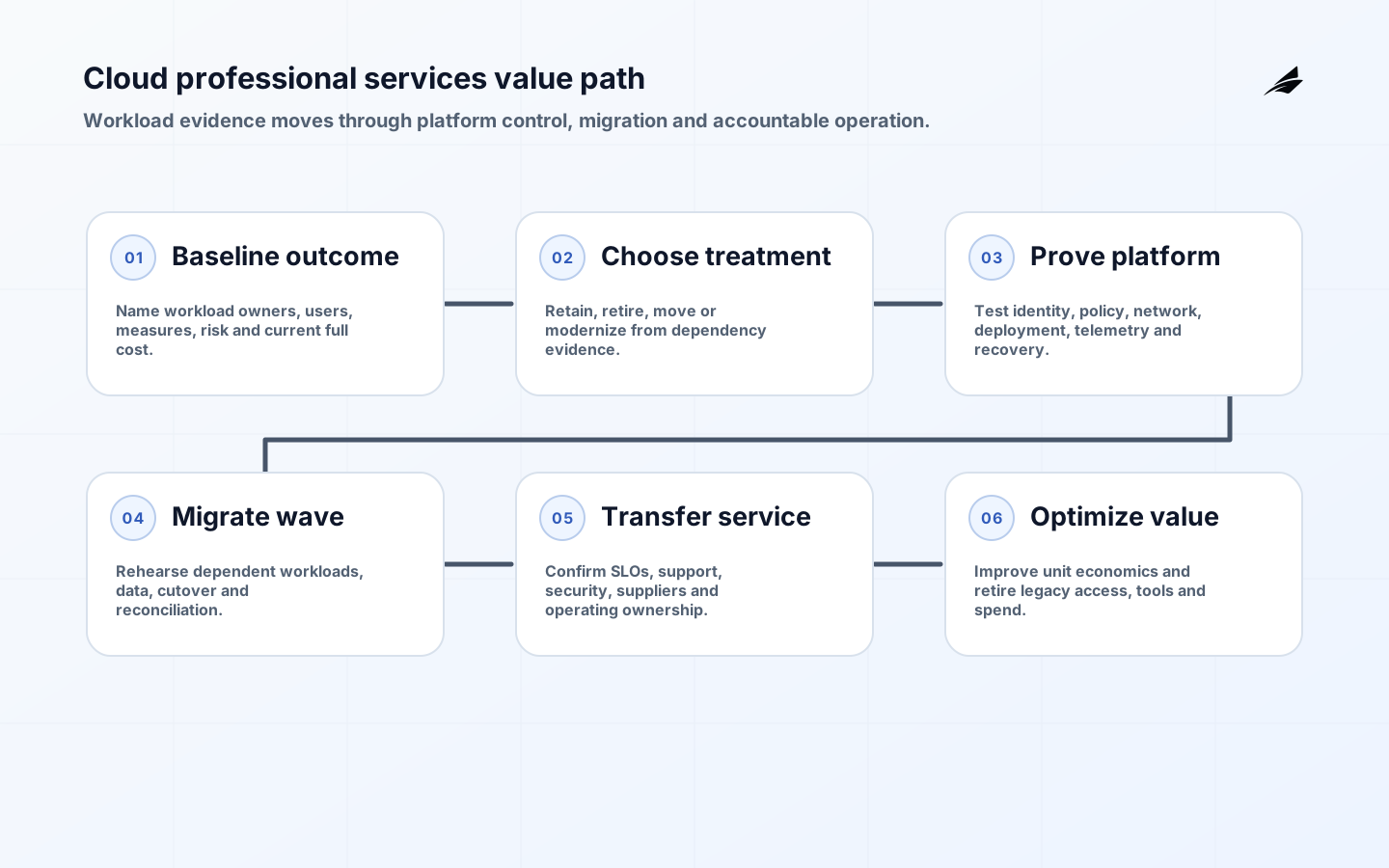
Cloud professional services are time-bounded expert services that help an organization assess, design, migrate, secure, operate or optimize workloads on cloud platforms. The deliverable should be working capability and transferable operating knowledge, not a generic target architecture. A strong engagement makes workload decisions explicit, creates repeatable platform controls, moves services safely and leaves accountable teams able to run cost, reliability and security after consultants depart.
This FAQ is for buyers comparing providers and internal leaders shaping a statement of work. Use the cloud professional services checklist for execution gates and the cloud services delivery plan for commercial structure. Public-sector teams should also review the government cloud scope guide and government implementation checklist.
What do cloud professional services include?
Common work includes portfolio discovery, business-case development, landing-zone design, identity and network architecture, workload migration, application modernization, data platforms, DevSecOps, resilience, FinOps, compliance evidence and service transition. These are not interchangeable packages. Scope should identify the workloads, users, regions, data classifications, providers, dependencies and operating responsibilities involved. It should also state what remains out of scope, especially end-user change, software licenses, data cleansing and long-term managed operations.
An assessment is valuable only if it changes a decision. It should produce a reconciled inventory, dependency evidence, workload treatment, risk assumptions, cost range, migration waves and named decision owners. Avoid assessments that label every application with a migration strategy based only on a questionnaire. Business criticality, peak demand, data gravity, latency, licensing, support horizon and exit constraints require evidence from owners and operational telemetry.
How should an organization choose a cloud provider?
| Decision area | Evidence to compare | Common mistake |
|---|---|---|
| Workload fit | Required services, regions, latency, scale and managed capabilities | Choosing from enterprise preference alone |
| Security and regulation | Identity, encryption, audit, residency and assurance evidence | Treating certification as complete compliance |
| Operations | Skills, support model, tooling and recovery capability | Ignoring the team that will run the service |
| Economics | Representative usage, discounts, data movement and support | Comparing headline compute prices |
| Portability | Data export, contracts, interfaces and replacement cost | Demanding lowest-common-denominator architecture everywhere |
Multi-cloud is an operating reality for many organizations, but it is not automatically a resilience pattern. Running one workload actively across providers adds identity, data consistency, deployment, observability and incident complexity. Use multiple providers where business capability, regulation, acquisition history or concentration risk justifies them. Decide portability selectively: preserve data access, automation and documented interfaces while using differentiated managed services where the value exceeds switching cost.
What should a landing zone provide?
A landing zone is a maintained product that supplies account or subscription structure, identity federation, policy, network patterns, logging, encryption, secrets, backup integration, resource inventory and cost allocation. It should offer paved templates that product teams can consume through automation. It is not a one-time collection of guardrails that only a central team understands. Version changes, publish support expectations and test the controls like any shared service.
Separate controls that must be enforced centrally from guidance teams may adapt. Deny unapproved public exposure or missing audit logging through policy where feasible. Offer approved modules for common architectures. Provide an exception path with owner, reason, compensating control and expiry. NIST zero trust principles reinforce that network location alone should not grant trust; each access decision should consider identity, resource and policy rather than assuming everything inside a cloud network is safe.
How is a cloud migration delivered safely?
- Reconcile each workload, business owner, technical owner, dependencies, data and operational criticality.
- Select retain, retire, relocate, rehost, replatform, refactor or replace using evidence and record the decision.
- Prove the landing zone, connectivity, identity, deployment, telemetry, backup and support path with a representative workload.
- Group migration waves by dependency and business calendar rather than by server count alone.
- Rehearse data transfer, cutover, rollback, reconciliation, recovery and support communication at representative scale.
- After cutover, verify user journeys and cost, then remove legacy traffic, credentials, tooling, contracts and infrastructure.

A migration factory can standardize discovery, automation and evidence, but it must preserve workload-specific accountability. Count a workload complete only when business service, data, security, monitoring, backup, support and legacy retirement satisfy acceptance criteria. Moving virtual machines while leaving old network paths, duplicate backups and unresolved licenses creates cost without completing the transition.
How are cost and value controlled?
| Cost layer | Include in the model | Owner action |
|---|---|---|
| Consumption | Compute, storage, database, network and managed service units | Set budgets, forecasts and anomaly response |
| Commercial | Commitments, licenses, marketplace and support plans | Coordinate finance, procurement and engineering |
| Delivery | Assessment, migration, remediation, testing and training | Fund by wave with evidence gates |
| Operations | On-call, observability, backup, security and service management | Allocate to products or services |
| Transition | Dual running, data transfer, termination and archive | Track until legacy closure |
| Business value | Successful transactions, users served or time saved | Compare unit cost with outcome |
FinOps is a collaborative operating practice, not a monthly bill review. The FinOps Framework emphasizes accessible cost data, shared ownership and decisions based on business value. Require tagging or account structures that allocate material spending, but do not wait for perfect labels before investigating anomalies. Track unit economics such as cost per active customer, processed document or completed simulation alongside reliability and growth. Optimization that damages response time or developer flow can reduce value even when the invoice falls.
Who owns security and reliability?
The provider secures underlying services according to its responsibility model; the customer still owns identities, configuration, data use, application behavior and many operational controls. The services partner may implement controls, but accountable risk owners must accept them. Put responsibility in a RACI that names policy, platform, product and incident duties. Verify evidence through configuration, logs, exercises and tests rather than relying on design documents.
Define service level indicators from user-visible behavior, then design availability, capacity, backup and recovery to meet agreed objectives. A highly available infrastructure component does not guarantee a complete order or claim. Exercise regional or dependency failures and restore data into a usable business service. Document maximum tolerable data loss, restoration priority and manual continuity. Provider status dashboards are inputs to incident response, not a replacement for customer-owned telemetry.
How should a services partner be evaluated?
Ask candidates to explain a relevant architecture decision, migration failure, security exception and handover. Assess whether named delivery staff have the claimed experience, not only whether the company holds certifications. Require sample deliverables, automation ownership, subcontractor disclosure, data handling, quality measures, rate structure and exit terms. A good partner challenges unclear outcomes and exposes assumptions. One that promises a transformation date before discovery may be optimizing the sale rather than the transition.
What should provider handover contain?
Handover should prove that the operating team can deploy, diagnose, restore and optimize the workload. Deliver customer-owned infrastructure code, repositories, architecture decisions, service and dependency records, identity and certificate procedures, data flows, dashboards, alerts, SLOs, runbooks, recovery evidence, cost allocation and open risks. Record product versions and support horizons. Documentation should be generated or maintained close to the implementation where possible, then tested by someone who did not author it.
Use an operational acceptance exercise. Ask the receiving team to respond to a failed deployment, unavailable dependency, expired credential, cost anomaly and restore scenario while the partner observes. Close access and knowledge gaps before final acceptance. Revoke temporary supplier privileges, rotate shared secrets and confirm data return or deletion obligations. Retain a short stabilization period with explicit incident and defect responsibility, but do not let it become indefinite dependence on the project team.
Close the engagement with an accepted decision log and improvement backlog. Each unresolved item should state business effect, risk, owner, funding path and due date. Confirm that billing exports, architecture inventories and policy evidence remain accessible in customer accounts. These details let future teams operate and optimize the service without reconstructing the project from vendor presentations.
Key takeaways
- Define cloud services around workload outcomes and the future operating owner.
- Choose providers from workload, security, operations, economics and exit evidence.
- Treat landing zones as versioned internal products with automated controls.
- Migrate in dependency-aware waves and count retirement in completion.
- Use FinOps to connect full technology cost with business units of value.
- Select partners by delivery evidence, named capability, knowledge transfer and clear exit terms.
Frequently asked questions
Are professional services the same as managed cloud services?
No. Professional services usually deliver a defined change or capability over a bounded period. Managed services assume ongoing operational responsibilities under service objectives. One provider may supply both, but transition criteria, staffing, liabilities and commercial measures differ. Avoid allowing project support to drift into an unpriced and poorly governed managed service.
Will cloud migration always reduce cost?
No. Cloud can convert capacity into variable consumption and reduce some infrastructure work, but architecture, usage, licensing, data transfer, support and organizational behavior determine cost. Rehosting an overprovisioned estate may initially cost more. Build a baseline, model representative demand and review unit value after migration rather than making a universal savings promise.
What should the first engagement produce?
It should reconcile a bounded portfolio, prove a platform path with one representative workload, identify migration waves, quantify assumptions and establish operating ownership. The result should let leaders fund, change or stop the next wave. A large strategy deck without tested connectivity, identity, deployment and recovery leaves the most consequential uncertainty untouched.
Conclusion
Cloud professional services create durable value when an engagement joins business decisions, automated platform controls, workload transition and operating ownership. Buy evidence rather than activity: reconciled inventory, explicit treatments, tested foundations, successful journeys, controlled cost and removed legacy obligations. That structure makes the provider accountable for delivery while leaving the organization capable of governing and improving its cloud services after handover.