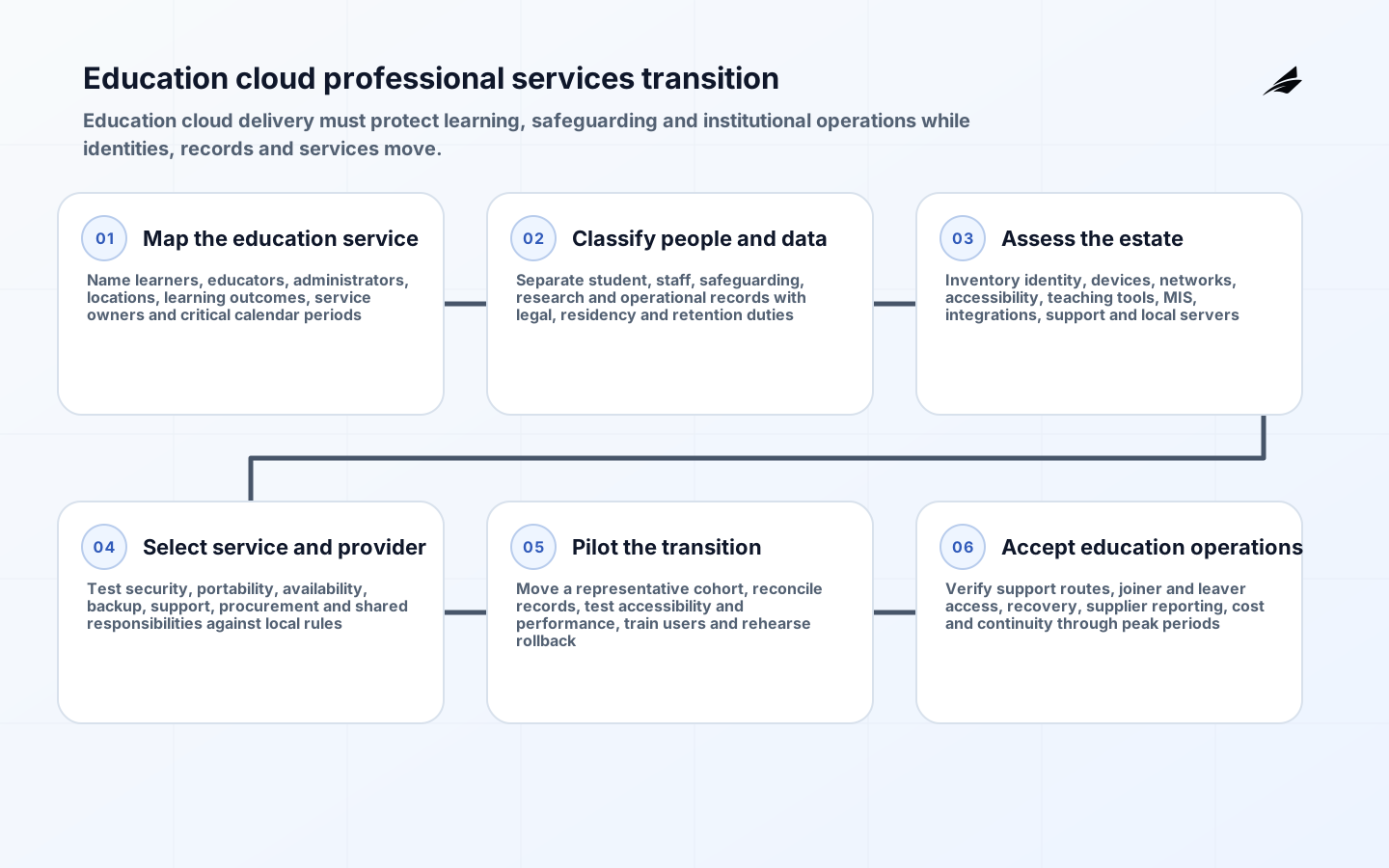
Education cloud professional services must work around an academic calendar, diverse users and unusually sensitive data. A learning platform, research environment, identity service or student system can affect instruction, safeguarding, financial aid and institutional trust. Consultants should therefore connect architecture to teaching continuity, student privacy, accessibility, decentralized governance and sustainable campus capability rather than treating education as a standard enterprise tenant.
This education cloud professional services FAQ supplements the scope, cost and risk guide and the education implementation checklist. It offers operational questions, not legal advice. Institutions should involve privacy, records, safeguarding, accessibility, research and procurement owners according to their setting.
What should education cloud professional services cover?
Services may include portfolio assessment, architecture, vendor evaluation, identity, security, data migration, application modernization, cost management, continuity and training. Define scope around an educational or administrative outcome: reliable course access, faster research provisioning, safer student records or a retired data center. State whether K-12, higher education, research or shared district services are included because authority and risk differ.
Require a current service map with learners, guardians, faculty, staff, guests, researchers and partners. Record peaks such as enrollment, examinations and result publication; accessibility needs; field or home connectivity; data classes; integrations; and support hours. Include institutionally unmanaged software and departmental cloud use. Central IT cannot govern an estate it deliberately refuses to see.
| Education workload | Distinct concern | Acceptance evidence |
|---|---|---|
| Learning platform | Peak access, minors, accessibility and teaching continuity | Load, assistive technology and outage exercise |
| Student information | Authoritative records, corrections and restricted disclosure | Role tests and reconciled migration |
| Research computing | Variable demand, funder terms and controlled data | Project boundary and cost attribution |
| Collaboration SaaS | Sharing, retention, account lifecycle and e-discovery | Configuration baseline and lifecycle test |
How should schools and universities assess a provider?
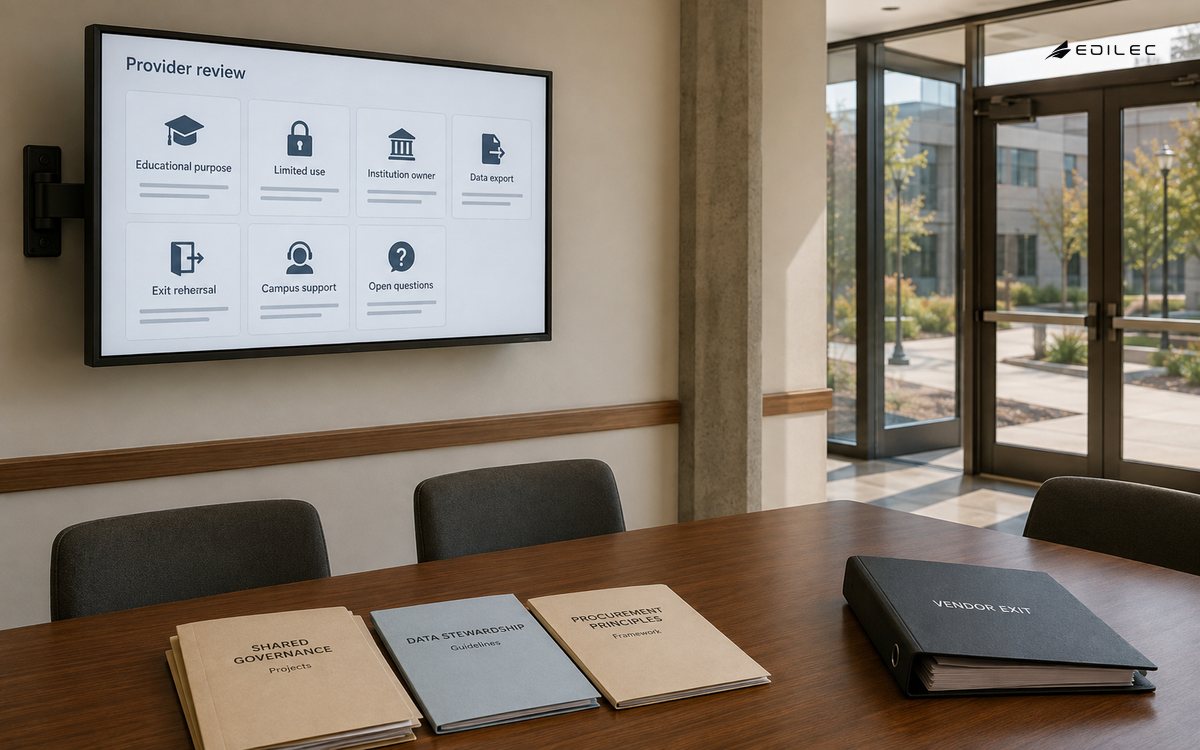
Evaluate the exact service boundary, region, features and support model. Ask about independent assurance, incident history, encryption, identity, logging, backups, secure development, vulnerability handling, subcontractors, accessibility, data use, deletion and export. Higher-education teams commonly use the community-developed HECVAT to structure vendor assessment, but supplier answers still require institutional risk analysis and contractual follow-through.
Use a proof with representative identity, roster, course or research data and failure scenarios. Confirm administrative logs, role granularity, API limits, bulk export and support escalation. Review changes the provider may make unilaterally, including new AI features and secondary data use. Contract for notice, controllability and deletion. Product popularity among peer institutions is useful context, not evidence that the service fits local obligations.
How should student privacy and data use be controlled?
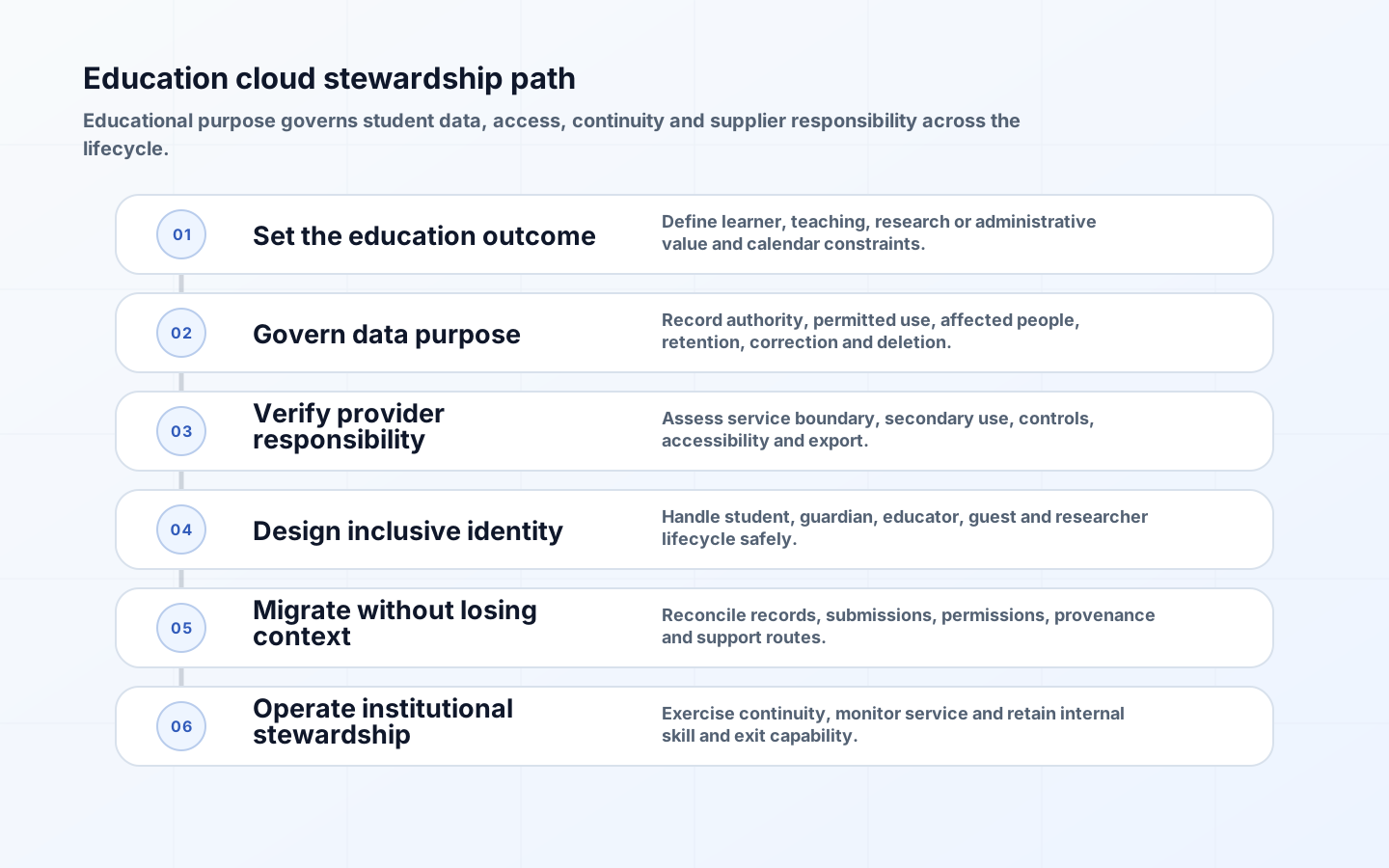
Create a data-use record for each service: educational purpose, categories, authority, users, disclosures, retention, correction and disposal. The U.S. Department of Education's cloud computing FAQ explains that FERPA does not prohibit cloud hosting but institutions must use reasonable methods to protect education records and satisfy applicable exceptions. Other jurisdictions and institutional contexts impose different duties.
For services involving children, assess parental or school consent, commercial use and notice carefully. The FTC's COPPA FAQ explains that school consent is limited to the educational context and use for the school's benefit, with related FERPA analysis. Prohibit advertising, profiling or model training unless explicitly lawful and approved. Minimize logs, test data and vendor support access.
How should identity and access reflect education workflows?
Design complete lifecycle events: applicant to student, student to alumnus, adjunct term, staff transfer, guardian relationship, guest researcher and contractor expiry. Integrate authoritative sources but handle delayed and disputed records. Apply multifactor authentication proportionately, with strong controls for administrators and staff handling sensitive data. Provide accessible recovery that resists social engineering without excluding young or vulnerable users.
Use roles and attributes for institution, course, program, project and term, then test resource-level authorization. Prevent instructors from retaining access after a teaching assignment and researchers from crossing project boundaries. Separate support impersonation and record every use. Review shared links and group inheritance, which often bypass intended classroom or departmental controls. Emergency access needs approval, duration, audit and retrospective review.
Which security improvements should come first?
CISA's K-12 report prioritizes multifactor authentication, known exploited vulnerability mitigation, tested backups, exercised incident response and training, while recognizing resource constraints. Institutions should translate these into owned services and supplier requirements. Start with internet-facing assets, privileged identity, email, endpoints, backup isolation and the systems required to teach and communicate during disruption.
Use NIST CSF 2.0 to connect governance, asset knowledge, protection, detection, response and recovery. Centralize critical logs with privacy controls and verify source health. Practice ransomware, compromised administrator and provider outage scenarios. Coordinate communications with academic leadership, safeguarding, legal, families and research sponsors as relevant. Security operations should preserve teaching continuity, not create an untested shutdown plan.
How can migration avoid disruption to learning and research?
Plan around academic and research calendars, but do not assume breaks are quiet for every population. Profile records, courses, submissions, media, permissions, integrations and custom reports. Define which system is authoritative during coexistence. Rehearse migration with representative large courses, accessibility workflows and research data. Verify timestamps, ownership, grades or status, links and audit evidence, not only row counts.
Pilot with a willing but representative group and staffed support. Preserve rollback and a read-only evidence period. Communicate what changes, how users recover access and where work completed during transition appears. Retire old connectors and accounts after acceptance. For research, maintain provenance, grant conditions, publication needs and reproducibility. A fast copy that loses context can compromise both academic decisions and scientific value.
| Gate | Institution evidence | Do not proceed when |
|---|---|---|
| Purpose | Educational outcome, owner, users and lawful data use | Secondary use or ownership is unresolved |
| Configuration | Identity, privacy, accessibility, logging and recovery tests | Critical role or learner path fails |
| Migration | Reconciliation, support, rollback and calendar approval | Records or submissions cannot be verified |
| Operation | SLO, incident route, cost owner and exit test | No team can run or recover the service |
How are cost, skills and exit managed?
Model licenses by active population, storage growth, research bursts, network transfer, support, security, migration and training. Define who pays for departmental or grant consumption and what happens when funding ends. Monitor unit cost such as active learner or research workload, but do not optimize away accessibility, retention or resilience. Negotiate renewal data and price dimensions before dependency becomes deep.
Require institution-owned configuration, documentation and administrative identities. Pair consultants with campus staff and test that they can provision, troubleshoot, restore and review privacy settings. Maintain exports in usable formats, including metadata and relationships. Define account closure for graduates and departed staff, project data disposition and supplier deletion. Exercise an exit sample before contract renewal rather than discovering portability limits during a dispute.
Define service-level evidence in terms users recognize. Monitor successful sign-in, course and record access, submission completion, integration freshness and support recovery by critical calendar period. Provider availability may remain green while a roster feed or identity mapping blocks a whole class. Review data access and vendor changes alongside service health, because reliability and privacy failures can arise from the same incorrect configuration.
Include faculty, teachers, librarians, researchers, disability services and students in improvement. Provide a governed route for urgent academic experiments and a clear process to adopt successful ones. When central controls are too slow or opaque, departments will create unmanaged alternatives. A useful professional service leaves a proportionate decision path that supports innovation while preserving institutional visibility, learner rights and response capability.
Set a process for urgent safeguarding and academic-integrity requests. Clarify who may access records, preserve evidence, suspend an account or disclose information, and how normal rights are restored afterward. Consultants should implement the required roles and logs without making policy themselves. Exercise the workflow with privacy and academic leaders before a real case demands rapid action.
Education cloud takeaways
- Scope services around learning, research or administration outcomes.
- Treat student data purpose and supplier secondary use as architecture decisions.
- Design identity for term, course, guardian, guest and research lifecycle events.
- Test accessibility, calendar peaks, incident communications and restore before migration.
- Fund internal capability and verify usable export and deletion before renewal.
Frequently asked questions
Does FERPA ban cloud services? No; applicable requirements concern control and protection of education records, not a blanket hosting prohibition. Do all education workloads have the same rules? No. Learner age, jurisdiction, institution type, research contracts and data use matter. Is a vendor's education edition sufficient? It may provide useful defaults, but the institution must verify configuration, contract and workflow.
Should schools move to cloud because it is more secure? Security capability may improve, but only with sound configuration, identity, monitoring and response. How should decentralized university IT be handled? Use common minimum controls, discoverable services and proportionate exception governance while preserving legitimate research autonomy. What is a good pilot? A complete, measurable service with manageable calendar and data consequence.
Conclusion
Education cloud work succeeds when it protects the conditions for learning and inquiry. Professional services should leave an institution with governed data use, inclusive access, tested continuity and people who can operate the result. Begin with one educational journey, verify the provider and lifecycle, migrate with record-level evidence and rehearse failure. That proof is a stronger modernization foundation than a broad license purchase.