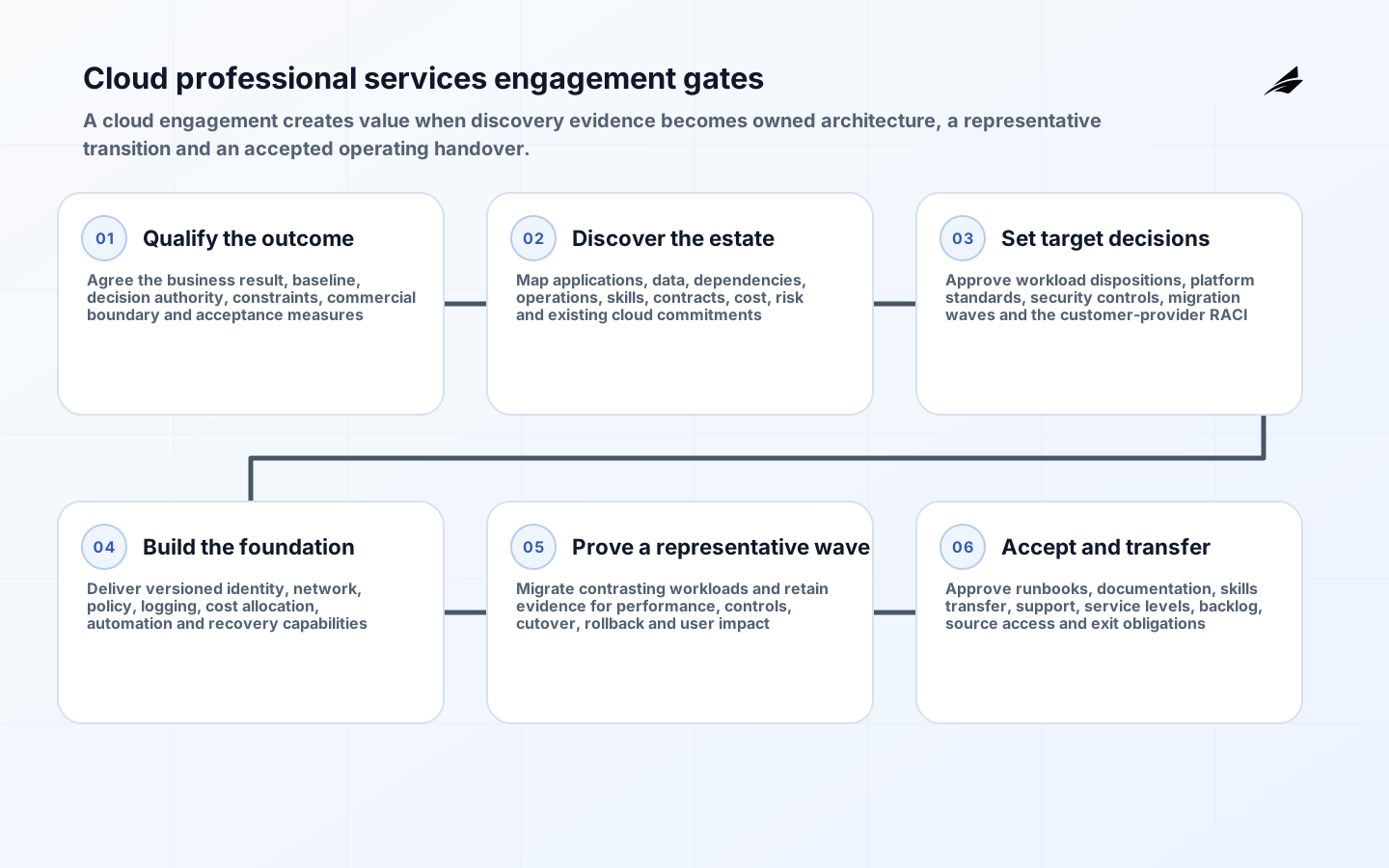
A cloud professional services implementation checklist should make consulting work testable. Strategy documents, landing zones and migration factories are only intermediate outputs; the desired result is a business service that internal owners can secure, recover, change and pay for. The engagement therefore needs a precise mandate, customer-controlled evidence and capability transfer from its first week.
Use the checklist alongside the professional services delivery plan and cloud consulting FAQ. Tailor each gate by workload consequence. The same documentation volume is not appropriate for a disposable development environment and a regulated transaction platform, but both need ownership and an acceptance test.
1. Set a decision-ready engagement mandate
Name the executive sponsor, service owners, users, baseline, constraints and decisions due. Express outcomes such as reducing recovery uncertainty, shortening environment lead time or retiring a license while preserving service levels. Avoid making cloud adoption itself the outcome. Define what the consultants may decide and what remains with risk, architecture, finance, security and product owners.
Establish repositories, meeting cadence, decision log, escalation path and acceptance authority. Record assumptions and confidence, especially about application dependencies and cost. Require material recommendations to show alternatives, evidence, trade-offs and invalidating conditions. A decision record should remain useful after the presenting consultants leave; slides without current configuration or accountable owners are not a transferable control.
2. Verify the estate and delivery baseline
Create a living workload portfolio with business owner, technical owner, users, criticality, data, dependencies, lifecycle, incidents, recovery, demand, cost and contract dates. Reconcile interviews with runtime discovery, invoices, configuration and service-desk evidence. Mark unknowns instead of filling them with false precision. An unowned system with unclear data should not enter a migration wave merely because a scanner found it.
Baseline delivery as well as infrastructure. Measure environment wait, deployment lead time, failed change, recovery performance, access lead time and operational toil. Confirm the intended service model using NIST's cloud definition; outsourcing virtual machines without measured self-service may change hosting location while preserving the old bottlenecks.
| Deliverable | Minimum acceptance evidence | Accountable customer owner |
|---|---|---|
| Workload portfolio | Sources, confidence, dependencies and disposition rationale | Portfolio or architecture lead |
| Cloud foundation | Deployed code, tests, control map and operations guide | Platform owner |
| Migration wave | Transaction reconciliation, recovery, monitoring and support | Service owner |
| Handover | Customer-led deploy, diagnosis, restore and cost review | Operations leader |
3. Build and accept the cloud foundation
Design organization hierarchy, accounts, identity, network, name resolution, logging, encryption, policy, deployment, backup and billing as a coherent platform product. CISA's cloud technical architecture provides useful shared-service and posture-management concepts. Put foundation code and tests in customer-controlled repositories and make emergency access both usable and attributable.
Define a standard path for common workloads and a documented exception route. Test isolation, denied access, log delivery, policy enforcement, budget alerts, backup and restore before onboarding critical systems. Version modules and publish compatibility expectations. A landing zone is not finished when resources exist; it is accepted when an internal team can safely consume, update and recover its capabilities.
4. Integrate security and compliance evidence
Use a responsibility matrix that distinguishes provider, consultant and customer operation for each control. Select outcomes from NIST CSF 2.0 or the applicable regime, then link them to architecture, configuration, tests, alerts and risk decisions. Certifications can support supplier assessment, but they do not prove correct tenant configuration or application authorization.
Give consultants time-bound, individually attributable access. Prohibit shared accounts and uncontrolled production data on personal devices or external collaboration tools. Review software components and infrastructure modules, protect build credentials and capture deployed artifact provenance. Findings need severity, owner, due date, compensating control and closure evidence. Do not let a large inherited findings list become an unpriced handover.
5. Deliver representative migration waves
Choose a pilot that exercises normal foundation controls and has measurable value, representative dependencies and manageable consequence. Deliver one thin end-to-end service path: data, identity, deployment, observability, recovery, support and cost. DORA's continuous delivery guidance supports keeping systems deployable through automation, fast feedback, version control and continuous testing rather than building a migration queue dependent on a few specialists.
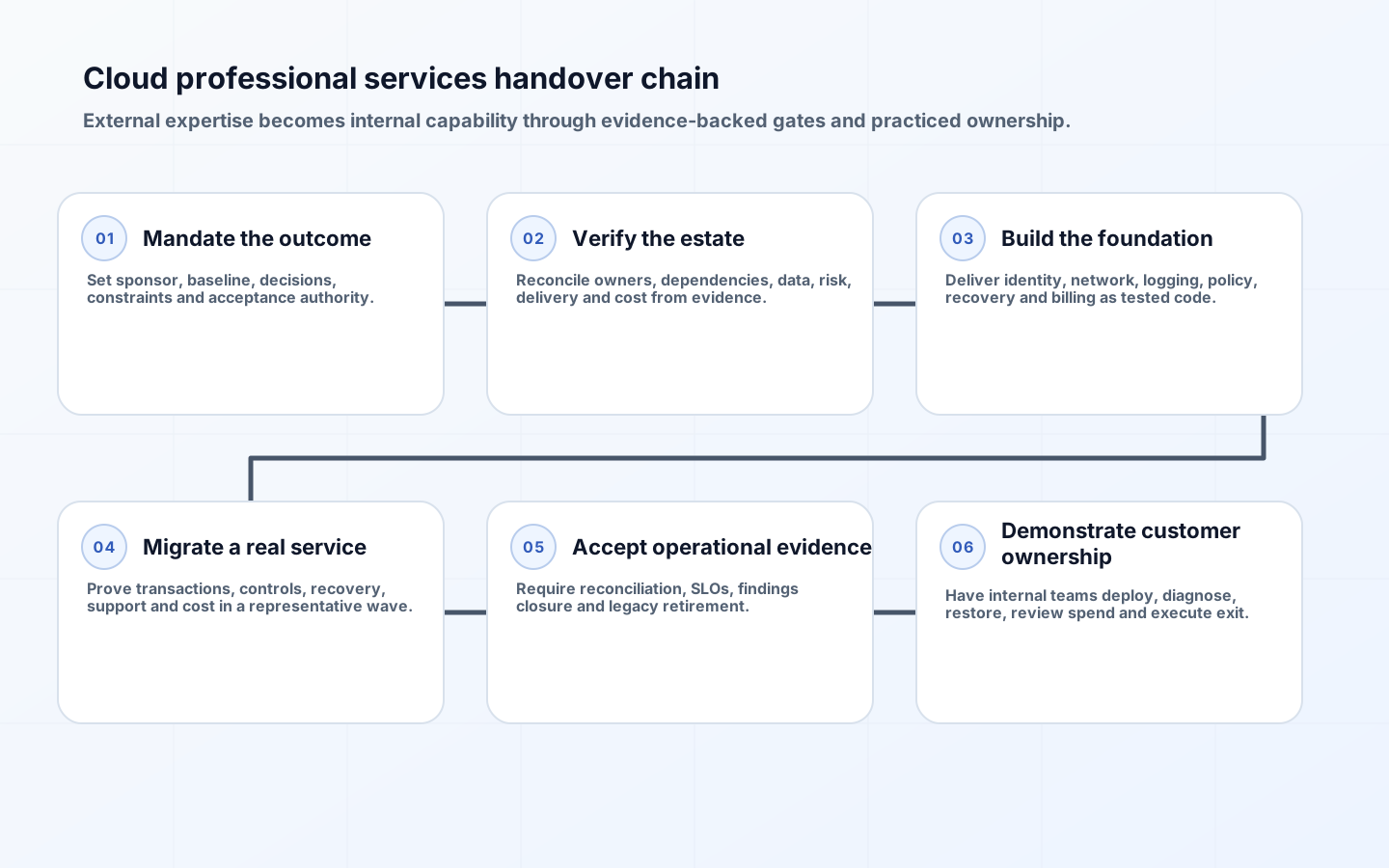
For every wave, document readiness, cutover, rollback, transaction reconciliation, communications and operational acceptance. Scale only after the pilot exposes and resolves platform friction. Track exceptions and feed repeated ones into the standard platform. Do not report servers moved as the primary outcome; report user service, legacy retirement, recovery evidence, risk change and actual run cost.
6. Control economics and commercial change
Estimate one-time discovery, foundation, migration, testing, training and retirement alongside recurring consumption, licensing, support, security, data transfer and staff. State demand and discount assumptions. The FinOps Framework frames cloud financial management as collaboration among engineering, finance and business roles; assign service cost before migration so teams can respond to feedback.
Use a transparent change process for scope, assumptions and rates. Time-and-materials work still needs prioritized outcomes and capacity limits; fixed-price work still needs discovery and explicit exclusions. Tie payment to accepted evidence where feasible. Review forecast versus actual by workload and investigate architecture, demand and commercial causes. Avoid savings claims that omit dual-running cost, retained licenses or added operational roles.
| Review cadence | Inputs | Required decision |
|---|---|---|
| Weekly delivery | Completed evidence, blockers, risk and forecast | Reorder work or escalate |
| Wave gate | Service test, reconciliation, recovery and support readiness | Proceed, remediate or stop |
| Monthly steering | Outcome trend, spend, exceptions and capability transfer | Adjust mandate and capacity |
| Closure | Retirement, open risk, owned artifacts and exit test | Accept or extend narrowly |
7. Transfer capability and close the engagement
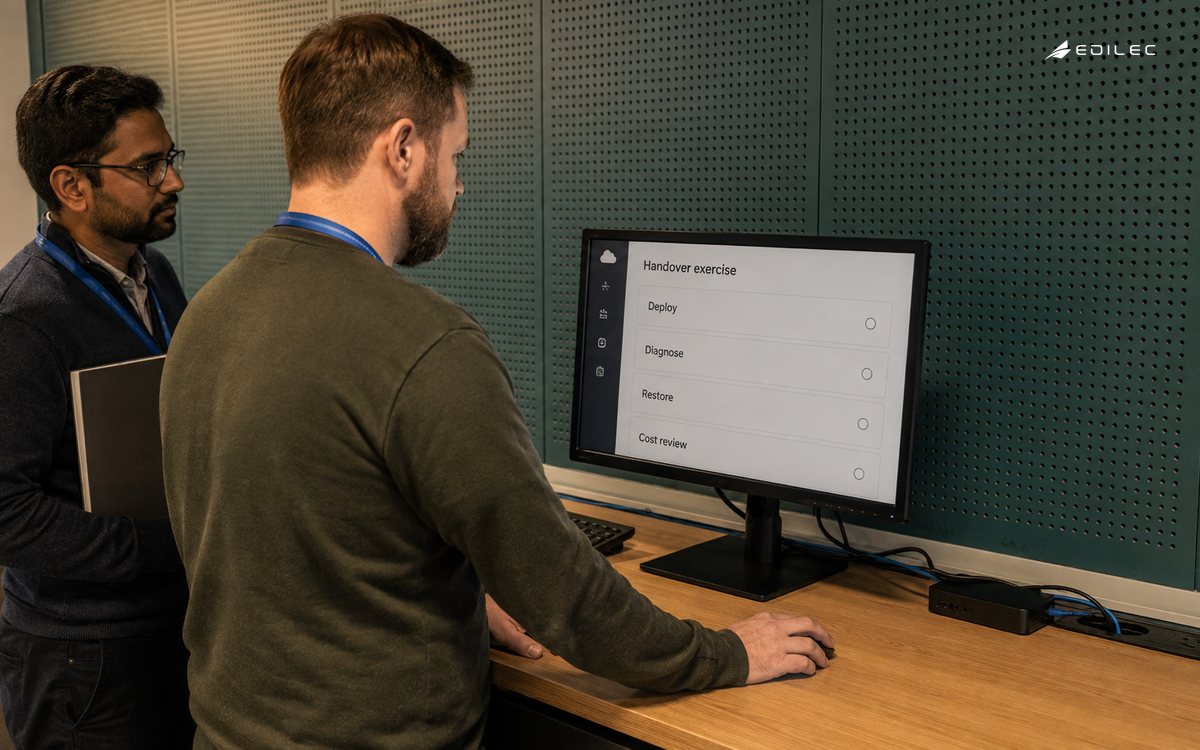
Pair consultant and internal operators throughout delivery. Maintain runbooks through actual incidents and exercises, not as a final writing sprint. Before handover, customer staff should provision an environment, release a change, investigate a service symptom, restore data, review access and explain a bill. Record skill gaps and fund them; attendance at training is weaker evidence than demonstrated operation.
Close temporary identities, shared channels, supplier storage and elevated access. Confirm ownership of code, domains, keys, subscriptions, support cases and documentation. Resolve or formally accept open risks. Test export and transition assistance. Hold a benefits review after operations stabilize, comparing the original baseline with service and cost outcomes. Capture reusable platform improvements and retire obsolete estate obligations.
Establish quality criteria for documentation itself. Architecture diagrams should show current boundaries and dependencies; runbooks should identify prerequisites, decision points and verification; cost models should expose assumptions; and risk records should link to deployed evidence. Sample the artifacts during delivery by asking an uninvolved internal engineer to use them. Correct ambiguity while consultants still have context rather than accepting a documentation bundle at the closing meeting.
Plan organizational adoption as concrete work. Update support queues, on-call rotations, service catalog entries, access requests, incident severity rules, budget ownership and change calendars before production acceptance. Communicate new responsibilities to application owners and finance partners. If the operating process still points to the retired data center or a consultant's private channel, the technical migration has created a hidden service gap.
Finally, evaluate the engagement's delivery system. Measure decision delay, environment lead time, repeated exceptions, escaped defects and consultant dependency by wave. Use the findings to improve the platform and contract, not to reward raw migration volume. A smaller number of fully accepted and retired workloads can produce more value than a large wave that leaves unresolved access, cost and recovery work for internal teams.
Schedule an independent readiness review for the first critical workload. The reviewer should inspect deployed configuration and observe tests rather than recreate every consultant document. Focus on responsibility gaps, unsupported assumptions, excessive privilege, recovery dependencies and operational load. Record accepted findings with owners and expiry dates, and verify closure independently. Resolve material findings before the migration pattern becomes difficult to change across later waves.
Cloud professional services takeaways
- Mandate business and operational outcomes, not a cloud activity target.
- Keep evidence and automation in customer-controlled systems.
- Accept the foundation through consumption, failure and recovery tests.
- Use representative waves and scale only after platform feedback is resolved.
- Make customer-led operation and legacy retirement closure conditions.
Frequently asked questions
How long should discovery last? Long enough to resolve decisions with material consequence; time-box it and mark remaining uncertainty. Should one partner design and migrate everything? It can, but the customer must retain architecture decisions, independent acceptance and exit capability. Is a hyperscaler certification enough for consultants? No. Verify relevant delivery evidence, domain experience, access practices and named personnel.
What is the most important deliverable? An operable service with owned automation and demonstrated internal capability. Can professional services guarantee savings? They can commit to methods and deliverables, but savings depend on demand, architecture, contracts and retirement. Require assumptions and measurement instead of an unconditional percentage. When is the engagement complete? When accepted outcomes and handover tests pass and temporary obligations close.
Conclusion
Professional services create durable cloud value when external expertise becomes internal operating capability. Begin with a decision-ready mandate, prove the estate, build a testable foundation and migrate one representative service. Keep acceptance evidence close to production reality. The strongest final presentation is an internal team safely changing and recovering the service without consultant dependency.