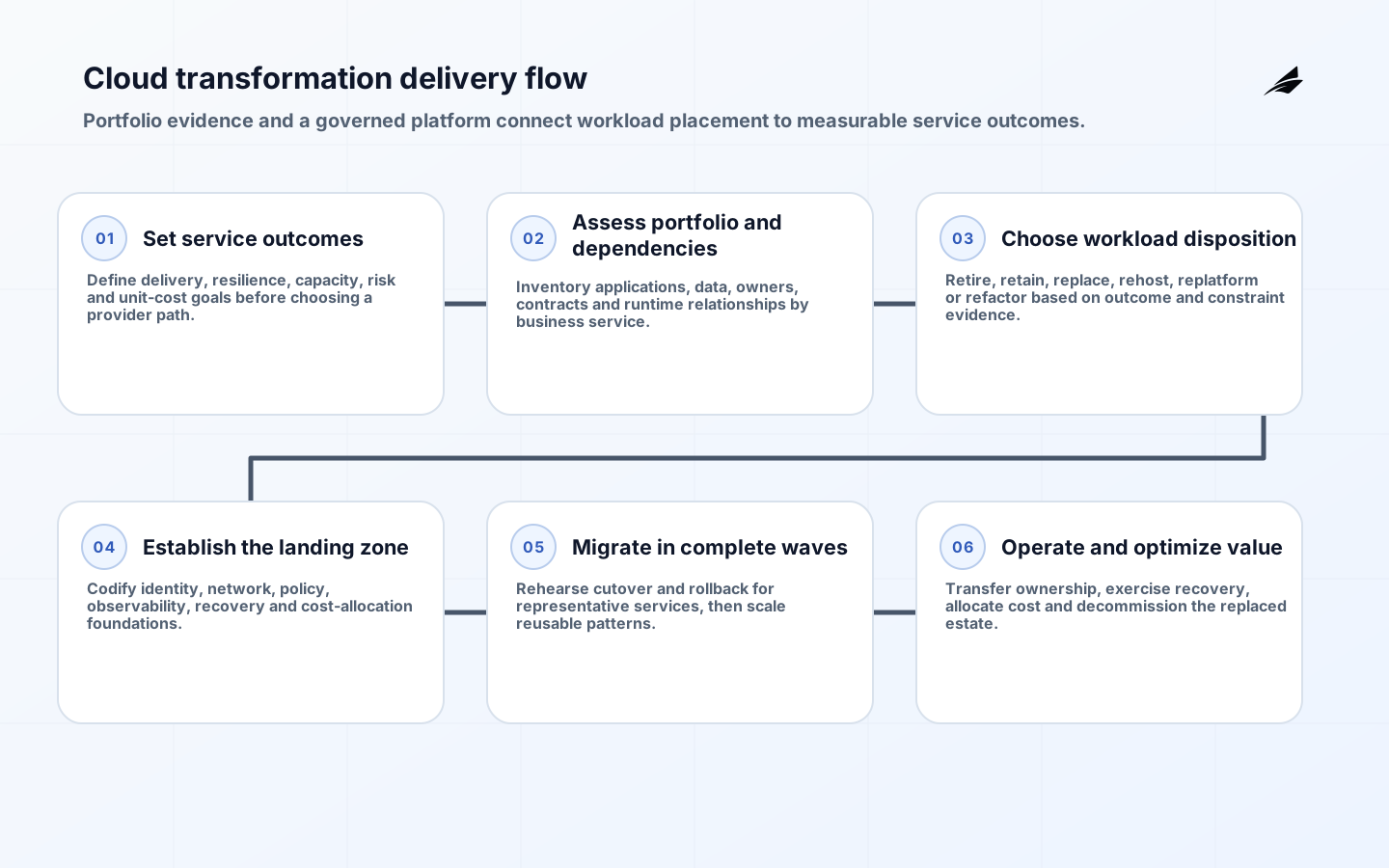
Cloud transformation is the redesign of technology delivery and operations around business outcomes, not the relocation of servers to a provider. It may include migration, application modernization, data platforms, security, platform engineering, operating-model change, resilience, and technology financial management. Moving an unchanged workload can be useful, but it does not automatically make the service scalable, secure, reliable, or economical.
This guide explains how to scope cloud transformation solutions, estimate cost, manage risk, and deliver in waves. It applies to public, private, hybrid, and multi-cloud decisions. Edilec supports related work through cloud and DevOps, cybersecurity, and software modernization.
1. Define transformation outcomes before provider choices
State the problem in service terms: releases are too slow, recovery is untested, capacity is difficult to obtain, infrastructure is unsupported, data products take too long, or unit cost cannot be allocated. Establish a baseline and target. 'Move 80 percent to cloud' is a portfolio measure, not a business outcome.
Name decision owners across business, product, architecture, security, operations, finance, data, procurement, and risk. Cloud changes shared responsibility and operating work; it does not remove them. Agree on constraints such as data location, latency, licensing, supplier concentration, exit, recovery, and workforce capability.
| Outcome | Baseline evidence | Possible measure | Common false proxy |
|---|---|---|---|
| Faster delivery | Lead time and release queue | Time from approved change to safe production | Number of cloud resources |
| Higher resilience | Recovery tests and incident impact | Recovery time, recovery point and critical-journey availability | Multi-region architecture without exercise |
| Scalable demand | Capacity events and response time | Service performance under expected peaks | Auto-scaling enabled |
| Better economics | Allocated cost and utilization | Unit cost tied to product outcome | Total bill alone |
| Reduced risk | Unsupported assets and control gaps | Closed risks and tested controls | Percentage migrated |
2. Build a portfolio and dependency evidence base
Inventory applications, data, infrastructure, interfaces, users, owners, costs, service levels, technology age, contracts, and compliance needs. Validate with logs, network flows, deployment records, and operational teams; configuration databases are often incomplete. Group systems by business service so migration sequencing reflects customer and operational dependencies.
Assess disposition rather than assuming migration. Retire unused systems, retain workloads with sound reasons, replace commodity capability, rehost for urgent exit, replatform to managed services, refactor where architecture blocks outcomes, or repurchase a suitable product. FinOps guidance on architecting and workload placement explicitly includes modernization, relocation, replacement, consolidation, and retirement.
| Disposition | When it fits | Main risk | Required evidence |
|---|---|---|---|
| Retire | No current owner, use or obligation | Hidden dependency or retention need | Usage, dependency and data decision |
| Retain | Current placement meets outcomes and constraints | Neglected lifecycle or integration debt | Support plan and review date |
| Rehost | Time-bound exit with low change tolerance | Old operating model and cost move unchanged | Performance, licensing and post-move plan |
| Replatform | Managed service removes undifferentiated operation | Compatibility, lock-in and behavior change | Prototype, portability and recovery test |
| Refactor | Architecture prevents scale, delivery or resilience | Scope expansion and migration complexity | Outcome case and incremental release plan |
| Replace | Market product meets non-differentiating need | Process fit, data exit and supplier dependency | Fit-gap, migration and exit assessment |
3. Establish a landing zone and shared controls
A landing zone provides account or subscription structure, identity federation, network patterns, logging, key management, policy, guardrails, backup, vulnerability management, cost allocation, and deployment foundations. It should be delivered as versioned code and product documentation, not a one-time collection of manual settings.
Define the boundary between central platform and workload teams. The platform should offer paved paths for common workloads while allowing reviewed exceptions. Too little governance creates inconsistent risk; too much manual approval drives teams around the platform. NIST's Cloud Computing Reference Architecture provides stable roles and relationships that help clarify provider, consumer, broker, auditor, and carrier responsibilities.
4. Design security and resilience into migration waves
Map identities, data, threats, controls, and evidence for each workload. Use short-lived workload identities where possible, centralize security telemetry, protect administrative access, scan infrastructure and artifacts, and keep secrets in managed stores. Apply the NIST Cybersecurity Framework 2.0 outcomes across governance, identification, protection, detection, response, and recovery.
Set recovery objectives from business impact. Backups are not evidence until restoration is tested. Include provider service dependencies, DNS, identity, keys, network, third-party APIs, and operational access in exercises. Multi-zone or multi-region designs add cost and complexity; choose them where impact tolerance justifies it, and prove failover and failback.
5. Deliver migration in dependency-aware waves
Use early waves to validate the landing zone, deployment path, monitoring, support, security, data movement, and cutover process. Select workloads that are representative but not existential. Migrate a complete service and its dependencies rather than optimizing the number of servers moved. Capture lessons in reusable patterns before scaling.

| Wave stage | Key work | Exit evidence |
|---|---|---|
| Mobilize | Outcomes, portfolio, operating model, landing-zone backlog | Approved governance and prioritized services |
| Foundation | Identity, network, policy, logging, delivery and cost allocation | Control tests and platform service levels |
| Pilot | Representative service migration with rehearsal | Performance, security, recovery and support results |
| Scale | Factory patterns, dependency waves, data and cutover | Repeatable throughput without rising exception debt |
| Modernize | Targeted platform and application improvements | Measured outcome improvement and retired legacy cost |
| Operate | Ownership, reliability, FinOps and lifecycle governance | Stable service indicators and continuous backlog |
Every cutover needs entry criteria, data validation, communication, rollback, hypercare, and final decommission evidence. Avoid leaving duplicate environments indefinitely. Decommissioning includes data retention, licenses, monitoring, backup, network paths, accounts, certificates, and supplier commitments.
6. Build a cloud operating model and platform product
Define who owns the platform, workloads, security response, incident command, capacity, cost, vendor management, and architecture exceptions. Create self-service templates with documentation and support. Measure platform adoption, lead time, reliability, exception volume, and developer effort. A central team that manually provisions every resource cannot scale transformation.
Teams need skills in infrastructure as code, cloud identity, networking, reliability, security, and cost. Use paired delivery and real workload operation rather than training alone. Update on-call, service management, change, incident, and recovery practices to match automated infrastructure and provider dependencies.
7. Model transformation cost and establish FinOps
Transformation cost includes discovery, dual running, network and data transfer, provider services, licenses, partner support, engineering change, security, testing, training, migration, decommissioning, and ongoing operations. Estimate by service and wave, with uncertainty ranges. Include cost that remains on premises during transition.
| Cost driver | Why it varies | Management action |
|---|---|---|
| Compute and managed services | Demand, architecture, region and pricing model | Capacity model, rightsizing and commitment strategy |
| Data | Storage class, retention, replication and transfer | Lifecycle policy, locality and data-product ownership |
| Licensing | Mobility rights, cores, support and contract term | Validate before placement and compare replacement |
| Migration | Dependency, data volume, testing and downtime tolerance | Wave planning and rehearsal |
| Dual running | Cutover confidence and decommission delay | Time-box overlap and define exit evidence |
| Operations | Support model, observability, security and skill | Platform automation and named service ownership |
The FinOps Framework defines FinOps as a collaborative operational framework for maximizing technology value and creating financial accountability. Allocate costs to products and environments, make data timely, forecast demand, optimize usage and rates, and connect spend to outcomes. Cost control added after migration is slower and less effective than cost-aware architecture.
8. Manage the risks that derail cloud programs
Common failures include provider selection before workload discovery, migrating technical debt without an operating plan, weak identity foundations, untested recovery, inconsistent infrastructure code, no decommission authority, and finance receiving an unallocated bill. Another risk is transforming everything at once. Portfolio segmentation allows different paths and protects scarce engineering capacity.
Maintain a risk and decision register with owners, due dates, and evidence. Review concentration, exit, data location, supplier incidents, service quotas, rate limits, and contractual responsibilities. Test the manual and technical procedures needed when the provider or network is degraded.
Key takeaways
- Define service outcomes before choosing migration targets.
- Use evidence to retire, retain, replace, rehost, replatform or refactor each workload.
- Treat the landing zone and paved paths as a maintained platform product.
- Migrate complete services in waves with tested cutover, rollback and recovery.
- Establish operating ownership, skills and FinOps during foundation work.
- Measure outcome and decommission evidence, not resource-migration percentage alone.
Frequently asked questions
How long does cloud transformation take?
A landing zone and pilot may take a few months; a complex portfolio transformation often spans years. The useful plan is wave-based, with quarterly outcomes and explicit decommissioning, rather than one distant completion date.
Does transformation require multi-cloud?
No. Use multiple providers when workload, regulatory, supplier, acquisition, or resilience evidence justifies the complexity. A vague desire to avoid lock-in can create duplicated skills and weak standardization. Portability should be designed at the level the business actually needs.
Will cloud transformation reduce cost?
It can improve value and flexibility, but savings are not automatic. Rehosted, overprovisioned, poorly allocated, or indefinitely duplicated workloads can cost more. Build an outcome and unit-cost model, then operate FinOps and decommission legacy capacity.
Procurement should evaluate more than headline discounts. Review support boundaries, service-level definitions, data egress, marketplace commitments, licensing, audit evidence, regional availability, incident communication, roadmap dependency, and termination assistance. Record where architecture depends on a provider-specific capability and what recovery or exit would require. Not every service needs easy portability, but every material dependency needs an explicit owner and risk decision.
Measure workforce and process change as well. Teams need to provision environments, investigate incidents, review cost, and recover services using the new platform. Pair platform specialists with product teams during real releases and incidents, then verify that ownership transfers. If every change still depends on the transformation program, the organization has moved workloads without building the capability to operate them.
Conclusion
Cloud transformation is successful when services become easier to change, protect, recover, and finance. Portfolio evidence, a governed landing zone, dependency-aware waves, platform ownership, and FinOps make that result repeatable. Provider adoption is part of the means; a better-operated technology portfolio is the outcome.