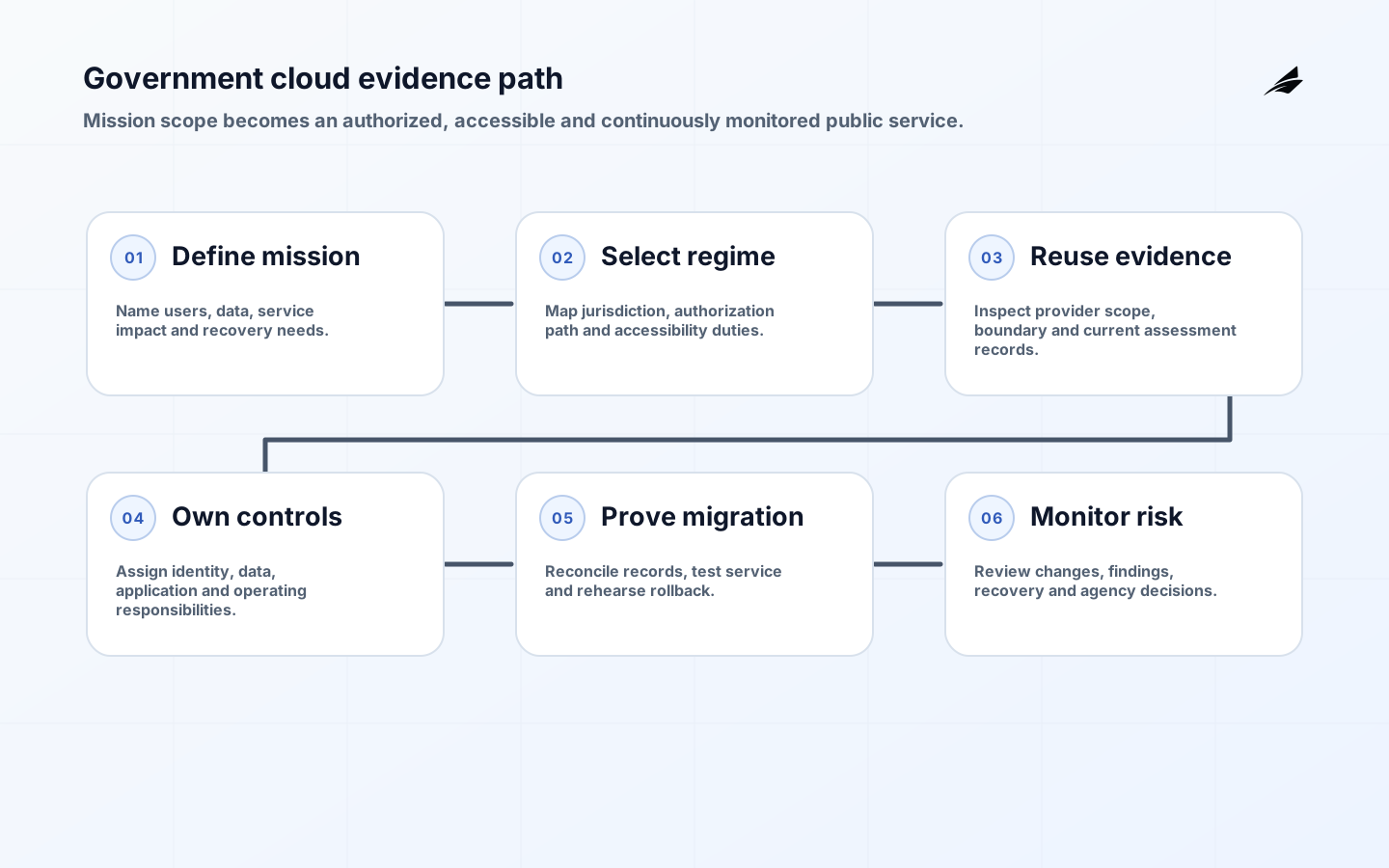
Government cloud professional services must connect mission delivery to public accountability. A program can use an authorized provider and still fail because the agency misconfigures access, loses records context, excludes people with disabilities, cannot explain inherited controls or has no continuity path. The implementation task is to define the information system, select applicable obligations, assign shared responsibilities, preserve evidence and prove that public service continues under normal and disrupted conditions.
This checklist uses US federal references where they provide concrete examples, but “government cloud” is not one universal regime. Federal, state, local, tribal, territorial and non-US authorities have different authorization, procurement, sovereignty, accessibility, records and incident duties. Use the government cloud scope and cost plan, government cloud FAQ and local government cloud checklist with qualified authority-specific review.
Define mission outcome and system boundary
Name the public outcome, users, assisted channels, service owner, critical transactions and minimum service during disruption. Inventory data types, records schedules, interfaces, contractors, devices, identity, networks and external services. Draw the authorization boundary around components that process, store, transmit or protect the information, with explicit interconnections. A contract boundary, billing account and authorization boundary are different and should not be assumed to match.
Classify information and impact using the authority’s current method, then determine hosting, region, personnel, encryption, logging, accessibility, records and continuity requirements. NIST SP 800-145 defines cloud characteristics, service models and deployment models; it does not make “government community cloud” automatically correct. Select a deployment from mission, risk, sharing and operational needs, and document exceptions.
| Boundary question | Evidence | Decision | Accountable role |
|---|---|---|---|
| What is the mission service? | Journey, volume, impact and minimum operation | Scope and service objectives | Mission owner |
| What information is handled? | Data inventory, classification and records schedule | Control and location needs | Data and records owners |
| What forms the system? | Architecture, flows and interconnections | Authorization boundary | System owner |
| What is inherited? | Provider and agency control statements | Responsibility allocation | Authorizing team |
| What must survive? | Impact analysis and dependency order | Continuity and recovery design | Service owner |
Confirm the applicable authorization regime
For US federal agencies, the current Scope of FedRAMP explains that applicability depends on the federal agency use case and whether the cloud service handles federal information within the program's scope. FedRAMP certification supplies reusable assessment material; an agency still makes its authorization-to-operate decision for the information system. State and local entities may reference FedRAMP evidence through policy or procurement, but they need their own legal and risk decisions. Do not advertise a workload as compliant because its provider has a differently scoped offering.

Build a requirements matrix with source, applicability, implementation owner, assessment method and evidence location. Include security, privacy, procurement, records, accessibility, incident, data location, continuity and sector rules. Track versions and effective dates. Authorization is a risk decision by the responsible authority, not a vendor deliverable. Professional services can prepare evidence and remediate controls, but the agency retains system ownership and acceptance.
Evaluate provider evidence and the exact offering
Use the current FedRAMP Marketplace to confirm the exact cloud service offering and its current program status. Verify certification type and class, agency connections, region, service boundary and any government-specific partition. Review service dependencies, exceptions, plans of action where applicable, customer-responsibility material, incident terms and ongoing-certification posture under authorized access. A similarly named commercial product may not share the listed evidence.
Evaluate capability fit separately from authorization: identity federation, logging, encryption and key options, accessibility, records export, availability, recovery, data deletion, support, subcontractors, price, quotas and exit. Test customer-controlled configuration. Provider evidence describes how the offering protects its boundary; the agency system security plan must explain how the agency configures, integrates, monitors and uses it. Reuse assessment evidence, not someone else’s risk decision.
Allocate controls and build the foundation
NIST SP 800-53 Revision 5 provides a flexible catalog spanning access, audit, configuration, contingency, identity, incident response, acquisition, system integrity and privacy. Select and tailor the applicable baseline through the authority’s process. For each control, state provider, shared, common and system-specific portions; implementation; parameter values; evidence; assessor; deficiency; and remediation owner. Avoid copying provider prose that does not describe agency use.
Create governed accounts or subscriptions, federated workforce identity, least privilege, phishing-resistant authentication where required, break-glass access, protected centralized logs, network and DNS patterns, managed keys and secrets, approved images, policy as code, backup and budget controls. Separate production and non-production. Keep administrative actions attributable to individuals and contractors. Deploy the foundation through versioned automation and assess it before onboarding mission data.
| Foundation capability | Agency responsibility | Provider evidence | Proof before use |
|---|---|---|---|
| Identity | Role design, federation and recertification | Service authentication features | Access and break-glass exercise |
| Logging | Events, retention, review and response | Available audit sources and protection | End-to-end event trace |
| Encryption | Data classification, key policy and rotation | Supported algorithms and service boundaries | Key loss and recovery test |
| Configuration | Secure baseline and exception process | Service settings and constraints | Automated conformance report |
| Continuity | Minimum service, RPO/RTO and reconciliation | Regional and backup capabilities | Restored mission journey |
Apply zero trust to mission transactions
Do not translate zero trust into a single product purchase. For each request, authenticate the person or workload, assess device and session as applicable, authorize the specific resource and action, protect traffic, log the decision and continually reassess risk. Segment administrative paths, use short-lived credentials and minimize standing privilege. Identity-provider failure and emergency access need tested continuity behavior.
CISA’s federal cybersecurity resources link a Cloud Security Technical Reference Architecture and Zero Trust Maturity Model. Use them to structure agency planning while preserving mission-specific requirements. Map policy enforcement across identity, devices, network, applications, workloads and data. A workload is not protected merely because it sits behind a government cloud network boundary.
Include accessibility, privacy and records from design
Identify applicable accessibility standard and test the complete public and staff journey, including identity, document upload, generated notices, timeouts, help and third-party components. Combine automated checks with keyboard, screen-reader, zoom and representative-user testing. Maintain an assisted channel and support path. Contract for remediation of provider components because an agency cannot delegate its public-service obligation by purchasing inaccessible software.
Map personal data purpose, authority, minimization, sharing, retention, access and correction. Keep privacy and records schedules aligned but distinct: a record may need preservation while ordinary analytics data should be deleted. Capture content, metadata, audit and disposition holds in exportable formats. Test data access, legal hold, transfer to an archive and verified deletion across active systems, replicas and providers. Counsel, privacy and records officers determine the exact duties.
Migrate through evidence gates
- Approve mission scope, information classification, authorization boundary and requirements matrix.
- Select the exact cloud offering and review reusable evidence plus customer responsibilities.
- Build and assess the agency foundation, interfaces and mission workload through automation.
- Rehearse data transfer, reconciliation, cutover, rollback, continuity and public communication.
- Release to a bounded cohort while monitoring service, controls, accessibility and support.
- Authorize and scale only after deficiencies, residual risk and continuous monitoring are accepted.
Use production-scale samples and reconcile record counts, financial totals, case state, documents, permissions and retention metadata. Preserve source evidence until acceptance and records obligations allow disposition. Entry and exit criteria should include assessor findings, remediation, service objectives, restore results, operator readiness, help-desk scripts and rollback. Do not compress assessment and recovery work to protect a politically announced migration date; surface the consequence to the accountable authority.
Operate continuous monitoring and change control
Authorization is not the end state. FedRAMP’s current Collaborative Continuous Monitoring guidance describes how agencies review shared, ongoing provider information while retaining their own risk decisions. The agency also needs vulnerability, configuration, identity, log, incident, supplier, accessibility, privacy, cost and service monitoring for its complete system. Define evidence frequency, thresholds, reporting, response and authority for significant changes.
Maintain an inventory of cloud services, regions, versions, dependencies and owners. Route provider notices to technical and authorizing teams. Assess new services and architecture changes before use; update diagrams and control evidence through the delivery pipeline. Exercise incident coordination, degraded minimum service, backup restoration, provider failure and exit. Track unresolved findings, exceptions and plans of action to accountable owners and dates rather than accepting dashboard age as risk treatment.
Key takeaways
- Start government cloud professional services with mission outcome, information and an explicit system boundary.
- Determine the actual authority and authorization regime; FedRAMP scope is federal, not universal.
- Inspect the exact cloud offering and translate shared controls into agency-owned implementation evidence.
- Build accessibility, privacy, records, minimum service and exit into architecture and procurement.
- Use gated migration, formal risk acceptance and continuous monitoring across the complete system.
Frequently asked questions
Does a state or local government need FedRAMP?
FedRAMP applies to in-scope US federal agency cloud use. State and local requirements come from their own laws, policies, grants, contracts and risk decisions, though they may choose to reference or reuse FedRAMP evidence. Confirm with the responsible authority rather than assuming equivalence.
Is an authorized cloud service automatically safe for every workload?
No. Authorization covers a defined offering, boundary and evidence at an impact level. The agency must confirm workload fit, configure customer controls, protect its application and data, monitor the integrated system and accept residual risk. Check current status and scope before procurement and use.
Should agencies require multi-cloud for resilience?
Only when mission analysis justifies the additional identity, networking, data consistency, testing, authorization, skill and cost burden. Often a well-tested regional or provider recovery design is clearer. Require evidence that the alternate path can deliver minimum service, not a generic multi-cloud architecture statement.
Conclusion
Government cloud delivery succeeds when reusable provider assurance meets agency-specific mission ownership. Define the boundary, apply the right regime, engineer agency controls, preserve public access and records, prove migration and recovery, and monitor continuously. Professional services add value by making that evidence coherent; they do not replace the public authority’s accountability.