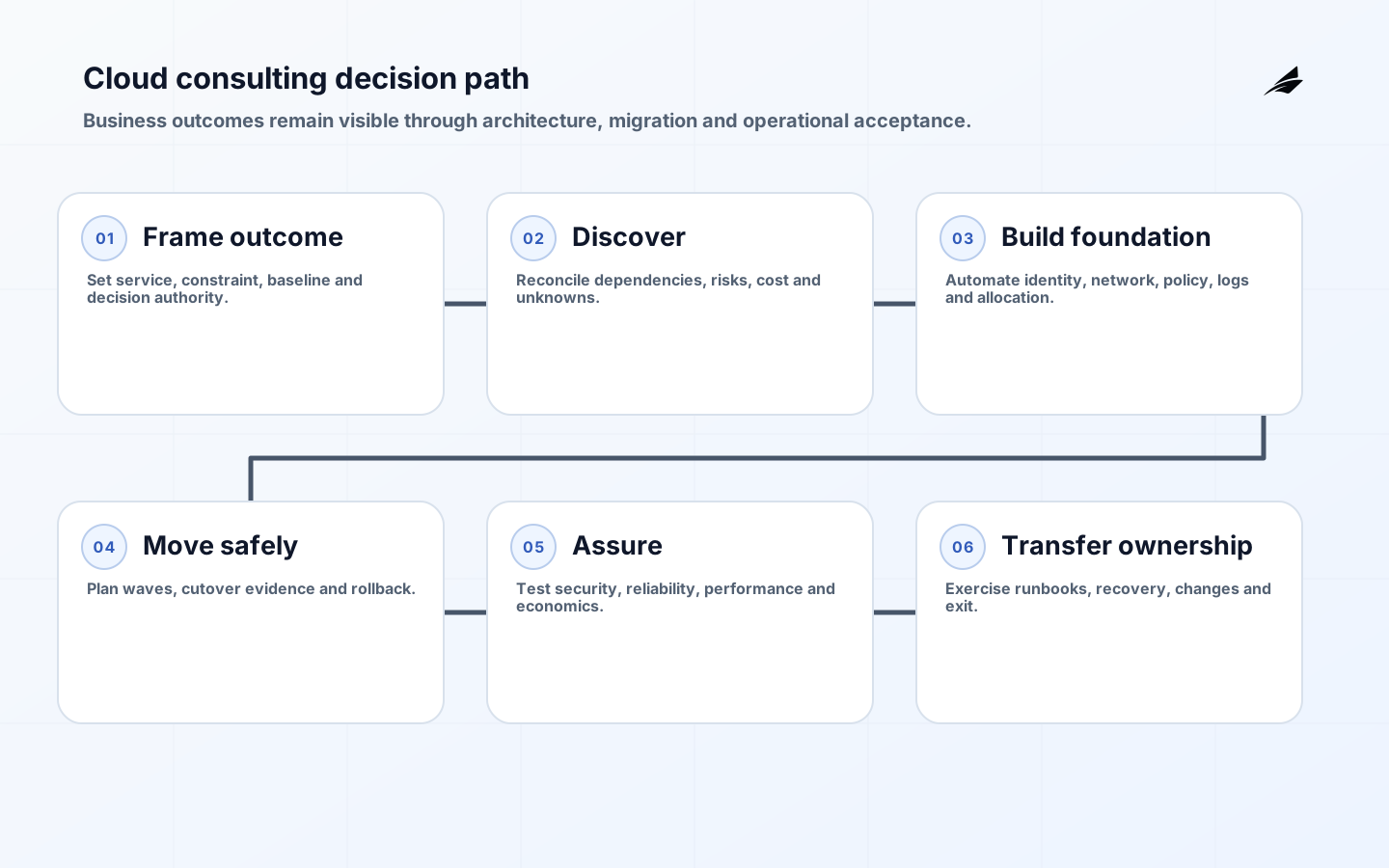
Cloud consulting services should turn a business constraint into an architecture and operating change that a client can verify. They are not simply account setup, a migration factory or a collection of provider recommendations. A useful consultant clarifies which outcomes matter, what control the organization is prepared to retain, how workload risk differs, and which evidence will prove that the new environment is secure, reliable, supportable and economically justified.
NIST defines cloud computing through characteristics such as on-demand self-service, resource pooling, rapid elasticity and measured service, with distinct service and deployment models. Those choices change who controls the operating system, platform, application and data, but they do not remove customer accountability. The questions below help buyers scope an engagement around decisions and acceptance. They apply whether the destination is one provider, a hybrid estate or a deliberately limited multi-cloud design.
What problems should cloud consultants solve?
The engagement should begin with a named business service and a reason to change: release delay, recovery risk, capacity constraint, unsupported infrastructure, regional expansion, audit finding or excessive unit cost. Translate the reason into measurable conditions. If resilience is the objective, specify recovery time, acceptable data loss, dependency behavior and exercise evidence. If speed is the objective, measure lead time and change success rather than the number of resources migrated. A broad mandate to modernize encourages activity without a finish line.
Consulting may include portfolio discovery, target architecture, landing-zone design, migration planning, platform engineering, security, data movement, reliability, financial governance and operational transition. Do not buy every workstream automatically. Sequence the uncertainties. A short discovery can reveal that identity, network address space, licensing or application ownership must be corrected before migration. A good proposal names assumptions, client dependencies, exclusions and decision dates instead of hiding them in a generic methodology.
| Engagement type | Primary deliverable | Acceptance test |
|---|---|---|
| Strategy | Prioritized business case and target state | Executives approve outcomes, constraints and funding gates |
| Foundation | Landing zone and guardrails | A sample workload deploys with identity, logging and policy |
| Migration | Wave plan and migrated services | Service objectives and rollback evidence pass |
| Modernization | Changed architecture and delivery path | Measured reliability or delivery improvement |
| FinOps | Allocation and decision process | Spend reconciles to owners and unit measures |
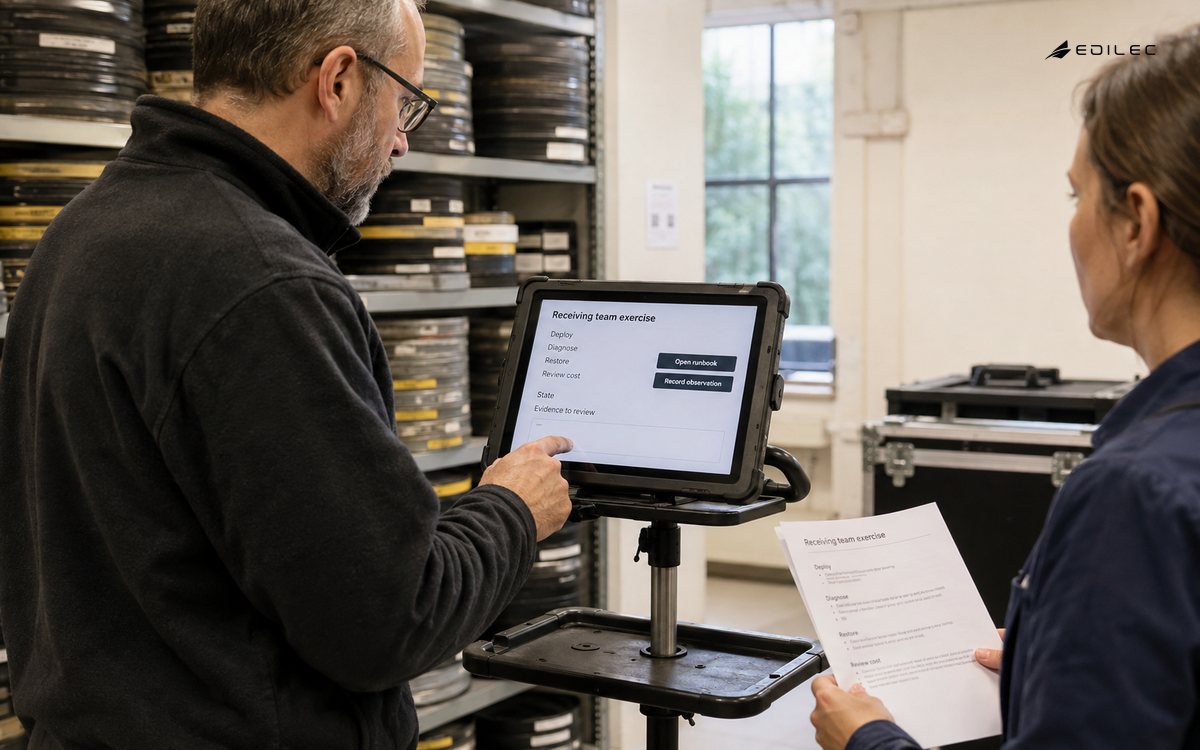
| Operations | Owned service model and runbooks | Receiving team handles representative events |
What should discovery produce?
Discovery needs a reconciled inventory, not an exported list of servers. Connect business services to applications, data, identities, integrations, certificates, schedules, owners, recovery needs, regulatory constraints, licenses and current incidents. Mark confidence and unknowns. Observe traffic and operations where documentation is unreliable. Classify workloads by treatment such as retain, retire, rehost, replatform, refactor or replace, but record the evidence and business owner behind the decision. Portfolio labels without dependency and outage context are not a migration plan.
The output should include a decision log, risk register, dependency map, cost baseline and a small set of candidate waves. It should also state what is not known and how it will be learned. Use a representative proof rather than an easy demo: one workload with private connectivity, sensitive data, external integration and recovery needs can reveal foundation gaps. Discovery ends when decision-makers can choose a funded path, not when every application has accumulated a questionnaire.
What belongs in a cloud foundation or landing zone?
A landing zone establishes organization structure, accounts or subscriptions, identity federation, privileged access, network patterns, DNS, logging, key management, policy, security monitoring, billing allocation and deployment paths. It should be expressed through version-controlled automation and accompanied by an exception process. Central controls need a service owner and support objective. A guardrail that blocks delivery without explaining remediation becomes a source of unmanaged workarounds.
Avoid designing one universal network and account model before testing workload needs. Define a small number of approved patterns with explicit trust boundaries. Separate production from development, management from workload traffic, and human administration from automation. Preserve provider-native audit records outside workload administrator control. Test account creation, emergency access, key recovery, log delivery, policy exception and account closure. Foundation acceptance is an exercised capability, not a diagram.
How should migration waves and cutovers be planned?
Build waves around dependencies, business calendars and learning. Early waves should be useful enough to expose real constraints but recoverable enough to limit consequence. For each service, define data synchronization, identity change, integration endpoint, observability, performance baseline, cutover authority and rollback trigger. Rehearse the cutover with production-sized data where feasible. A successful copy is not a successful migration if operational teams cannot diagnose it or users experience hidden correctness failures.
Treat modernization separately from relocation when combining them would obscure risk. Rehosting can create a controlled exit from failing infrastructure, followed by measured replatforming. Conversely, moving a tightly coupled application unchanged may preserve its cost and reliability problems. Make the trade explicit. Close each wave with reconciliation of data, configuration, monitoring, backup, security findings, cost and decommissioning. Leaving the source environment running indefinitely weakens both the business case and control picture.
How are security, reliability and performance reviewed?
Use well-architected guidance as a set of questions, not a compliance badge. AWS and Google organize recommendations around operations, security, reliability, performance, cost and sustainability. Tailor findings to workload consequence and record accepted risk. Review identity paths, data classification, encryption, backup, regional dependencies, quotas, failure isolation, scaling, software supply chain and incident response. High-risk findings need an owner, due date, interim control and retest evidence.
Define service-level indicators from the user journey, then connect them to component telemetry. Test dependency timeout, retry, queue, failover and restoration behavior. Performance tests need realistic data, concurrency and geographical conditions. Recovery tests must prove data reconciliation, not merely resource recreation. A consultant should leave repeatable tests and dashboards behind; otherwise the assurance disappears as soon as the architecture changes.
How should cloud cost be estimated and governed?
Estimate a range using measured current demand, growth, environment count, data transfer, observability, support, backup and software licensing. Separate one-time migration labor from recurring platform and provider cost. Identify costs that move rather than disappear, including database licenses and specialist support. Tagging is only one allocation mechanism; account structure, labels, billing exports and workload measures must reconcile. Forecast uncertainty should be visible rather than replaced by a precise but fragile total.
The 2026 FinOps Framework emphasizes business value and shared financial accountability across technology categories. Establish owners, budgets, anomaly response, commitment authority and unit measures such as cost per active customer or processed order. Optimization recommendations require a decision and verified result. A theoretical saving that increases outage risk or engineering labor is not automatically valuable. Review architecture, usage and rates at an agreed cadence, and make decommissioning part of delivery completion.
| Evidence at handover | Owner | Failure it prevents |
|---|---|---|
| Architecture and decision records | Service architect | Undocumented assumptions |
| Infrastructure source and pipeline | Platform team | Manual configuration drift |
| Service indicators and alerts | Operations owner | Blind production failure |
| Restore and incident exercises | Service and security owners | Untested recovery |
| Cost allocation and forecast | Product and finance | Unowned spend |
| Exit and decommission record | Program owner | Permanent duplicate estate |
How should a cloud consulting partner be evaluated?
Ask for the team and artifacts, not only certifications. Interview the people who will design, migrate and hand over the service. Review a redacted decision record, test plan, runbook and cost model. Ask how they handle a failed cutover, a customer dependency that is late, a critical finding and a provider service limitation. Strong answers identify authority, evidence and escalation. Product partnerships can be useful, but commercial incentives and architectural alternatives should be disclosed.
Contract for outcomes the parties can control. Define deliverables, acceptance, client responsibilities, source ownership, security access, subcontractors, change control, data handling, knowledge transfer and exit. Time-and-materials may suit uncertain discovery; a fixed price can suit a bounded foundation. In either case, preserve decision visibility and avoid tying payment solely to resource counts. Require remediation of defects against agreed criteria and clarify how cloud charges during testing are approved.
Key takeaways
- Tie every workstream to a business service, measurable outcome and decision owner.
- Use discovery to reconcile dependencies and uncertainty, not to produce inventory volume.
- Treat landing zones, migrations and operations as exercised capabilities.
- Govern reliability, security and cost together because architecture decisions affect all three.
- Accept knowledge transfer through client-led scenarios and complete decommissioning.
Frequently asked questions
Is multi-cloud always safer?
No. It can reduce selected provider dependencies but adds identity, network, data, tooling and skill complexity. Use multiple providers only for explicit business or risk requirements, and test the actual portability or failover claim.
How long should a cloud assessment take?
Duration depends on estate size and evidence quality. A bounded assessment should be time-boxed around priority services and end with decisions. Extend it only when the value of resolving an uncertainty exceeds the delay.
Should consultants operate the environment after migration?
They can, under a defined managed-service boundary. The client still needs service ownership, risk authority, financial accountability and access to authoritative records. Design exit and internal capability before operations begin.
Keep the engagement backlog connected to decision evidence. When an assumption changes, update the architecture record, cost range, risk and acceptance test together so governance follows the actual system rather than an obsolete design presentation.
Conclusion
Cloud consulting creates value when it reduces uncertainty and leaves a stronger operating capability. The client should understand why the architecture was chosen, how it fails, what it costs, who controls it and how improvement is measured. Require representative proofs, client-led acceptance and evidence that survives the engagement. That turns cloud adoption from a relocation program into a deliberate change in how digital services are built and run.