Education cloud professional services should protect the educational purpose while changing technology. A successful engagement improves a learner, teaching, research or administrative outcome and leaves the institution able to govern the service. It does not merely move servers or sign a software subscription. Student records, accessibility, safeguarding, academic calendars, research obligations, shared governance and limited operating capacity create constraints that must be designed into scope and acceptance.
This delivery plan covers discovery through handover. The companion education cloud checklist translates it into tasks, while the education cloud FAQ addresses privacy and continuity questions. Institutions should obtain qualified legal and records advice for their jurisdictions; provider claims never replace a documented local determination.
Anchor scope in an education outcome
Name the population and transaction: students submit assessments, researchers analyze approved data, teachers publish learning materials, families receive notices or staff complete admissions. Establish a baseline for availability, task completion, support demand, accessibility defects, release time and unit cost. Identify critical dates such as enrollment, examinations, grading, grant reporting and term start. A cloud change that interrupts one of these periods can cause harm disproportionate to its technical duration.
Build a service map across learning platforms, student information, identity, library, finance, research, collaboration, endpoints and integrations. Identify system and data owners, not only administrators. Record authoritative sources, manual workarounds and unofficial tools. Shadow applications often indicate an unmet teaching need, but they may also expose student information without institutional review. Bring educators, learners, disability services, privacy, security, records, procurement and operations into discovery while choices remain reversible.
| Education domain | Discovery question | Required evidence |
|---|---|---|
| Learning | Which teaching activity and learner group must improve? | Baseline task, accessibility and continuity measures |
| Student records | Which system is authoritative and who may disclose records? | Data map, role rules and correction process |
| Research | What sponsor, ethics, residency or export conditions apply? | Approved data plan and controlled workspace |
| Administration | Which approvals and reconciliations are business controls? | Transaction trace and accountable owner |
| Community access | Who lacks devices, connectivity, language support or digital skill? | Assisted channel and tested accommodation |
Translate student privacy into technical and contractual controls
Map every category of personal information to an educational purpose, authority, source, user, recipient, retention period, correction route and deletion event. The U.S. Department of Education’s privacy and education technology guidance shows why cloud use must be connected to FERPA responsibilities. Other countries and states have different requirements, so create an obligation register rather than copying a generic compliance statement.
For younger learners, the FTC’s COPPA guidance for schools and operators distinguishes school-authorized educational use from a provider’s commercial purpose. Contracts should identify purpose limits, roles, security duties, incident notification, subprocessors, retention, deletion, export, audit evidence and termination assistance. Verify product behavior and settings against the agreement. Disable unnecessary telemetry, advertising, model training or public sharing; do not assume an education edition makes every optional feature appropriate.
Design accessible and inclusive cloud services
Accessibility is a service acceptance criterion, not a procurement checkbox. Evaluate keyboard operation, focus order, headings, labels, errors, contrast, reflow, captions, transcripts, time limits and assistive-technology behavior against the institution’s obligations and WCAG 2.2. Test representative workflows with disabled users and accessibility specialists. A vendor conformance report is a starting claim; document exceptions, remediation owners and an equivalent accessible route.
Inclusion also covers device age, intermittent connectivity, shared households, language, digital confidence and support hours. Avoid architecture that assumes constant high bandwidth for core learning. Provide low-bandwidth content, resumable submissions and clear recovery from session failure. Preserve telephone, in-person or delegated support where policy permits. Measure successful task completion by affected group so an average improvement does not conceal a worse outcome for learners who already face barriers.
Model the education identity lifecycle
Education identity is unusually seasonal and multi-role. A person may be a student, teaching assistant, employee, alumnus, guardian or visiting researcher at different times. Define authoritative identity sources, affiliation start and end, role changes, guest sponsorship, parental access, privileged administration and emergency access. Use groups and attributes carefully; a stale course membership can disclose submissions, while abrupt deletion can remove records that must be retained.
Provision and deprovision through tested workflows, protect administrators with strong authentication, and separate support impersonation from ordinary access. Log high-risk actions and make review responsibilities explicit. Test late enrollment, deferred study, staff departure, contractor expiry, legal-name change and account recovery. When integrating multiple cloud providers, document where identity decisions and sessions are enforced so incident responders can revoke access predictably.
Use six delivery gates around the academic calendar
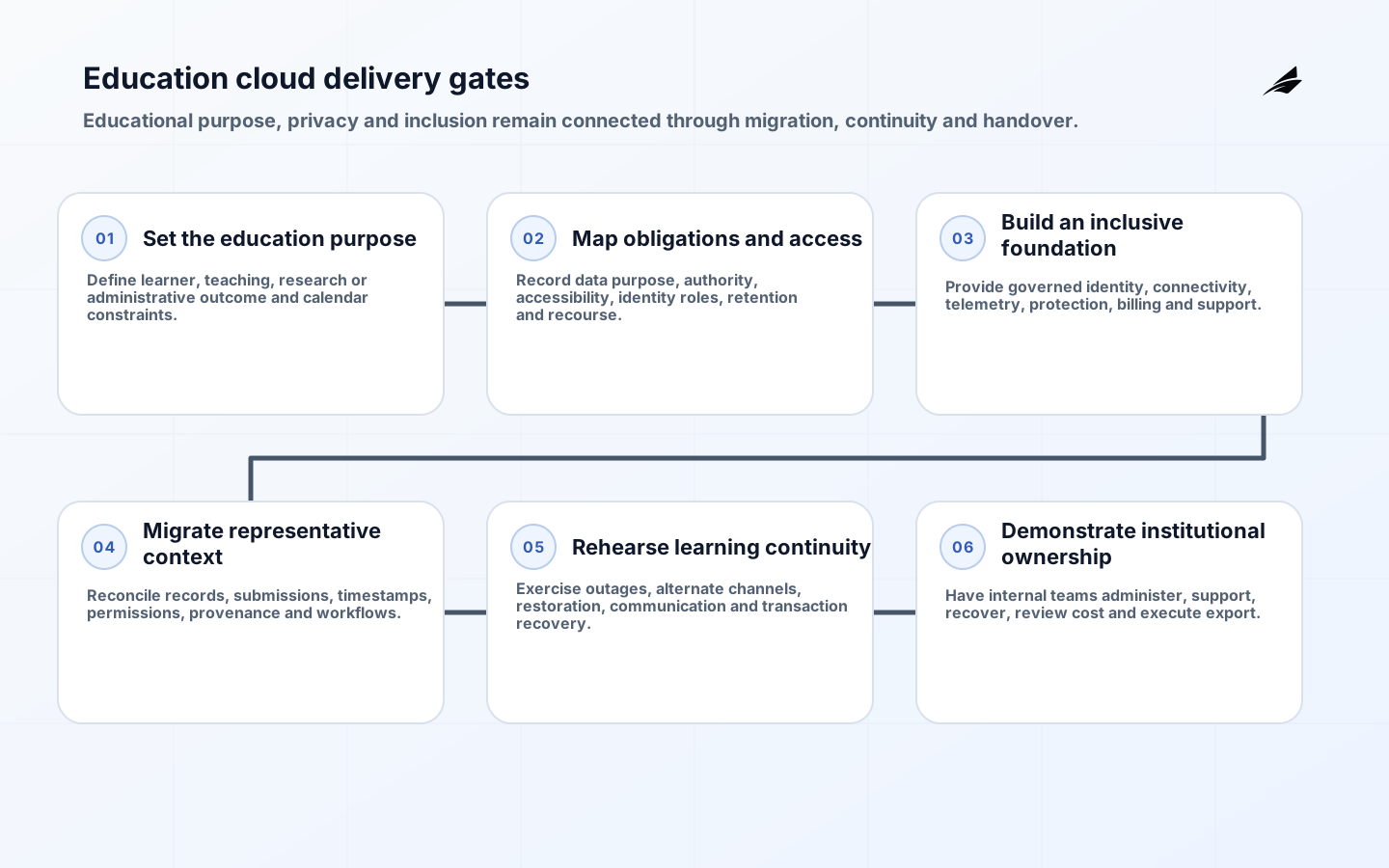
Progress through purpose, obligations, foundation, representative migration, continuity rehearsal and institutional handover. At each gate, name the decision authority and evidence. Avoid major cutovers immediately before enrollment, examinations or grading unless delay creates greater risk and leadership accepts a tested contingency. Use a real but bounded course, department or administrative workflow to expose identity, integration, accessibility and support issues before institution-wide rollout.
Migration evidence must preserve context, not just bytes. Reconcile enrollments, timestamps, grading state, submission history, feedback, permissions, retention labels and links. Define the source-of-truth transition, freeze or synchronization method and rollback conditions. Ask educators and records owners to validate representative workflows. Keep the previous system protected and readable through the approved assurance window, then retire it deliberately to avoid indefinite duplicate exposure and licensing.
Engineer security and learning continuity together
Threat-model account takeover, public sharing, ransomware, fraudulent payment changes, assessment leakage, research data exfiltration and provider outage. Apply least privilege, secure defaults, managed endpoints where appropriate, vulnerability management, protected logs, data loss controls and tested incident communications. Use the NIST Privacy Framework alongside cybersecurity work so teams consider problematic data processing as well as unauthorized access.
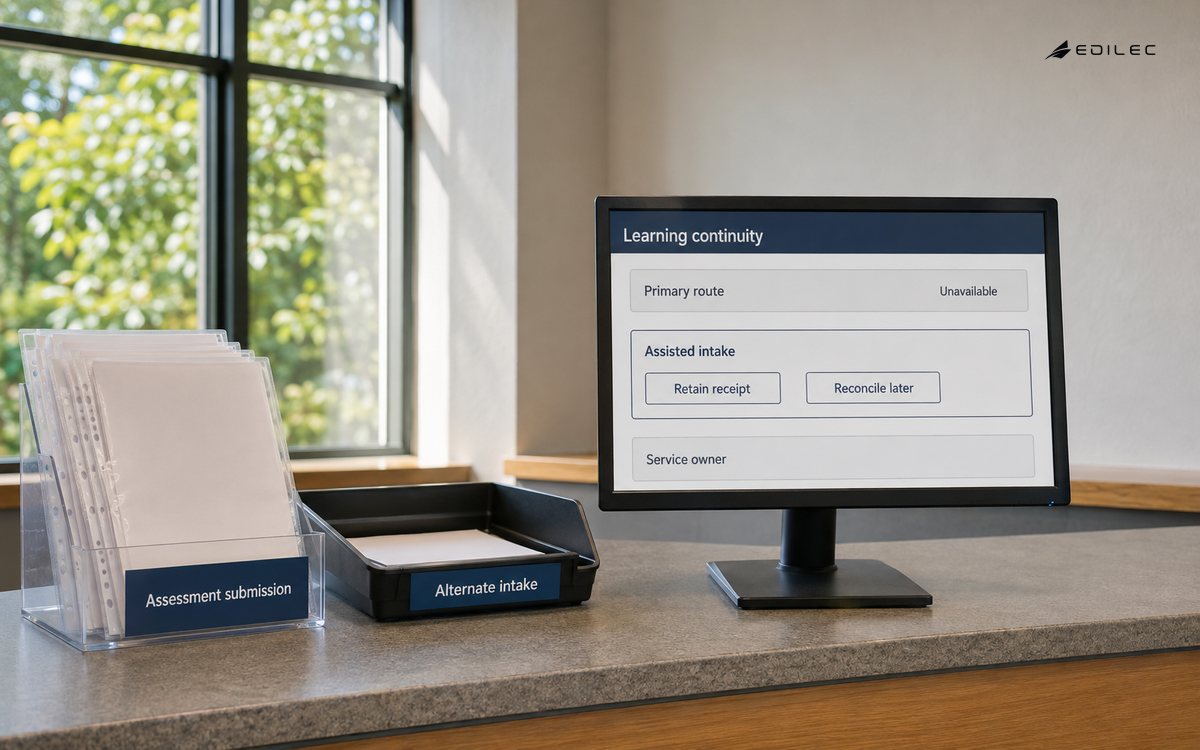
Set recovery objectives from educational impact. A learning platform may tolerate degraded analytics but not lost submissions; an admissions service may require a manual intake route. Back up customer-controlled data and configuration where the service model permits, understand provider recovery limits and export critical records. Exercise identity outage, unavailable vendor, corrupted integration and compromised administrator scenarios. Reconcile submitted work and decisions after recovery, and communicate clearly to learners and staff.
| Risk scenario | Prevent or limit | Recovery evidence |
|---|---|---|
| Student account takeover | Strong authentication, anomaly detection and scoped sharing | Revoke sessions, restore ownership and notify through policy |
| Assessment platform outage | Capacity testing and alternate submission route | Timestamped intake and later reconciliation |
| Vendor data misuse | Purpose-limited contract, settings and subprocessor review | Export, deletion evidence and escalation |
| Ransomware or destructive admin | Separated privilege and protected generations | Isolated restore with record-level validation |
| Accessibility blocker | User testing and release criteria | Equivalent route and tracked remediation |
Plan cost, procurement and supplier exit
Estimate subscriptions by role and peak population, infrastructure demand, storage growth, transfer, backup, integration, accessibility remediation, support, training and migration overlap. Account for grants, research charge codes and fiscal cycles. A low initial subscription can become expensive when export, premium identity, security logs or API capacity are separate. Model three years with enrollment and research growth, then show assumptions rather than claiming a universal saving.
Procurement should preserve institutional control. Define service levels around critical workflows, support escalation, incident notice, data location, change notification, accessibility, price adjustments, exit formats, deletion and transition assistance. Identify who owns custom integration and automation. Test a sample export before award when feasible and again during service reviews. Avoid contract terms that make the institution’s own records or configuration practically inaccessible at termination.
Accept evidence and transfer capability
Require the institution to demonstrate account administration, course or service setup, deployment, access review, incident triage, accessibility regression, restore or export, cost review and vendor escalation. Store runbooks, architecture, data maps, infrastructure code, contracts, decision records and risk acceptance in institution-controlled repositories. Close consultant accounts and shared data at handover. Record remaining skill gaps with funded owners instead of hiding them in a final report.
Review outcomes after a full academic cycle where appropriate. Compare task completion, support volume, availability, accessibility issues, privacy incidents, release speed and unit cost with the baseline. Include learner and educator feedback, but distinguish satisfaction from successful educational use. Maintain a service council with authority to prioritize reliability, privacy, teaching needs and cost. Cloud stewardship continues after project closure because curricula, populations, threats and provider features change.
Education cloud professional services takeaways
- Define a learning or institutional outcome and protect critical calendar periods.
- Tie every student-data flow to purpose, authority, retention and recourse.
- Test accessibility and low-bandwidth workflows with affected users.
- Reconcile educational records and permissions, not only migrated files.
- Finish with demonstrated institutional operation, recovery and supplier exit.
Frequently asked questions
Does FERPA prohibit education cloud services? No; applicable conditions and institutional responsibilities still need to be met. Is a provider’s compliance statement sufficient? No. The institution must verify its configuration, contract, data use and local obligations. When should migration happen? Choose a window from academic impact, test evidence and rollback readiness rather than defaulting automatically to a holiday.
Should all education data use one cloud? Not necessarily; choose boundaries from purpose, integration, risk, capability and exit needs. Can consultants own the cloud tenant? Customer-controlled administration is the safer durable model. What is the key acceptance test? Representative learners and staff complete the workflow accessibly, while the institution can support, recover, govern and explain the service without consultant dependence.
Conclusion
Education cloud work succeeds when technology change remains accountable to learning and institutional stewardship. Establish purpose and obligations, build inclusive identity and platform controls, migrate a representative workflow, rehearse continuity and transfer real capability. The result should be more than a functioning platform: it should be an accessible, recoverable service whose data use and operating choices the institution can defend.