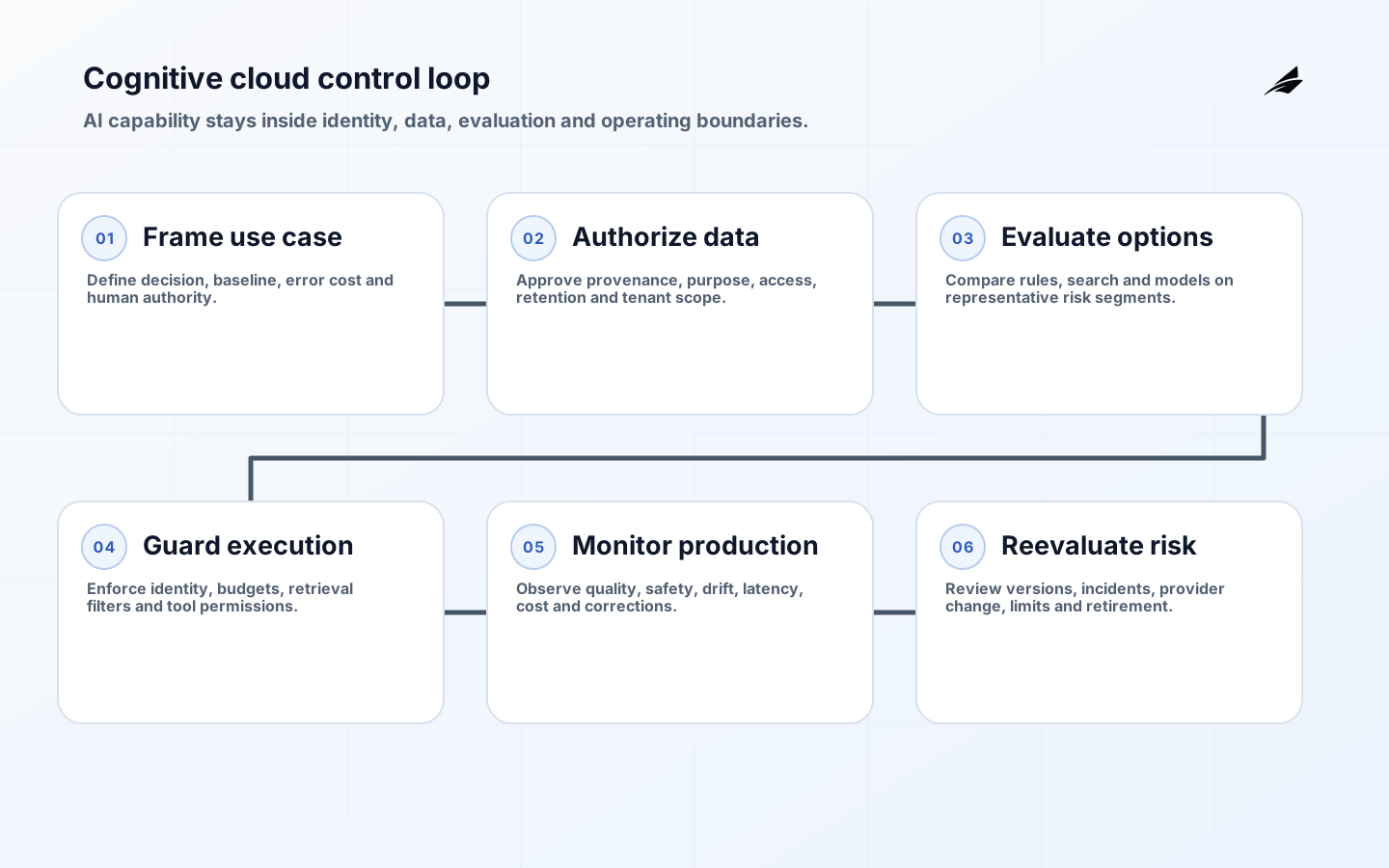
Cognitive cloud services combine managed AI capabilities, enterprise data and application workflows to classify, predict, retrieve, generate or recommend. The phrase can cover traditional machine learning, document processing, speech, search, foundation models and agents. A useful buying process begins with the decision or task, then selects the least complex service that meets quality, control and operating needs.
This FAQ is for product, architecture, data, security and operations leaders. Read it with the cognitive cloud scope and delivery guide, implementation checklist and broader cloud-services plan. AI law and provider terms vary; obtain qualified review for the markets and decisions involved.
Which use cases belong in cognitive cloud services?
Choose work where probabilistic output can improve a named outcome and errors can be detected or bounded. Good candidates include document classification with review, support knowledge retrieval, demand forecasting, anomaly prioritization and assisted drafting. High-impact eligibility, safety or financial decisions need stronger governance and may not suit autonomous use.
Define user, input, output, action, baseline, error cost and human authority. Compare with rules, search and workflow redesign before using a model. AI is justified when evaluation shows material benefit that exceeds the new data, security, cost and operational burden.
| Use-case question | Evidence before build | Control implication | Stop condition |
|---|---|---|---|
| What decision changes? | Named owner and current baseline | Output must enter an explicit workflow | No accountable action owner |
| How harmful is error? | False-positive and false-negative examples | Review, threshold or prohibition by class | Critical harm cannot be bounded |
| What data is needed? | Authorized, representative sample | Purpose, access and retention controls | Rights or provenance unresolved |
| Why AI? | Comparison with rules and search | Use simplest sufficient approach | No measurable incremental value |
| How does it age? | Expected drift and knowledge change | Monitoring and reevaluation cadence | Quality cannot be observed |
| Who can override? | Escalation and correction path | Human authority and audit event | Automation removes required judgment |
Should we buy a managed model, tune one or train our own?
Start with a managed pre-trained capability when its task fit, data terms, region, latency, cost and controls are acceptable. Add retrieval when answers need current enterprise knowledge. Fine-tune when repeated, evaluated behavior or domain format cannot be achieved reliably through simpler configuration. Training a foundation model requires exceptional data, compute and specialist capability and is rarely the default enterprise path.
Run a bake-off on the same representative evaluation set. Compare quality by risk segment, not only an average; include latency, throughput, availability, content controls, explainability, version policy and total unit cost. AWS’s current Machine Learning Lens treats data evolution, monitoring and the iterative ML lifecycle as core architectural concerns.
What does a production AI workload contain?
Separate the user-facing application, policy and orchestration layer, model endpoint, approved tools, knowledge or feature layer, data pipelines, evaluation system and telemetry. Propagate user and tenant identity to every retrieval and action boundary. Microsoft’s AI workload guidance highlights non-deterministic functionality, data design, operations, testing and responsible AI in addition to ordinary workload concerns.
Keep models behind a server-side intelligence API that enforces authorization, rate and token limits, provider routing, redaction, output validation and audit. Do not let a browser call a model or data store with broad credentials. Define fallbacks for endpoint failure, stale indexes, safety-filter rejection and provider degradation. A deterministic workflow may be safer than a free-form agent for known sequences.
How should data and retrieval be governed?
Create inventories for training, tuning, evaluation, grounding and feedback data. Record origin, rights, purpose, sensitivity, geography, transformations, quality and retention. Keep production prompts and outputs out of future training unless notice, authority and controls explicitly permit that use. Remove secrets and unnecessary personal data before requests leave the application boundary.
For retrieval-augmented generation, authorize documents at query time and filter by the current user and tenant before context reaches the model. Preserve source identifiers, version and retrieval scores so citations can be checked. Re-index through a controlled pipeline and define deletion propagation. A model disclaimer does not repair unauthorized retrieval.
| Layer | Primary control | Evaluation evidence | Operational signal |
|---|---|---|---|
| Input | Authentication, classification and prompt limits | Abuse and boundary test set | Rejected, truncated and sensitive requests |
| Retrieval | Identity-bound filtering and source lineage | Permission and freshness tests | Empty, stale and cross-tenant retrieval |
| Model | Approved version, endpoint and safety settings | Quality by risk segment | Latency, errors, token and version |
| Tools | Allowlisted operation and least-privilege identity | Unauthorized and duplicate-action tests | Tool calls, denial and business outcome |
| Output | Schema, policy and citation validation | Hallucination and harmful-output review | Fallback, correction and escalation |
| Feedback | Purpose, moderation and poisoning controls | Label agreement and sampling review | Volume, abuse and drift indicators |
When are agents appropriate?
Use an agent only when flexible planning across tools creates value that a defined workflow cannot. Give it narrow tools with explicit schemas, read-only access by default, per-action authorization, budgets, timeouts and human confirmation for consequential effects. Treat model output as untrusted input to every tool. An agent must not inherit the end user’s unrestricted session or a platform administrator credential.
Test prompt injection from user input, retrieved documents and tool results. The OWASP LLM application project covers risks including prompt injection, sensitive disclosure, supply chain weaknesses, excessive agency and overreliance. Log plan, tool request, authorization decision, result and final user-visible outcome without storing unnecessary secrets or content.
How should AI risk be governed?
Use NIST’s AI RMF functions of govern, map, measure and manage to assign accountability and lifecycle controls. Map affected people, context, foreseeable misuse and impact. Measure validity, reliability, safety, security, privacy, transparency and harmful bias where relevant. Manage through limits, monitoring, incident response and retirement.
Generative systems add confabulation, prompt injection, information integrity, model dependency and content risks addressed in NIST’s Generative AI Profile. Maintain an AI system record containing purpose, owner, providers, versions, data, evaluation, known limits, controls, incidents and approval. Review material model or provider changes as releases.
What security controls differ from normal cloud workloads?
Apply normal identity, network, secret, dependency, vulnerability and incident controls first. Add inventories of models, prompts, datasets, indexes and tools; protect model and data supply chains; validate outputs before code or queries consume them; and detect unusual extraction or resource use. Google’s Secure AI Framework organizes risks across data, infrastructure, model and application components.
Threat-model theft, data poisoning, indirect prompt injection, cross-tenant retrieval, denial of wallet, unsafe code or query generation and compromised tools. Use provider private networking or isolation where justified, customer-managed keys where required, egress controls and workload identities. Confirm which provider personnel and subprocessors can access data and how that access is logged.
How do we evaluate quality before launch?
Build a versioned evaluation set from real task categories, difficult edge cases and adversarial examples. Define expected output or reviewer rubric, acceptance by segment and critical-failure rules. Separate offline capability evaluation from end-to-end workflow evaluation. For generative outputs, measure groundedness, source support, completeness, policy compliance and calibrated refusal rather than one vague accuracy score.

Use qualified reviewers, blind comparisons where practical and agreement checks. Evaluate every model, prompt, retrieval and tool change. Release to a bounded cohort with sampling and a correction channel. Production feedback is not ground truth until reviewed; accepting raw thumbs-up data can amplify popularity, manipulation or selection bias.
How are cost and reliability controlled?
Model cost per completed business outcome, not per API call alone. Include input and output tokens, embeddings, retrieval, storage, moderation, evaluation, network, observability, review labor and retries. Set per-tenant and per-workflow budgets, maximum context and tool steps, caching rules and alerts. Validate provider quotas and capacity under peak concurrency.
Observe application success, model and retrieval quality, endpoint errors, latency, token use, safety rejection, tool denial, corrections, provider version and drift. Define fallback: alternate model, deterministic search, queued review or clear unavailability. Rehearse provider outage and model withdrawal. Store prompts and configuration as versioned assets so an incident can be reproduced within privacy limits.
How can teams limit provider lock-in?
Abstract only the stable needs: request policy, identity, evaluation, telemetry and business contract. Model capabilities and safety features differ, so a lowest-common-denominator wrapper can hide important behavior. Preserve source data and indexes in exportable forms, version prompts outside provider consoles, and automate the same evaluation suite across candidate endpoints.
Contract model-change notice, data use, retention, region, service objectives, incident cooperation, export and termination. Maintain a tested exit for the highest-consequence workload. Portability has a cost; compare it with the business impact and likelihood of provider change rather than requiring theoretical interchangeability everywhere.
- Define the decision, error cost, baseline and human authority.
- Compare rules, search and model options on representative evidence.
- Approve application, data, retrieval, model and tool boundaries.
- Threat-model AI-specific abuse and implement identity-bound controls.
- Evaluate by risk segment and release to a bounded cohort.
- Monitor quality, safety, cost and provider change through retirement.
Key takeaways
- Use the simplest cognitive service that improves a defined task.
- Keep identity and policy enforcement outside the model and at every data or tool boundary.
- Evaluate models, retrieval and full workflows by risk segment.
- Treat prompts, indexes, models and tools as versioned production assets.
- Control cost and provider change with telemetry, budgets, fallbacks and exit evidence.
Frequently asked follow-up questions
When is a proof of concept ready for production?
After representative evaluation, architecture and security review, data authority, failure handling, observability, cost limits, support ownership and bounded user acceptance are proven. A persuasive demo tests possibility; production acceptance tests sustained behavior and harm controls.
Does human review make an AI workflow safe?
Not automatically. Reviewers need time, context, authority, training and a usable correction path. Measure automation bias, disagreement and workload. Some outputs should be prohibited or routed to specialists rather than presented for routine approval.
Can model quality be monitored without storing all prompts?
Yes. Use sampled, redacted or derived measures, synthetic probes, outcome reconciliation and case-specific secure capture. Choose from purpose and risk. Do not collect sensitive content by default merely because it might help later debugging.
Conclusion
Cognitive cloud services become dependable when intelligence sits inside an accountable system. Select a bounded use case, enforce identity and data policy around the model, evaluate real failure costs, and operate versions, budgets and fallbacks explicitly. The model is one component; the product and organization remain responsible for the outcome.