Hybrid cloud solutions combine distinct cloud infrastructures that remain separate but are connected to support data or application portability. That NIST definition is narrower and more useful than calling every environment with a data center and public cloud “hybrid.” A sound hybrid design explains what is bound together, which workload outcome requires the connection and how identity, policy, data, operations, cost and failure are controlled across it.
This FAQ complements the hybrid cloud implementation checklist, hybrid cloud scope and cost guide, cloud innovation planning guide and cloud innovation checklist. Use it to challenge architecture proposals and plan a measurable migration.
What counts as a hybrid cloud solution?
A genuine hybrid design has at least two distinct private, community or public cloud infrastructures and technology that binds them for application or data portability. A private cloud should exhibit cloud characteristics such as on-demand service, pooling, elasticity and measured use; a conventional virtualized data center does not become cloud through branding. The distinction matters because operating assumptions, chargeback, automation and responsibility differ.
Hybrid is an architecture choice, not a maturity destination. Valid reasons include fixed-latency processing near equipment, regulated placement, existing investment, disconnected operation, specialized hardware, staged modernization or measured resilience. Weak reasons include avoiding a hard application decision or claiming universal portability. Every additional environment adds interfaces and skills. State the workload-level reason and the condition that would trigger reconsideration.
| Placement driver | Evidence to collect | Likely design implication |
|---|---|---|
| Latency or locality | Measured end-to-end timing and failure tolerance | Keep time-critical processing near the user or equipment |
| Data obligation | Classification, authority, location and transfer analysis | Constrain stores, replicas, keys and support paths |
| Availability | Dependency map and business recovery objectives | Design independent failure domains and fallback |
| Specialized capability | Benchmark, capacity and supply evidence | Place component where capability is supportable |
| Economics | Whole-life cost and demand scenarios | Compare unit cost including network and operations |
| Exit or portability | Transition objective and tested artifact boundaries | Invest selectively in standards and export evidence |
How should workloads be placed?
Profile the workload before choosing a platform. Record users, data, dependencies, demand shape, latency, availability, recovery, security, legal constraints, operational skill, modernization appetite and expected life. Decompose only where a boundary has clear value. Splitting a chatty transaction across a slow or fragile link can destroy reliability; keeping an entire service together may be safer even if individual components could run elsewhere.
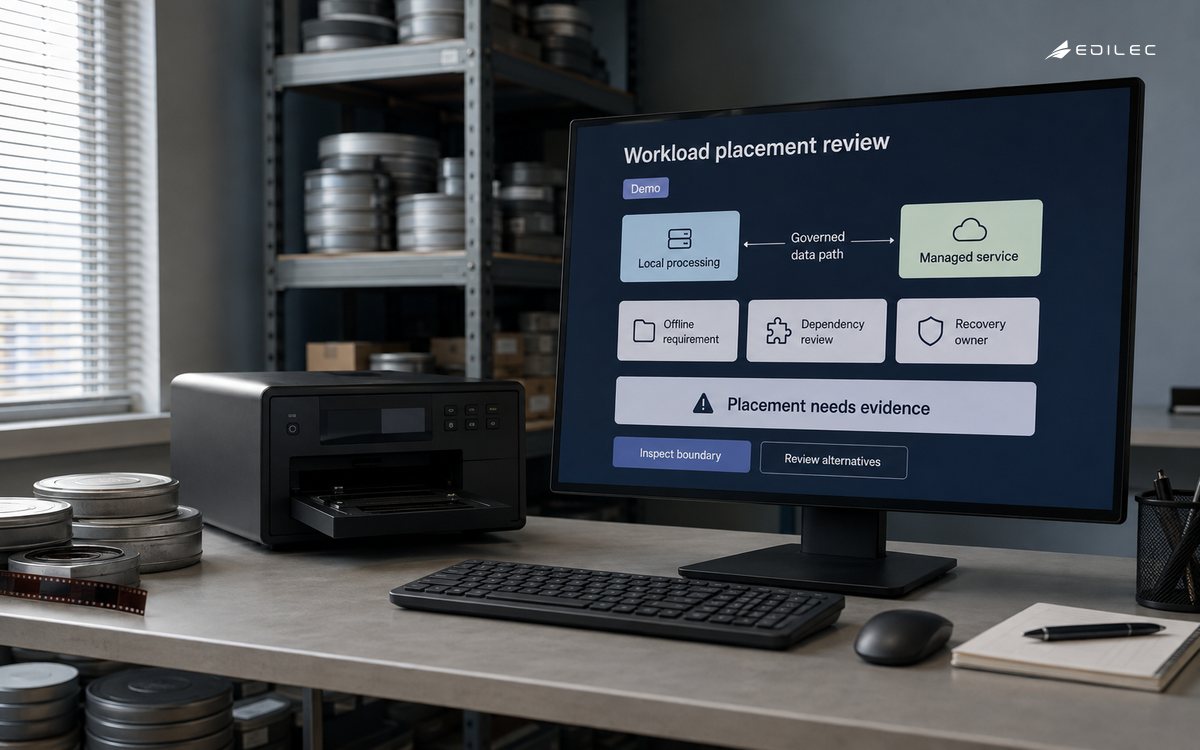
Use a documented placement decision with alternatives and expiry. Compare public cloud, private cloud, edge, retained infrastructure, replacement and retirement. Include organizational readiness and exit. Run a representative benchmark or technical probe for uncertain interfaces. Revisit the decision when demand, provider capability, regulation, support life or observed cost changes. Hybrid architecture should remain an actively managed portfolio, not a permanent exception catalog.
Which controls should be common across environments?
Common does not always mean one tool. Establish consistent outcomes and evidence for identity, asset inventory, policy, secrets, secure delivery, vulnerability handling, observability, backup, incident response and cost ownership. Federation can reduce duplicate accounts, while local emergency access protects against central dependency failure. NIST access-control guidance for cloud systems and zero trust architecture both support resource-focused, explicitly evaluated access rather than trust inherited from location.
Define an authoritative source for users, services, assets and configuration. Normalize identifiers so an alert can be traced across cloud and private systems. Use individual and workload identities, short-lived credentials and least privilege. Keep policy versions and exceptions visible. A single dashboard is not a control plane if teams can create resources outside it or if it cannot show which policy actually governed an action.
How should network and data paths be engineered?
Map name resolution, routing, address space, encryption, segmentation, bandwidth, quality of service, egress, inspection and administrative access. Design for link saturation, asymmetric routing, stale DNS and provider outage. Treat private connectivity as transport, not trust. Authenticate and authorize application calls at the destination. Monitor path health from the user journey and each side of the boundary, because a green circuit can still carry a broken service.
For data, identify the system of record, replicas, consistency model, conflict handling, retention, backup, key authority and deletion behavior. Avoid uncontrolled bidirectional synchronization. Decide what happens during disconnection and how records reconcile afterward. Test with production-like volume and failure. If an application cannot tolerate stale or conflicting data, moving one tier to another environment may be a poor decomposition regardless of nominal network speed.
| Failure or risk | Required design evidence | Test |
|---|---|---|
| Interconnect loss | Timeout, queue, cache, fallback and recovery behavior | Disconnect under representative demand |
| Identity outage | Local continuity and protected emergency access | Disable federation and review actions |
| Policy drift | Versioned baseline, exception owner and comparison | Introduce controlled drift and detect it |
| Data conflict | Ownership, ordering and reconciliation rules | Create concurrent updates during partition |
| Unexpected egress cost | Flow inventory, rates, budgets and owner | Replay peak and recovery traffic scenario |
| Environment exit | Portable data, artifacts, build and dependency record | Restore representative service elsewhere |
Why do hybrid cloud costs surprise teams?
Teams often compare compute prices while omitting connectivity, transfer, duplicate security and observability, private capacity, facilities, platform engineering, licenses, support, recovery, migration and exit. Idle private capacity and public-cloud consumption behave differently, so avoid forcing both into one simplistic unit. Model fixed and variable cost, growth, peak, failure and transition scenarios. Include the internal people who operate common controls and resolve cross-environment incidents.
Allocate cost to products and shared platforms with documented accounts, projects, tags, labels or derived metadata. The FinOps Framework treats allocation as a foundation for accountability. Require ownership and purpose at provisioning, report unallocated spend and apportion shared cost consistently. Pair financial measures with value and reliability: cost per transaction, active user or protected endpoint is more actionable than provider spend alone.
What is a safe hybrid cloud migration procedure?
Start with discovery and a target service design. Establish identity, network, logging, security, cost and recovery foundations before migrating critical demand. Select one vertical user journey whose dependencies are understood. Rehearse data movement, reconciliation, traffic switch, rollback and communication. Move in cohorts with health thresholds. Accept the workload only after operational teams prove monitoring, incident response, backup restore, cost ownership and support.
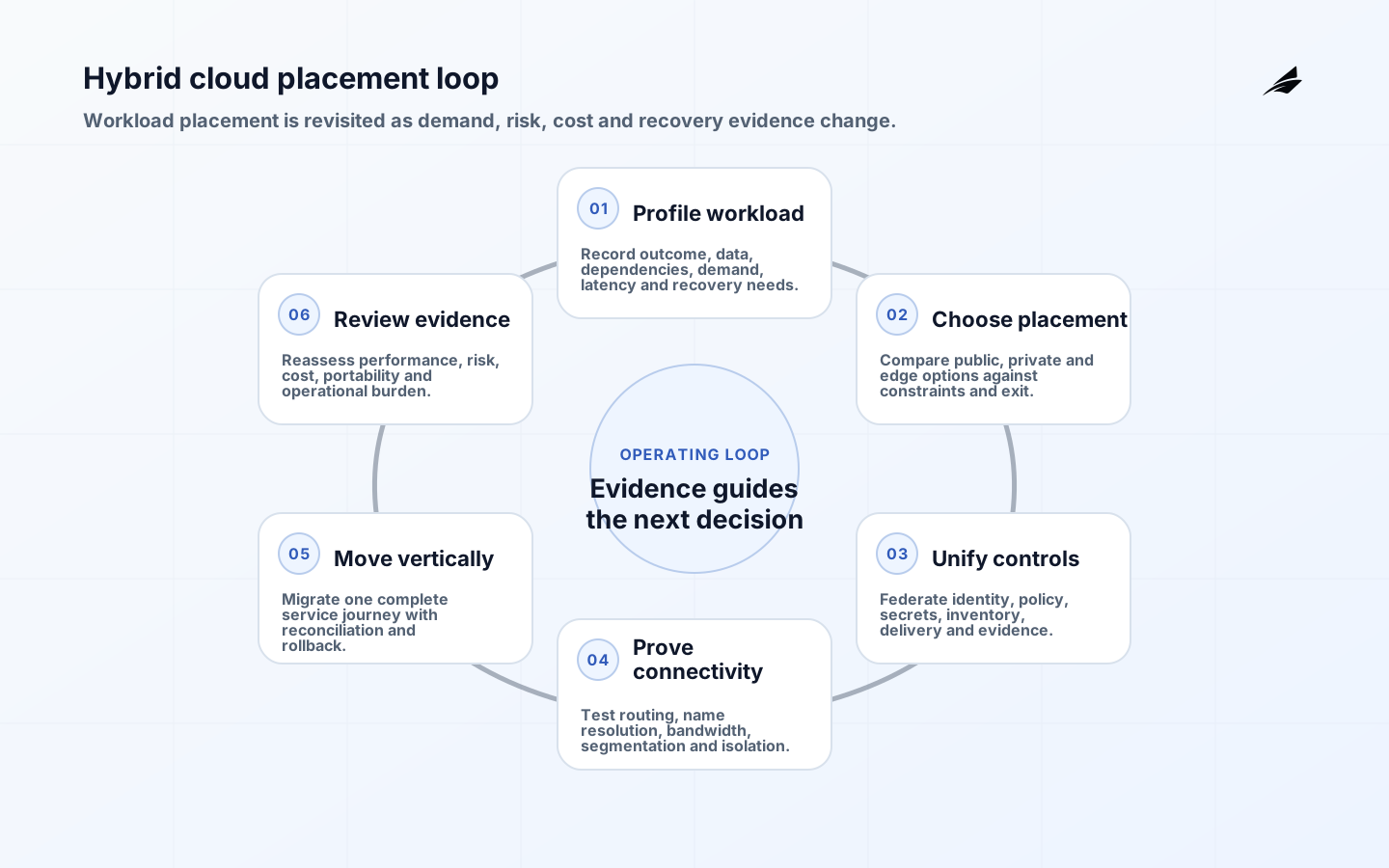
- Profile outcome, data, dependencies, demand, latency, recovery, obligations and remaining life.
- Choose placement through explicit alternatives, evidence, risk and a scheduled review condition.
- Implement common control outcomes for identity, inventory, policy, delivery, telemetry and cost.
- Prove network, name, data consistency and disconnected behavior at representative load.
- Migrate one complete journey with reconciliation, rollback and customer communication.
- Review observed service, risk, cost, portability and operational burden before scaling.
Example: a manufacturer retains plant execution near machinery while moving analytics to public cloud. It defines the plant as system of record, sends append-only events through a store-and-forward channel, expires remote commands, isolates analytics identity from control networks and keeps local safe operation during disconnection. The pilot measures event delay, backlog recovery, cloud egress, operator impact and reconciliation rather than celebrating that both environments exchanged data.
How should hybrid cloud be operated?
Assign one service owner for each user journey and clear platform owners for each environment. Use correlated telemetry with common time, service, request, identity and configuration identifiers. Route incidents by customer impact while preserving component expertise. Change reviews should consider both sides of interfaces and shared capacity. Run game days for link, identity, provider, private-platform and data failures, then update runbooks and architecture from observed behavior.
Measure service objectives, recovery results, configuration drift, unsupported assets, cross-environment latency, failed changes, alert coverage, unallocated cost and engineering toil. Watch the complexity tax: if teams spend growing effort reconciling tools and policies, the hybrid boundary may be poorly placed. Architecture governance should be able to consolidate, modernize, repurchase or retire workloads, not only add new platform exceptions.
Document an exception budget for each environment: unsupported operating systems, manual deployments, local identities, unencrypted legacy flows and resources without cost ownership. Give every exception a consequence, compensating control, owner and deadline. Review the total burden, not only individual justifications, because many reasonable exceptions can collectively make the hybrid platform unoperable.
Key takeaways
- Use the precise hybrid-cloud definition and require a workload-specific reason for binding environments.
- Make placement decisions from measured service, data, risk, cost and exit evidence, then revisit them.
- Standardize control outcomes and identifiers even when implementation tools differ.
- Engineer and test network partitions, identity failure and data reconciliation as normal design cases.
- Measure the operational complexity tax and retain authority to simplify the architecture.
Frequently asked questions
Is hybrid cloud the same as multi-cloud?
No. Multi-cloud generally means using services from more than one provider. Hybrid cloud refers to distinct cloud infrastructures bound for portability. An architecture can be both, either or neither. Define the actual environments and relationships rather than relying on labels.
Does Kubernetes make applications portable?
It can standardize part of packaging and orchestration, but applications still depend on data, identity, network, storage, managed services, policy and operations. Test the specific exit objective. Portability has value only when the organization can maintain and exercise it.
Is private cloud inherently more secure?
No. Security depends on architecture, operation, threat, staffing and evidence. Private environments can offer control and locality while carrying patching, capacity and physical responsibilities. Public services can offer managed controls while adding provider and configuration dependencies.
When should a workload be repatriated?
Reconsider placement when observed cost, performance, regulation, provider constraints, service life or operational burden materially change. Compare alternatives and transition risk with current evidence. Moving because of one surprising bill without correcting architecture or demand may relocate the problem.
Conclusion
Hybrid cloud solutions are useful when a clear service requirement justifies distinct environments and the connection between them is engineered as a product. Profile workloads, make explicit placement decisions, unify control outcomes, test failure and account for whole-life complexity. A good hybrid architecture preserves options without making every team operate every platform.