A cognitive infrastructure services FAQ needs a plain definition. In this guide, the term means infrastructure operations that use telemetry, topology, analytics and sometimes AI to detect conditions, correlate evidence, recommend actions or execute tightly bounded remediation. It can cover cloud, network, compute, storage, edge and platform services. It does not mean infrastructure understands the business by itself. Value comes from better operational decisions and reliable automation built on accurate inventory, useful signals, explicit authority and feedback from real outcomes.
The offering can be internal, vendor-managed or jointly operated. Buyers should separate foundational observability, deterministic automation, statistical detection and generative assistance because each has different data, evaluation and risk. The NIST AI Risk Management Framework provides a useful structure when AI is involved. Conventional reliability and security engineering still govern the surrounding service. This FAQ explains what to include, what evidence to demand and where claims of autonomy should be replaced with specific operating behavior.
What are cognitive infrastructure services offerings?
A complete offering may include discovery and inventory, telemetry engineering, service topology, event normalization, anomaly detection, correlation, capacity forecasting, operator assistance, runbook automation, cost optimization and continuous model or rule evaluation. Scope should identify environments, technology layers, regions, hours, data retained and actions permitted. Some services only surface recommendations; others open tickets, change capacity or restart a component. State that authority precisely. A dashboard that groups alerts is not equivalent to a service that owns diagnosis and verified remediation.
Define an initial operational constraint such as repeated alert storms, slow dependency diagnosis, avoidable capacity incidents or high manual toil. Baseline it and choose one service journey. The cognitive infrastructure scope, cost and delivery plan supports commercial design, and the implementation checklist provides detailed acceptance gates. Avoid platform-wide rollout until the offering proves signal quality, workflow integration and operator trust on representative services.
| Capability | Useful output | Required control |
|---|---|---|
| Discovery | Owned asset and dependency inventory | Provenance, freshness and reconciliation |
| Detection | A condition linked to expected behavior and impact | Threshold or model version and false-positive review |
| Correlation | Evidence grouped around a service hypothesis | Traceable inputs and operator correction |
| Recommendation | Specific action with rationale and predicted consequence | Current-state validation and approval policy |
| Remediation | Bounded, idempotent infrastructure change | Least privilege, stop condition and outcome verification |
What data and telemetry does the service require?
Start with service ownership, resource inventory, configuration, topology, changes, incidents and business-critical journeys. Collect the minimum telemetry needed to answer operational questions. OpenTelemetry documents signals including traces, metrics and logs; profiles and events may add context in suitable environments. Normalize resource identity, timestamps, environment and service ownership so evidence can be correlated. A large ungoverned data lake creates cost and ambiguity if names conflict, clocks drift or resources cannot be mapped to a service.
Treat telemetry as sensitive operational data. It can reveal customer identifiers, network structure, vulnerabilities, credentials or business volume. Define collection purpose, access, location, retention, sampling and redaction. Protect collectors and pipelines because compromised telemetry can blind or mislead automation. Monitor ingestion loss and schema drift. Preserve raw evidence long enough for investigation where justified, but keep derived features and training sets versioned separately. Evaluate whether historical incidents represent current architecture before using them as labels or exemplars.
What does a safe reference architecture look like?
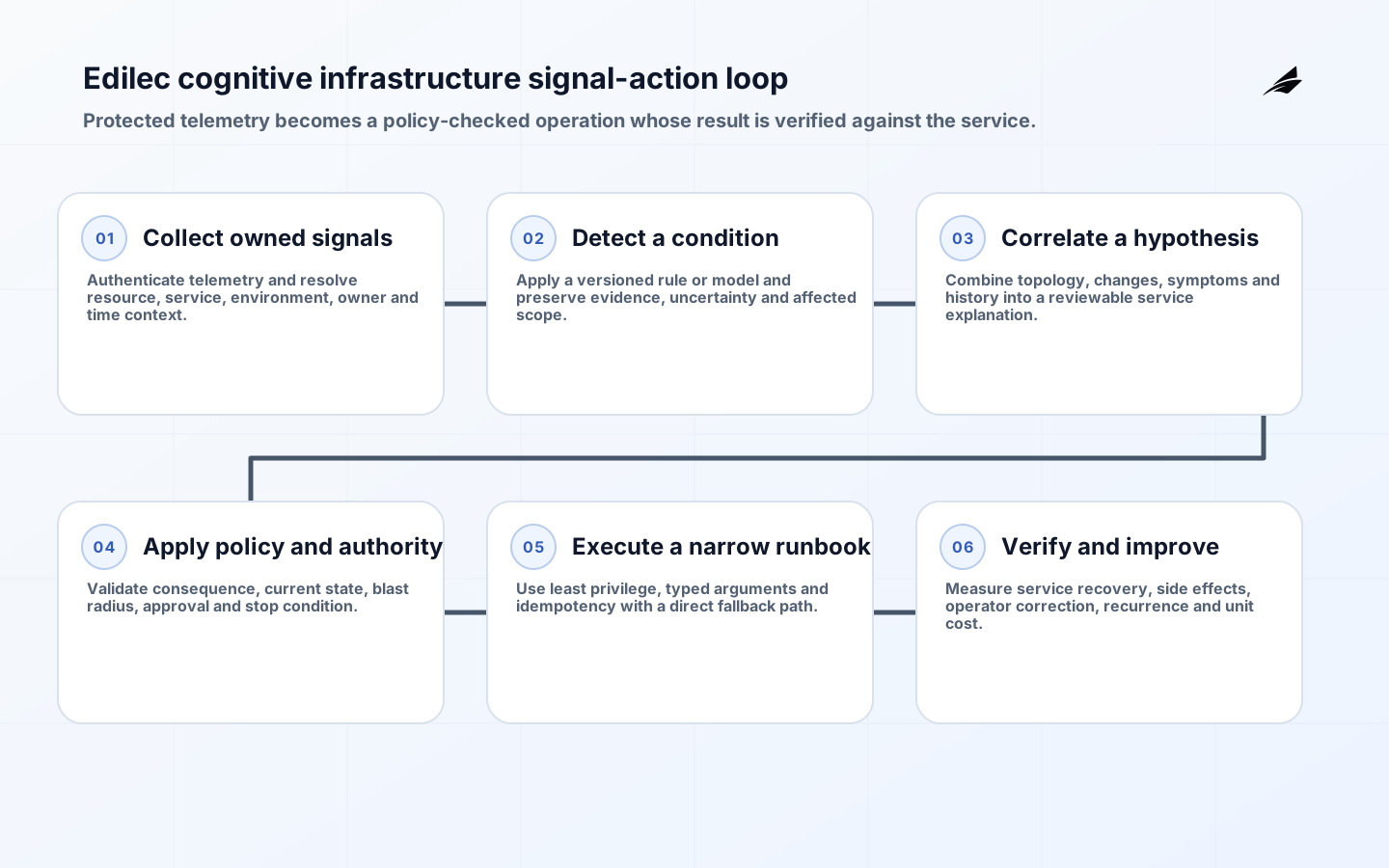
Use layered control. Collection receives authenticated signals. Normalization resolves resource, service and time context. Analytics detects or correlates conditions. A policy layer evaluates consequence, confidence, current state and action authority. Workflow routes a recommendation, approval or deterministic runbook. Execution uses narrow credentials and idempotent operations. Verification checks the service outcome and records whether the hypothesis was correct. Keep the source monitoring and emergency controls available if the cognitive layer fails. Do not let the same model both propose and approve a high-impact action.
Integrate with configuration management, deployment, incident, security and cost systems through typed contracts and stable correlation identifiers. Record rules, model, prompt, topology and runbook versions for every material recommendation or action. The six-stage Edilec cognitive infrastructure signal-action loop at this heading makes evidence, policy and verification explicit. It shows why a prediction is not an operational result: value appears only after an authorized action improves the service without producing unacceptable side effects.
When should remediation be automated?
Begin with deterministic, reversible, frequently repeated actions whose preconditions and success criteria are observable. Examples may include clearing a safe cache, scaling within an approved range or restarting a stateless component, but suitability depends on architecture and consequence. Validate current state immediately before action, set rate and blast-radius limits, use idempotency and stop when verification fails. Keep a manual path. Higher-impact changes require stronger approval or should remain advisory. Autonomous scope should expand from production evidence, not vendor demonstration.
Generative systems can summarize evidence or draft a diagnostic plan, but their output remains untrusted. Restrict retrieved data and tool permissions, validate commands and never expose a general administrative shell. Reviewers need source evidence and exact proposed change. CISA's Secure by Design program emphasizes shifting security burden toward technology producers; infrastructure offerings should provide safe defaults, strong logging and bounded authority rather than requiring every operator to detect unsafe suggestions manually.
| Automation tier | Example authority | Promotion evidence |
|---|---|---|
| Observe | Detect and correlate without changing systems | Signal quality and operator usefulness |
| Recommend | Propose a runbook and supporting evidence | Qualified acceptance, correction and false-negative review |
| Approve then execute | Run exact action after bound approval | Precondition, idempotency and verification tests |
| Bounded automatic | Act inside narrow policy and blast radius | Sustained safe outcomes and tested stop behavior |
| Emergency fallback | Disable automation and restore direct operations | Exercise proves operators retain visibility and authority |
How should AIOps quality and operational risk be evaluated?
Evaluate against real operating decisions. For detection, measure precision, recall, time gained and severity of missed conditions. For correlation, test whether grouped evidence leads to the right service and dependency. For recommendations, score rationale, action safety and predicted consequence. For automation, measure verified success, rollback, recurrence and side effects. Segment by service type, environment and failure mode. A global accuracy score can conceal dangerous misses. Use shadow mode and replay historical incidents, then validate with controlled exercises because history lacks novel failures.
Monitor operator interaction for overreliance and disuse. Frequent false positives teach teams to ignore the system; opaque success can erode their ability to respond when it is unavailable. Preserve manual drills and explain evidence rather than displaying unsupported confidence. Track changes in topology, deployment, telemetry and demand that can invalidate models or rules. The Google SRE Workbook provides practical material on service-level objectives, alerting and incident response; cognitive capabilities should strengthen those disciplines, not replace them with a proprietary score.
How are value, cost and ongoing ownership measured?
Build the cost model from telemetry ingestion and retention, platform licenses, model inference, integration, engineering, review and change management. Compare against a baseline of incident impact, operator toil, capacity waste and tool duplication. Avoid claiming all avoided downtime as benefit when causality is uncertain. Useful measures include time to qualified hypothesis, actionable-alert rate, verified automated recovery, repeat incident, operator hours and unit infrastructure cost. DORA's research program reinforces measuring delivery and operational systems rather than optimizing one isolated activity.
Assign a product owner for the cognitive service, data and telemetry owners, model or rule owners, platform operators, security review and workload consumers. Review incidents, corrections, unused recommendations, automation stops, cost and drift together. The FinOps Framework can help connect infrastructure economics to engineering and business decisions. Retire duplicate collectors and alert routes only after coverage is proven. Define provider exit, export of rules and evidence, data deletion and continued direct operation if a vendor service becomes unavailable.
Cognitive infrastructure services takeaways
- Define cognitive infrastructure as specific detection, correlation, recommendation and bounded-action capabilities.
- Build on owned inventory, normalized telemetry, service topology and protected operational data.
- Separate analytics, policy, workflow, execution and outcome verification in the architecture.
- Increase automation authority gradually using reversible actions and production evidence.
- Evaluate missed conditions, false positives, operator behavior and service outcomes by failure mode.
- Measure total operating cost and retain direct operational capability and provider exit evidence.
Frequently asked questions
Is cognitive infrastructure the same as AIOps? AIOps is often a major component, but an offering may also include inventory, observability engineering, deterministic automation and operating services. Ask for exact capabilities and authority instead of relying on either label.
Does the service require a single observability platform? No. Consistent resource identity, context and contracts matter more than one tool. Consolidation can reduce fragmentation, but specialized telemetry may remain. Design federation and ownership deliberately.
Can AI safely remediate production without approval? Sometimes, within a narrow, reversible and well-tested policy where consequence is low and verification is strong. Default to advisory or approved execution until evidence supports more authority, and keep an emergency disable path.
Conclusion
Cognitive infrastructure services are useful when they shorten the path from trustworthy signal to verified operational outcome. Their intelligence depends less on a model label than on service context, data quality, explicit policy and safe execution. A layered architecture, progressive authority and outcome-based review let teams reduce toil and improve response while preserving the human and technical controls needed when analytics are wrong or unavailable.