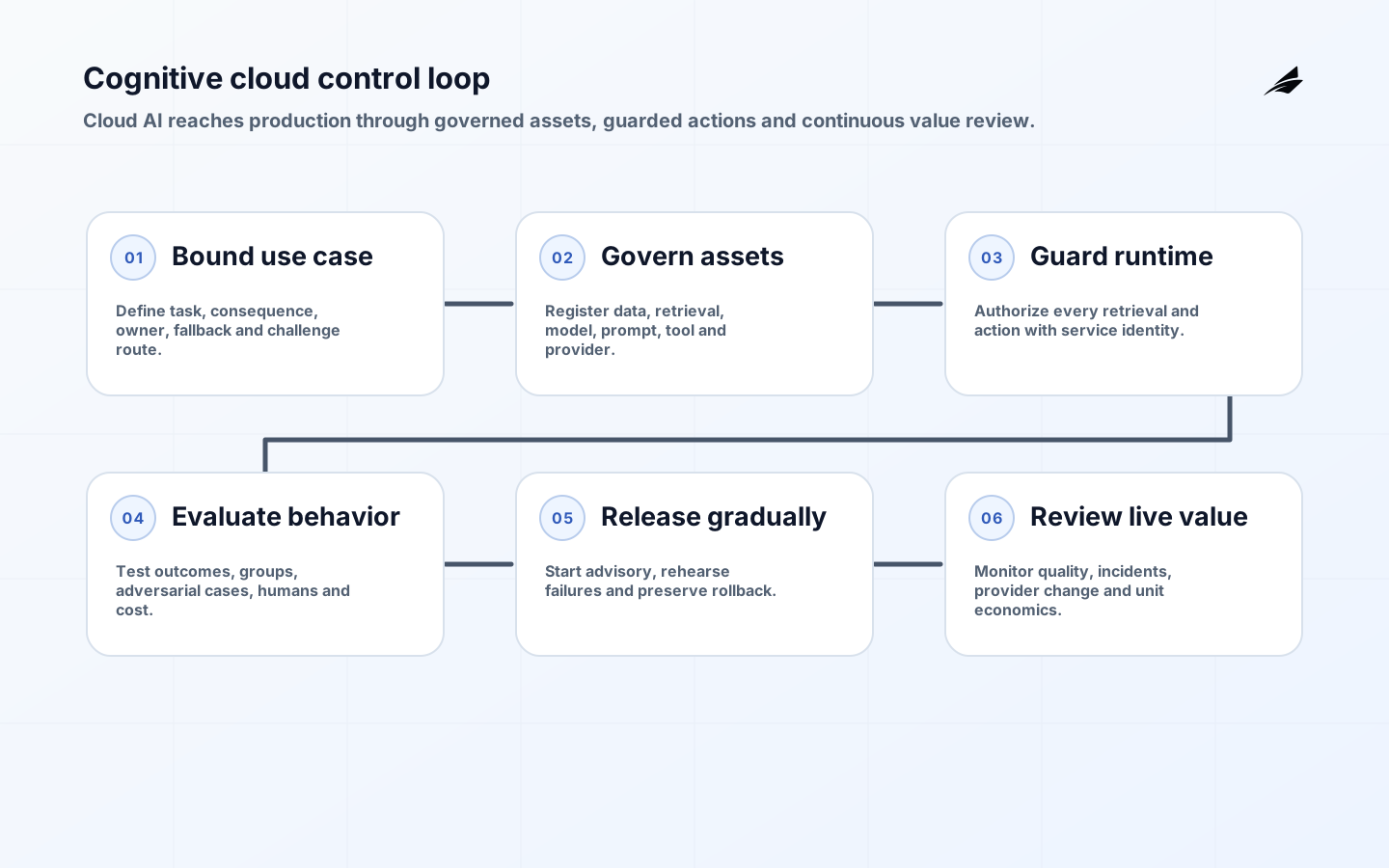
Cognitive cloud services combine elastic cloud capabilities with machine learning, generative AI, search, language, vision or decision-support components delivered as governed services. The phrase is useful only when the system boundary is explicit. A hosted model API is one component; production value also depends on data authority, workflow integration, identity, evaluation, human review, telemetry, cost and incident response.
This cognitive cloud services implementation checklist complements the cognitive cloud scope, cost and risk plan and cognitive cloud FAQ. The cloud business-value checklist helps teams decide what cloud capability should bring to an organization. Begin with one bounded user outcome rather than a central platform intended to solve unspecified AI needs.
1. Select the use case and consequence boundary
Define the user, task, current baseline, target, data, decision consequence and non-AI fallback. Classify whether the service summarizes, retrieves, predicts, recommends or acts. An assistant drafting internal notes has a different assurance need from a service changing credit, health, safety or employment outcomes. Name affected people and where they can correct data or challenge a result. Exclude uses that lack authority, evaluation evidence or a workable human process.
Map provider and consumer responsibilities. NIST's cloud reference architecture identifies actors such as consumer, provider, broker, auditor and carrier; actual contracts and service choices determine duties. Assign data preparation, model selection, integration, access, evaluation, approval, monitoring, incident response and retirement. One business service owner must remain accountable across cloud and model boundaries, even when multiple managed services are involved.
| Use-case gate | Evidence | Decision |
|---|---|---|
| Purpose | Baseline, user and permitted outcome | Admit or reject |
| Consequence | Affected people, review and appeal | Risk tier and controls |
| Data | Authority, quality, provenance and retention | Use, remediate or prohibit |
| Model fit | Representative evaluation and limitations | Select or continue search |
| Operations | Fallback, telemetry, cost and owner | Pilot readiness |
2. Build governed data and model foundations
Create data products with owners, schemas, lineage, quality checks, access policy, retention and approved AI purposes. For retrieval systems, curate source collections, capture effective dates and access controls, and return citations that users can inspect. Prevent documents from granting instructions merely because they are retrieved. Separate tenant and sensitivity boundaries in indexes, caches and logs. Test deletion and permission changes through every derived store.
Maintain a model catalog with provider, version, intended uses, prohibited uses, context limits, evaluation results, regions, data terms, rate limits, cost and end-of-support. Support multiple models only when routing value exceeds operational complexity. Pin production versions or control upgrades through evaluation. Record prompts, system policies, tools and output filters as versioned configuration. Avoid retaining raw prompts by default when they contain sensitive business or personal information.
3. Design secure runtime and tool access
Use workforce and workload identity, least privilege, short-lived credentials, encrypted transport, managed keys and controlled egress. NIST SP 800-207A focuses zero-trust access on application and service identities across cloud-native environments. Apply authorization at every data retrieval and tool action, not only at the chat interface. Separate read, draft, submit and approve capabilities and require fresh authorization for consequential actions.
Threat-model prompt injection, data exfiltration, insecure output use, excessive agency, model endpoint compromise, denial of wallet and poisoned knowledge. Validate tool parameters and downstream output with deterministic controls. Place allowlists, transaction limits and human approval around external effects. Isolate execution sandboxes and do not expose cloud metadata or broad service credentials. Red-team the complete workflow because a safe model can still participate in an unsafe application.
4. Evaluate quality, safety and human performance
Build a representative evaluation set from real task categories, rare cases, languages, user groups and adversarial inputs. Protect privacy and separate it from development examples. Score task correctness, groundedness, completeness, harmful behavior, refusals, latency and cost. Add human-factors measures: whether reviewers detect errors, time saved after correction and calibration of user trust. Evaluate the fallback and non-AI alternative with the same outcome lens.
Use the NIST AI Risk Management Framework to connect governance, context, measurement and treatment. For generative systems, NIST's Generative AI Profile provides additional risk-management considerations. These sources are voluntary guidance, not product certification. Set thresholds from the use consequence and require independent review for high-impact claims. Record uncertainty and residual risk.
5. Pilot and release with controlled exposure
Run the service in shadow or advisory mode before it can create external effects. Recruit representative users and train them on purpose, limits, review and reporting. Capture corrections and reasons. Include model outage, rate limiting, stale retrieval, revoked data access, tool denial and rollback in operational rehearsal. A pilot is complete when the team can explain quality, human impact, operating burden and full cost, not when a compelling demonstration succeeds.

- Approve the use-case purpose, consequence tier and accountable owner.
- Register data, models, prompts, tools and providers with approved boundaries.
- Build runtime identity, retrieval authorization and guarded action paths.
- Evaluate representative, subgroup, adversarial and failure scenarios.
- Pilot in shadow or advisory mode with trained users and fallback.
- Release gradually; monitor versions, outcomes, incidents and unit cost.
Progress from internal to limited and general availability using explicit thresholds. Version every release and preserve rollback to a tested configuration. Communicate material limitations in the user experience. If a provider changes a model, rerun the relevant evaluation before expansion. Close pilot-only identities, datasets and temporary exceptions. Decide who can pause the service without waiting for a commercial or steering meeting.
6. Operate observability, reliability and AI cost
Instrument the user journey, retrieval, model call, tool action and fallback with correlation and privacy controls. The OpenTelemetry observability primer explains metrics, logs and traces; define collection from operational questions. Monitor accepted outcomes, corrections, refusal patterns, policy denials, latency, saturation, provider errors, drift indicators and data freshness. Limit prompt and output logging and provide secure access for necessary investigations.
Allocate platform, storage, retrieval, model, network, observability, evaluation, review and support costs to the service. FinOps is a collaboration and value practice, not merely discount buying. Use budgets and anomaly detection for unbounded loops or abuse. Track cost per accepted task or avoided effort with quality held constant. Cache and use smaller models only where freshness, isolation and evaluation allow. Negotiate commitments after demand becomes credible.
| Production measure | Decision supported | Misleading proxy |
|---|---|---|
| Accepted task success | Whether users receive usable value | Model calls |
| Correction and override cause | Where data, model or workflow fails | Aggregate thumbs-up |
| Grounded citation validity | Retrieval trust and freshness | Citation count |
| Fallback success | Continuity during model or policy failure | Provider uptime |
| Cost per accepted task | Sustainable architecture and routing | Token price |
7. Govern provider change and service retirement
Contract for model and feature change notice, data-use boundaries, region, security evidence, incident cooperation, service levels, pricing units, export and deletion. Identify subproviders and shared dependencies across apparently separate services. Maintain a provider-change playbook that reruns relevant quality, safety, latency and cost evaluations before production adoption. Where a provider does not offer version control, use a routing layer and observation gates to contain unannounced behavior changes.
Test portability at the application contract, evaluation set and data layer. A substitute model need not produce identical words, but it must meet the accepted task and risk thresholds. Avoid proprietary prompt or agent constructs unless their value outweighs exit work. Preserve retrieval sources, policy, tool schemas and evaluation harnesses independently from the model provider. Estimate migration lead time and temporary dual-running cost while options are available.
Retire a service when the use ends, quality cannot be maintained, cost exceeds value, a provider becomes unacceptable or a simpler process replaces it. Notify users, disable actions first, preserve required decision records, revoke identities, remove indexes and caches, delete provider data under contract and terminate commitments. Continue monitoring dependent workflows through the transition. Retirement is a production change and needs the same reconciliation, rollback and accountable approval as launch.
Run quarterly service reviews with product, data, platform, security, finance and frontline users. Examine outcome samples, subgroup behavior, incidents, provider changes, capacity, cost anomalies and planned scope. Approve corrective work before new features when thresholds are missed. Record decisions against the service version and assign dates. This cadence keeps cognitive capability connected to the business service instead of leaving model quality to a separate technical dashboard. Include support cases and operator feedback that metrics miss.
Key takeaways
- Define cognitive cloud services as bounded business workflows with accountable owners.
- Govern data, retrieval sources, models, prompts and tools as versioned production assets.
- Authorize every retrieval and action using service identity and least privilege.
- Evaluate representative outcomes, human review and failure modes before release.
- Operate quality, reliability and full unit cost together throughout the lifecycle.
Frequently asked questions
Is cognitive cloud the same as MLOps?
No. MLOps covers practices for developing and operating machine-learning systems. Cognitive cloud services include the broader cloud architecture, data, managed models, workflow integration, user experience, governance and economics needed to deliver an AI-enabled service.
Should one model serve every use case?
Usually not by default. Different tasks have different quality, latency, data, regional and cost needs. Standardize evaluation, access and operations, then approve the smallest set of models that satisfies measured requirements without unnecessary routing complexity.
Does private cloud make AI data safe?
Placement changes some risks but does not provide safety by itself. Identity, authorization, data minimization, encryption, software security, model behavior, logging, people and incident response still matter. Select placement from the complete threat and operating model.
Conclusion
Cognitive cloud services become dependable when cloud scale is joined to AI evidence and operational control. Choose a bounded outcome, govern data and models, secure every runtime action, evaluate realistic behavior, release progressively and manage quality, reliability and cost as one service. That approach turns a collection of AI APIs into a production capability that teams can observe, challenge and improve.