IoT software development spans hardware constraints, firmware, local networks, gateways, cloud services, mobile applications, manufacturing systems, and a fleet that may remain deployed for years. A web API can be patched centrally; a device behind an unreliable network may be inaccessible when a defect is found. Scope and cost therefore depend on lifecycle support, identity, updates, diagnostics, and safe degraded behavior as much as on the first application features. The primary planning lens is IoT software development, with decisions expressed in language that product users and operating teams can verify.
Nearby planning resources include IoT Software Development Implementation Readiness Checklist, IoT Software Development Implementation FAQ, IoT Software Development Company for Startups: Scope, Cost, Risks and Delivery Plan, IoT Software Development Company for Finance: Scope, Cost, Risks and Delivery Plan. Those pages provide companion scope and checklist views; this article develops the technical and operating evidence for the topic here.
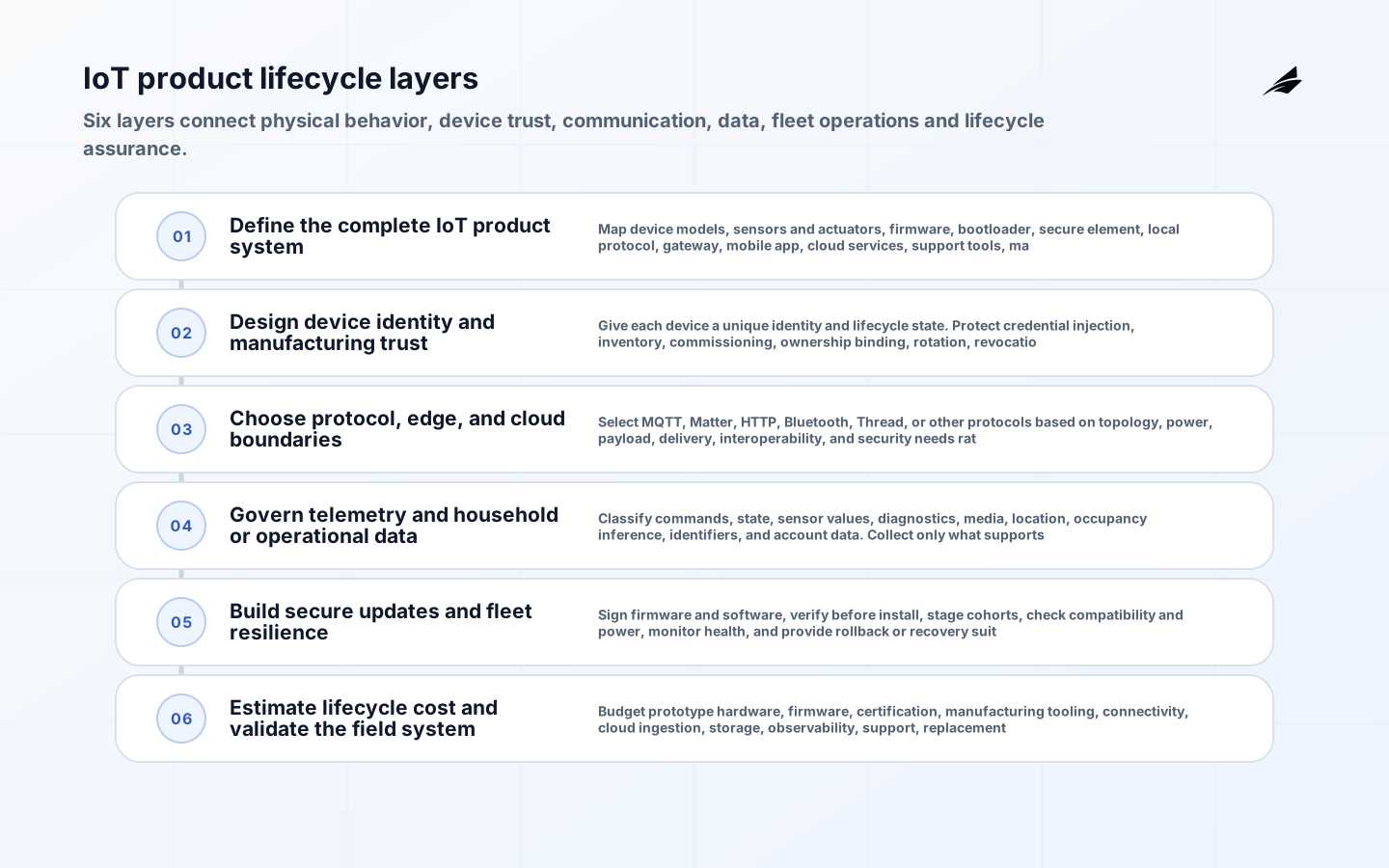
Define the complete IoT product system
Map device models, sensors and actuators, firmware, bootloader, secure element, local protocol, gateway, mobile app, cloud services, support tools, manufacturing, and third parties.
Describe user and physical outcomes, installation, connectivity assumptions, safety consequence, data sensitivity, service life, and behavior during power, network, and cloud loss. Scoping only the mobile app or cloud API hides the components that determine security, reliability, and field support.
Design device identity and manufacturing trust
Give each device a unique identity and lifecycle state. Protect credential injection, inventory, commissioning, ownership binding, rotation, revocation, reset, transfer, and retirement.
Separate device, user, installer, service, and manufacturer authority. Maintain provenance for hardware revision, firmware, certificates, capabilities, and production test. Shared default credentials and weak factory reset create fleet-wide compromise and residual ownership risk.
| Decision area | Required decision | Acceptance evidence |
|---|---|---|
| Define the complete IoT product system | Map device models, sensors and actuators, firmware, bootloader, secure element, local protocol, gateway, mobile app, cloud services, support tools, manufacturing, and third parties. | Describe user and physical outcomes, installation, connectivity assumptions, safety consequence, data sensitivity, service life, and behavior during power, network, and cloud loss. |
| Design device identity and manufacturing trust | Give each device a unique identity and lifecycle state. Protect credential injection, inventory, commissioning, ownership binding, rotation, revocation, reset, transfer, and retirement. | Separate device, user, installer, service, and manufacturer authority. Maintain provenance for hardware revision, firmware, certificates, capabilities, and production test. |
| Choose protocol, edge, and cloud boundaries | Select MQTT, Matter, HTTP, Bluetooth, Thread, or other protocols based on topology, power, payload, delivery, interoperability, and security needs rather than fashion. | Define topic and authorization models, quality of service, retained messages, session behavior, ordering, idempotency, buffering, stale-state rules, and gateway responsibility. |
Choose protocol, edge, and cloud boundaries
Select MQTT, Matter, HTTP, Bluetooth, Thread, or other protocols based on topology, power, payload, delivery, interoperability, and security needs rather than fashion.
Define topic and authorization models, quality of service, retained messages, session behavior, ordering, idempotency, buffering, stale-state rules, and gateway responsibility. A reconnect storm or retained command can cause fleet-wide load and physical actions long after the original context changed.
Govern telemetry and household or operational data
Classify commands, state, sensor values, diagnostics, media, location, occupancy inference, identifiers, and account data. Collect only what supports defined operation, security, safety, and consented improvement.
Use timestamps, sequence, clock confidence, correlation, provenance, retention, access, deletion, and redaction. Keep sensitive payloads out of logs and test fixtures. Cheap storage encourages indefinite collection that raises privacy exposure and makes support access harder to control.
| Control area | Failure to prevent | Production proof |
|---|---|---|
| Govern telemetry and household or operational data | Cheap storage encourages indefinite collection that raises privacy exposure and makes support access harder to control. | Use timestamps, sequence, clock confidence, correlation, provenance, retention, access, deletion, and redaction. Keep sensitive payloads out of logs and test fixtures. |
| Build secure updates and fleet resilience | An update that cannot recover can strand devices, while an outage can release a storm of stale telemetry and queued commands. | Control retries, queues, backpressure, regional failure, rate limits, and command expiry. Ensure a noisy cohort cannot exhaust shared cloud or broker capacity. |
| Estimate lifecycle cost and validate the field system | A successful bench prototype does not establish radio behavior, fleet scale, update safety, or support cost in real installations. | Build a test fleet across hardware revisions, networks, signal quality, time zones, battery states, firmware combinations, and offline periods. Exercise transfer and end-of-life. |
Build secure updates and fleet resilience
Sign firmware and software, verify before install, stage cohorts, check compatibility and power, monitor health, and provide rollback or recovery suited to device constraints.
Control retries, queues, backpressure, regional failure, rate limits, and command expiry. Ensure a noisy cohort cannot exhaust shared cloud or broker capacity. An update that cannot recover can strand devices, while an outage can release a storm of stale telemetry and queued commands.
Estimate lifecycle cost and validate the field system
Budget prototype hardware, firmware, certification, manufacturing tooling, connectivity, cloud ingestion, storage, observability, support, replacements, security response, and years of updates.
Build a test fleet across hardware revisions, networks, signal quality, time zones, battery states, firmware combinations, and offline periods. Exercise transfer and end-of-life. A successful bench prototype does not establish radio behavior, fleet scale, update safety, or support cost in real installations.
Evidence required before an IoT product leaves controlled testing
Require a product-system data flow, device identity and credential process, hardware and firmware inventory, threat model, protocol contracts, cloud authorization, telemetry policy, signed-update chain, staged-rollout criteria, recovery method, vulnerability disclosure and support policy, and end-of-life plan. NIST IR 8259 Rev. 1 emphasizes manufacturer activities before sale, while the core baseline helps define device capabilities customers need.
Run a mixed-fleet exercise with factory-new, transferred, offline, low-battery, outdated, compromised, and unsupported devices. Simulate broker loss, duplicated MQTT delivery, expired certificate, stolen phone, failed update, cloud-region outage, and deletion request. The team must identify the affected cohort, stop unsafe commands, restore service, and communicate support without requiring unrestricted access to device or user data.
Taken together, the decision for IoT software development must connect define the complete iot product system, design device identity and manufacturing trust, choose protocol, edge, and cloud boundaries, govern telemetry and household or operational data, build secure updates and fleet resilience, estimate lifecycle cost and validate the field system. The release review should show which owner accepts each decision, where its source evidence is stored, which threshold blocks production, and how a failed dependency or incorrect result is contained. It should also explain how changes to data, policy, integrations, identities, customer scope, or software versions trigger renewed testing. That linkage matters because controls assessed independently can still conflict in operation: a secure interface may carry stale data, a reliable service may enforce the wrong authority, and a useful workflow may become uneconomic when review or support demand rises. Record these dependencies as maintained product artifacts, not one-time project notes, so later operators can distinguish an approved constraint from an accidental behavior.
The control chain starts with define the complete iot product system: Map device models, sensors and actuators, firmware, bootloader, secure element, local protocol, gateway, mobile app, cloud services, support tools, manufacturing, and third parties. Evidence must explicitly guard against Scoping only the mobile app or cloud API hides the components that determine security, reliability, and field support. Next, design device identity and manufacturing trust: Give each device a unique identity and lifecycle state. Protect credential injection, inventory, commissioning, ownership binding, rotation, revocation, reset, transfer, and retirement. Evidence must explicitly guard against Shared default credentials and weak factory reset create fleet-wide compromise and residual ownership risk. Next, choose protocol, edge, and cloud boundaries: Select MQTT, Matter, HTTP, Bluetooth, Thread, or other protocols based on topology, power, payload, delivery, interoperability, and security needs rather than fashion. Evidence must explicitly guard against A reconnect storm or retained command can cause fleet-wide load and physical actions long after the original context changed. Next, govern telemetry and household or operational data: Classify commands, state, sensor values, diagnostics, media, location, occupancy inference, identifiers, and account data. Collect only what supports defined operation, security, safety, and consented improvement. Evidence must explicitly guard against Cheap storage encourages indefinite collection that raises privacy exposure and makes support access harder to control. Next, build secure updates and fleet resilience: Sign firmware and software, verify before install, stage cohorts, check compatibility and power, monitor health, and provide rollback or recovery suited to device constraints. Evidence must explicitly guard against An update that cannot recover can strand devices, while an outage can release a storm of stale telemetry and queued commands. Next, estimate lifecycle cost and validate the field system: Budget prototype hardware, firmware, certification, manufacturing tooling, connectivity, cloud ingestion, storage, observability, support, replacements, security response, and years of updates. Evidence must explicitly guard against A successful bench prototype does not establish radio behavior, fleet scale, update safety, or support cost in real installations. Reading these checks as one chain prevents a local pass from hiding an end-to-end failure. The accountable owners should review the chain after any material incident or change and record whether the original assumptions, thresholds, and fallback remain valid.
Implementation takeaways
- Scope device, firmware, edge, cloud, apps, manufacturing, and support together.
- Treat unique identity and secure update as core product capabilities.
- Specify protocol delivery, ordering, retry, and stale-command behavior.
- Minimize telemetry and govern support access.
- Estimate and test the full deployed lifecycle, including retirement.
Frequently asked questions
| Question | Answer |
|---|---|
| Is MQTT automatically secure? | No. MQTT is a transport protocol; authentication, authorization, secure communication, topic design, and deployment controls must be implemented. |
| Should every feature require cloud connectivity? | No. Decide local and cloud behavior from latency, safety, privacy, interoperability, and product promise. |
| How long should updates be provided? | Set and publish a support period based on expected product life, risk, obligations, and the organization's ability to maintain components. |
| What is the most important fleet test? | A staged update and recovery across representative hardware, connectivity, power, and prior-version conditions. |
Conclusion
IoT software development is product lifecycle engineering. Device identity, protocol semantics, update safety, telemetry governance, and support policy determine whether the fleet remains trustworthy after the launch team has moved on.
The delivery plan should prove that the product can be commissioned, operated, diagnosed, updated, transferred, and retired under imperfect networks and mixed versions. Building those capabilities early costs less than attempting to recover an opaque fleet after a security or reliability failure.