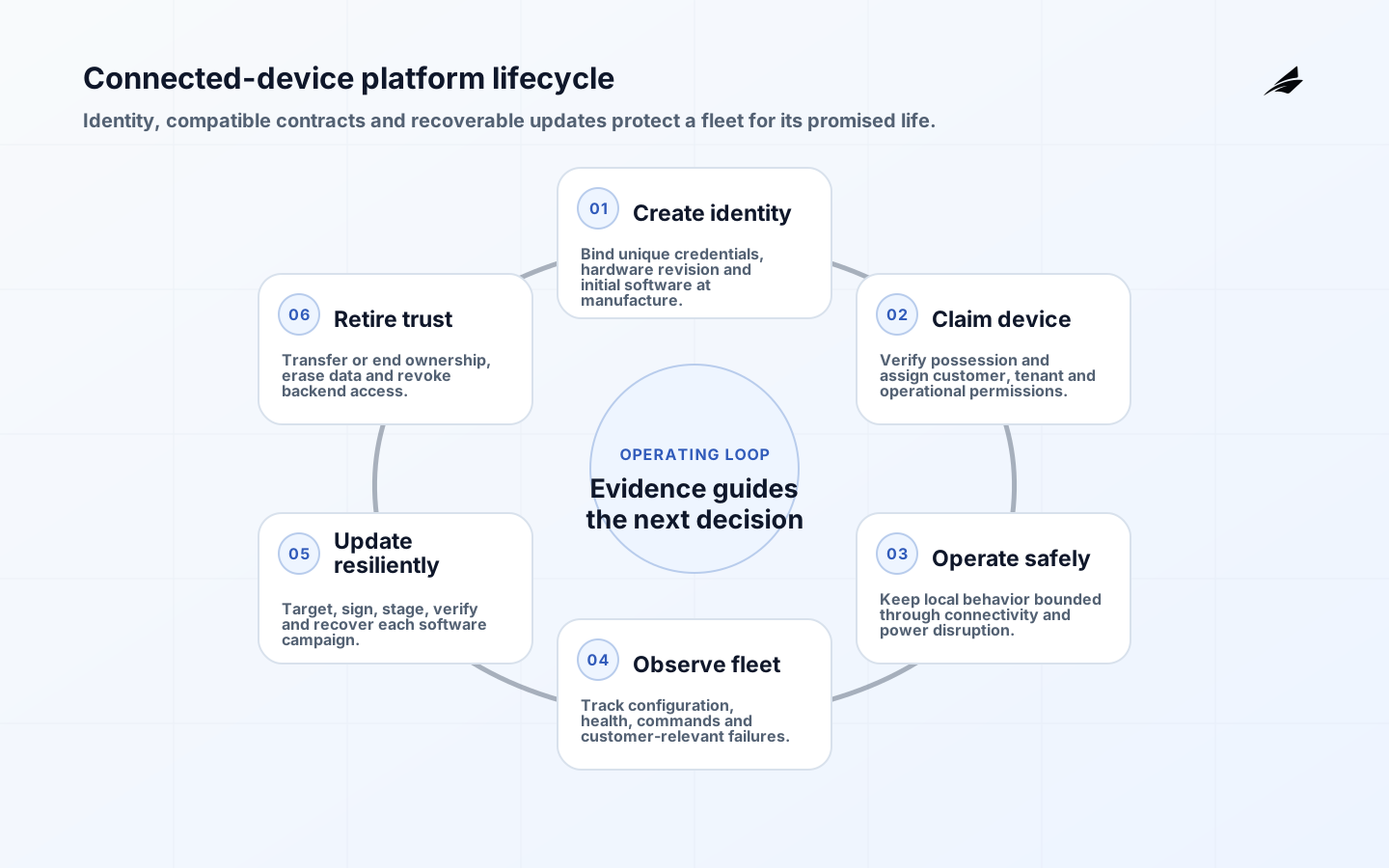
Device platform software is the product system that connects hardware, embedded software, applications, cloud services and fleet operations over years of change. A successful platform can identify every unit, provision it safely, exchange compatible data, deliver updates, diagnose failures and retire access. The difficult work lies in the lifecycle: devices lose power, stay offline, ship with hardware revisions, cross ownership boundaries and remain exposed long after the launch team has moved on.
This guide helps business and engineering teams define that lifecycle before choosing protocols or vendors. Use the device platform implementation checklist for release preparation and the device platform FAQ for operating decisions. Organizations handing an existing fleet to a service partner should also review the application management transition checklist.
Define the whole device product
Start with the job the physical product performs and the consequence of losing connectivity, cloud service or power. List users, installers, service technicians, administrators and downstream systems. Then draw trust and ownership boundaries from manufacturing through customer transfer and disposal. A connected controller may include a bootloader, operating system, firmware, local interface, phone app, APIs, message broker, data store, support console, update service and factory key-injection process. All are part of the customer experience and security posture.
| Layer | Primary responsibility | Lifecycle question |
|---|---|---|
| Hardware root | Boot trust, key protection and recovery path | Can compromised software be prevented or recovered? |
| Device software | Control, local safety, storage and communications | What works safely when disconnected? |
| Edge or gateway | Protocol adaptation and local aggregation | How are partial fleets and legacy equipment isolated? |
| Cloud platform | Identity, commands, telemetry, policy and updates | Can every action be attributed and reconciled? |
| User applications | Setup, consent, status and support | Can a user understand and recover the product state? |
Write non-functional requirements by environment: temperature, intermittent networks, bandwidth, battery, storage, latency, expected lifetime and service access. Include regional radio and privacy constraints where applicable. A product that depends on cloud connectivity must define degraded behavior and visible status. Do not let an unavailable analytics service stop a safety-relevant local control loop.
Design identity and onboarding first
A fleet cannot be managed safely without durable device identity and a known ownership state. NIST's IoT baseline includes device identification, configuration, data protection, interface access control, software update, cybersecurity state awareness and device security. Translate those capabilities into a manufacturing and onboarding ceremony. Give each device a unique identity protected according to hardware risk, keep production credentials out of source code and shared images, and record which factory or process created them.
- Create device identity and manufacturing record in a controlled station; prevent duplicate or test credentials from entering saleable stock.
- Bind the physical unit, hardware revision and initial software manifest without exposing reusable secrets on labels.
- Use proof of possession and a short-lived claim process when the customer or installer enrolls the unit.
- Issue operational credentials with narrow permissions, rotation and revocation independent of user accounts.
- Record ownership transfer, service access and factory reset as explicit state transitions.
- Test disposal and refurbishment so old tenant data and authorization cannot survive unintentionally.
Avoid using a serial number alone as authentication; identifiers are often observable. Separate device, user, installer and service identities so permissions can be revoked independently. A support technician may need diagnostics without authority to change ownership. A mobile app may configure one unit without receiving a fleet-wide credential. These boundaries reduce the impact of a lost phone, cloned device or compromised service account.
Control protocols, data contracts and variants
Treat every message as a versioned contract. Specify units, ranges, required and optional fields, timestamps, sequence behavior, privacy classification and compatibility. Commands need identifiers, expiry, authorization context and acknowledgement so the platform can distinguish delayed, duplicated and rejected work. Telemetry needs device time and receipt time because field clocks drift. Schemas should evolve additively where possible, with a declared support window for old versions.
| Contract case | Required behavior | Test |
|---|---|---|
| Unknown field | Ignore safely or reject by declared version | New cloud with old firmware and reverse |
| Duplicate command | Return prior result without repeating the effect | Replay after timeout |
| Out-of-order telemetry | Preserve event time and deterministic merge | Delay and reorder a recorded stream |
| Unsupported configuration | Reject before changing active state | Cross hardware and firmware matrix |
| Partial connectivity | Buffer within bounds and expose data loss | Long offline period and reconnect storm |
Maintain a product configuration model linking hardware revision, bootloader, firmware, calibration, region and enabled features. The test matrix should be risk-based, not every theoretical combination, but the platform must reject combinations that were never approved. Feature flags need device compatibility and expiry rules; a cloud-side flag cannot make absent hardware appear safe.
Build security and privacy into defaults
NIST's 2026 foundational activities ask manufacturers to understand customer cybersecurity needs, address them in the product and plan support before sale. ETSI EN 303 645 provides a consumer IoT baseline. Use such guidance to establish secure defaults, vulnerability handling and a support period suited to the market. Apple and Android security architectures also illustrate layered trust, controlled application access and secure update mechanisms, though a custom device must tailor those concepts to its own hardware and threats.
| Threat | Design control | Operational control |
|---|---|---|
| Credential extraction | Hardware-backed or isolated keys and no universal secret | Revoke individual devices and monitor cloning |
| Exposed service | Minimize interfaces, authenticate and rate-limit | Inventory endpoints and patch vulnerabilities |
| Data overcollection | Collect the minimum purpose-bound telemetry | Retention, access review and deletion workflow |
| Malicious command | Authorize each command and protect integrity | Alert on unusual actor, fleet or rate |
| Abandoned product | Defined support and safe end state | Notify owners and disable backend trust deliberately |
Make privacy visible in the product. Explain what data leaves the device, why, how long it remains and what stops working when optional collection is disabled. Factory diagnostics and production logs can contain identifiers too; govern them. Security contact, vulnerability intake and patch triage need owners before shipment. A disclosure mailbox without engineering capacity is not a response program.
Engineer a recoverable update system
A device update path needs signed metadata, target compatibility, authenticated transport, anti-rollback policy, power-loss tolerance, health verification and fleet campaign controls. Android's A/B and Virtual A/B documentation shows one robust pattern: prepare a new system state separately, boot it, verify success and retain a usable fallback. Constrained devices may use different mechanisms, but the invariant remains: an interruption or bad image should not leave the product unrecoverable.
- Build a reproducible release and sign it in a restricted service separate from ordinary developer credentials.
- Declare hardware, bootloader, current-version and storage preconditions in update metadata.
- Test full, incremental, interrupted, corrupted, wrong-target and downgrade cases on representative units.
- Deploy to internal, canary and expanding cohorts with health and business stop thresholds.
- Reconcile every target into installed, rejected, deferred, failed or unknown state; investigate unknown state.
- Maintain local or service recovery for failures that remote update cannot repair.
Rollback is not universally safe. If an update changes durable data, security counters or device behavior, an old version may no longer understand the state. Use forward-compatible migrations or a tested recovery image, and document the point of no return. Coordinate app, cloud and firmware releases through compatibility contracts rather than simultaneous deployment assumptions.
Operate the fleet as a product
Build a fleet inventory that answers what exists, where ownership sits, which software runs, whether credentials are healthy and when the device last reported. Observe customer-relevant state rather than collecting every metric. Useful indicators include onboarding completion, command success and latency, crash or reset rate, update adoption and failure by hardware revision, offline duration, battery impact, support contacts and security patch coverage.
Support tools are privileged production software. Use role-based access, case-bound elevation, audit trails and masked data. Operators need a timeline of identity, configuration, commands, updates and errors, plus approved remediation actions. Run incident exercises for certificate expiry, backend outage, bad update and compromised device. A bulk action should require preview, cohort limits, confirmation and a stop mechanism.
Deliver in six evidence stages
| Stage | Deliverable | Exit question |
|---|---|---|
| Product model | Lifecycle, actors, degraded behavior and support promise | Is the whole product bounded? |
| Trust foundation | Manufacturing identity, onboarding and access model | Can each unit and actor be controlled? |
| Vertical slice | One device-to-user journey with telemetry | Does the system work through real network failure? |
| Update proof | Signed campaign and recovery evidence | Can deployed software change safely? |
| Fleet pilot | Representative cohort and support operation | Are quality, security and cost observable? |
| Scale and sustain | Capacity, vulnerability and retirement processes | Can the organization support the promised life? |
Key takeaways
- Treat hardware, firmware, apps, cloud, manufacturing and support as one product lifecycle.
- Establish unique identity and explicit ownership state before adding fleet features.
- Version every data and command contract across hardware and software variants.
- Make updates recoverable and observable under interruption, incompatibility and partial rollout.
- Fund vulnerability response, fleet tooling and retirement for the full promised support period.
Frequently asked questions
Should we buy an IoT platform or build one?
Buy commodity fleet capabilities when they fit identity, protocol, region, scale and exit needs. Build differentiating product behavior and missing controls. Prototype data export, credential migration and device repointing before lock-in becomes a field constraint.
How much offline behavior is enough?
Derive it from safety and customer promises. Define which local functions continue, how long data buffers, which commands expire and how state reconciles. Test the maximum credible outage, not a brief network toggle.
How often should device certificates rotate?
There is no single interval. Choose it from key protection, connectivity, lifetime, revocation capability and operational risk. Prove renewal before expiry and provide a controlled recovery path for devices offline through the renewal window.
What should an end-of-support plan include?
Include last security update, customer notice, export or local operation, credential and cloud-service treatment, repair and refurbishment rules, data deletion and safe disposal. State the support period before purchase where law and product context require it.
Conclusion
A device platform earns trust through years of identifiable, compatible and recoverable operation. Define the product lifecycle, secure onboarding, contract behavior, update proof and fleet ownership before scale. That foundation lets teams add capabilities without turning every hardware revision or network outage into a product-wide emergency.